
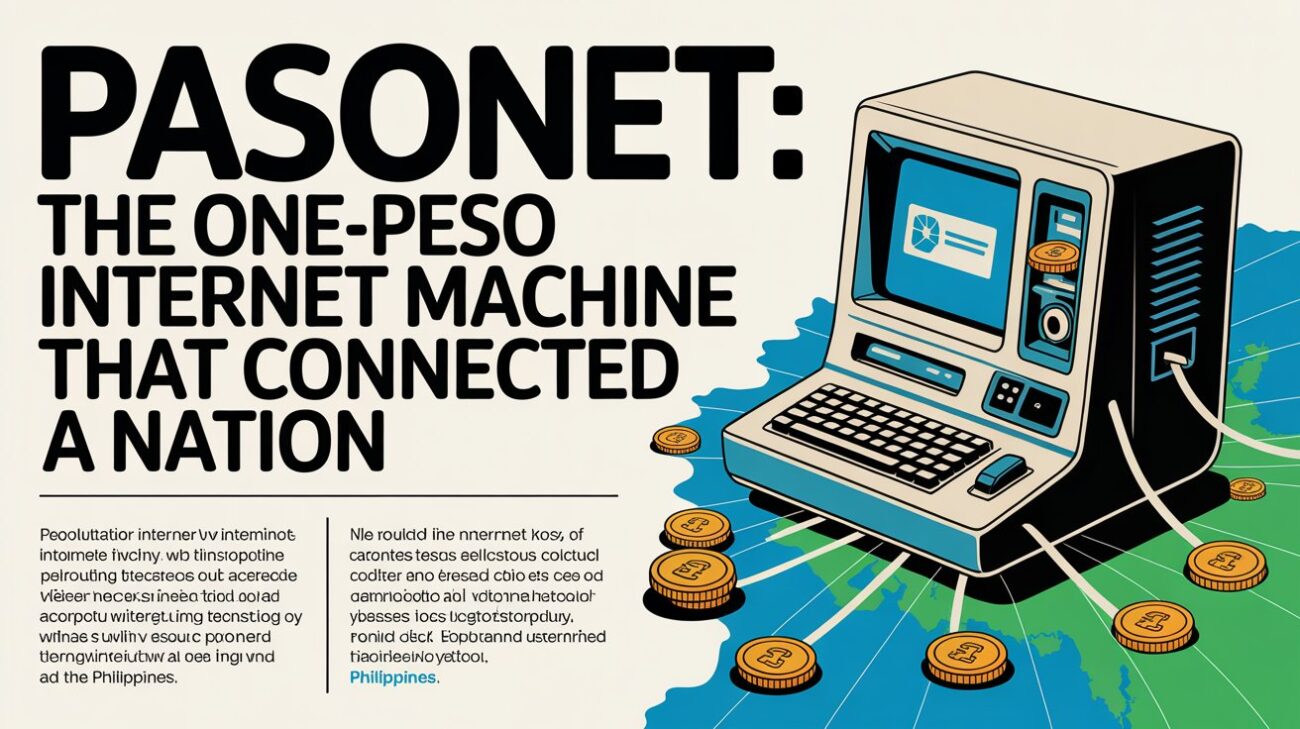
Picture a wooden box. It’s sitting inside a tiny store in Manila. Kids are lined up. Each one clutches a single peso coin.
They drop the coin in. The screen lights up.
For the next five minutes, they have the entire internet.
That’s Pasonet. And it’s one of the most quietly revolutionary inventions to ever come out of Southeast Asia.
Quick Facts:
| Detail | Information |
| Full name origin | “Piso” (Filipino: one peso, ₱1) + “Net” (internet) |
| Also known as | PisoNet, Piso Net, PisoWiFi, Piso-Net |
| Country of origin | Philippines |
| Invented | Early 2000s, traced to Dagupan City, northern Philippines |
| How it works | Insert ₱1 coin → monitor activates → 4 to 7 minutes of internet access |
| Cost per peso | Approximately US$0.02 per session (as of 2023) |
| Machine cost to set up | PHP 9,000 to PHP 13,000 per unit (roughly US$250–$300) |
| Who uses it most | Students, low-income households, children, job seekers |
| UNICEF stat (2021) | 53.7% of Filipino children used pisonet cafes for internet access |
| Modern evolution | PisoWiFi — connect your own device for ₱1 |
| Cultural status | Symbol of Filipino digital ingenuity and grassroots innovation |
A Note on the Name
If you searched “Pasonet” expecting to find something about tech platforms or business software — you’re not alone.
Several websites describe Pasonet as some kind of generic digital network concept. Some call it a business framework. Others say it’s a payment processing system. Much of that content is vague and unsupported by real facts or named sources.
The documented, historically verified, academically researched meaning of Pasonet is the Philippine coin-operated internet system. It has been studied by universities, covered by major international publications, and cited in UNICEF reports. That’s the story this article tells — the real one.
What exactly is Pasonet?
Imagine you’re a 14-year-old in a low-income neighborhood in Manila.
Your family can’t afford a computer. They definitely can’t afford an internet subscription. The local internet café charges ₱20 to ₱30 for a full hour. That’s a significant amount when your household income is tight.
Then someone opens a little shop nearby. Inside is a wooden unit — almost like an arcade machine — with a computer screen, a keyboard, a mouse, and a coin slot.
You put in one peso. One single coin. The screen turns on. You have about five minutes of real internet access. You check your messages. You look something up for school. You connect. When time runs out, the screen goes dark. You insert another peso if you need more.
That’s Pasonet in its purest form. Simple. Affordable. Life-changing for millions of people.
Where Did It Come From?
This is one of the most interesting parts of the story.
When researchers at De La Salle University in Manila started investigating pisonets, they assumed the concept had been brought over from another country — maybe China, Indonesia, or Malaysia.
They were wrong.
Professor Cheryll Ruth Soriano and her research team traced the origin of the pisonet back to Dagupan City in the northern Philippines. Filipino entrepreneurs created it themselves. No imported model. No foreign patent. Just local people who saw a problem — unaffordable internet — and built a solution out of necessity.
Professor Soriano told Rest of World magazine: “You don’t need sophisticated knowledge to be able to create the pisonet mechanism, but it needs an imperative.”
That imperative was poverty. And it produced something extraordinary.
The pisonet likely began spreading in the early 2000s. By the 2010s, units had spread across barangays, sari-sari stores, school canteens, and small roadside shops from Luzon to Mindanao. It became one of the fastest-growing informal technology businesses in the country.
How the Machine Actually Works
The mechanics are brilliantly simple. That’s what makes the whole thing genius.
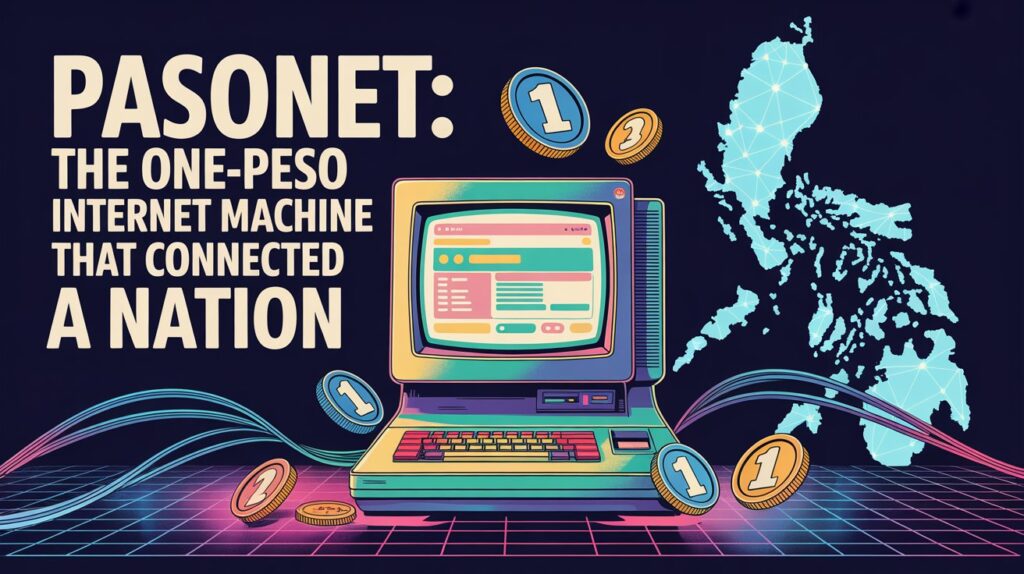
Inside a wooden or metal casing — usually bulky and compact, a bit like an arcade game cabinet — sits a basic computer. Connected to the monitor is a timer box. That timer is the heart of the whole system.
When a user drops a ₱1 coin into the slot, the timer activates the monitor, keyboard, and mouse. The computer itself stays connected to the internet the whole time. The coin doesn’t turn the computer on — it just wakes up the screen and peripherals and gives the user access for a fixed period.
Depending on how the operator set it up, one peso typically gave between four and seven minutes of access. As the session runs down, a beeping sound warns the user that one minute is left. Time expires, the screen goes dark, and the machine waits for the next coin.
Users could keep inserting coins to extend their time. No account. No login. No ID required. Just coins and the internet.
Later versions of the software became more sophisticated. Programs like Pisonet Timer and CoinOp gave operators the ability to set specific time limits per coin, monitor multiple machines from one location, control what websites users could visit, and even track daily earnings remotely.
A newer version called PisoWiFi took things further. Instead of using the shop’s computer, users bring their own phone or device and pay ₱1 for a timed WiFi connection. The coin-operated router gives them a fast, semi-private network for a set number of minutes. This evolution made pisonets even more relevant in the age of smartphones.
Why It Mattered So Much
Here’s the number that stops you in your tracks.
In 2021, UNICEF reported that 53.7% of Filipino children relied on pisonet cafes to access the internet.
More than half of the country’s children. Using a coin-operated machine. Because they had no other option.
The Philippines has long struggled with expensive, unreliable internet service. Two telecommunications companies — Globe and PLDT — dominated the market for years. Their pricing and infrastructure left huge portions of the population, especially in rural and urban-poor areas, completely offline.
A traditional internet café charged ₱15 to ₱30 per hour. You had to pay upfront, you couldn’t get change if you left early, and you needed enough money to commit to a full hour. For a child with two pesos in their pocket, that barrier was completely impassable.
Pasonet destroyed that barrier.
Two pesos gave you ten minutes. Enough to check Facebook, reply to a message, read a school assignment, or look something up. You got exactly what you paid for, down to the minute. No waste. No minimum.
Researchers who studied pisonet users found that young people treated them almost like mobile phones — short, frequent bursts of connection rather than long sustained sessions. Check a message. Respond. Log off. Repeat tomorrow.
The Entrepreneurs Behind It
Pasonet didn’t spread because of a big company or a government program.
It spread because individual Filipinos recognized a business opportunity and built it from scratch.
Setting up a pisonet unit required a modest upfront investment. A single unit cost PHP 9,000 to PHP 13,000 — roughly US$250 to $300. That was within reach for small entrepreneurs who couldn’t afford to open a full internet café but had a corner of their home or shop to spare.
Many operators started with one or two machines. If the location was good and foot traffic was steady, money came in continuously. The coin box filled up. The machine paid for itself within months in busy neighborhoods.
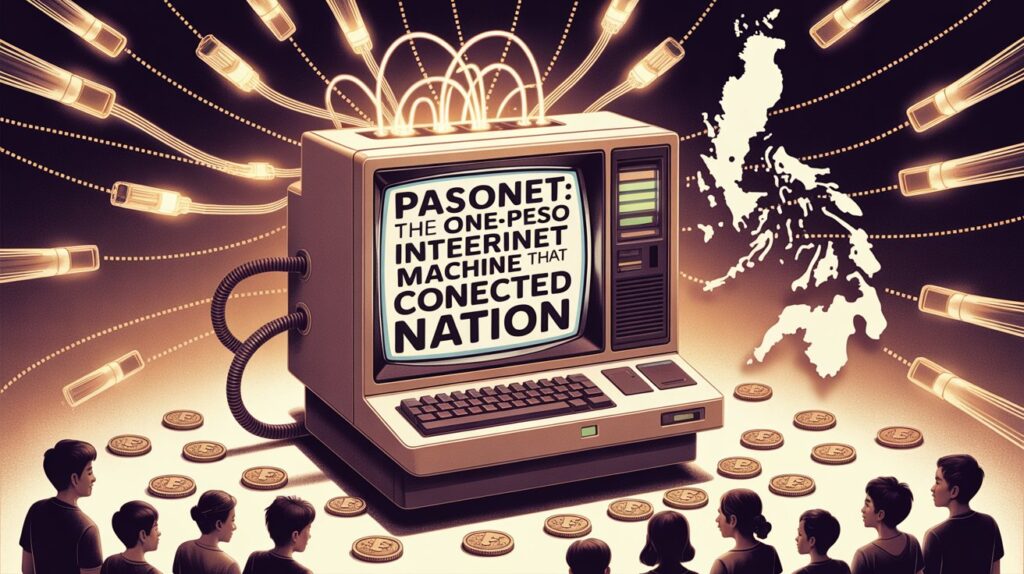
These were not large corporations. They were tricycle drivers who saved enough to buy their first machine. Mothers who set up units in their living rooms. Small shop owners who added pisonets to their existing business. Students who graduated and used their savings to become entrepreneurs.
This is what made pisonet a genuine grassroots economic movement — not just a technology story.
Who Was Using Pasonet Every Day?
The research is clear on this. The heaviest pisonet users were young people from low-income households.
Students used them for school research, homework, and online learning. During the COVID-19 pandemic, when schools shifted to remote learning overnight, pisonets became a lifeline. Children who had no laptop, no tablet, and no home WiFi used pisonet shops to attend virtual classes and submit assignments.
Young people used them to stay connected with friends and family — especially those with relatives working overseas as OFWs (Overseas Filipino Workers). A few minutes checking Facebook or sending a message home was affordable at ₱1 a shot in a way that nothing else was.
Job seekers used them to access government portals, apply for work online, or browse listings. In communities where having a computer at home was a luxury, the pisonet was often the only way to engage with the digital economy.
One real user, quoted in academic research published in the International Journal of Communication, said: “If I only have a few pesos and only want to check Facebook, the pisonet is the best for me. In the pisonet, you really get your money’s worth.”
That sentence captures something important. The pisonet didn’t feel like a compromise to its users. It felt like exactly the right tool for the situation they were in.
The Problems That Came With It
An honest account of pisonet has to include its real problems. And there were genuine ones.
Security and privacy. Shared public computers with no login systems, no antivirus maintenance, and no privacy screens created serious vulnerabilities. Users on pisonets were exposed to phishing risks, data theft, and malware at higher rates than people using secured home connections.These hazards continued in numerous areas since most operators were unable to invest in firewalls or endpoint security due to financial constraints.
Content filtering gaps. Without age verification or content controls, minors could — and did — access adult content on these machines. In 2014, the city government of Cebu tied pisonet operating permits to efforts against inappropriate content proliferation. Some operators installed CCTV cameras. But the fundamental challenge of an anonymous, self-service machine remained.
Limited time per session. For anyone who needed to do substantial work — writing a document, submitting a long application, doing extended research — five minutes per peso was genuinely limiting. The sachet model worked brilliantly for brief interactions. It was not designed for deep sustained work.
Competition from smartphones. As mobile data became cheaper across the Philippines, many pisonet operators saw foot traffic drop. Younger users who previously depended on coin-operated machines now had SIM cards with affordable data packages. Some pisonet businesses closed. Others adapted by shifting to PisoWiFi, which works alongside personal devices rather than replacing them.
PisoWiFi: The Natural Evolution
The pisonet adapted rather than disappeared.
PisoWiFi is the modern version of the same idea. Instead of a fixed computer inside a wooden box, it’s a coin-operated wireless router. Users pay ₱1 to connect their own phone, tablet, or laptop to a local WiFi network for a timed session.
The machine manages everything — counting coins, activating connection time, cutting off access when the session ends, and resetting for the next user.
This evolution was significant. It meant that owning a smartphone was no longer a barrier to using pisonet-style services. As long as you had a device and one peso, you could get online. The operator’s hardware cost actually decreased. And the service became more hygienic and private — you were using your own device, not a shared keyboard.
PisoWiFi units began appearing in the same locations pisonets had always occupied — sari-sari stores, waiting areas, small shops, market stalls. The business model remained micro-entrepreneurial. The coin-operated philosophy remained unchanged.
Pasonet as a Symbol of Filipino Ingenuity
There’s something deeply satisfying about this story when you see it whole.
The Philippines did not wait for its government to solve the digital divide. It didn’t wait for telecom companies to lower their prices. Individual people — ordinary Filipinos with small savings and big ideas — built their own solution.
They took spare computers, timer boxes, coin mechanisms, and basic internet connections and created an entire informal infrastructure for affordable digital access. They invented something that researchers initially assumed must have come from somewhere else, because it was too clever to have emerged from a low-income neighborhood.
But it did come from there. From Dagupan City. From the imperative of people who needed to connect and couldn’t afford to wait.
Academic researchers now study pisonet as a model of grassroots digital inclusion. It’s cited in papers about ICT access for low-income populations. It’s referenced in discussions about bridging the digital divide in developing countries. It influenced similar coin-operated internet concepts in other parts of Southeast Asia.
Starting a Pasonet Business Today
The pisonet business model still attracts new entrepreneurs in the Philippines.
A basic setup requires a computer or set of computers, a coin-operated timer device, and a stable internet connection. The timer controls access — one coin activates one session. Basic software handles time tracking and can allow operators to manage multiple units from one central point.
Typical starting costs for a small operation with one to three machines range from PHP 15,000 to PHP 40,000 (roughly US$350 to $700) when including hardware, installation, and the first month of internet service.
Revenue depends entirely on location and traffic. A unit in a busy market area near a school can collect 200 to 400 pesos daily from coin deposits alone. Adding services like printing or scanning brings in additional income.
Operators learn quickly that location matters more than anything else. A pisonet in a quiet side street earns very little. The same machine placed near a school gate, a market entrance, or a busy public transport stop can become a consistent daily earner.
Final Words
Pasonet is a five-minute internet session and one peso coin.
But it’s also much more than that. It’s a generation of Filipino children who got online for the first time through a wooden box in a corner store. It’s micro-entrepreneurs who built small businesses from a single machine and a power outlet. It’s a genuine homegrown solution to a problem that governments and corporations failed to address.
Researchers discovered it originated in Dagupan City. Academics published papers about it. UNICEF cited it in data about Filipino children’s internet access. International publications covered it as a case study in grassroots digital innovation.
And through all of that attention, the pisonet remained exactly what it always was — a simple, honest, coin-operated machine giving people exactly what they paid for, one peso at a time.
That’s a remarkable thing to build. And it was built by ordinary Filipinos who looked at a problem and found a solution sitting right in front of them.
FAQs
1. What does Pasonet mean?
Pasonet combines “piso” — the Filipino word for one Philippine peso (₱1) — and “net,” short for internet. It refers to a coin-operated internet access system where inserting one peso activates several minutes of computer or WiFi use.
2. Where did Pasonet originate?
Researchers at De La Salle University in Manila traced its origin to Dagupan City in northern Luzon, Philippines. It was not imported from another country — Filipino entrepreneurs invented it locally as a response to unaffordable internet access.
3. When did Pasonet start?
The pisonet system began spreading in the early 2000s. By the 2010s, units had become widespread across the Philippines in sari-sari stores, market stalls, school areas, and residential neighborhoods.
4. How does a Pasonet machine actually work?
A computer sits inside a wooden or metal casing. A coin-operated timer box is connected to the monitor. When a user drops in ₱1, the monitor, keyboard, and mouse activate, giving access for four to seven minutes. When time expires, the screen goes dark until another coin is inserted.
5. How much internet time does one peso buy?
Typically four to seven minutes, depending on how the operator configured the machine. Some operators set four minutes per peso, others as many as ten. The standard has generally settled around five minutes per peso.
6. Who uses Pasonet most?
Students, children from low-income households, job seekers, and young people trying to connect with overseas family members are the most consistent users. According to a UNICEF research from 2021, 53.7% of Filipino children utilized pisonet cafes to get online.
7. What is PisoWiFi and how is it different from PisoNet?
PisoWiFi is the evolved version. Instead of using a shared computer, users bring their own device (phone, tablet, laptop) and pay ₱1 for timed WiFi access. The coin-operated router manages session time automatically. The core concept — one peso per session — remains the same.
8. How much does it cost to start a Pasonet business?
A single unit costs PHP 9,000 to PHP 13,000 (approximately US$250 to $300) for hardware. A small multi-unit setup including installation and first-month internet service typically ranges from PHP 15,000 to PHP 40,000 depending on location and configuration.
9. Is Pasonet still relevant in 2025 and 2026?
Yes, particularly in lower-income communities and areas with limited smartphone penetration. PisoWiFi has extended the concept’s relevance into the smartphone era. Both pisonet and PisoWiFi continue to operate across the Philippines.
10. What were the main problems with Pasonet machines?
Shared machines created cybersecurity risks — phishing, malware exposure, and data theft were common concerns. Content filtering was difficult to enforce, allowing minors access to inappropriate material in some locations. Session time limitations made sustained work difficult. Competition from mobile data packages also reduced foot traffic in some areas.
11. Did Pasonet help during COVID-19?
Yes, significantly. When Philippine schools shifted to remote learning during the pandemic, many students without home internet or devices used pisonet shops to attend virtual classes and submit schoolwork online. It became a critical educational infrastructure in underserved communities.
12. Is Pasonet a Filipino invention?
Yes. Researchers initially assumed it must have been imported from elsewhere. Investigation revealed it was created by Filipino entrepreneurs in Dagupan City. It is now recognized as a genuine Filipino grassroots technology innovation.
13. What software do Pasonet operators use?
Programs like Pisonet Timer, CoinOp, and PisoWiFi Manager allow operators to set session durations per coin, manage multiple units remotely, and monitor daily earnings and usage patterns.
14. Can you still open a Pasonet business today?
Yes. Small entrepreneurs across the Philippines continue to set up pisonet and PisoWiFi units. The business works best near schools, markets, and public transport hubs where foot traffic from cost-conscious users is consistently high.
15. Has Pasonet influenced other countries?
Yes. Similar coin-operated internet access models have appeared in other parts of Southeast Asia. The concept has been studied by ICT researchers globally as a model of grassroots digital inclusion — showing how informal innovation can bridge the digital divide in ways that formal infrastructure programs sometimes cannot.
Keep creating, innovating, and inspiring with Content Ideators every day.
