
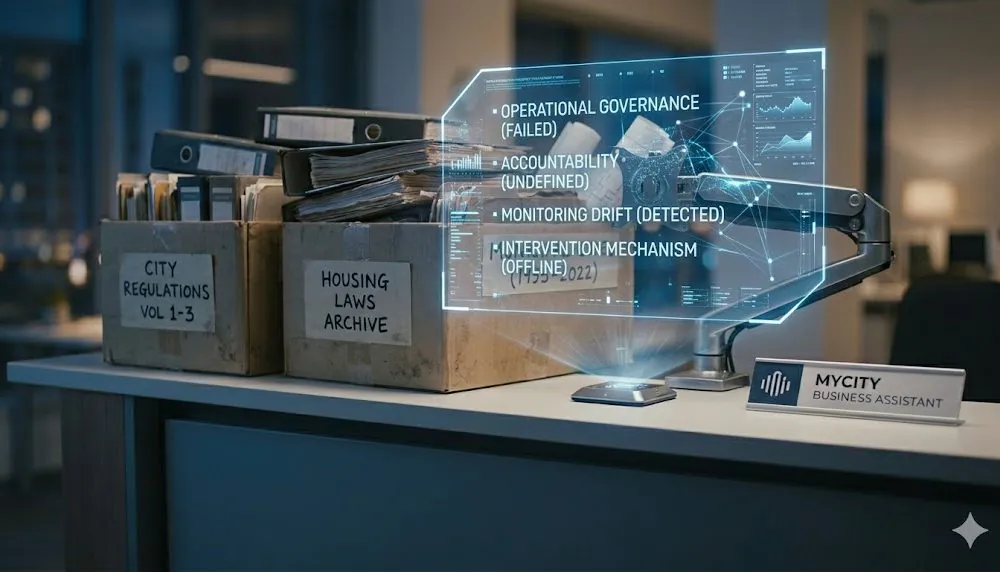
How operational maturity, not model accuracy, is becoming the true differentiator in AI adoption
There is a pattern playing out across industries right now that rarely makes headlines. A company spends months, sometimes years, building a promising AI model. Internal demos go well. Stakeholders are excited. The system launches. And then, quietly, things start to fall apart.
Predictions drift off. Infrastructure buckles under real traffic. Compliance teams raise flags that nobody anticipated. Engineers scramble to debug a system that made perfect sense in a notebook but behaves unpredictably in the wild. The model itself was never the problem. The problem was everything built or not built around it.
This gap between building AI and running AI reliably is the defining challenge of enterprise technology in 2026. And increasingly, the organizations closing that gap share a common denominator: they treat machine learning operations not as an afterthought, but as a first-class engineering discipline.
The Deployment Illusion
It is tempting to think of AI deployment as the finish line. In reality, it is closer to the starting gun.
A model trained on historical data begins aging the moment it goes live. User behavior shifts. Market dynamics change. Input distributions evolve. Without active monitoring, the model continues serving predictions that grow subtler in their wrongness until the wrongness becomes impossible to ignore. This is model drift, and it is one of the most insidious failure modes in production AI because it rarely announces itself loudly.
Drift is just one category of the problem. Others include the gap between a data scientist’s local environment and the production infrastructure their code ultimately runs on, the absence of versioning and rollback capability, and the inability to audit why a model made a particular decision, a growing regulatory concern in sectors from finance to healthcare.
These problems compound. A model running on mismatched infrastructure, with no monitoring and no audit trail, deployed by a process that cannot be reliably repeated, creates a system that teams are afraid to update. So they do not update it. And it gets worse.
Why 2026 Is a Different Conversation
The rise of generative AI has dramatically raised the stakes for operational maturity. Organizations are no longer managing a few predictive models on the side. They are deploying LLM-powered applications, multi-agent systems, retrieval-augmented generation pipelines, and real-time recommendation engines as core business infrastructure.
Each of these introduces its own operational surface area. Prompt engineering decisions need versioning. Token costs need to be tracked and optimized. Vector search performance affects user experience in ways that standard uptime metrics will never surface. AI agents interacting with external services need safety controls, not just unit tests.
The result is that the discipline once called MLOps has had to expand considerably. It now encompasses what some are calling LLMOps, the specific operational practices around large language models alongside traditional data operations and AI governance. The teams doing this well have moved beyond tooling checklists. They have built coherent frameworks that span the entire lifecycle of an AI system, from data ingestion to retirement.
What Operational Maturity Actually Looks Like
Mature MLOps is not about having the most tools. It is about having the right capabilities working together.
Continuous pipelines that actually work
CI/CD for machine learning looks different from traditional software CI/CD because the artifact being tested is not just code, it is a model with statistical behavior. Well-designed pipelines automate not only packaging and deployment but also model validation, performance benchmarking, and staged rollouts, allowing teams to catch regressions before they affect all users.
Observability built for probabilistic systems
Traditional application monitoring tells you whether a service is up and how fast it responds. AI observability asks harder questions: Is the model making good predictions? Are outputs drifting from expected distributions? For generative systems specifically, are responses hallucinating, and with what frequency? Are prompt templates performing as intended across diverse user inputs?
These questions require different instrumentation. Organizations leading in this area have invested in dedicated AI observability tooling rather than repurposing APM dashboards.
Governance as architecture, not compliance theater
As AI regulations expand in the EU, the US, and across Asia-Pacific, governance is shifting from a checkbox exercise to a structural requirement. Organizations need complete audit trails of model decisions, versioned lineage from data through training to production, role-based access controls, and explainability mechanisms that can satisfy regulators without requiring a research paper to interpret.
Embedding governance into the operational pipeline, rather than bolting it on after the fact, is consistently cheaper and more reliable. It also tends to surface problems earlier, when they are still fixable.
The Industries Feeling This Most Acutely
Some industries are experiencing the operational gap more sharply than others, simply because the consequences of failure are higher.
- Healthcare organizations using AI for clinical decision support or diagnostic assistance face strict requirements around accuracy, explainability, and continuous performance validation. A model that degrades silently is not just a technical failure; it is a patient safety risk.
- Financial services firms deploying fraud detection, credit scoring, or algorithmic trading systems operate under regulatory frameworks that demand auditability for every consequential decision. MLOps governance is not optional in these environments.
- Retail and e-commerce companies using AI for real-time personalization and demand forecasting need systems that scale elastically and adapt quickly. Infrastructure automation and retraining pipelines determine whether competitive advantages hold or erode.
- Manufacturing operations relying on AI for predictive maintenance and quality control often deploy at the edge, in environments far less forgiving than cloud data centers. Stable, well-maintained deployment pipelines are what separate a useful system from one that sits unused because nobody trusts it.
The Compounding Advantage of Getting This Right Early
One underappreciated dynamic in enterprise AI is how much the operational foundation compounds over time. Organizations that invest in automated retraining pipelines, robust monitoring, and clean data lineage practices early find that subsequent AI initiatives deploy faster, fail less often, and require less firefighting to maintain.
The opposite is also true. Technical debt in ML systems accumulates differently than in traditional software. A brittle deployment pipeline does not just slow down the next release; it increases the risk that the existing system silently degrades in ways nobody notices until a business outcome suffers.
This is why the organizations winning in AI right now are not always the ones with the largest models or the biggest research teams. They are the ones that have built operational ecosystems capable of deploying, monitoring, updating, and improving AI systems reliably at whatever scale the business demands.
The shift from experimentation to production-grade AI infrastructure is not just a technical milestone. It is a strategic one. And in 2026, it is increasingly the clearest line between organizations that are genuinely extracting value from AI and those still waiting for it.
