
Quick Facts
| Measurement | Details |
| Full name: ml | Milliliter (also spelled millilitre) |
| Full name: oz | Fluid ounce (fl oz) |
| System: ml | Metric — used worldwide |
| System: oz | US Customary / Imperial |
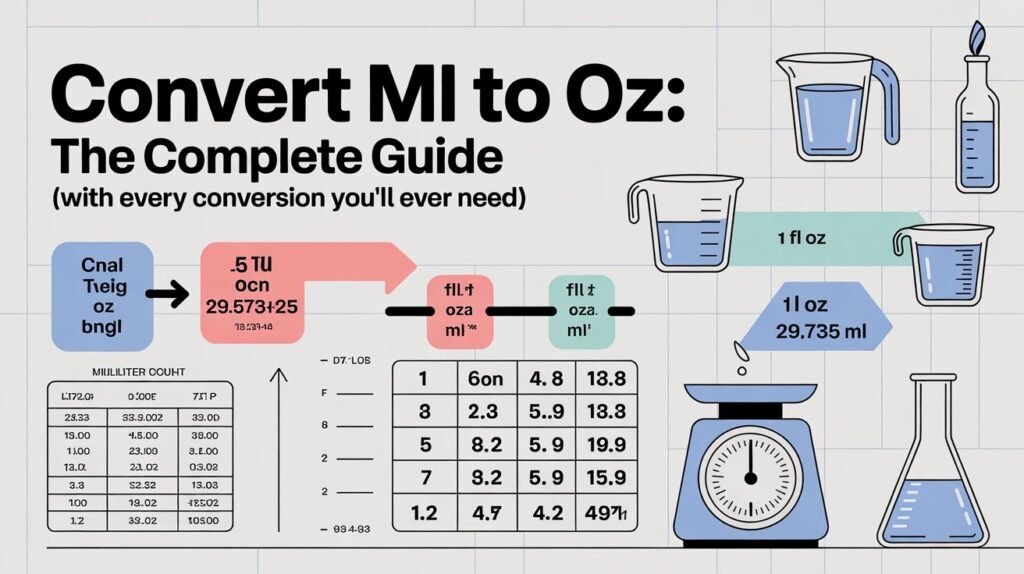
| 1 US fl oz = | 29.5735 ml (exact) |
| 1 UK fl oz = | 28.4131 ml (slightly smaller) |
| Easy rounding rule | 1 oz ≈ 30 ml for everyday use |
| 1 ml = | 0.033814 US fl oz |
| Used in cooking? | Yes — extremely common |
| Used in medicine? | Yes — critical precision required |
| Origin of ml | French metric system, late 1700s |
| Origin of fl oz | Originally: weight of one oz of wine or water |
Why This Conversion Actually Matters
Picture this. You open a recipe from a French food blog. Everything looks perfect. Then you see “200 ml of cream” — and your measuring cup only shows ounces.
You freeze.
That tiny moment of confusion happens to millions of people every single week. In kitchens. In pharmacies. At airport security. In baby feeding rooms at 3 in the morning.
The ml to oz conversion is one of the most searched measurements on the entire internet. And yet nobody ever sat down and explained it properly — not in plain English, not for real everyday life.
That is what this guide is for.
See also “How to Check Website Position on Google: The Complete 2026 Guide“
What Is a Milliliter (ml)?
Start with something small. Really small.
Picture a single raindrop on a window. One milliliter is roughly that size — about twenty drops of water packed together.
One thousandth of a liter is one milliliter. The word “milli” originates from that. In Latin, milli means one thousand. So one milliliter = one thousandth of a liter.
The metric system was born during the French Revolution in the late 1700s. Scientists wanted a clean, logical system where everything was divided neatly by ten. The milliliter was part of that plan.
Today it is used by almost every country on Earth. Your medicine bottle uses it. The nutrition label on your yogurt uses it. The IV drip in a hospital uses it.
It is also written as “mL” with a capital L. Both are correct — ml and mL mean the exact same thing.
What Is a Fluid Ounce (oz)?
Now here is where it gets interesting — and a little messy.
A fluid ounce has been around for centuries. Back in medieval times, people needed a way to measure wine and water. They used the weight of one ounce of liquid as their guide. That was the original idea.
Over time, two slightly different versions developed. One in the United States. One in the United Kingdom.
They are close. But not identical. And that small gap has been causing kitchen disasters ever since.
- The US fluid ounce = 29.5735 ml
- The UK (imperial) fluid ounce = 28.4131 ml
That is about a 4% difference. Small, yes. But if you are measuring 16 oz of something, that small gap adds up to almost 18 ml. In baking, that absolutely changes the result.
The Core Formula: How to Convert ml to oz
Here is the math. And I promise it is simpler than it looks.
To go from ml → oz (US): Divide the ml number by 29.5735
To go from ml → oz (UK): Divide the ml number by 28.4131
To go from oz → ml (US): Multiply the oz number by 29.5735
That is it. Two operations. Division going one way. Multiplication going the other way.
Quick mental math trick: For everyday use, just pretend 1 oz = 30 ml. It is slightly off, but close enough for cooking, drinks, and most recipes. Save the exact number for medicine or lab work.
The Big Conversion Table
Here are the numbers people search for most often — all in one place.
| Milliliters (ml) | US Fluid Oz | UK Fluid Oz |
| 5 ml | 0.17 oz | 0.18 oz |
| 10 ml | 0.34 oz | 0.35 oz |
| 15 ml | 0.51 oz | 0.53 oz |
| 30 ml | 1.01 oz | 1.06 oz |
| 50 ml | 1.69 oz | 1.76 oz |
| 60 ml | 2.03 oz | 2.11 oz |
| 100 ml | 3.38 oz | 3.52 oz |
| 120 ml | 4.06 oz | 4.22 oz |
| 150 ml | 5.07 oz | 5.28 oz |
| 200 ml | 6.76 oz | 7.04 oz |
| 240 ml | 8.11 oz | 8.45 oz |
| 250 ml | 8.45 oz | 8.80 oz |
| 300 ml | 10.14 oz | 10.56 oz |
| 355 ml | 12.00 oz | 12.50 oz |
| 500 ml | 16.91 oz | 17.60 oz |
| 750 ml | 25.36 oz | 26.40 oz |
| 1000 ml (1 liter) | 33.81 oz | 35.20 oz |
Print this. Tape it inside a kitchen cupboard. You will thank yourself later.
US oz vs UK oz: Why It Matters Where You Live
Most people have no idea this difference exists. Until they ruin a recipe.
If you follow a British cookbook using US measurements, or an American recipe using UK cups, the numbers drift. They start small but stack up fast.
Here is a real example. A recipe calls for 16 UK fluid ounces of stock. You measure 16 US fluid ounces instead. You have just used 473 ml instead of 455 ml. That is 18 ml too much. In a sauce or a soup, you might not notice. In a risotto, you probably will.
The rule of thumb:
- If your recipe is from the USA — use 29.5735 ml per oz
- If your recipe is from the UK — use 28.4131 ml per oz
- If you are not sure — check the source of the recipe
Most online converters default to US fluid ounces. That is the right choice for most people reading English-language recipes.
Kitchen Conversions: What You Really Need to Know
Let’s talk about the measurements that show up in recipes every single day.
1 teaspoon = 5 ml = 0.17 oz You see this in vanilla extract, spice mixes, syrups. Five milliliters is your standard teaspoon. Easy to remember.
1 tablespoon = 15 ml = 0.51 oz Oils, sauces, vinegar — this one comes up constantly. Half an ounce, roughly.
1/4 cup = 60 ml = 2 oz Common in baking. A small pour of oil or milk.
1/2 cup = 120 ml = 4 oz You will see this in cake recipes all the time.
1 cup = 240 ml = 8 oz This is the big one. The standard US cup is 8 fluid ounces, which is 236.59 ml. Most people round it to 240 ml and no one’s cake has ever suffered.
Here is something that surprises people. A UK cup is 10 fluid ounces — which is 284 ml. That is almost 50 ml more than a US cup. Follow a British recipe with American measuring cups and your batter will be noticeably thicker.
Medicine: Where You Must Get It Exactly Right
In the kitchen, a little rounding is fine. In medicine, it is not.
Liquid medications — syrups, drops, suspensions — are measured in milliliters. Doctors prescribe in milliliters. Pharmacists dispense in milliliters. The measuring syringe in the box is marked in milliliters.
But some labels still show both. And some older measuring spoons in American homes are marked in ounces. That is where mistakes creep in.
A pediatric dose of 5 ml sounds tiny. Because it is. Now imagine confusing that with 5 oz — which is 147 ml. That is almost thirty times the dose. I am not saying this to scare you. I am saying it because this exact kind of error has happened.
The safest rule for medicine: Always use the syringe or dropper that came with the medication. Never guess. Never eyeball it. And if the instructions are in ml, measure in ml.
If you ever need to check: 5 ml = 0.17 oz. Not 0.17 tablespoons. Not half an ounce. Just 0.17 of one fluid ounce. That number puts it in perspective fast.
Baby Feeding: Small Numbers, Big Responsibility
New parents face ml-to-oz confusion almost immediately.
Baby formula packaging uses both units, but instructions are often in milliliters. American baby bottles are marked in both ml and oz — which helps, but only if you know which side to read.
A newborn baby takes in roughly 60 to 90 ml per feeding in those first few weeks. That is just 2 to 3 oz. By three months, that rises to about 120 to 180 ml — around 4 to 6 oz.
These are small numbers. Getting them even slightly wrong over many feedings across a day matters. The gut health of an infant is delicate. Too little nutrition and growth suffers. Too much and digestion struggles.
This is one situation where rounding to “roughly 30 ml per oz” is fine for estimation but not for actual preparation. Use the marked line on the bottle. Every time.
Travel and the Famous 3.4 oz Rule
You know that stressful moment at airport security when they confiscate your shampoo? That 100 ml rule is exactly 3.38 oz.
Most major airlines and airport security systems around the world follow the same guideline. Each liquid container in your carry-on must be 100 ml or less. In American terms, that is about 3.4 oz.
Travel-size products are often labeled 3.4 oz precisely because of this rule. They are designed to hit just under the limit. Now you understand why.
So next time you are packing and you see a bottle labeled 95 ml — that is fine. A bottle labeled 4 oz? That is 118 ml. Confiscated.
This conversion — 100 ml = 3.38 oz — is probably the most useful one a traveler can memorize.
Skincare and Beauty Products
Walk into any drugstore or beauty shop. Check the back of a serum, moisturizer, or shampoo bottle.
European brands use ml. American brands mix it up — often showing both. A 30 ml serum is 1 oz. A 50 ml bottle is about 1.7 oz. A full-size 100 ml shampoo is roughly 3.4 oz.
Knowing this helps when you are shopping online and comparing products across brands. A French serum “30 ml” and an American serum “1 fl oz” are the same size. You are not getting more or less — you are getting identical volume, just labeled differently.
Full-size skincare is often 200 ml to 250 ml. That is about 6.8 to 8.5 oz — a solid few months of daily use.
Drinks: The Sizes We All Know in Two Languages
Let us make this section fun, because these are containers you hold in your hand every day.
Espresso shot: 30 ml = 1 oz That sharp, intense little cup of coffee? Just one ounce. Tiny but mighty.
Standard soda can (US): 355 ml = 12 oz Every 12 oz soda can in America holds exactly 355 ml. It’s entertaining to mention that fact during gatherings.
Standard water bottle: 500 ml = 16.9 oz The most common water bottle sold in the US is actually labeled 16.9 fl oz. That is exactly 500 ml. Perfect metric packaging sold with imperial labeling.
Pint of beer (US): 473 ml = 16 oz Pint of beer (UK): 568 ml = 20 oz This is why ordering “a pint” in London gives you noticeably more beer than in New York. A UK pint is 95 ml bigger than a US pint.
Wine bottle: 750 ml = 25.36 oz A standard bottle of wine is 750 ml worldwide. That is just over 25 oz — or about five standard 5 oz pours.
Quick Mental Math Tricks
You do not always have a calculator. Here is how to estimate in your head.
Trick 1 — The 30 rule: Pretend 1 oz = 30 ml. Not exact, but fast. Multiply oz by 30 to get ml. Divide ml by 30 to get oz. Works for cooking every time.
Trick 2 — The 3.4 anchor: 100 ml = 3.4 oz. This one is worth memorizing. If you know a bottle is 200 ml, it is 6.8 oz. If it is 300 ml, it is about 10 oz.
Trick 3 — The teaspoon anchor: 5 ml = 1 teaspoon. If you are dealing with tiny amounts, count teaspoons. Ten teaspoons = 50 ml = 1.7 oz.
Trick 4 — The cup anchor: 1 cup = 240 ml = 8 oz. Everything scales from there. Half a cup is 120 ml = 4 oz. A quarter cup is 60 ml = 2 oz.
Common Mistakes People Make
Mistake 1 — Confusing weight ounces with fluid ounces. A regular ounce measures weight. A fluid ounce measures liquid volume. They are completely different things. Eight ounces of honey weighs more than 8 oz of water even though both are “8 oz” in liquid form — because honey is denser.
Mistake 2 — Using US conversions for UK recipes without checking. People are constantly caught by this one. A British recipe calling for “a pint” means 568 ml. In an American recipe, “a pint” refers to 473 milliliters. That 95 ml gap changes recipes in ways you will notice.
Mistake 3 — Rounding medicine doses. Thirty ml per oz is great for soup. It is not acceptable for a child’s fever medication. Use the exact factor — 29.5735 — or better yet, use the measuring device that came with the medication.
Mistake 4 — Assuming cc and ml are different things. They are not. One milliliter is precisely equal to one cubic centimeter (cc). You will see cc used in medical and scientific contexts. Same measurement, different label.
Final Words
Numbers do not have to be scary. The ml to oz conversion is just one of those things that feels confusing until the moment it clicks — and then it feels completely obvious.
The key facts are simple. One US oz is about 30 ml for everyday use, and 29.5735 if you need precision. The UK oz is slightly smaller at 28.4131 ml. And 100 ml equals roughly 3.4 oz, which will serve you well from the airport to the kitchen to the pharmacy.
Once you know these anchor points, everything else is just multiplication and division.
Keep this guide somewhere handy. Because no matter how good your memory is, there will be a moment — usually at 11 pm, mid-recipe, with your hands covered in something sticky — when you need to look this up.
FAQs
Q1. Is 1 oz the same as 30 ml?
Not exactly. One US fluid ounce is 29.5735 ml. People round it to 30 ml for ease, which works fine for cooking. But for medicine, science, or precise baking, use 29.5735 or your measurement will be slightly off.
Q2. What is 100 ml in oz?
One hundred milliliters equals 3.38 US fluid ounces. In UK ounces, it is 3.52 oz. This is also the famous airport security liquid limit — roughly 3.4 oz per container.
Q3. How many ml is 8 oz?
Eight US fluid ounces equals 236.59 ml — which rounds neatly to 240 ml. This is also the volume of one standard US measuring cup.
Q4. How many oz is 500 ml?
Five hundred milliliters equals 16.91 US fluid ounces. This is the size of a standard water bottle, often labeled “16.9 fl oz” in the United States.
Q5. Is a UK fluid ounce the same as a US fluid ounce?
No. A US fluid ounce is 29.5735 ml. A fluid ounce in the UK is 28.4131 milliliters. The difference is about 4%. It matters when following recipes from different countries.
Q6. How do I convert ml to oz without a calculator?
Use the 30 ml rule for a fast estimate. Divide any ml amount by 30 and you get a close enough answer in ounces for most kitchen purposes. For exact results, divide by 29.5735 instead.
Q7. What does 1 ml look like?
One milliliter is roughly the size of a single water drop — or about twenty drops packed together. A standard teaspoon holds 5 ml. A tablespoon holds 15 ml.
Q8. Why does my bottle show both ml and fl oz?
Products sold internationally must display both units to meet labeling requirements in different countries. The US requires fluid ounces on consumer products. Most of the world uses ml. Manufacturers print both so one product works in all markets.
Q9. How many ml is a teaspoon?
One teaspoon equals 5 ml. This is a globally recognized standard used in cooking and medicine. A tablespoon is three teaspoons, so that equals 15 ml.
Q10. Can I use ml to oz for thick liquids like honey or syrup?
Yes — fluid ounces and milliliters measure volume, not weight. Honey and water both fill the same amount of space at, say, 100 ml. But honey weighs more. Volume conversion works the same regardless of thickness.
Q11. How much is 250 ml in oz?
Two hundred fifty milliliters equals 8.45 US fluid ounces. It is slightly more than one standard US cup (which is 240 ml or 8 oz). Many international juice boxes and small drink containers are 250 ml.
Q12. What is the most important ml to oz conversion to memorize?
If you only memorize one, make it this: 100 ml = 3.38 oz. From there you can scale up or down quickly in your head for almost any everyday situation — travel, cooking, beauty products, or drinks.
Q13. Are “ml” and “cc” the same thing?
Yes, completely. One milliliter and one cubic centimeter (cc) are exactly equal. You will see cc used mostly in medical and scientific settings. If a nurse says “give 10 cc,” that is 10 ml.
Keep creating, innovating, and inspiring with Content Ideators every day.
