
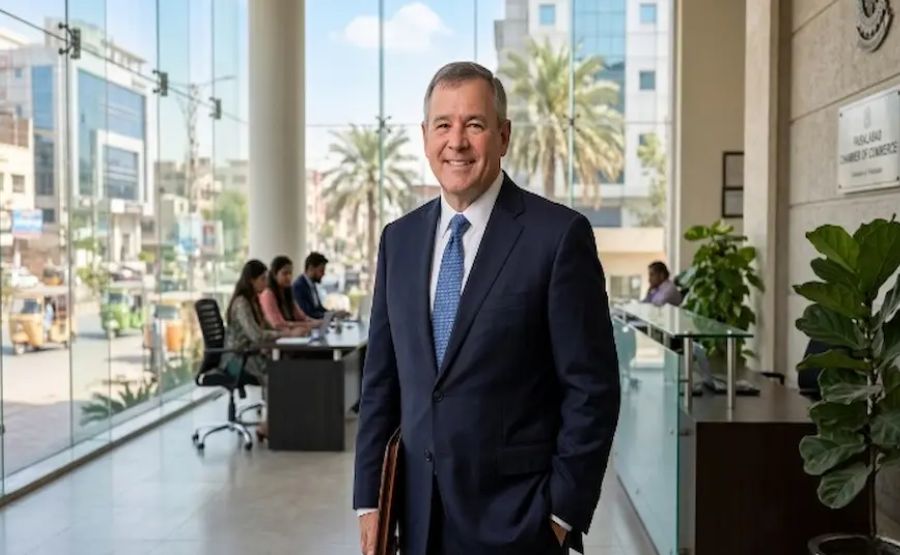
When the Georgia Chamber of Commerce named its 2025 Chair in January of that year, the choice was historic — for the first time in the organization’s 110-year history, a Class I railroad executive held the gavel. That man was Claude Edward Elkins Jr., known throughout the industry simply as Ed Elkins, the Executive Vice President and Chief Commercial Officer of Norfolk Southern Corporation.
His ascent is not the story of a well-connected business school graduate dropped into a corner office. It is something rarer and more instructive: a fourth-generation railroader who started by coupling freight cars on the ground and spent 37 years learning every layer of one of America’s most complex industries before reaching its commercial summit.
Quick Bio
| Detail | Information |
| Full Name | Claude Edward Elkins Jr. |
| Known As | Ed Elkins |
| Origin | Southwest Virginia, USA |
| Military Service | United States Marine Corps (pre-1988) |
| Education | Executive Programs at Harvard Business School, UVA Darden, and the University of Tennessee Supply Chain Institute; B.A. in English from the University of Virginia’s College at Wise; MBA in Port and Maritime Economics from Old Dominion University |
| Career Start | 1988, Road Brakeman, Norfolk Southern |
| Current Role | Executive Vice President & Chief Commercial Officer, Norfolk Southern Corporation |
| Appointed CCO | December 2021 |
| Board Roles | Vice Chair, Georgia Chamber (2025 Chair); National Association of Manufacturers; TTX Company; East Lake Foundation; Georgia State University Marketing RoundTable |
| Base | Atlanta, Georgia (relocated from Virginia in 2022) |
Roots in Southwest Virginia: Where Rail Is Not Metaphor
Southwest Virginia does not produce many famous executives. What it does produce is people who understand, in a bone-deep way, how physical labor connects to economic survival.
Elkins grew up in a region where railroad tracks were not abstract infrastructure — they were the arteries that moved coal, timber, and industrial goods out of Appalachian communities and into the national economy. For a boy raised there, trains were neither romantic nor distant. They were just a part of everyday existence.
He is, by multiple accounts, a fourth-generation railroader. Whatever his father, grandfather, and great-grandfather did along those tracks, the industry was already a family inheritance before Ed Elkins drew his first paycheck.
See also “BigXthaPlug Age: Life, Career, and the Dallas Rapper Rewriting the Country-Rap Rulebook“
The Marine Corps Chapter: Discipline Before Commerce
Before Norfolk Southern, before English literature, before any boardroom, Elkins went into the United States Marine Corps.
The exact years of his service are not publicly documented, but the sequence is clear: military service first, then his 1988 entry into Norfolk Southern. The Marines are not a soft institution. They build leaders who function under pressure, who communicate with clarity, and who do not confuse discomfort with failure.
Those who have worked with Elkins consistently describe a leader who remains calm in operational complexity, who insists on accountability without theater, and who connects genuinely with people across every level of an organization. Those are not MBA characteristics. Those are earned ones.
An Unlikely Degree for a Railroad Career
Here is where Elkins’ story diverges from the standard rail executive biography. When he pursued his undergraduate degree at the University of Virginia’s College at Wise, he did not study engineering, logistics, or business. He studied English.
A bachelor’s degree in English is not typically a pipeline into freight transportation management. But it trains the mind in something operations-focused careers often neglect: the ability to read an argument carefully, write with precision, and communicate complex ideas to varied audiences. For someone who would later spend decades convincing customers, regulators, policymakers, and employees to trust a railroad, those skills proved useful.
He later returned to formal education to fill the technical gaps, earning an MBA from Old Dominion University with a concentration in Port and Maritime Economics. He then added executive programs at Harvard Business School, the University of Virginia’s Darden School of Business, and the University of Tennessee Supply Chain Institute. Each program added a new lens. None of them replaced the fundamentals he built on the railroad itself.
1988: Starting at the Bottom, Literally
In 1988, freshly out of the Marine Corps, Elkins took a job at Norfolk Southern as a Road Brakeman. This was not a management training program with a brakeman rotation. This was the job itself — physically demanding, weather-exposed, and unambiguous.
A brakeman’s work involves coupling and uncoupling rail cars, operating switches, inspecting equipment, and ensuring the safe movement of freight. It requires attention to detail, physical endurance, and the ability to work in coordinated silence with a crew that trusts each other’s judgment.
Elkins did not pass through this role quickly. He stayed in operational positions long enough to also become a Conductor, a Locomotive Engineer, and eventually a Relief Yardmaster. Each step revealed a different layer of how Norfolk Southern actually functioned. Years later, when he would make commercial decisions affecting tens of thousands of employees and hundreds of thousands of customers, this foundation would matter in ways no case study can replicate.
Two Decades in Intermodal Marketing: The Bridge Role
After mastering operations, Elkins made a pivot that would define his trajectory. He moved into Intermodal Marketing, a function that sits at the intersection of rail operations and commercial logistics.
Intermodal freight — the movement of goods in standardized containers that transfer between ships, rail, and trucks — is the backbone of modern global supply chains. Managing it requires understanding both the operational realities of running a railroad and the commercial demands of businesses that need their goods to arrive on time. Most people on the rail know one side or the other. Elkins knew both.
He spent nearly two decades in this role, building customer relationships and designing freight solutions that linked rail to the broader logistics ecosystem. By the time he left Intermodal Marketing, he had a reputation inside Norfolk Southern as someone who understood the business from ground to ceiling.
Chemicals, Industrial Products, and the Climb to the C-Suite
In 2016, Elkins was appointed Group Vice President of Chemicals Marketing. This is one of the most regulated freight segments in American rail — the movement of hazardous materials, industrial chemicals, and specialty products requires not just commercial acumen but a serious understanding of safety, compliance, and environmental risk. His operational background made him credible in this role in ways a pure commercial hire would not have been.
Two years later, in 2018, he moved to Vice President of Industrial Products, overseeing freight categories including metals, construction materials, and forest products. These are cyclical industries tied tightly to the health of the broader American economy. Managing them through economic fluctuations requires both strategic steadiness and tactical flexibility.
Elkins was appointed Executive Vice President and Chief Commercial Officer of Norfolk Southern in December 2021. The appointment placed him among the five or six most senior people in a company that moves more than 7 million carloads of freight annually across 22 states.
What the CCO Role Actually Means
The title Executive Vice President and Chief Commercial Officer sounds significant. What it means in practice is more revealing.
Elkins is in charge of the Intermodal, Automotive, and Industrial Products business divisions of Norfolk Southern. In addition, he oversees field sales, short-line marketing, industrial development, real estate, and customer logistics. Norfolk Southern, by its own accounting, delivers freight to a majority of the country’s population and manufacturing base, with connections to more than 54 ports.
When Elkins makes a pricing decision, it affects what manufacturers pay to ship steel. When he shapes intermodal strategy, it determines whether freight that might otherwise move by diesel truck shifts to a method that produces roughly 70 to 80 percent fewer carbon emissions. These are not abstract business decisions. They ripple through supply chains, consumer prices, and regional employment.
In a 2025 interview following his Georgia Chamber appointment, Elkins made the commercial case for rail with characteristic directness. He described rail as a proposition that saves customers money, dramatically cuts carbon emissions, and prevents deaths from truck-passenger vehicle collisions. “You would probably invest in that company,” he said. It was an argument that merged environmental responsibility with pure commercial logic — and it reflected how he approaches the job.
Norfolk Southern’s Turbulent Years: Leading Through Disruption
Elkins did not inherit a smooth runway. The years immediately following his 2021 CCO appointment were among the most turbulent in Norfolk Southern’s recent history.
The COVID-19 pandemic had already fractured global supply chains. In early 2023, a Norfolk Southern freight train derailed near East Palestine, Ohio, releasing toxic chemicals and triggering one of the most visible railroad safety crises in years. The incident forced the entire company to reckon publicly with its safety infrastructure. Norfolk Southern also underwent significant leadership instability, cycling through three CEOs in three years. During this same period, the company relocated its headquarters from Norfolk, Virginia to Atlanta, Georgia — a move that uprooted long-tenured employees and restructured the company’s civic relationships.
Elkins moved his own family to Atlanta’s Buckhead neighborhood in 2022, leaving a Virginia home where he had spent his entire adult life. That relocation was not symbolic. It was a deliberate public commitment to Georgia, to Atlanta, and to the company’s new direction.
Through the East Palestine aftermath, through CEO changes, through market volatility, Elkins continued running Norfolk Southern’s commercial operation. Across all merchandise business areas, his Q4 and full-year 2025 statistics showed record revenue, with exceptional performance in Automotive and Chemicals, the very industries he had spent years understanding from the ground up.
The Georgia Chamber Chairmanship: A Historic Signal
Elkins officially became the 2025 Chair in front of over 2,600 lawmakers, corporate executives, and political officials at the Georgia Chamber’s annual Eggs & Issues breakfast in January 2025. It was, as noted at the time, the first time in the organization’s 110-year history that a Class I railroad executive had held that position.
The significance runs deeper than a ceremonial title. The Georgia Chamber is a serious policy organization that coordinates between Governor Brian Kemp’s office, Fortune 500 companies, small business owners, and local chambers across all 159 Georgia counties. Chairing it requires credibility with people who have radically different interests, which is a job description not unlike managing a railroad’s commercial portfolio.
Elkins spent 2023 as the Chamber’s Foundation Chair, 2024 as Vice Chair, and 2025 as Chair — a structured, deliberate progression. This was not an honorary appointment dropped on a convenient executive. He earned this role on a multi-year timeline, the same way he earned everything else.
His term focused on an initiative called GEORGIA 2050, a long-range economic competitiveness project. The Georgia Chamber’s own data projected that Georgia’s freight tonnage would increase 91 percent by 2050. Elkins positioned Norfolk Southern — and rail transportation broadly — as central to that future.
Beyond Norfolk Southern: Board Work and Industry Influence
Elkins carries board positions that extend his influence well beyond Norfolk Southern’s commercial operation.
He sits on the board of the National Association of Manufacturers, a body that represents more than 13,000 manufacturing companies and shapes federal industrial policy. He serves on the board of TTX Company, the rail car pooling company co-owned by several major North American railroads. He is a member of the East Lake Foundation, a community development organization based in Atlanta. He participates in the Georgia State University Marketing RoundTable and holds membership in The Conference Board’s Council for CMOs.
These are not resume decorations. Each role requires actual time, actual decisions, and actual accountability to other serious people. Together, they give Elkins a seat at tables where transportation policy, manufacturing strategy, and community investment get shaped.
Leadership Philosophy: Experience First, Then Strategy
Those who have described Elkins’ leadership style — from industry journalists to fellow executives to his own public statements — converge on a consistent picture.
He is not a leader who manages the dashboard. He earned his authority by understanding the railroad at every level — from the physical mechanics of coupling cars to the financial mechanics of pricing intermodal contracts. That comprehensive knowledge makes him genuinely credible with frontline workers in a way that many C-suite executives are not.
He emphasizes that safety, sustainability, and commercial performance are not competing priorities but integrated ones. He has argued publicly that the railroad’s environmental value proposition — its ability to dramatically reduce freight’s carbon footprint — is also its strongest commercial argument in a market where large shippers increasingly face sustainability pressure from their own customers.
His approach to growth also reflects patience. He spent 37 years at one company. He did not job-hop upward. He built deep expertise in each role before moving to the next one. In an era that rewards visible hustle and frequent movement, this kind of methodical, institutional loyalty is genuinely unusual.
What the Record Does Not Tell Us
An honest biography acknowledges the gaps. Elkins keeps his personal life carefully private. His family situation, his specific age, the details of his upbringing beyond the regional and generational context — these remain outside public documentation.
The East Palestine derailment raises questions that no individual executive can fully answer but that the entire company must own. As the head of commercial strategy during that period, Elkins was not personally responsible for operational safety decisions. However, there is a lot of economic pressure on railroads to compete with trucking, move more quickly, and reduce prices. This pressure is there in every conversation about commercial leadership. That tension does not make Elkins blameworthy. It makes him human, and it makes his organization’s challenges real.
The railroad industry also faces structural headwinds — workforce constraints, regulatory pressure, competition from increasingly efficient trucking, and the enormous capital demands of maintaining 19,300 route miles of track. Elkins’ 2025 commercial performance was strong. Whether that momentum holds against macroeconomic volatility is a question his own LinkedIn posts in early 2026 addressed with notable candor: “our team stayed focused on what we could control.”
Legacy in Progress
Claude Edward Elkins Jr. is not a finished story. He is an active executive in the middle of his most consequential chapter.
What his career has already demonstrated is significant. He showed that an English major with a Marine Corps background can become one of the most commercially effective executives in American freight transportation. He showed that patience — real, multi-decade institutional patience — still produces results that fast career movement rarely matches. He showed that understanding the bottom of an organization makes you more effective at its top.
His legacy also intersects with something larger than his individual career. The decisions Norfolk Southern makes about intermodal investment, about customer relationships, about where to locate industrial development — these shape the economic geography of the American East. Every working day, Elkins makes such choices.
Rail moved this country in the 19th century. It moves it still, largely invisible to people who think goods appear magically on shelves. Ed Elkins is one of the small number of people who understand that system deeply, who built their understanding the hard way, and who now hold genuine authority over how it evolves.
That is the honest, complete picture: a serious man, forged in a working-class Virginia landscape, shaped by military discipline, educated in unexpected directions, patient to an almost unfashionable degree, and now wielding real influence over infrastructure that most Americans depend on without ever thinking about it.
FAQs
1. Who is Claude Edward Elkins Jr.?
He is the Executive Vice President and Chief Commercial Officer of Norfolk Southern Corporation, one of the largest freight railroads in the United States. He is based in Atlanta, Georgia, and has spent his entire 37-year professional career at Norfolk Southern.
2. Where did Claude Edward Elkins Jr. grow up?
He grew up in Southwest Virginia, a region historically tied to industrial labor, coal mining, and railroad transportation. He relocated to Atlanta in 2022 following Norfolk Southern’s headquarters move.
3. Did he serve in the military?
Indeed. Elkins was a member of the US Marine Corps prior to joining Norfolk Southern. That service shaped his discipline, leadership approach, and ability to function under pressure — qualities that have defined his executive style.
4. What did he study in college?
He earned a Bachelor of Arts in English from the University of Virginia’s College at Wise. He later added an MBA with a concentration in Port and Maritime Economics from Old Dominion University, plus executive programs at Harvard Business School, UVA Darden, and the University of Tennessee Supply Chain Institute.
5. What was his first job at Norfolk Southern?
He was hired as a Road Brakeman in 1988 — one of the most physically demanding frontline roles in railroad operations. He subsequently worked as a Conductor, Locomotive Engineer, and Relief Yardmaster before transitioning to marketing.
6. Why did he study English rather than engineering or business?
This is not publicly explained in detail. What is clear is that the communication and analytical skills from an English degree served him well in commercial roles that require presenting compelling arguments to customers, policymakers, and employees.
7. Is he a fourth-generation railroader?
Multiple sources, including detailed biographies drawing from industry sources, describe him as a fourth-generation railroader. The specific history of his family’s railroad employment has not been formally documented in public sources.
8. What happened at Norfolk Southern during his CCO tenure?
He has led commercial operations through several disruptions: the COVID supply chain crisis, the 2023 East Palestine, Ohio train derailment, three CEO changes in three years, and the corporate headquarters relocation from Virginia to Georgia.
9. What is his role with the Georgia Chamber of Commerce?
He served as Foundation Chair in 2023, Vice Chair in 2024, and became the 2025 Chair — the first Class I railroad executive to hold that position in the Chamber’s 110-year history. He currently serves as Immediate Past Chair as of 2026.
10. What boards does he sit on?
He holds positions on the boards of the National Association of Manufacturers, TTX Company, the East Lake Foundation, and the Georgia State University Marketing RoundTable. He is also a member of The Conference Board’s Council for CMOs.
11. What is Norfolk Southern’s commercial footprint under his leadership?
Norfolk Southern operates approximately 19,300 route miles across 22 eastern states. It delivers more than 7 million carloads annually, operates the most extensive intermodal network in the eastern U.S., and is the largest rail shipper of automotive products and metals in North America.
12. What makes his leadership style unusual for a C-suite executive?
He spent 37 years at one company and progressed through frontline operational roles before entering management. This gives him credibility with frontline workers and a firsthand understanding of safety and logistics challenges that purely commercial executives typically lack. His consistent emphasis on patience and long-term thinking is notably at odds with modern corporate culture.
Keep creating, innovating, and inspiring with Content Ideators every day.
