
Most businesses already have the data they need.
Customer queries, product details, workflows, and internal processes are all documented somewhere. But access is slow. Teams search across systems. Customers wait for answers. Support repeats the same steps.
This gap between information and action is where delays happen. An AI chatbot for business closes that gap. It connects users directly to the right information and actions in real time, without forcing them to navigate systems or wait for responses.
Customer Service Is Becoming Instant by Default
Customer expectations have changed. They expect answers immediately. Not in hours. Not after multiple steps. Delays lead to drop-offs, repeated queries, and poor experiences. This is especially visible in support-heavy environments.
An AI chatbot customer service system improves this by removing wait time completely. Customers can ask questions and get answers instantly, without switching channels or repeating themselves.
This leads to:
- Faster responses without queues
- Reduced dependency on support teams
- Continuous support across all hours
In high-volume industries, this shift is already measurable. A large percentage of routine queries can now be managed without human involvement. The result is not just faster service, but also a smoother experience.
Efficiency Improves Without Increasing Resources
Traditional support models scale with people.
More queries mean more hiring, more training, and more operational costs. This model does not scale efficiently.
AI changes this.
An AI-powered chatbot for customer service helps businesses handle more conversations without adding more staff. It lowers pressure on teams and ensures consistent service even during peak demand.
This directly impacts operations:
- Thousands of conversations are handled simultaneously
- Lower cost per interaction compared to human support
- Reduced manual effort across repetitive tasks
Efficiency is no longer tied to team size. It is tied to how well systems are connected and automated.
How AI Chatbots Improve Customer Service
1. Instant, Always-On Support
Customers get immediate replies at any time, removing queues and long waits. This 24/7 availability keeps engagement ongoing, with businesses seeing up to 3x faster response times than traditional support models.
2. Faster Resolution
Repetitive queries are handled instantly by chatbots, cutting down multi-step interactions and long back-and-forth delays. Faster first responses can make businesses 21x more likely to qualify leads when engagement happens within minutes.
3. Scalable Support
Thousands of conversations can be handled at the same time by AI chatbots without any drop in performance, even during peak demand. This helps businesses automate up to 80% of routine queries while keeping speed high without growing support teams.
4. Consistent Responses
Predefined logic and centralised knowledge guide every interaction, ensuring accuracy across conversations. This consistency lowers support errors and allows over 30% of interactions to be handled reliably by AI in some industries.
5. Personalised Interactions
Chatbots use customer data, earlier interactions, and behaviour signals to adjust responses in real time. This level of personalisation supports a 20–30% improvement in conversion rates through more relevant and contextual engagement.
Industry Impact: Where Chatbots Deliver the Most Value
AI chatbot adoption is strongest in industries with high interaction volume and time-sensitive decisions.
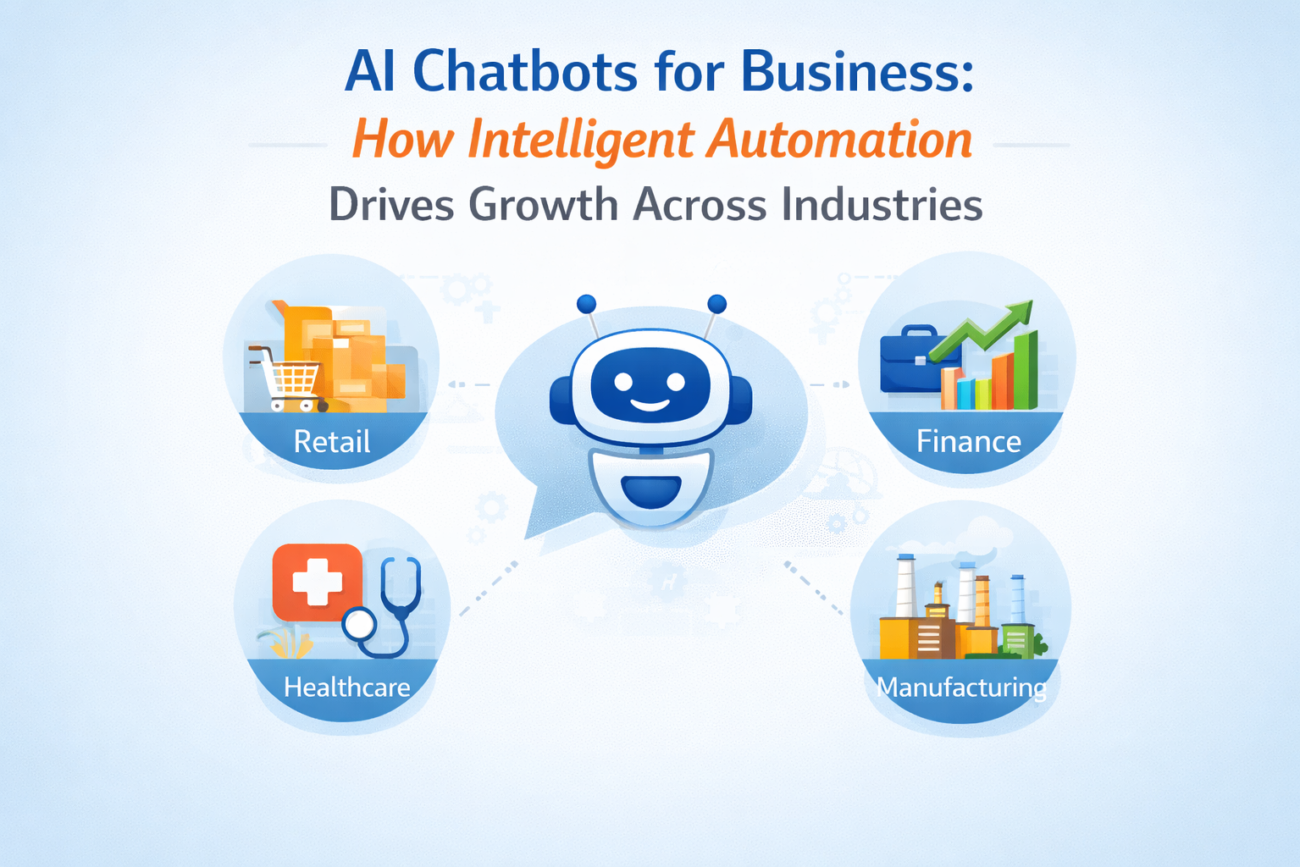
E-commerce and Retail
In e-commerce, speed directly affects revenue.
An e-commerce AI chatbot supports product discovery, answers queries, and assists during checkout. It helps users make decisions faster and reduces drop-offs.
This leads to:
- Higher conversion rates
- Faster purchase decisions
- Reduced cart abandonment
Chatbots here are not just support tools. They actively influence sales.
Banking and Financial Services
Financial systems deal with large volumes of structured queries.
Tasks like balance checks, transaction queries, and service requests are handled by a finance AI chatbot, reducing manual work while keeping accuracy high.
This improves:
- Response time for routine queries
- Operational efficiency
- Compliance through consistent answers
In many cases, most routine interactions are already automated.
Telecommunications
Telecom is one of the most support-heavy industries.
To handle billing issues, network concerns, and account updates at scale, many businesses use an AI chatbot for customer support. It reduces call centre dependency and improves response time.
This results in:
- Lower support costs
- Faster issue resolution
- Better customer experience in high-volume environments
Healthcare
Healthcare systems deal with both high volume and high sensitivity.
An AI chatbot for healthcare helps handle appointment queries, basic information requests, and patient communication. It reduces admin workload while keeping responses on time.
This supports:
- Continuous patient engagement
- Reduced staff workload
- Faster access to information
Accuracy and consistency remain critical here, making structured AI systems highly effective.
Logistics and Supply Chain
Operations in logistics depend on coordination and real-time updates.
An AI chatbot for logistics helps handle shipment queries, delivery updates, and team coordination. It reduces delays caused by manual communication.
This improves:
- Visibility across operations
- Faster response to issues
- Reduced inefficiencies in workflows
Automation here goes beyond support. It improves how operations run.
From Support Tool to Growth Infrastructure
The role of chatbots has changed.
They are no longer limited to answering questions. They are now part of how businesses operate, communicate, and scale. They connect systems, reduce delays, and improve how decisions happen. This is why their impact goes beyond cost savings.
It affects:
- Revenue through faster engagement
- Efficiency through reduced manual effort
- Customer experience through instant access
Businesses that adopt this approach do not just improve support. This improves how the entire system works.
Conclusion: Faster Access Drives Better Outcomes
Most business delays are not caused by missing information. They are caused by slow access to it. AI chatbots solve this directly. They provide instant responses, reduce friction, and connect users to actions without unnecessary steps. This improves both customer experience and operational efficiency. Because in most cases, the difference between action and delay is simple. How quickly the right answer is delivered.
