
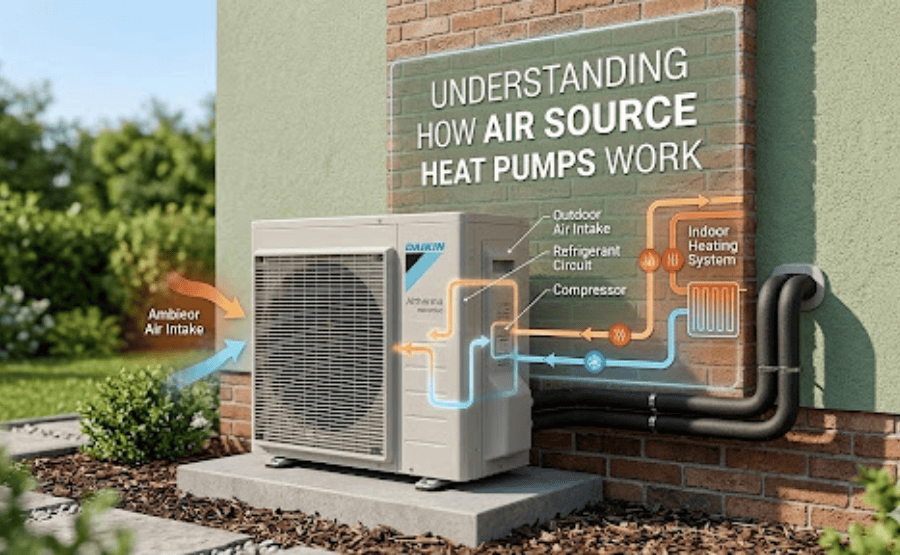
Air source heat pumps have now become very popular in the UK for warm and comfortable heating. They draw out heat even in temperatures below zero and utilise it to warm property. In contrast to conventional gas boilers, which consume fuel, heat pumps utilise electricity to transfer warmth and, therefore, make an environmentally friendly and efficient alternative.
They have become a source of attraction for homeowners in consideration of high energy bills and a desire for cleaner energy, with a view towards minimising their heating bills. They offer a safe, low-carbon option for your heating and can save your energy consumption. You can also have grants for air source heat pumps under the ECO4 scheme.
What Is an Air Source Heat Pump?
An air source heat pump is a unit that absorbs heat from its surrounding environment and brings it inside. There is a significant amount of heat present in the atmosphere even in winter, and ASHPs make use of it to heat your property and produce hot water.
ASHPs work in a reverse mechanism of a refrigerator. In a refrigerator, warm indoors is drawn in and exhausted out, but in an ASHP, warm out is drawn in and drawn indoors. It is an efficient mechanism and can work even when temperatures drop below zero degrees.
How Do Air Source Heat Pumps Work?
The principle of working of an air source heat pump can be understood in four simple phases:
- Absorbing Heat from the Outside Air
The system contains a certain fluid, a refrigerant. Outside a heat pump, a unit absorbs air, and a refrigerant takes in its heat, changing its state to a gas.
- Compressing the Gas
The heat pump then compresses the gas. As gas is compressed, it will become warmer, similar to a bicycle pump warming when you squeeze it.
- Transferring Heat to a Home
The warm gas runs through a heat exchanger. It distributes its heat to your home’s heating system, warming radiators, underfloor, and hot water.
- Cooling and Restarting the Cycle
Once the heat is circulated, the gas reverts and turns into a liquid form. The process is recycled in order to warm your dwelling.
Types of Air Source Heat Pumps
The two overall categories of ASHPs are:
- Air-to-water heat pumps
They serve to warm radiators, underfloor heating, and hot water circuits. And most UK homes have them installed in them.
- Air-to-air heat pumps
They blow warm air with a fan directly. There is no hot water and can be installed in commercial buildings.
Benefits of Air Source Heat Pumps
Here are the key advantages that can be derived:
- Lowered Energy Costs
An air source heat pump will save 50% off your heating bill compared with electrics, and 30% compared with traditional gas boilers. It is efficient, producing 3 to 4 units of heat for a 1 unit consumption of electricity. That is a lot of heat for not a lot of energy, and in the long run, a lot of savings for you.
- Green Heating
ASHPs produce a lot less emissions when compared with gas and oil-fired boilers. Since they extract renewable heat from the atmosphere, the use of fossil fuels is saved and CO₂ emissions are reduced.
- Year-Round Comfort
They function differently compared to conventional heating systems in that they function in all four seasons. During winter, they deliver constant heat, and during summertime, certain types reverse the function to deliver cool temperatures.
- Long Lifespan and Low Maintenance
Air source heat pumps have a lifespan of 15-20 years, which is longer than a gas boiler (usually around 10-15 years). They also require minimal maintenance, with only an annual service recommended to keep them running efficiently.
- Increased Property Value
Properties with effective heating systems are ideal for purchase. Properties with an installed ASHP will have value added, with future owners benefiting from lowered energy costs. It will also boost a property’s EPC rating, and, as a result, make it a preferred property for purchase.
- Works Well with Other Renewable Systems
Once installed with solar panels, a heat pump can then function in collaboration with them to produce even greater savings in terms of energy use. By powering a heat pump with solar-powered generated electricity, one can drive operational costs down to almost zero.
Costs of Installing an Air Source Heat Pump
The cost of fitting an air source heat pump can vary between £10,000 and £14,000, including installation, a heat pump unit, and system balancing.
Although a one-time outlay can sound pricey, grants under government ECO4 can cover it, and hence, it can become reasonably priced.
Things to Check Before Installing an Air Source Heat Pump
- Insulation: For an ASHP to work effectively, your property will have to be well-insulated. Poor insulation will result in loss of heat and loss of efficiency.
- Outdoor Installation Space: There should be a proper airflow for the exterior unit. Install it in an outdoor location with proper airflow near your home.
- Existing Heating Installation: Heat pumps work best with underfloor radiators or larger radiators since they produce heat at a relatively low temperature compared to a gas boiler.
- Cost: Installation can be pricey, but part of it can be supported with grants.
Free Air Source Heat Pump Grant Under the ECO4 Scheme
If your residence is low-income or your house heating is poor, then a free air source heat pump can become a feasible option under the ECO4 scheme. ECO4 scheme is a scheme run by the UK government to grant access to efficient heating for low-income groups in their homes. Energy companies pay for the ECO4 scheme, and under its terms, an efficient heat pump can be installed free of expense for such groups of homeowners.
Who Qualifies for a Heat Pump for Free?
You may qualify if you:
- To receive Universal Credit, Pension Credit, Income Support, and other benefits.
- Live in a poorly efficient heating system.
- Do not have a central heating system, or use an inefficient one (e.g., an older model oil-fired, or a gas-fired one).
- Have a low EPC rating (E, F, or G).
- Own your property, or with your landlord’s permission, in case of a lessee.
The Bottom Line
Heat pumps make a perfect alternative to conventional heating systems. They deliver cheap, environmentally friendly, and efficient heating, and save homeowners both money and carbon emissions. Many people wonder, Are Electric Oil Heaters Expensive to Run, but heat pumps consistently offer a more sustainable long-term solution. The installation cost can actually be pricey, but with free heat pumps for eligible homeowners, ECO4 makes a transition to cleaner sources of heating affordable for low-income communities.
Are you assuming that you’re qualified for the ECO4 grant? Check your qualifications today and use your opportunity to have your property warm for free!
