
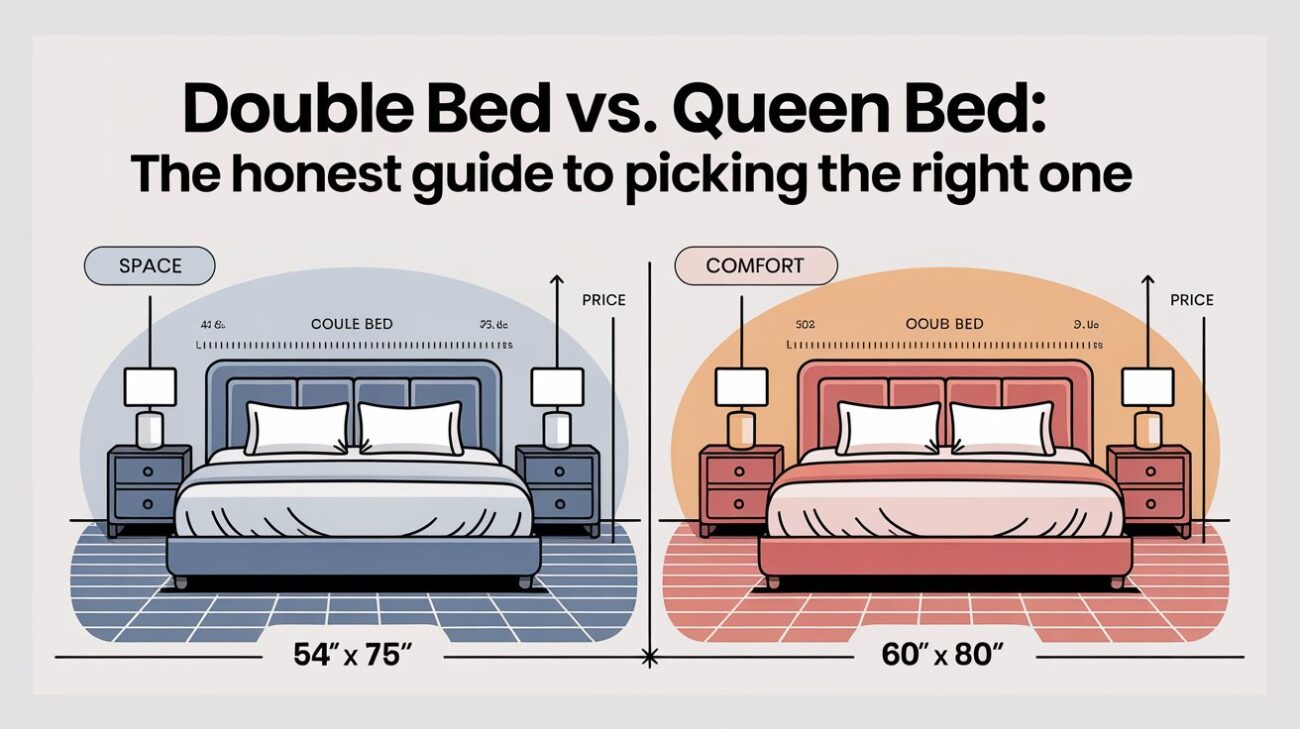
Picture this. You’re standing in a mattress store. There are two beds side by side. They look almost the same. You lie on one, then the other. The salesperson is watching. And you still can’t tell what the right choice actually is.
That moment of confusion is completely normal. But this article will end it for good.
By the time you finish reading, you’ll know exactly which bed belongs in your bedroom — no second-guessing, no buying the wrong size and regretting it a year later.
Let’s start from the very beginning.
Quick Facts
| Feature | Double Bed (Full) | Queen Bed |
| Width | 54 inches | 60 inches |
| Length | 75 inches | 80 inches |
| Total sleeping surface | 4,050 sq inches | 4,800 sq inches |
| More surface than double | — | 18.5% more |
| Space per person (couples) | ~27 inches each | ~30 inches each |
| Minimum room size | 9 ft × 9 ft | 10 ft × 10 ft |
| Ideal room size | 10 ft × 10 ft | 10 ft × 12 ft |
| Cost vs. each other | 15–25% cheaper | More expensive |
| Best for | Single sleepers, small rooms, guests | Couples, tall people, main bedrooms |
| Most popular US size? | No | Yes — ~47% of all mattress sales |
| Also called | Full bed | Queen |
| Bedding harder to find? | No | No — widest selection available |
What Are These Two Beds, Really?
First, a quick naming thing that confuses everyone.
A full bed and a double bed are interchangeable.. Same mattress. Same dimensions. Just two different names for the same size. The word “double” is older and dates back to when this was the standard size couples used in the 1800s. “Full” is the modern version of that same name.
So when you see “full” on a website and “double” in a store — they’re talking about the exact same bed.
A queen, on the other hand, is a separate, larger category altogether.
Let’s now discuss the numbers that are truly important.
See also “Unblocked Movies: The Complete, Honest Guide for 2026 and Beyond“
The Real Size Difference — And Why Six Inches Is a Bigger Deal Than You Think
The dimensions of a double bed are 75 inches long by 54 inches wide.
A queen bed measures 60 inches wide and 80 inches long.
The difference is 6 inches of width and 5 inches of length. That sounds small. And honestly, when you hear those numbers spoken aloud, your brain tends to dismiss them.
But here’s what those numbers mean in real life.
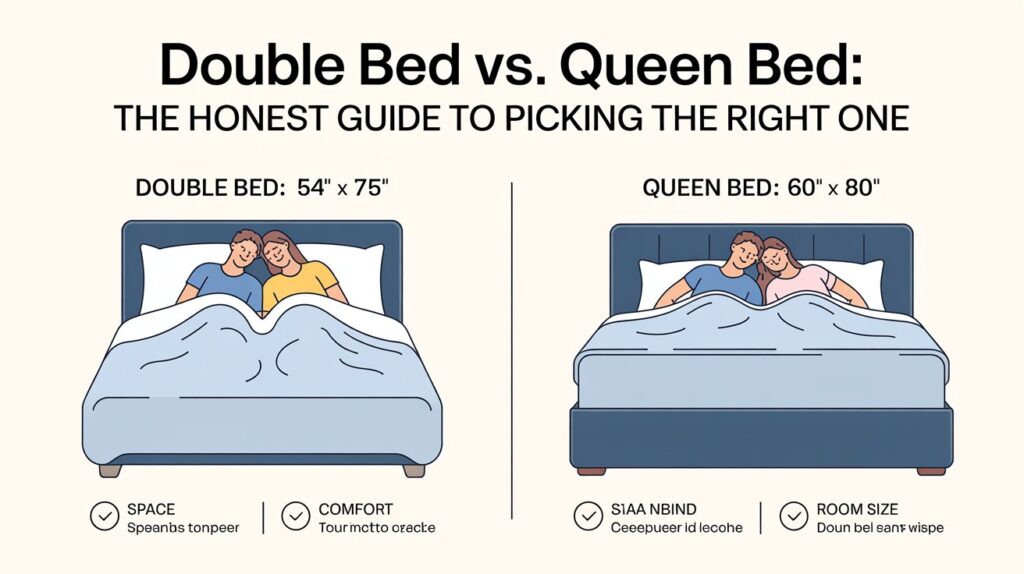
Imagine two adults lying side by side in a double bed. Each person gets about 27 inches of space. Twenty-seven inches. That’s actually narrower than a standard baby crib, which measures 28 inches across. Two grown adults, each with less room than an infant’s sleeping space.
Now imagine the same two people in a queen. Each person gets 30 inches. Three extra inches per person. It sounds minimal. But those three inches are the difference between touching your partner every time you roll over and actually having your own sleeping space.
A 2024 survey by the Sleep Foundation found that 67% of couples who switched from a double to a queen reported sleeping better. They averaged 23 more minutes of uninterrupted sleep per night. Twenty-three minutes per night adds up to nearly three extra hours of sleep per week.
All from six inches of extra mattress width.
The Height Problem Nobody Talks About
Here’s the detail that gets overlooked most often.
A double bed is 75 inches long. If you’re taller than about 5 feet 9 inches, you might find your toes brushing the footboard — or hanging completely off the edge.
A queen is 80 inches long. That extra five inches of length means anyone up to about 6 feet 4 inches can sleep completely comfortably.
If you’re six feet tall and buying a double bed, you’re buying trouble. You’ll wake up with cramped feet. Your sleeping position will unconsciously shift throughout the night. And over years of this, you’ll wonder why you wake up stiff.
Before you buy anything, measure your height. Then compare it to the mattress length. This one step prevents a lot of regret.
Room Size: What You Actually Need on Each Side of the Bed
A bed doesn’t live in a vacuum. It lives in a bedroom. And bedrooms have walls, doors, dressers, and nightstands.
The general rule is to leave at least 24 to 30 inches of walking space on every accessible side of the bed.
For a double bed, the minimum comfortable bedroom size is about 9 feet by 9 feet. A 10-by-10 room feels genuinely comfortable with a double. You’ll have space for nightstands, a small dresser, and room to walk around without squeezing.
For a queen bed, you need at least 10 feet by 10 feet. A 10-by-12 room is much better. This gives you enough space for the queen mattress plus a little breathing room around it.
Here’s the honest truth. If your bedroom is under 9 feet 6 inches wide, a queen is going to feel tight. A double is the only practical option. If your room is 11 feet or wider, a double will look small and underwhelming — and you might as well get the queen.
Measure your room before you shop. Write those numbers down. Bring them to the store.
Who Should Get a Double Bed?
Let’s be direct about this.
A double bed makes real sense in these situations:
- You sleep alone and your bedroom is on the smaller side. A double gives you plenty of personal space without eating up your entire floor.
- It’s a guest room. Occasional visitors don’t need a king. A double is comfortable for one person and works fine for couples who visit once or twice a year.
- You’re a teenager or young adult in a first apartment or dorm-adjacent space. The smaller footprint leaves room for a desk, a chair, and actual floor space.
- You’re furnishing a small space like an RV, a studio apartment, or a converted room. Some spaces simply can’t fit a queen.
- Your budget is tight right now. Double mattresses cost 15 to 25 percent less than queens from the same brand. Double bedding costs less too. When money is genuinely tight, this adds up.
If you’re a single sleeper under about 5 feet 9 inches, in a smallish bedroom, watching your spending? The double bed is a genuinely great choice. Don’t let anyone pressure you into more beds than you need.
Who Should Get a Queen Bed?
A queen makes clear sense in a different set of situations.
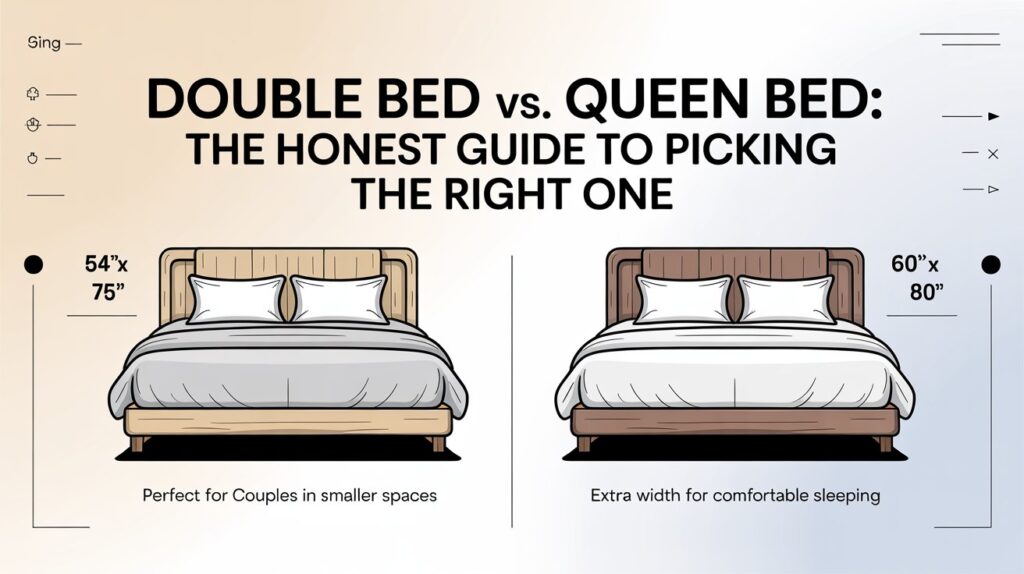
- Two people share the bed regularly. This is the strongest case for a queen. That extra space reduces disturbance, improves sleep quality for both people, and means you can actually rest without feeling like you’re sleeping in a sandwich.
- You’re taller than 5 feet 9 inches. The 80-inch length gives your body real room to fully stretch out.
- You sleep with a pet. Dogs and cats migrate. They don’t understand personal space. A queen gives you room to coexist peacefully through the night.
- You toss and turn a lot. Active sleepers benefit enormously from those six extra inches. More room to move means fewer moments of accidentally waking your partner (or yourself).
- You’re buying a master bedroom. Queens fit well in standard primary bedrooms and offer the best balance of size, comfort, and bedding availability.
- You’re thinking about the future. Maybe you’re single now but might share the bed in a few years. Mattresses last 8 to 10 years. Buying a queen now means you won’t need to replace it just because your life situation changes.
The Cost Difference — And Whether It’s Worth It
Let’s get specific about money.
A mid-range double mattress typically runs $400 to $900, depending on brand and materials. The same model in queen size usually costs $150 to $400 more.
Over ten years — the typical lifespan of a quality mattress — that price gap works out to $40 to $80 per year. For a couple, that’s around $40 cents to 67 cents per person, per night. That’s genuinely less than a cup of coffee per week, for a decade of better sleep.
Beyond the mattress itself, there’s bedding to consider.
Queen sheets, duvet covers, and mattress protectors cost a bit more than double sizes. Expect to pay $20 to $50 more per bedding set. Over the years, if you replace your sheets every couple of years, that adds another few hundred dollars total.
The total ten-year cost difference between a quality double setup and a quality queen setup is roughly $400 to $800.
For a solo sleeper in a small room on a tight budget? The savings are real and meaningful. Keep the double.
For a couple who shares the bed every night? That $400 to $800 spread over a decade feels like the best money you’ll ever spend on your sleep.
Bedding Availability: Which Size Is Easier to Find?
This matters more than people expect.
When you need to replace sheets at midnight because one ripped, or you want to buy a new comforter during a sale, availability is everything.
Queen is the most popular mattress size in America. About 47% of all mattress sales in the US are queen size. That means virtually every bedding brand, every retailer, every sheet set comes in queen. You will never struggle to find queen bedding.
Double (full) bedding is also widely available. You won’t have trouble finding it, but the selection is noticeably narrower than queen. Some boutique designs and specialty materials show up in queen first — and occasionally only in queen.
If you have a double bed and fall in love with a specific sheet set, always double-check that it comes in your size. Most of the time it does. But not always.
Can Two People Really Sleep on a Double Bed? The Honest Answer
Yes. But probably not well. Not long-term.
Technically, two adults fit on a double bed. Physically, their bodies can occupy that 54-inch width. But comfort is another story.
At 27 inches per person, there’s almost no room to move independently. If one partner shifts positions, the other feels it immediately. If one person runs hot at night, there’s no escaping into your own cool space. If one person is a restless sleeper, both people suffer.
For couples who sleep in very close contact and genuinely prefer that warmth and closeness? A double can work beautifully. Some couples love it.
For couples who need independent sleep space, sleep at different temperatures, or wake up easily from movement? A double is a nightly compromise that chips away at your rest over time.
The honest recommendation from sleep experts is consistent: a queen is the practical minimum for two adults who share a bed regularly.
Double and Queen Beds Around the World: A Quick Note
The measurements in this article are standard US and Canadian dimensions.
In the UK, Australia, and Europe, the word “double” sometimes refers to a different size. UK double beds are typically 54 by 75 inches — the same as a US double. But some European and Australian standards differ slightly.
If you’re buying internationally or importing a bed frame, confirm the exact measurements in inches or centimeters before purchasing. Don’t assume “double” means the same thing in every country. Measure everything.
The Resale Question Nobody Asks
Here’s something worth thinking about.
Queen beds have dramatically better resale value than doubles.
Because queen is the most popular size, there’s always someone looking to buy a used queen mattress, frame, or bedding set. If you move, upgrade, or furnish a new space in five years, a queen holds its value and sells relatively easily.
Double beds sell for 20 to 30 percent less on the secondhand market. There’s less demand. If you’re thinking about the full lifecycle cost of your purchase — including eventual resale — the queen edges ahead again.
The Full XL: The Option Nobody Mentions
There’s actually a middle option that almost no one knows about.
It’s called the Full XL. It measures 54 inches wide — same as a double — but it’s 80 inches long, matching the queen’s length.
It’s genuinely useful for one specific person: a tall solo sleeper in a narrow bedroom. You get the queen’s leg room without the queen’s extra width taking up precious floor space.
The catch? Almost no major brands make them. Finding Full XL bedding is a real challenge. If you go this route, make sure your chosen mattress brand actually stocks it before you fall in love with the idea.
How to Make Your Final Decision Without Overthinking It
Here’s a simple process that takes five minutes.
Step one: measure your bedroom. Width and length. Write it down.
Step two: think about who sleeps there. Just you? Occasionally someone else? Always two people?
Step three: measure your height (and your partner’s height if relevant).
Step four: look at your budget for both the mattress and bedding over the long term — not just the sticker price today.
If you’re solo, under 5 ’10”, in a room under about 10 feet wide, and watching your budget — double bed. Easy.
If you’re in a couple, taller than 5 ‘9″, in a room at least 10 by 10 feet, and planning to stay in this space a while — queen bed. Also easy.
If you sit right in the middle — room is borderline, you’re occasionally sharing, budget is tight — go to an actual mattress store. Lie down on both. Your body will tell you something your brain has been arguing about all week.
Final Words
Here’s the truth about this decision.
It’s not complicated. Both beds are good. Neither is wrong. The right one simply depends on your actual life — your room, your body, your budget, and who you share your sleep with.
A double bed is not “lesser.” It’s the right tool for the right jobA single person in a comfortable apartment who spends eight restful hours each night on a double bed is sleeping better than a couple jammed into the same space, both of whom secretly wish they had more space..
A queen is the most popular bed size in America for a reason. For couples and taller adults, those six extra inches deliver real, measurable improvements in sleep quality. That’s not marketing. That’s what the numbers show.
Whatever you choose — measure twice, buy once. And go lie on it in person before you commit.
Your sleep is worth the extra five minutes.
FAQs
1. What is the exact size difference between a double bed and a queen bed?
A double (also called a full) measures 54 inches wide by 75 inches long. A queen measures 60 inches wide by 80 inches long. The queen is 6 inches wider and 5 inches longer, giving about 18.5% more total sleeping surface.
2. Is a double bed the same thing as a full bed?
Yes, completely. “Double” and “full” are two names for the same mattress size. Depending on where you shop, stores may use one term or the other, but the dimensions are identical.
3. Can two adults sleep comfortably in a double bed?
Technically yes, but each person only gets about 27 inches of width — narrower than a standard baby crib. For occasional guest use it works fine. For permanent couples, most sleep experts say the queen is the practical minimum for comfortable nightly sleep.
4. What room size do I need for a queen bed?
The comfortable minimum is 10 feet by 10 feet. A 10-by-12 foot room is better. You want at least 24 to 30 inches of walking space on every accessible side of the bed to move comfortably and fit nightstands.
5. Can I use queen sheets on a double bed?
No. Queen sheets are 6 inches wider and 5 inches longer than double sheets. They’ll be loose, bunch under you, and pull off the corners during the night. Always match your bedding to your exact mattress size.
6. How much more does a queen mattress cost than a double?
Typically 15 to 25 percent more for the same mattress model. The total cost difference over a decade — including mattress, bedding, and frame — is roughly $400 to $800 depending on the quality tier you choose.
7. Who should choose a double bed?
Single sleepers in smaller bedrooms, people on tight budgets, teenagers, guest rooms that don’t need permanent couple-level space, and anyone in a compact living space like an apartment, RV, or studio.
8. Who should choose a queen bed?
Couples who share the bed regularly, solo sleepers taller than 5 feet 9 inches, people who sleep with pets, active sleepers who move around a lot, and anyone buying a mattress for a master bedroom with adequate floor space.
9. Does the extra 6 inches in a queen really make a difference?
Yes, measurably so. A 2024 Sleep Foundation survey found that couples who switched from double to queen reported 23 more minutes of uninterrupted sleep per night on average. The extra width reduces partner-caused disturbances significantly.
10. Is a queen bed good for a single person?
Absolutely. Many solo sleepers prefer a queen because the extra room lets them move freely, sleep diagonally, and share the bed with a pet without feeling squeezed. If your room can accommodate it and your budget allows, a queen is a comfortable choice for one person.
11. What is a Full XL bed?
A Full XL is 54 inches wide (same as a double) but 80 inches long (same as a queen). It’s designed for tall solo sleepers in narrow rooms. The major downside is that very few brands make this size, and bedding is hard to find.
12. Which bed size has more bedding options?
Queen has by far the widest selection. It accounts for nearly half of all US mattress sales, so every major bedding brand prioritizes it. Double bedding is available but carries a narrower range of styles, materials, and price points.
13. How long does a queen or double mattress typically last?
Both sizes last approximately 8 to 10 years with proper care. The lifespan depends on the quality of materials, not the size. Rotating your mattress every 3 to 6 months extends the life of either size.
14. Which is better for a guest room — double or queen?
For occasional guests, either works. A double is more practical in a smaller guest room and costs less. A queen is a better investment if the guest room also serves as a spare room for couples or if you want the space to feel generous and welcoming.
15. Does a double or queen bed have better resale value?
Queen beds hold their resale value significantly better. Because queen is the most widely purchased bed size, there’s always demand on the secondhand market. Double beds typically resell at 20 to 30 percent less than comparable queens.
Keep creating, innovating, and inspiring with Content Ideators every day.
