
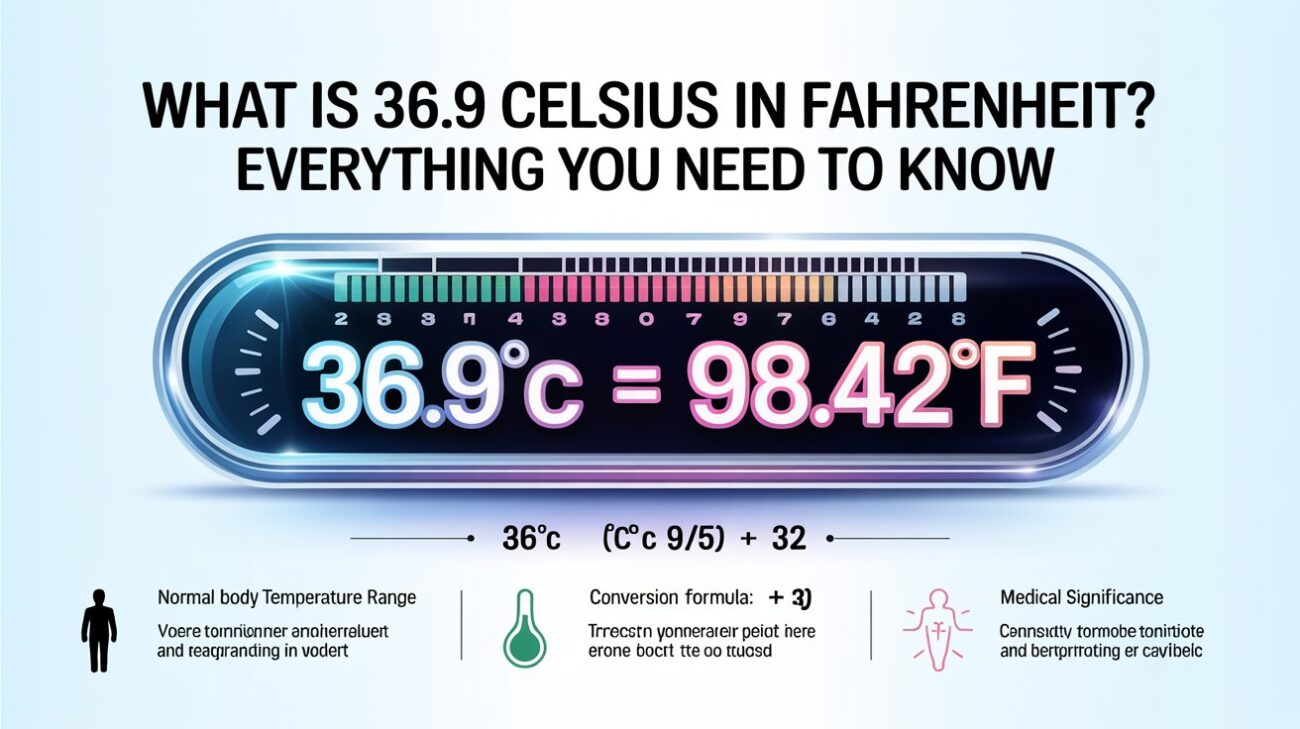
You look at a thermometer and it says 36.9°C.
Your brain immediately asks one question: Is that okay?
Maybe you’re checking your child’s temperature. Maybe you just got back from the doctor. Maybe you live in a Fahrenheit country and Celsius numbers just don’t click instinctively yet.
Whatever brought you here — you’re about to understand this temperature completely. Not just the number, but what it means for your body, when to worry, and when to relax.
Quick Reference
| Detail | Information |
| Temperature in Celsius | 36.9°C |
| Temperature in Fahrenheit | 98.42°F |
| Rounded to one decimal | 98.4°F |
| Medical classification | Normal healthy body temperature |
| Average adult body temp | 36.1°C – 37.2°C (97°F – 99°F) |
| Classic “normal” standard | 37°C / 98.6°F (older reference point) |
| Fever threshold (adults) | 38°C / 100.4°F |
| Low-grade fever range | 37.3°C – 37.9°C (99.1°F – 100.2°F) |
| Hypothermia threshold | Below 35°C / 95°F |
| Best time to measure | Late afternoon (body temp is naturally highest) |
| Conversion formula | (°C × 9/5) + 32 = °F |
| Reverse formula | (°F − 32) × 5/9 = °C |
The Answer First — No Waiting
36.9 degrees Celsius equals 98.42 degrees Fahrenheit.
Most people round that to 98.4°F.
Both are correct. The tiny difference is just rounding.
Now you know the number. But numbers alone don’t tell the whole story. Let’s talk about what this temperature actually means for a living, breathing human being.
See also “Sephora Return Policy: Everything You Need to Know Before You Shop or Return in 2026“
How the Conversion Works — The Math Made Simple
The formula for converting Celsius to Fahrenheit has two steps.
It looks scary at first. Once you see it explained slowly, it clicks forever.
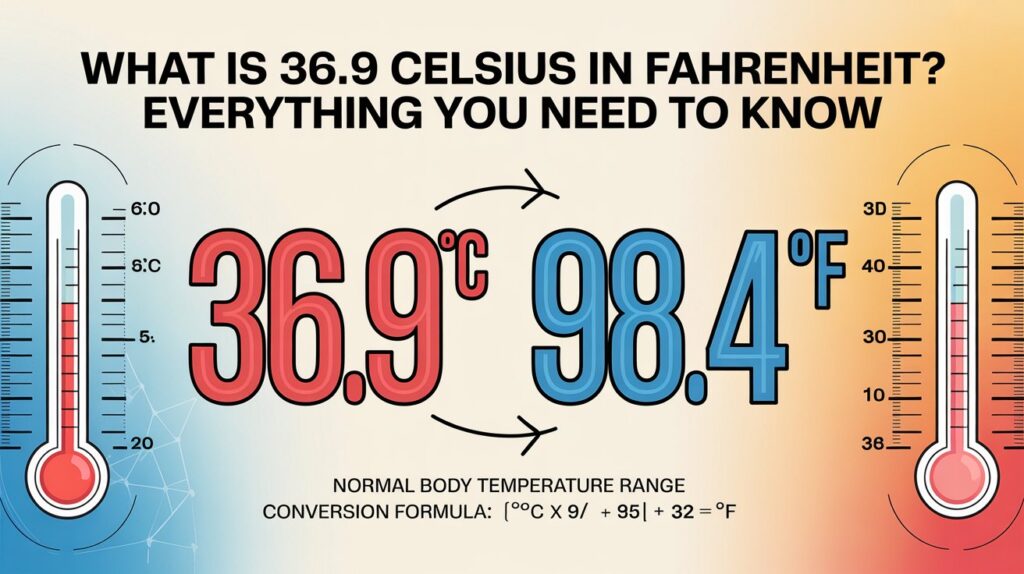
The formula: (Celsius × 9/5) + 32 = Fahrenheit
Let’s do it together with 36.9.
Step 1: Multiply 36.9 by 9/5 (which is the same as multiplying by 1.8) 36.9 × 1.8 = 66.42
Step 2: Add 32 66.42 + 32 = 98.42
That’s your answer. 98.42°F. Done.
If you ever want to go the other direction — from Fahrenheit back to Celsius — use this: (Fahrenheit − 32) × 5/9 = Celsius
So: (98.42 − 32) × 5/9 = 66.42 × 0.5556 = 36.9°C
The math works perfectly in both directions. You can check it yourself right now if you want.
Why Two Temperature Scales Even Exist
This confuses a lot of people. Why does the world use two different systems?
The answer is history.
Daniel Gabriel Fahrenheit was a German physicist born in 1686. He invented one of the first practical thermometers using mercury. He set 32°F as the freezing point of water and 212°F as the boiling point. His scale was used widely in English-speaking countries for centuries.
Swedish astronomer Anders Celsius was born in 1701.. He created a cleaner, simpler scale. Water freezes at 0°C and boils at 100°C. The scientific world loved this simplicity. Most countries eventually switched to Celsius.
Today, the United States, the Cayman Islands, and a handful of other territories still use Fahrenheit for everyday temperature.Celsius is used by the majority of the remainder of the world. Scientists everywhere use Celsius or Kelvin.
Neither scale is “right” or “wrong.” They’re just different languages for the same thing — heat.
Is 36.9°C a Normal Body Temperature?
Yes. Completely and totally normal.
36.9°C sits right in the middle of the healthy adult temperature range. Doctors consider anything between 36.1°C and 37.2°C (97°F to 99°F) to be perfectly healthy.
The old textbook standard was 37.0°C (98.6°F) — a figure set by a German physician named Carl Wunderlich in 1851. He studied 25,000 patients and landed on that number as the average.
But here’s the thing — it was average. Not a rule.
Your actual normal temperature depends on who you are. Age, the time of day, where you measured, what you ate, whether you just exercised — all of it shifts the number slightly.
36.9°C is not “almost a fever.” It is not “borderline.” It is simply a normal human temperature, sitting comfortably in the healthy range.
Body Temperature Is Not One Fixed Number
Most people think the body stays at exactly one temperature all day. It doesn’t.
Your temperature moves in a natural rhythm called a circadian pattern. It rises and falls on its own schedule throughout every 24-hour period.
Here’s roughly how it works in a typical adult:
- Early morning (around 4–6 AM): Temperature is at its lowest — often around 36.1°C (97°F)
- Mid-morning to afternoon: Temperature gradually rises
- Late afternoon (around 4–6 PM): Temperature peaks — often 37.0°C to 37.4°C (98.6°F to 99.3°F)
- Night: Temperature begins dropping again during sleep
So a reading of 36.9°C in the afternoon is completely unremarkable. The same person might read 36.3°C at 5 in the morning. Both are healthy. The body just runs warmer in the evening.
This rhythm is one reason doctors say: if you’re going to track a temperature, write down the time too.
Where You Measure Changes the Number
This surprises people the most.
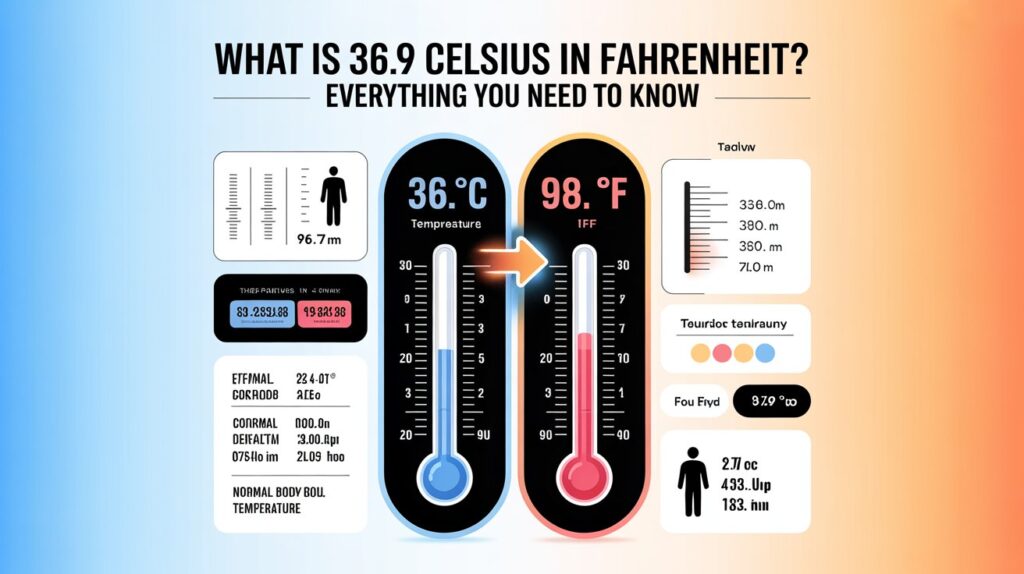
The spot on your body where you put the thermometer changes the reading. Different measurement sites give different results — and all of them can be “correct” for that location.
Here’s a comparison:
| Measurement Location | Typical Adjustment | Notes |
| Oral (mouth) | Standard reference point | Keep mouth closed for 5 minutes before reading |
| Axillary (armpit) | About 0.5°C lower than oral | Less accurate, convenient for kids |
| Rectal | About 0.5°C higher than oral | Most accurate; standard for infants |
| Tympanic (ear) | Close to core temp | Affected by earwax and angle |
| Temporal (forehead) | Varies | Can read low if skin is sweaty |
So a reading of 36.9°C in the mouth and 36.4°C in the armpit could both represent the same actual body temperature.
If your thermometer shows 36.9°C under the arm, the true core temperature is closer to 37.4°C — still normal, but worth knowing.
When Should You Actually Worry?
36.9°C is not a worry temperature. Let’s be absolutely clear about that.
But since we’re here, let’s talk about the numbers that do deserve attention.
Low-grade fever: 37.3°C to 37.9°C (99.1°F to 100.2°F) This isn’t an emergency. Your body might be fighting something minor — a cold, mild infection, or just post-exercise heat. Rest and fluids usually handle this.
True fever: 38.0°C and above (100.4°F and above) This is where doctors formally call it a fever. Your immune system is actively fighting something. For most healthy adults, this still isn’t a panic situation. But you should monitor it.
High fever: 39.5°C and above (103.1°F and above) Now you should contact a doctor, especially if it persists more than 48 hours or comes with other concerning symptoms.
Dangerous fever: 40.0°C and above (104°F and above) Seek medical care promptly. At this level, the body can start experiencing harmful effects.
Hypothermia: Below 35.0°C (95°F) Low temperature can be just as dangerous as high temperature. The body struggles to function when its core temperature drops too far.
36.9°C is nowhere near any of those thresholds. It sits quietly in the healthy zone, doing what healthy temperatures do — nothing alarming at all.
Children’s Temperatures — The Numbers Work Differently
If you’re a parent checking this for your child, there’s an important nuance here.
Children naturally run slightly warmer than adults. A temperature that would be considered “elevated” in a 40-year-old can be completely normal in a 3-year-old.
Here’s a rough guide for children:
- Newborns (0–3 months): Normal range is approximately 36.5°C–37.5°C (97.7°F–99.5°F). Any fever above 38°C (100.4°F) in a baby under 3 months is a medical emergency — call the doctor immediately, no waiting.
- Infants and toddlers (3 months–3 years): Rectal measurement is most accurate. The fever threshold is still 38°C.
- Older children (3 years and up): More similar to adult ranges. Oral measurement becomes reliable.
36.9°C in a child of any age is completely healthy. No action needed.
How to Use a Thermometer Correctly
A thermometer gives you wrong answers if you use it wrong. People are unaware of how frequently this occurs.
For oral (mouth) temperature:
- Wait 30 minutes after eating, drinking, or smoking
- Put the tip toward the back, beneath the tongue.
- Keep lips closed
- Wait for the beep — don’t take it out early
- Read immediately
For armpit temperature:
- Make sure the skin is dry — moisture lowers the reading
- In the middle of the armpit, place the thermometer.
- Press the arm firmly against the body
- Hold still until the thermometer finishes
For ear temperature:
- Pull the outer ear gently back to straighten the ear canal
- Point the probe toward the eardrum, not the ear wall
- Press the button and hold steady
- Earwax buildup can cause low readings
For forehead (temporal) temperature:
- Sweep across the center of the forehead from hairline to hairline
- The skin must be dry — sweat causes lower readings
- Follow your specific thermometer’s instructions carefully
A good thermometer well-used beats an expensive thermometer used sloppily every time.
Digital vs Mercury Thermometers — What’s Different Now
Most homes don’t have mercury thermometers anymore. Many countries banned them because broken mercury thermometers create a genuine environmental and health hazard.
Modern digital thermometers are actually more precise. They’re faster too. Most take 10–60 seconds instead of 3–4 minutes.
Infrared thermometers — the forehead or ear kind — are fast and convenient but slightly less accurate for detecting exact temperatures. They’re great for quick screening. For monitoring a sick person carefully, a digital oral or rectal thermometer gives more reliable data.
Whichever type you use, calibrate your expectations. Know that your thermometer has a small margin of error — usually ±0.1°C to ±0.2°C. That tiny variation is normal and expected.
Fever vs. Normal — The Immune System Story
Here’s something most people find genuinely fascinating.
A fever isn’t a malfunction. It’s your immune system doing its job on purpose.
When bacteria or viruses enter the body, white blood cells release chemicals called pyrogens. These pyrogens travel to the brain and tell the hypothalamus — your body’s internal thermostat — to turn up the heat.
Why? Because most pathogens reproduce best at normal body temperature. A warmer environment slows them down. Your body is essentially trying to make itself a less comfortable place for the invader.
This is why reducing every low-grade fever with medication isn’t always the right call. A mild fever is often your immune system working correctly. Many doctors advise letting a fever below 38.5°C run its course in healthy adults unless the person is very uncomfortable.
36.9°C is well below any fever threshold. The immune system is resting. Everything is fine.
The Celsius Scale in Everyday Life
Since we’re talking about Celsius, here are some other reference points that help the scale make intuitive sense:
| Temperature | What It Means |
| 0°C (32°F) | Water freezes |
| 10°C (50°F) | A cool autumn day |
| 20°C (68°F) | Comfortable room temperature |
| 30°C (86°F) | A warm summer day |
| 36.9°C (98.4°F) | Your healthy body temperature |
| 37.5°C (99.5°F) | Slightly elevated — monitor |
| 38.0°C (100.4°F) | Fever threshold |
| 100°C (212°F) | Water boils |
Seeing 36.9°C on this scale immediately shows you how close it sits to “comfortable room temperature.” The difference between a warm day outside and a human body is only about 7 degrees Celsius.
Other Temperatures Close to 36.9°C — For Context
Sometimes it helps to see nearby numbers side by side.
| Celsius | Fahrenheit | Medical Meaning |
| 36.0°C | 96.8°F | Low normal — monitor if sustained |
| 36.5°C | 97.7°F | Normal |
| 36.9°C | 98.4°F | Normal — healthy |
| 37.0°C | 98.6°F | Normal — classic “average” |
| 37.2°C | 99.0°F | Normal — upper end |
| 37.5°C | 99.5°F | Slightly elevated — mild concern |
| 38.0°C | 100.4°F | Fever begins here |
| 38.5°C | 101.3°F | Moderate fever |
| 39.0°C | 102.2°F | Significant fever — see doctor |
| 40.0°C | 104.0°F | High fever — seek care promptly |
36.9°C sits three rows above the very bottom of concern and four rows below the first sign of trouble. It is, in the most literal sense, right in the middle of health.
FAQ
1. What is 36.9 Celsius in Fahrenheit exactly?
36.9°C equals 98.42°F. Using the formula (36.9 × 9/5) + 32 gives you 98.42. Most people write this as 98.4°F when rounding to one decimal place. Both figures are accurate.
2. Is 36.9°C a normal body temperature?
Yes, completely normal. The healthy adult range is approximately 36.1°C to 37.2°C (97°F to 99°F). 36.9°C sits comfortably within that range and does not indicate any illness or concern.
3. Does 36.9°C mean I have a fever?
No. Fever in adults begins at 38.0°C (100.4°F). 36.9°C is more than a full degree below that threshold. It is not a fever, not a low-grade fever, and not an elevated temperature. It is simply healthy.
4. Is 36.9°C normal for a child?
Yes. Children have slightly wider normal ranges than adults, and 36.9°C is well within healthy parameters for any child beyond newborn age. For newborns under 3 months, any temperature above 38.0°C (100.4°F) is a medical emergency regardless of how mild the symptoms look.
5. My thermometer shows 36.9°C under my arm — is that still normal?
Armpit measurements typically read about 0.5°C lower than core temperature. So 36.9°C under the arm suggests a core temperature of roughly 37.4°C — still completely normal and within the healthy range.
6. Why does the old standard say 37.0°C (98.6°F) is “normal”?
That figure comes from German physician Carl Wunderlich, who calculated an average temperature from 25,000 patients in 1851. It was always meant to be an average, not a universal target. Modern research shows the healthy range is wider and varies by person, time of day, age, and measurement location.
7. What time of day should I take my temperature for the most accurate reading?
Late afternoon — around 4 to 6 PM — when your body temperature is naturally at its daily peak. Morning temperatures are naturally lower. If you’re monitoring a fever, take readings at the same time each day for consistent comparison.
8. How do I convert any Celsius temperature to Fahrenheit?
Add 32 to the Celsius number after multiplying it by 1.8 (or 9/5). For example: 36.9 × 1.8 = 66.42, then 66.42 + 32 = 98.42°F. This formula works for any Celsius value.
9. How do I convert Fahrenheit back to Celsius?
Subtract 32 from the Fahrenheit number, then multiply by 5/9 (or 0.5556). For example: 98.42 − 32 = 66.42, then 66.42 × 0.5556 = 36.9°C. The math works perfectly in reverse.
10. Can body temperature be different in different people even when everyone is healthy?
Yes. Individual baseline temperatures vary. Some healthy people naturally run at 36.3°C. Others run at 37.1°C. Both are normal for those individuals. What matters more than the absolute number is whether your temperature has changed significantly from your personal baseline.
11. What is considered dangerously low body temperature?
Below 35.0°C (95°F) is hypothermia — when the body loses heat faster than it can produce it. This is a medical emergency. Causes include cold exposure, but also severe illness, certain medications, and extreme exhaustion. 36.9°C is nearly 2 full degrees above the hypothermia threshold.
12. Should I be worried if my temperature is slightly above 36.9°C?
Not until you reach 38.0°C (100.4°F). Anything between 36.9°C and 37.9°C is either normal or mildly elevated — worth monitoring but not a reason to worry or rush to a doctor. Stay hydrated, rest if you feel unwell, and check again in a few hours.
13. Why does the US still use Fahrenheit while most countries use Celsius?
Historical momentum. The US adopted the Fahrenheit scale in the colonial era and never fully transitioned to the metric/Celsius system the way most other countries did in the 20th century. The scientific and medical communities worldwide use Celsius regardless of the country’s everyday temperature system. Most American doctors and hospitals track body temperature on both scales.
Keep creating, innovating, and inspiring with Content Ideators every day.
