
Quick Facts
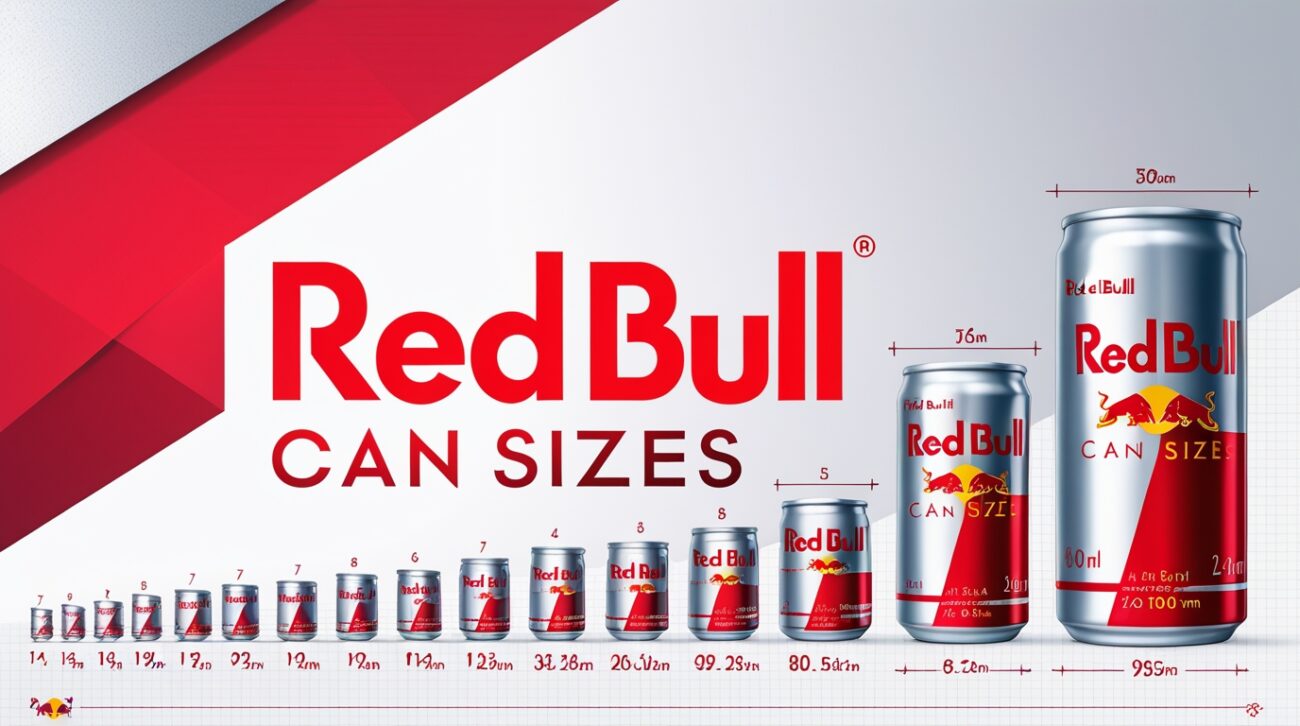
| Can Size | Volume | Height | Diameter | Caffeine | Calories (Regular) |
| Classic / Original | 8.4 oz / 250 ml | ~5.25 in / 13.3 cm | ~2.25 in / 5.7 cm | 80 mg | ~110 |
| Medium | 12 oz / 355 ml | ~6.2 in / 15.7 cm | ~2.6 in / 6.6 cm | 114 mg | ~160 |
| Large (Tallboy) | 16 oz / 473 ml | ~6.9 in / 17.5 cm | ~2.6 in / 6.6 cm | 151 mg | ~220 |
| Extra Large | 20 oz / 591 ml | ~7.6 in / 19.3 cm | ~2.9 in / 7.3 cm | 160 mg | ~270 |
| Energy Shot | 2 oz / 60 ml | ~3.5 in / 8.9 cm | ~1.3 in / 3.3 cm | 80 mg | ~10 |
Note: Measurements can vary slightly by region and production batch. 1-2 mm variations are very normal.
The Little Can That Started a Global Revolution
In 1987, a small silver and blue can appeared on shelves in Austria.
Nobody had seen anything like it before. It was taller than a regular soda can. Thinner too. It sat in your hand differently. It felt deliberate.
That was the first Red Bull.
Dietrich Mateschitz was an Austrian businessman. He had discovered a Thai energy drink called Krating Daeng — invented by pharmacist Chaleo Yoovidhya back in 1975. The two men partnered up and adapted the formula for a Western audience. The new drink launched on April 1, 1987.
It was not a joke.
They created a whole new category of product that day. Not soda. Not juice. Not coffee. Something that called itself an energy drink — and meant it.
Red Bull is now sold in over 175 countries. It is the best-selling energy drink on the entire planet. And that same slim, tall, narrow can shape that made people stop and stare in 1987 is still the shape people grab off shelves today.
The can size was never an accident. It was always a decision.
See also “Passport Size Photo Dimensions: The Complete, Honest Guide for 2026“
Why the Can Shape Matters More Than You Think
Most people open a Red Bull without ever thinking about why it looks the way it does.
But that shape has a story behind it.
Back when Red Bull launched, every other drink on the market came in a short, fat, chunky can. Think about an old Coke or Pepsi can. Wide. Squat. Unmistakably a soda.
Red Bull went the opposite direction on purpose. The 250 ml slim can was designed to look different from everything else on the shelf. It worked immediately.
The narrow design does something else too. Your hand wraps around it comfortably in one grip. You do not need two hands. You do not need a cup holder — though the can fits into one just fine.
Red Bull’s can was built to say: this is not your regular drink. This is something sharper, more focused, more concentrated. Even before you take a sip, the shape tells you something.
And the engineers who designed it thought about even more than aesthetics. A narrower can slow down how quickly the heat from your hand warms the liquid. You drink your Red Bull cold for longer. That was genuinely thought about.
Packaging design sounds boring until you realize how many decisions are packed inside one aluminum cylinder.
The 8.4 oz Can: The Original, The Iconic One
Let’s start where everything started.
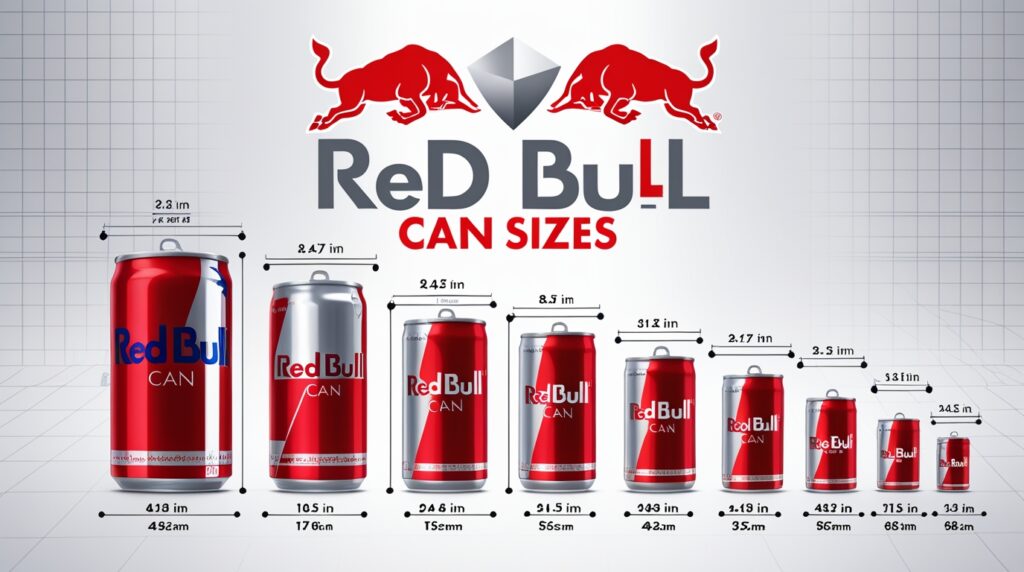
The 8.4 oz can — that is 250 millilitres for anyone working in metric — is the one most people picture when they think Red Bull. It is the original. The one that started it all.
This can stand about 5.25 inches tall. Its diameter is roughly 2.25 inches across. Pick one up and it feels just right in a single hand.
Inside you get 80 milligrams of caffeine. That is about the same as one regular cup of coffee. Not overwhelming. Not tiny. Just enough to feel the difference.
The regular version has around 110 calories. Red Bull Sugar Free drops that to almost nothing — just 10 calories per can, same caffeine. Red Bull Zero is the newest sugar-free formula, designed to taste even closer to the original.
The 8.4 oz is the size you find everywhere. Every petrol station. Every vending machine. Every corner shop fridge. Every hotel minibar. If someone says “a Red Bull,” this is the one they are picturing.
It is popular for a reason. It is simple to do in a single sitting. It does not feel like too much of a commitment. You crack it open, you drink it, you carry on with your day.
One thing people do not always notice: the 8.4 oz can is slimmer than a standard soda can. It slips into car cup holders easily. It drops into backpack side pockets without a struggle. That matters more than it sounds.
The 12 oz Can: The Middle Ground
Red Bull added the 12 oz (355 ml) size to the US market in 2018. It was a smart move.
Before that, your only options were the small classic can or a jump straight to the 16 oz. The 12 oz filled a gap that a lot of people did not even realise existed — until it did.
This can stand about 6.2 inches tall. The diameter is roughly 2.6 inches. Still slim, but noticeably taller than the original. When you hold both sizes side by side, the difference is obvious.
The 12 oz gives you 114 milligrams of caffeine. That is not dramatically more than the 8.4 oz, but it is a meaningful bump. For someone who found the original a little short and the 16 oz a little much, this became the sweet spot.
The Sugar Free and Zero versions of this size contain around 15 calories.
This is a great size for long drives, afternoon slumps, study sessions, or gaming marathons where you want a steady flow of energy rather than one sharp hit.
It also happens to fit the same koozies as a standard 12 oz soda can. Handy if you care about that sort of thing.
The 16 oz Can: The Tallboy for Bigger Days
When things get serious, people reach for the 16 oz.
This can contains 473 ml of Red Bull. It stands close to 6.9 inches tall — roughly 17.5 centimetres. The diameter stays similar to the 12 oz at about 2.6 inches.
Inside you are looking at 151 milligrams of caffeine. That is almost twice the classic can. That is a meaningful amount.
The 16 oz is popular with people who need energy for longer stretches. Think of long shifts at work. Long road trips. Lengthy training sessions. Festivals. Night events. Situations where a small can would feel like it runs out before you need it to.
This size gets called a “tallboy” by fans of the brand. It is taller than anything you normally see on a shelf and it has a satisfying weight to it when you hold it.
One thing worth knowing: the 16 oz can is slightly wider than the 8.4 oz. It still fits most standard cup holders, but snugly. If you have a narrow cup holder in your car, it might be a tighter fit than you expect.
The 20 oz Can: The Monster of the Range
The 20 oz Red Bull is not for everyone. It was never meant to be.
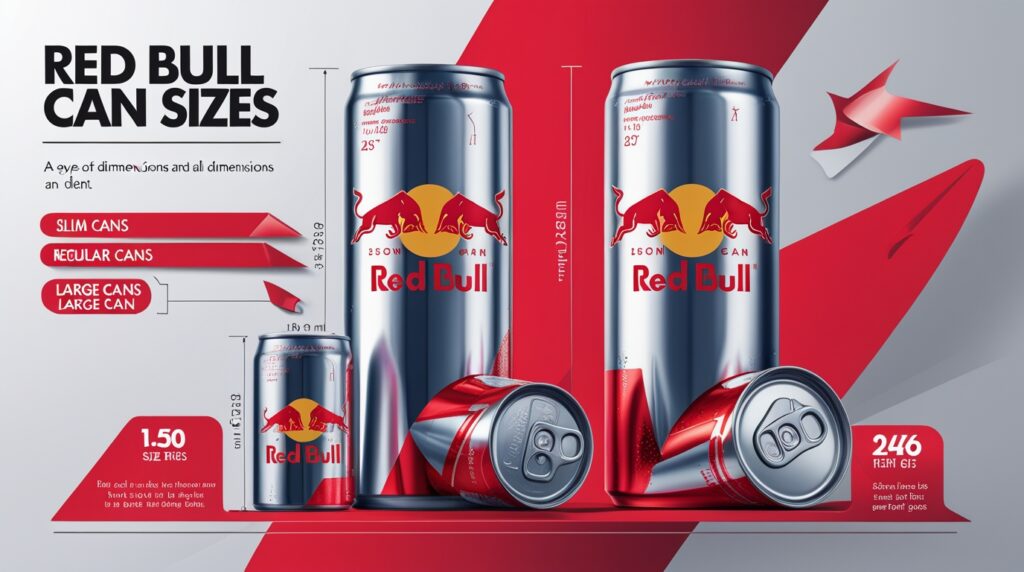
At 591 ml and 7.6 inches tall, this is a large can. As soon as you pick it up, you notice it. It has a diameter of around 2.9 inches — the widest of any regular Red Bull size.
Inside there is 160 milligrams of caffeine. The calorie count for the regular version is substantial too.
This size is primarily found in North American convenience stores and petrol stations. It is not as widely available internationally as the smaller sizes. Many parts of Europe and Asia still only stock up to 16 oz.
The 20 oz is built for one specific type of person: someone who knows they need a big hit of energy and does not want to drink two cans to get it. Long-haul truckers. Night-shift workers. Anyone running on fumes at hour nine of a twelve-hour workday.
For most casual drinkers, 20 oz is too much in one go. But for the person it was designed for, it is exactly right.
The 2 oz Energy Shot: Red Bull in a Tiny Punch
Here is one that surprises a lot of people. Red Bull also makes a 2 oz shot.
It launched in 2009 under the name Red Bull Energy Shot. The can is tiny — about 3.5 inches tall, barely more than a finger’s width across.
But it packs 80 milligrams of caffeine into those two ounces. the same quantity as the entire 8.4-ounce original can. Just in a much more concentrated, fast-drinking format.
The shot is ideal for people who do not want to consume a full can of liquid. Maybe they are watching their fluid intake. Maybe they just want something quick and small before a presentation, a workout, or a late-night drive.
You toss it back in one go and you are done in seconds. No lingering over a 250 ml can. No sitting and sipping for ten minutes.
It is not as widely available as the main can sizes, but it is out there in the right spots.
Red Bull Editions: Same Sizes, Different Flavours
For years, Red Bull only came in one flavour. The original. That was it.
In 2013, all of that changed.
Red Bull launched the Editions range — a lineup of flavoured versions that kept the exact same formula and energy content but added something different to the taste experience.
The key thing to know: all Red Bull Editions come in the same can dimensions as the standard range. The size does not change. The shape does not change. The measurements stay consistent across every flavour.
Current Editions include:
- Red Edition — Watermelon flavour
- Blue Edition — Blueberry
- Yellow Edition — Tropical fruit
- Green Edition — Dragon fruit
- Purple Edition — Acai berry
- Peach Edition — Peach nectarine
- Coconut Edition — Coconut berry
- Amber Edition — Apple ginger
- Winter Edition — Seasonal, limited availability
- Summer Edition — Seasonal, limited availability
Both Sugar Free and Zero versions now exist for several Editions, expanding the range even further.
Red Bull Editions have been a clever move. They offered something fresh to consumers who had been drinking the original for years and desired variation while maintaining the brand’s unity—the same can, size, and visual identity.
The Sugar Free and Zero Story
Red Bull was the first major energy drink brand to launch a sugar-free version.
The original Red Bull Sugar Free arrived in 2003. It tasted slightly different from the original — lighter, less sweet. Some people loved it. Others missed the original flavour.
In 2012, Red Bull Total Zero hit shelves. This was positioned as a zero-calorie option.
Then in 2018, the company released Red Bull Zero. This was a different formula to both Sugar Free and Total Zero — engineered specifically to taste much closer to the original Red Bull while still containing no sugar.
Today the three options are:
- Red Bull Original — contains sugar and glucose, around 110 calories per 8.4 oz
- Red Bull Sugar Free — no sugar, uses artificial sweeteners, about 10 calories per 8.4 oz, slightly different taste
- Red Bull Zero — no sugar, different sweetener blend, engineered to mimic the original flavour more closely, about 5 calories per 8.4 oz
All three come in the same can sizes. All three contain the same 80 milligrams of caffeine per 8.4 oz.
The difference is purely in the sugar content and the taste profile. The energy ingredients — caffeine, taurine, B vitamins — remain identical.
What Is Actually Inside Every Red Bull Can?
No matter which size you pick up, the ingredients are the same core formula.
Every Red Bull contains:
- Caffeine — the primary active ingredient, 80 mg per 8.4 oz
- Taurine — an amino acid, 0.4% of the formula
- B-Group Vitamins — B3, B5, B6, B12 for energy metabolism
- Glucuronolactone — a naturally occurring carbohydrate
- Sucrose and glucose — in the original version
- Sodium bicarbonate and magnesium carbonate — mineral salts
- Carbonated water — gives it the fizz
- Natural and artificial flavours
The caffeine content scales with can size. Larger can mean more caffeine because there is simply more liquid. The concentration stays the same per millilitre — so if you compare 80 mg in 250 ml, the 473 ml version naturally contains about double.
Red Bull is also:
- Gluten-free
- Lactose-free
- Dairy-free
- Suitable for vegetarians and vegans
That broad dietary compatibility is intentional. Red Bull wants as many people as possible to be able to drink it.
Size and Can Design: The Engineering Behind the Shape
Red Bull’s 250 ml can size did not come from thin air.
Austria — where Red Bull was born — uses 250 ml as a standard serving size for many beverages. So when Mateschitz designed the drink for an Austrian launch, 250 ml was the obvious starting point. It was what Austrian consumers recognised as a sensible single serving.
The slim, tall design was a separate decision — and a deliberate one. In the 1980s, every energy beverage and soft drink came in a wider, shorter can format. Red Bull’s team chose to go narrow and tall to make the can stand out visually on shelves. When you look into a full cooler of drinks, the Red Bull is the one that catches your eye first. It is tall when everything else is squat.
That visual identity became one of the most recognisable pieces of packaging design in the world.
The can is made from 100% recyclable aluminium. An empty 8.4 oz can weighs about 15 grams. The same can filled with liquid weighs around 270 grams. The 16 oz version weighs close to 480 grams.
Red Bull has also kept the can dimensions extraordinarily consistent. No matter which flavour, which variant, or which size you pick up — the physical shape matches what you expect. That consistency is part of the brand promise. You are always aware of what you are getting.
Which Size Should You Actually Pick?
Here is how to think about it simply.
The 8.4 oz is for most people, most of the time. It is quick, easy, not too heavy on caffeine, and finishes before it gets warm. Perfect for a morning boost, a pre-workout sip, or a quick pick-me-up on a tired afternoon.
The 12 oz is the smart middle choice. If you regularly want a little more than the original gives you but do not want to go overboard, this is your size. Study session, long commute, extended work meeting.
The 16 oz is for when you need to go longer. Night shifts, long events, endurance training, road trips. You want that energy to carry you through hours, not just one hour.
The 20 oz is for high-demand situations. Not everyday use. This is the one you reach for when you genuinely need a serious amount of energy support and you want it all in one can.
The 2 oz shot is for speed. No time to drink a full can. Just want the hit quickly. This is your option.
A simple note on health: all sizes contain real caffeine. The NHS and health authorities around the world generally suggest adults stay under 400 mg of caffeine per day. One original Red Bull uses 80 mg of that allowance. A 20 oz uses 160 mg. Keep that in mind and drink sensibly.
Red Bull vs. Other Energy Drinks: How the Sizes Compare
Walk into any petrol station and you will see Red Bull sitting next to Monster, Rockstar, and Celsius.
The difference in can shape is noticeable immediately.
Monster typically comes in a 16 oz can — a wider, shorter format. It is around 2.6 inches across and 6.2 inches tall. That is the same height as a 12 oz Red Bull but holds significantly more liquid.
Rockstar also goes wide and large — 16 oz is their standard, same wider can format.
Celsius comes in a 12 oz slim can that actually looks quite similar to Red Bull’s profile.
Bang Energy uses a standard 16 oz format.
Red Bull has always been the slimmest major energy drink on the market. That 2.25-inch diameter on the original is narrower than almost anything else in the same aisle. It slides into spaces that other cans cannot fit.
Whether that matters to you personally depends on how you carry your drink. But for anyone using cup holders, gym bag pockets, or desk spaces — the Red Bull shape genuinely works better in tighter spots.
Final Words
Red Bull is one of those things that has been so present in our lives for so long that we stop seeing it clearly.
That slim silver-and-blue can has sat in airport lounges, on desk corners, in gym bags, and beside drivers on night roads for nearly four decades. It has become part of the visual furniture of modern life.
But the sizes tell a story. The original 8.4 oz was built for a single moment of focus. The 12 oz for a longer commitment. The 16 oz for when the day gets demanding. The 20 oz for when you are running on empty and need serious help. And the tiny 2 oz shot for when you need it now, fast, with no fuss.
Every single one of those cans holds the same fundamental formula — caffeine, taurine, B vitamins — just in the right amount for the right moment.
That is not an accidental design. That is forty years of thinking carefully about how people actually live and what they actually need.
Next time you reach for one, you will see it differently.
FAQ: 14 Real Questions People Are Asking
1. What sizes does Red Bull come in?
In the US market, Red Bull comes in five main sizes: 2 oz (60 ml) shot, 8.4 oz (250 ml), 12 oz (355 ml), 16 oz (473 ml), and 20 oz (591 ml). Some international markets only carry the smaller sizes.
2. How tall is a standard Red Bull can?
The original 8.4 oz can is approximately 5.25 inches (13.3 cm) tall. Heights increase with each larger size, going up to about 7.6 inches for the 20 oz version.
3. What is the diameter of a Red Bull can?
The classic 8.4 oz can is about 2.25 inches (5.7 cm) in diameter. The 12 oz and 16 oz cans are slightly wider at approximately 2.6 inches. The 20 oz is the widest at around 2.9 inches.
4. How much caffeine is in each Red Bull size?
The 8.4 oz has 80 mg, the 12 oz has 114 mg, the 16 oz has around 151 mg, and the 20 oz has 160 mg. The 2 oz shot contains 80 mg — the same as the original, in a much smaller volume.
5. Does Red Bull come in a sugar-free version?
Yes — actually three versions. Red Bull Sugar Free (launched 2003), Red Bull Total Zero (2012), and Red Bull Zero (2018, different formula designed to taste closer to original). All have the same caffeine as the originals.
6. Can a Red Bull fit in a car cup holder?
The 8.4 oz and 12 oz cans slip into standard car cup holders easily. The 16 oz fits most holders but can feel snug. The 20 oz may be too wide for narrow or older cup holders.
7. Are Red Bull Editions the same size as the original?
Yes. All Red Bull Editions — Watermelon, Blueberry, Dragon Fruit, Coconut Berry, and others — use exactly the same can dimensions as the standard range. Only the flavour and colour change.
8. What is the smallest Red Bull can available?
The smallest is the 2 oz Red Bull Energy Shot, launched in 2009. Some regions also offer 190 ml mini cans, though those are not widely sold in the US.
9. When did Red Bull first launch?
Red Bull officially launched on April 1, 1987 in Austria. It was created by Dietrich Mateschitz and Chaleo Yoovidhya, who adapted a Thai energy drink formula for a Western market.
10. Are Red Bull cans recyclable?
Yes. All Red Bull cans are made from 100% recyclable aluminium. An empty 8.4 oz can weighs about 15 grams.
11. How can Red Bull’s can compare in size to Monster Energy?
Monster typically comes in a wider, shorter 16 oz can. Red Bull’s slim, narrow profile is distinctively different. Red Bull is generally slimmer than every other major energy drink brand.
12. Is the 20 oz Red Bull available everywhere?
No. The 20 oz size is primarily found in North America, particularly in convenience stores and petrol stations. Many international markets stop at the 16 oz (473 ml) size.
13. Does caffeine content change between regular and sugar-free versions?
No. The caffeine content stays exactly the same across Original, Sugar Free, and Zero versions within the same can size. The only difference is the sugar and calorie content.
14. Why is Red Bull’s can thinner than other soft drink cans?
Red Bull deliberately chose a slim, tall format when it launched in 1987 to visually differentiate itself from standard soda cans. The design has stayed consistent ever since because it became the brand’s most recognisable physical feature.
Keep creating, innovating, and inspiring with Content Ideators every day.
