
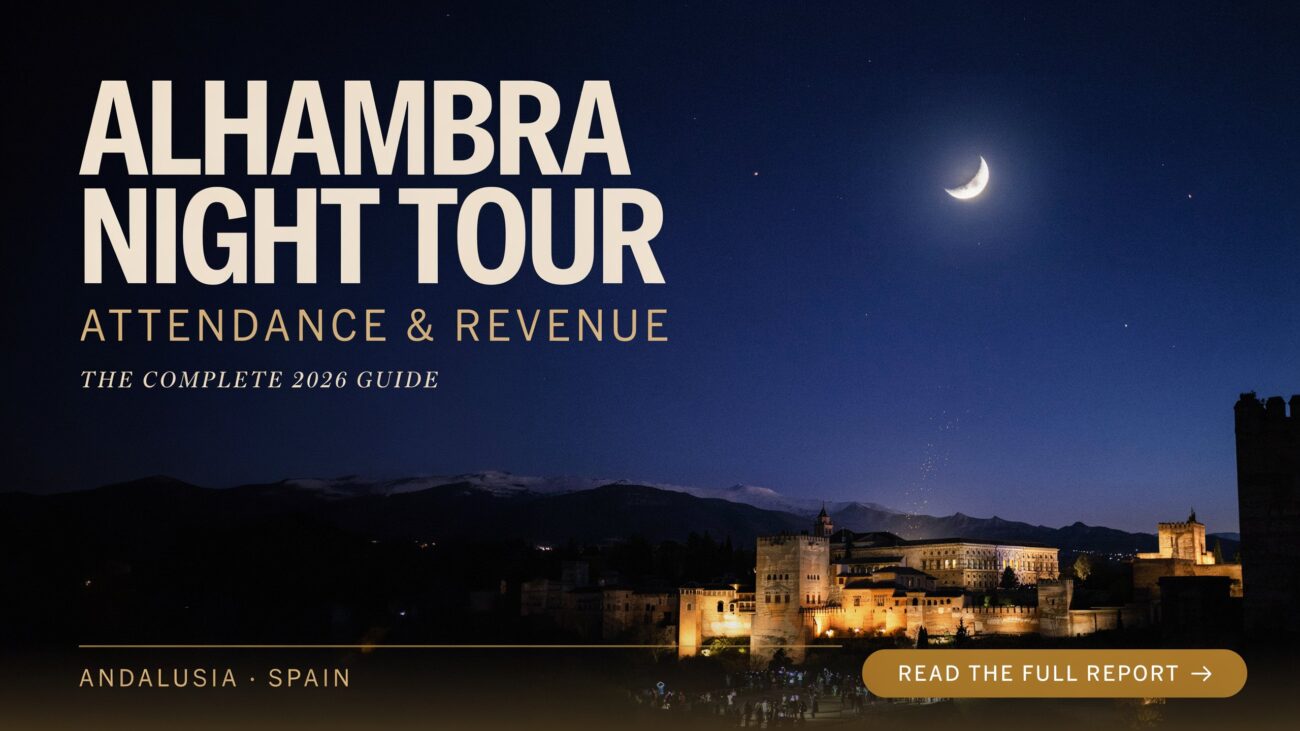
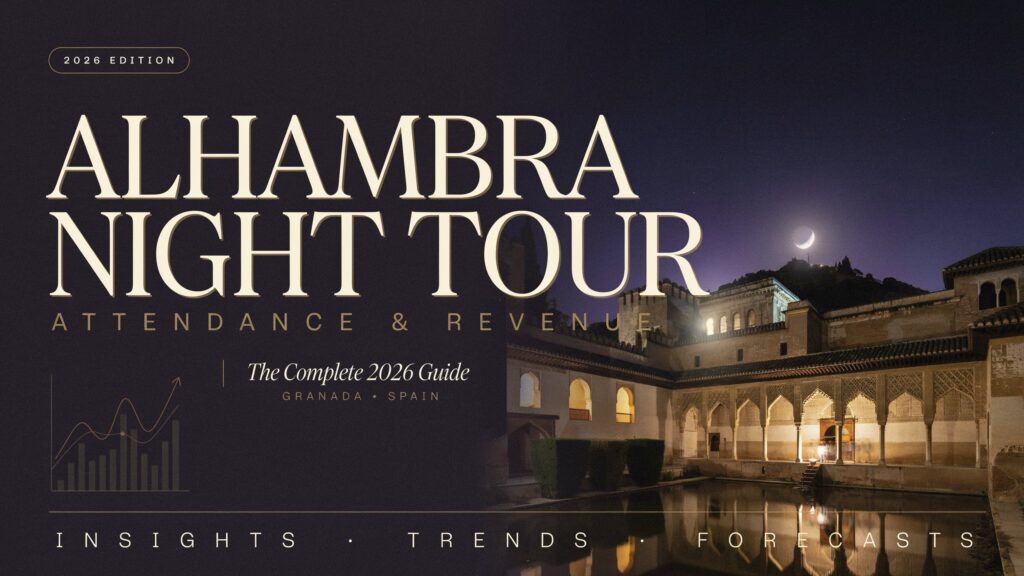
There’s a moment, just after the sun drops behind the Sierra Nevada, when the Alhambra transforms into something it cannot be during the day. The crowds shrink to almost nothing. The lights come on slowly across the carved stone walls. The reflecting pools in the Nasrid Palaces turn into mirrors, and the ceiling you’ve seen in a hundred photographs becomes something you want to stand under for a very long time.
Thousands of travelers plan their entire trip to Granada around getting into one of those evening sessions. And the people who manage the Alhambra have built a serious economic strategy around that desire.
This article tells the full story — the attendance numbers, how the revenue actually works, who the visitors are, why peak summer nights sell out a month in advance, and what all of this means for the future of heritage tourism in Spain.
Quick Facts
| Topic | Data |
| Total Annual Visitors (2025) | 2,726,871 |
| Annual Maximum Capacity | 2,763,500 visitors |
| Night Tour Annual Visitors | ~120,000–150,000 |
| Night Tour % of Total Visitors | ~5–6% |
| Night Tour Annual Revenue | ~€8.4 million–€12 million |
| Night Tour % of Total Ticket Revenue | ~20–22% |
| Peak Night Attendance | 400–500 visitors per night |
| Off-Season Night Attendance | 200–300 visitors per night |
| Nasrid Palaces Night Ticket | €12.73 (official); ~€10.60 earlier rates |
| Generalife Night Ticket | €8.48 |
| Guided Night Tour | From ~€60–€69 per person |
| Best Month Revenue | July: ~€892,000–€900,000 |
| Lowest Month Revenue | January: ~€385,000 |
| Summer Share of Night Revenue | 48% of full-year total |
| Peak Advance Booking | 28 days ahead in summer |
| UNESCO Status | World Heritage Site since 1984 |
| Official Ticketing | alhambra-patronato.es |
| Location | C. Real de la Alhambra, Granada, Spain |
The Alhambra After Dark — Why People Come Back Twice
Most heritage sites are visited once. You see them during the day, you take your photos, you go home. The Alhambra is different.
About 30% of the people who attend a night tour have already visited Alhambra earlier the same day or on a previous trip. They paid two separate admissions. They came back on purpose.
That’s remarkable. And it tells you something important about what the evening version of this place actually is.
During the day, the Alhambra is magnificent. It’s also busy. Guided groups move through the Nasrid Palaces in coordinated waves. The Patio de los Leones has a constant hum of voices and cameras. The experience is real, but it’s shared with thousands of other people.
At night, the numbers drop to a few hundred. The dedicated lighting system — which cost €2.3 million to install in 2019 — picks out individual details in the carved stucco that daylight flattens. The fountains sound louder. The geometric patterns in the tile floors seem to glow from underneath.
It’s the same place. It’s a completely different experience.
See also “Newtopy: The Complete Guide to What It Is, What It Does, and Why People Are Talking About It“
Total Visitors and Night Tour Numbers
The Alhambra has a visitor problem that most tourist sites would envy. The problem isn’t too few people. It’s too many.
In 2025, the Patronato de la Alhambra y Generalife — the official body that manages the site — reported 2,726,871 total visitors. That figure made the Alhambra the single most visited cultural monument managed by the Junta de Andalucía. It also sat within 37,000 of the site’s regulated annual maximum of 2,763,500 visitors.
The annual limit isn’t a suggestion. It’s a conservation ceiling set to protect 700-year-old walls, floors, fountains, and wooden ceilings from the damage that foot traffic and humidity cause over time. The Alhambra is always close to that ceiling.
Against that total of 2.7 million, night tour visitors look small. Every year, between 120,000 and 150,000 individuals visit the Alhambra after nightfall. That’s roughly 5 to 6 percent of all annual visitors.
But here’s where the story gets interesting. That 5 to 6 percent of visitors generates approximately 20 to 22 percent of total ticket revenue.
A small group of people. An excessively high portion of the funds. Understanding how that happens is what the rest of this article is about.
The Ticket Structure — What You’re Actually Paying For
The Alhambra doesn’t sell one type of night ticket. It sells several, covering different parts of the complex at different prices.
Nasrid Palaces Night Visit — €12.73
This is the headline night ticket. It gets you into the inner royal palaces — the Mexuar, the Palace of Comares with its towering throne room, the famous Patio de los Leones with its 124 marble columns, and the connecting corridors of the Lindaraja area.
These are the rooms that appear in every photograph. They are the reason most people come to the Alhambra at all. At night, with controlled lighting and a fraction of the daytime crowd, they are genuinely breathtaking.
This ticket doesn’t include the Alcazaba military fortress or the Generalife gardens. It covers the palaces only.
Generalife Night Visit — €8.48
The Generalife is the summer retreat built above the main palace complex — terraced gardens, water channels, fragrant plants, and views across Granada that stop most people in their tracks.
At night in summer, the Generalife is cooler than the city below by several degrees. The water in the long central fountain channel reflects back the stars. Many visitors who have seen the Nasrid Palaces during the day choose this ticket instead for their evening return.
Alhambra Experiencias — Combined Ticket
This is the option for people who want both worlds in one booking. You get an evening visit to the Nasrid Palaces, and then a follow-up daytime ticket the next morning covering the Alhambra, Generalife gardens, and the Alcazaba fortress.
It’s the two-day experience compressed into a single purchase. For anyone coming to Granada specifically for the Alhambra, this ticket makes strong practical sense.
Guided Night Tours — From €60–€69
A separate market exists above the standard admission tickets. Private and group guided tours include the ticket price but wrap it inside a narrated experience led by a specialist.
Guides explain the symbolism in the tilework. They describe the political intrigues of the Nasrid sultans in rooms where those intrigues actually happened. They point out architectural details that most independent visitors walk straight past.
These tours command a significant premium — four to six times the standard ticket price. The people who book them tend to be culturally curious travelers who want to walk away understanding what they saw, not just having photographed it.
Online Booking Fee
One practical note for visitors: all advance online purchases carry a booking commission of approximately €1.27 per ticket on top of the advertised price. The General Admission daytime ticket, listed at €21, becomes €22.27 when purchased online. Night tickets carry a proportional fee.
The Revenue Numbers — How €8+ Million Is Generated
Night tours generate somewhere between €8.4 million and €12 million in annual ticket revenue. Here’s how those numbers are built.
On a typical summer evening, between 400 and 500 visitors attend the night session. The average effective ticket price — blending standard admissions with the premium guided tour market — sits around €15 per person.
On a summer night with 450 visitors paying an average of €15: that’s €6,750 in a single evening. Multiply across the seven months of peak and shoulder season activity and the numbers accumulate quickly.
The annual operating cost for night tours runs approximately €985,000. That covers extended staffing, security, lighting and maintenance costs for the evening operation, and administrative overhead. Against gross revenue of over €8.4 million, the net operating margin is strong — estimated at around 88 to 90 percent by tourism analysts.
This efficiency is a direct result of the capacity-controlled model. The Alhambra doesn’t scale up staffing as attendance rises. The visitor cap stays fixed. Costs remain relatively stable while pricing can flex with seasonal demand.
The Seasonal Revenue Pattern — When the Money Comes In
Night tour revenue does not arrive in equal monthly installments. It follows a clear seasonal curve, and the swings are dramatic.
July is the peak. In July 2024, night tour revenue reached approximately €892,000 to €900,000 in a single month. That’s nearly one month out of twelve generating 10% of the annual total on its own.
January sits at the other end. Cold temperatures, shorter nights, fewer international tourists, and reduced demand push January revenue to around €385,000. That’s still a meaningful number for a single month, but it’s less than half of July’s output.
Summer overall — June, July, and August — accounts for 48% of annual night tour revenue despite covering only 33% of the calendar year. That concentration creates real cash flow management challenges for the Patronato.
Shoulder season — April, May, September, and October — is the area showing the strongest growth trend. Between 2022 and 2024, shoulder season night bookings grew 42%. Travelers increasingly seek these months to avoid the extreme July heat, which regularly reaches 35–40°C in Granada during the day.
The evening temperature differential is significant. On a July night when the city is still 28°C, the Alhambra grounds are typically 22–26°C. That’s a meaningful difference for outdoor exploration. It’s one of the primary reasons the night tour market has grown specifically in the summer months.
Who Comes to the Night Tour — The Visitor Profile
The 120,000 to 150,000 annual night visitors are not a homogeneous group. Different types of travelers attend for completely different reasons, and understanding these segments explains a lot about the pricing strategy.
Heat refugees. The single biggest segment comes specifically to escape daytime temperatures. July and August afternoon temperatures in Granada can make prolonged outdoor exploration genuinely uncomfortable. Evening tours at comfortable temperatures have pulled this group in consistently, and the segment grew 45% between 2019 and 2024.
Photographers. The 2019 lighting installation transformed the Alhambra’s appeal to serious photographers. The specialized illumination creates conditions — shadow depth, color temperature, geometric contrast — that cannot be replicated in daylight. Photography enthusiasts frequently book premium-access sessions that allow longer exposure times and smaller group sizes, spending significantly more than standard admission.
Return visitors. Roughly 30% of night tour attendees have already visited the Alhambra during the day on the same trip. They came back because the evening experience genuinely feels different enough to justify a second ticket. This segment is particularly valuable because they have already demonstrated willingness to pay full daytime admission and are now paying again.
Domestic Spanish tourists. Since the pandemic years, Spanish domestic visitors have grown to represent 55% of night tour attendance, up from 40% in 2019. This domestic base provides income stability when international travel fluctuates due to exchange rate movements, political disruption, or public health concerns. A strong domestic market is a genuine buffer for any heritage site.
The Conservation Logic Behind the Capacity Cap
The Alhambra’s night tour model didn’t emerge purely from a revenue optimization process. It emerged from a preservation problem.
The main complex was built in the 13th and 14th centuries. The wooden muqarnas ceilings, the ceramic tile dados, the carved plaster panels, and the stone floors were all created by craftsmen whose skills and materials are now irreplaceable. Moisture from human breath causes measurable damage to certain carved surfaces over time. Physical foot traffic gradually degrades tile patterns. Heat from concentrated crowds affects delicate materials.
The visitor cap — both the 2.76 million annual total and the nightly limit — exists to slow that damage. Every visitor allowed inside is a small, cumulative cost to the monument’s longevity. The pricing model is partly designed to recover more revenue per visitor so the overall visitor count doesn’t need to be higher.
In this sense, the high-revenue, low-volume night tour is not just good business. It’s good conservation practice. A smaller number of paying visitors generating substantial income creates less physical impact than a larger number generating the same revenue through lower ticket prices.
Tickets Always Sell Out — And What That Means
During peak summer months, Alhambra night tour tickets sell out an average of 28 days in advance. That’s nearly a full month of forward booking lead time.
This isn’t unusual for the Alhambra specifically — daytime Nasrid Palace slots are recommended to be booked two to three months ahead in peak season. But the night tour’s consistent sell-out pattern tells you something specific about the product.
People are not impulsively deciding to attend a night tour after arriving in Granada. They are planning their entire visit around securing that ticket. The Alhambra night tour is not a nice addition to a Granada trip for these visitors. It is the reason for the trip.
That kind of demand is extraordinarily rare among heritage sites anywhere in Europe. It creates pricing power that the Patronato exercises carefully — not through dramatic price increases that would exclude middle-income visitors, but through the premium guided tour market and the “Experiencias” combined ticket product.
The Granada Economy — Ripple Effects Beyond the Gate
The Alhambra’s night tours don’t just generate revenue for the monument itself. They change the economic pattern of an entire city’s evening.
Visitors attending a 10pm summer night tour don’t arrive at the gate at 9:55. They arrive in Granada hours earlier. They eat dinner in the restaurants of the Realejo neighborhood or around the Plaza Nueva. They buy wine in tapas bars. They browse the craft shops along the Calle Elvira. They may book another day in the city specifically to have both a daytime Alhambra visit and an evening one.
Tourism economists estimate that each night tour visitor generates secondary spending of between €80 and €180 in the local Granada economy beyond their ticket purchase. Across 120,000 to 150,000 annual night visitors, that secondary economic impact runs to somewhere between €9.6 million and €27 million in local spending per year.
For a mid-sized Spanish city that competes with Barcelona and Madrid for visitor attention, that is a significant contribution to the local economy — and it flows from a product that didn’t generate meaningful revenue at all two decades ago.
Looking Ahead — 2025, 2026, and the Sustainability Question
The Alhambra is operating at near-maximum annual capacity. The 2025 figure of 2,726,871 sits only 36,629 visitors below the regulated ceiling. There is almost no room to grow total visitor numbers.
The strategic response has been to grow revenue per visitor rather than total visitor count. Night tours with their premium pricing structure are a core part of that strategy. Shoulder season marketing — promoting April, May, September, and October as ideal visiting periods — is another tool, shifting demand away from peak months to reduce conservation pressure while maintaining annual revenue levels.
The €2.3 million lighting investment of 2019 has already paid for itself multiple times over through the night tour revenue it helped generate. Future investments in digital booking systems, conservation technology, and visitor experience infrastructure all flow from that revenue stream.
The fundamental challenge is a good one to have: more people want to come than can be accommodated. The Alhambra’s approach — constrain supply, maintain quality, price accordingly, invest returns in conservation — is increasingly being studied by heritage managers across Europe as a model for sustainable cultural tourism.
Final Words
One of those experiences that people talk about with exceptional emotion is visiting the Alhambra at night. Not because it’s the biggest thing they’ve ever seen, or the oldest, or the most famous. But because it has a quality that’s hard to put into words — quiet, golden, somehow both ancient and alive.
The economic story behind that experience is equally compelling in its own way. A small fraction of total visitors. A disproportionate share of ticket income. Conservation funding that exceeds operating costs. Secondary economic benefit to an entire city. And a pricing model built around the simple principle that scarcity, quality, and genuine demand support premium pricing without exploitation.
The Alhambra night tour isn’t just a beautiful evening out. It’s one of the most successful revenue management experiments in European heritage tourism. And in 2026, with visitor interest growing and capacity firmly capped, that experiment shows no signs of running out of lessons to teach.
FAQs
1. How many people visit the Alhambra night tour each year?
Between 120,000 and 150,000 visitors attend Alhambra night tours annually. That represents approximately 5 to 6 percent of the site’s total annual visitors, which in 2025 reached 2,726,871.
2. How much money do night tours of the Alhambra bring in?
Annual night tour revenue is estimated at between €8.4 million and €12 million. This accounts for roughly 20 to 22 percent of total Alhambra ticket income, despite representing only 5 to 6 percent of total visitors — a clear illustration of how premium pricing and controlled capacity drive financial efficiency.
3. What does an Alhambra night ticket cost?
The Nasrid Palaces night ticket is officially listed at approximately €12.73, with a small online booking fee on top. The Generalife night ticket costs €8.48. Guided night tours — which include the ticket plus expert narration — start from around €60 to €69 per person.
4. What does the night ticket include?
The Nasrid Palaces night ticket covers the Mexuar, the Palace of Comares, the Patio de los Leones, and the Lindaraja corridor area. It does not include the Alcazaba military fortress. The Generalife night ticket covers the terraced gardens and summer palace areas. Neither night ticket grants access to all areas that a full daytime general admission would.
5. When do Alhambra night tours take place?
Summer night tours run from 10pm to 11:30pm. Winter night tours run from 8pm to 9:30pm. On December 25 and January 1, the Alhambra is closed.
6. When should I make my reservation?
During peak summer months, night tickets sell out an average of 28 days in advance. For any visit between June and September, booking at least a month ahead is strongly recommended. Shoulder season visits in April, May, September, and October are more flexible but still benefit from advance booking.
7. Where do I buy official Alhambra night tickets?
Official tickets are sold through the Patronato de la Alhambra’s own website (alhambra-patronato.es). Third-party platforms may offer tickets but typically at higher prices due to additional commission layers. Always verify that a third-party seller is a legitimate authorized reseller before purchasing.
8. Which month generates the most night tour revenue?
July generates the most revenue, with estimates placing July 2024 earnings from night tours at approximately €892,000 to €900,000. June and August also perform strongly. The three summer months combined account for nearly half of the annual night tour revenue total.
9. Is the night tour worth it if I’ve already done the daytime visit?
Many experienced visitors say yes without hesitation. About 30 percent of night tour attendees have already visited during the day on the same trip. The evening experience — smaller crowds, specialist lighting, cooler temperatures, and a qualitatively different atmosphere — is consistently described as distinct enough from the daytime visit to justify the additional cost.
10. How many visitors are allowed at the Alhambra per night?
Peak season nights admit between 400 and 500 visitors across the evening session. Off-season nights run with 200 to 300 visitors. These numbers are fixed by conservation regulations set by the Patronato and UNESCO, not adjusted based on commercial demand.
11. Why is the Alhambra’s total annual visitor count capped?
The annual cap of 2,763,500 visitors exists to protect the monument’s fragile surfaces and materials. Human foot traffic, body heat, and moisture from breath cause measurable cumulative damage to 700-year-old carved stone, tile, plaster, and wooden elements. The cap is a conservation decision, not a commercial one.
12. What percentage of Alhambra night visitors are Spanish?
As of 2024, approximately 55 percent of night tour visitors are Spanish domestic travelers, up from 40 percent in 2019. International visitors — particularly from Europe, the US, and Asia — make up the remaining 45 percent.
13. What is the Alhambra Experiencias ticket?
The Alhambra Experiencias is a combined ticket that includes an evening visit to the Nasrid Palaces plus a follow-up daytime ticket the next morning covering the full Alhambra, Generalife, and Alcazaba. It’s designed for visitors who want to experience both versions of the monument and provides better total value than purchasing each separately.
14. What economic impact do Alhambra night tours have on Granada?
Beyond the ticket revenue, each night tour visitor generates an estimated €80 to €180 in secondary spending in Granada’s local economy — at restaurants, bars, shops, and accommodation. Across 120,000 to 150,000 annual night visitors, this translates to a secondary economic impact of between €9.6 million and €27 million per year for the city.
15. Can I visit the Alhambra at night without a guided tour?
Yes. Standard night admission tickets to the Nasrid Palaces (€12.73) and Generalife (€8.48) are available for independent visitors. Guided night tours cost significantly more — starting from around €60 — but include expert interpretation of the architecture, history, and symbolism that independent visitors typically miss. For first-time visitors with a strong interest in the history, guided access significantly enhances the experience.
Keep creating, innovating, and inspiring with Content Ideators every day.
