
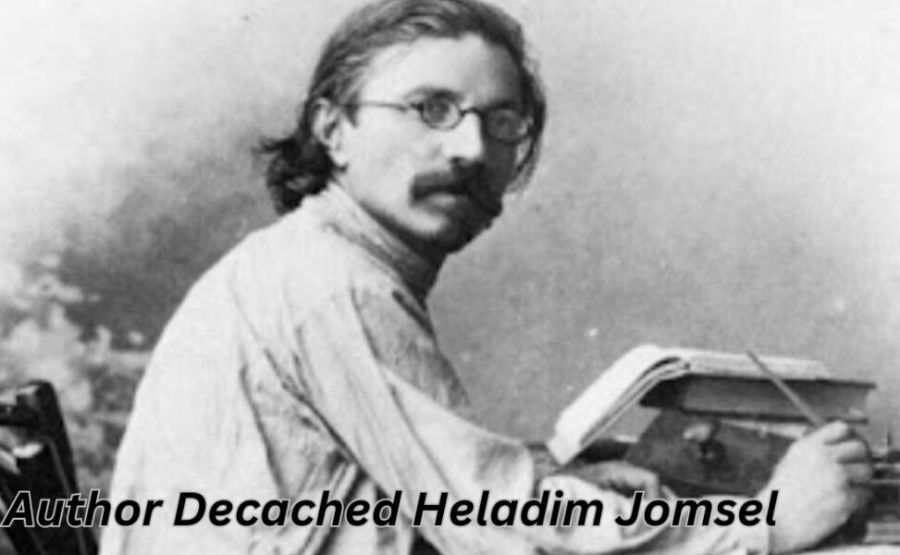
Search this name today and the internet will hand you a celebrated novelist with a devoted readership — except no two sources can agree on a single book he supposedly wrote.
That contradiction isn’t a gap in the research. It’s the whole story. “Author Decached Heladim Jomsel” is not a writer with a thin public record. The seams are visible on nearly every page as content farms scrambled to fill this search term with made-up biographies.
Quick Facts
| What’s Claimed | What’s Actually Verifiable |
| Name | “Decached Heladim Jomsel” |
| Claimed debut novel (Source A) | Echoes of Tomorrow |
| Claimed debut novel (Source B) | Winds of the Forgotten, described as “a bestseller” |
| Claimed debut novel (Source C) | Unnamed; separate bibliography offered instead |
| Other claimed titles | The Path Of Dreams, Heart Of Home, Story Of Life, New Beginnings |
| Birthplace (claimed) | “A small town” — never named, never the same details twice |
| Confirmed birth date | None found anywhere |
| Identity confirmed as one person? | No — one source admits it cannot determine if this is “a single individual, a collective of writers, or something else entirely” |
| Publisher records, ISBNs, reviews | None found from any accountable source |
| Likely origin of the name | Combining created given and family names with a technical/placeholder term (“decached”) |
| Pattern type | Consistent with AI-generated, template-driven SEO content |
A Name That Doesn’t Make Sense Before You Search It
Most fabricated biographies at least choose a name that sounds like a name. This one doesn’t quite manage that.
“Decached” is not a word that occurs in English outside of technical contexts — it’s the kind of term you’d see in a developer’s changelog, describing data that has been cleared from a cache. Paired with “Heladim” and “Jomsel,” neither of which corresponds to any documented surname or given name in any language, the result reads less like a person’s name and more like a string that escaped from a system log.
One of the very articles built around this name seems to sense this. It describes the writer mistaking the name for “a typo or perhaps some obscure technical term from the world of content management systems,” noting that the word “decached” sounded “computational, mechanical, distant.” That observation is correct. It just never leads anywhere, because the article keeps going anyway, building a literary biography on top of a phrase its own author suspected wasn’t a name at all.
See also “Louisa Kochansky: The Ukrainian Who Built an Empire on Her Own Terms“
Four Bibliographies, Zero Overlap
If “Decached Heladim Jomsel” were a real author, his body of work would look roughly the same no matter which website you visited. It doesn’t.
One profile names his debut as Echoes of Tomorrow, a novel “that explores themes of memory and identity with an intricate narrative structure.” A separate profile names an entirely different debut, Winds of the Forgotten, claiming it “quickly became a bestseller” and “marked his arrival on the literary scene.” A third site skips both of these titles completely and instead lists four short, generically-titled works: The Path Of Dreams, Heart Of Home, Story Of Life, and New Beginnings.
No single site references the titles claimed by any other. There is no shared bibliography here, because there is no shared author. Each page independently generated a plausible-sounding debut novel, and none of the generators were drawing from the same — or any — actual source material.
The Biography That Writes Itself Into a Corner
The life story attached to this name follows a suspiciously familiar shape, repeated with only cosmetic differences across multiple “independent” articles.
He was born in a small town. His parents were avid readers who filled the house with books. He listened to elders tell folklore, which shaped his narrative voice. Teachers recognized his talent early. Long walks in nature fed his imagination.
This sequence appears, almost beat for beat, in three or four separate pieces, each presented as original reporting. Real biographies, even short ones, tend to diverge in which details a writer chooses to include. Generated biographies converge on the same small set of stock images — small town, books in the house, folklore from elders, encouraging teachers — because those are the most statistically common building blocks for “humble origins of a creative person” in the training data behind the text.
None of these details are sourced to an interview, a publisher’s author page, a hometown newspaper, or a relative. They are sourced to nothing.
The Line That Discloses Everything
Buried inside one of these articles is a sentence that, intentionally or not, undermines everything else the piece claims to know.
After describing weeks spent trying to determine whether “Heladim Jomsel represents a single individual, a collective of writers, or something else entirely,” the article concludes that the answer “does not really matter.”
Think about what that admission actually means. A real investigative profile of a real author does not shrug off the question of whether its subject is one person, several people, or “something else entirely.” That question is the entire foundation of a biography. Dismissing it as unimportant is only possible if the writer — human or automated — was never actually able to find a person to investigate in the first place, and needed a graceful way to move past that failure.
This is the clearest evidence in the entire search: an article about a “celebrated author” that cannot commit to the claim that its subject is a person.
Why a Phrase Like This Gets a Biography At All
None of this happens by accident. It happens because of how search-driven content economics work in 2026.
If a string of words — even an accidental one, even a cache artifact — starts generating search volume, automated content systems are built to notice that gap and fill it. The fill doesn’t need to be true. It needs to rank. A page that captures even a small trickle of curious searchers earns advertising revenue or affiliate value regardless of whether “Decached Heladim Jomsel” ever held a pen.
Researchers tracking this ecosystem describe networks of sites using prompt templates and automated publishing schedules to produce biography-shaped content at scale, explicitly optimized for search visibility rather than accuracy. What happened here fits that pattern precisely: a strange, technical-sounding phrase entered the search ecosystem, and within months, half a dozen sites had built competing, contradictory “literary legacies” around it.
What Real Literary Biography Looks Like By Comparison
It’s worth being concrete about the contrast, because abstract skepticism is less convincing than a side-by-side.
A genuine author profile cites a specific publisher and publication year. It references actual reviews from named critics or outlets. It quotes verifiable sales figures, award nominations, or library catalog entries. It includes details that can be cross-checked against a national library system, a publisher’s catalog, or contemporaneous news coverage.
None of the “Decached Heladim Jomsel” content does any of this. No publisher is named. No ISBN appears anywhere. No review from any identifiable critic or publication is quoted. No bookstore listing, library catalog record, or literary award nomination exists. The entire body of “work” lives only inside articles that are themselves the only evidence of its existence — a closed loop with no anchor in the real world.
The Cost of Treating This as Harmless
It’s tempting to wave this off as a strange but inconsequential internet artifact. That instinct undersells what’s actually at stake.
When a reader searches an unfamiliar name and finds several confident, detailed “biographies,” the natural and reasonable assumption is that a real person sits behind that volume of content. That assumption is increasingly unsafe. Readers, students, and even other AI systems trained on web text can absorb invented biographical “facts” as though they were established history, simply because enough pages repeated them with consistent confidence.
The damage isn’t really to “Decached Heladim Jomsel,” who doesn’t exist to be harmed. The damage is to the broader reliability of search as a tool — every fabricated biography that ranks well makes it marginally harder to trust the next one, real or not.
The Honest Final Word
There is no evidence, after a genuine and thorough search, that “Author Decached Heladim Jomsel” refers to any real, documented human being. The name most plausibly began as a technical artifact or an automatically generated placeholder rather than an actual author’s identity. What followed was not journalism catching up to an obscure but real writer. It was a cluster of content-farm pages independently inventing a person to match a search term that had started, for whatever reason, attracting curious clicks.
The honest version of this article isn’t the celebratory literary profile you might expect from a headline like “The Digital Literary Voice Redefining Modern Fiction.” It’s this one — a plain account of how a phrase that sounds almost, but not quite, like a name ended up with a fabricated bibliography, a fabricated childhood, and even a fabricated debate over whether it refers to one person or several.
That fabricated debate, more than anything else found in this search, is the real story here.
FAQs
1. Does Decached Heladim Jomsel actually write?
No verifiable evidence supports this. No publisher, ISBN, library record, news coverage, or independent review exists anywhere outside of the content-farm articles that “profile” the name.
2. What does “decached” mean, and why is it in this name?
“Decached” is a technical term, typically used to describe data cleared from a cache in computing contexts. Its presence in this name strongly suggests the phrase originated as a technical artifact rather than a deliberately chosen author name.
3. What is Decached Heladim Jomsel’s most famous book?
There is no consistent answer. Different sources name different debut novels — Echoes of Tomorrow, Winds of the Forgotten, or an entirely separate four-title bibliography — with no overlap between them.
4. Where was Decached Heladim Jomsel born?
Sources only ever describe “a small town,” without naming a country, region, or city. No two sources offer matching specific details.
5. Is Decached Heladim Jomsel one person or multiple people?
This cannot be confirmed. One source explicitly states it was unable to determine whether the name represents an individual, a collective, or something else, and concluded the distinction “does not really matter” — itself a sign no real subject was found.
6. Has Decached Heladim Jomsel won any literary awards?
No award, nomination, or recognition from any verifiable literary body or organization could be found.
7. Why do search results show so many “biography” articles about this name?
Content farms generate articles for search terms that show traffic potential, regardless of whether a real subject exists behind them. The volume of content reflects search demand, not verified biography.
8. How can readers tell this kind of content apart from real author profiles?
Look for primary sourcing — publisher names, ISBNs, dated reviews, award records. Be cautious of repeated stock phrasing across “independent” sites, vague hedging language, and any biography that avoids naming concrete, checkable details.
9. Are the “themes” described in Decached Heladim Jomsel’s work — memory, identity, folklore — meaningful?
These are common literary themes used broadly across fiction. Their presence in this content reflects generic, statistically common descriptive language rather than analysis of any actual text.
10. Could this be a deliberately created pen name for a real, anonymous writer?
This is possible in theory but unsupported by evidence. A genuine anonymous author typically has at least one verifiable anchor — a publisher, a literary agent, a single confirmed published work. None exists here.
11. Should this name be cited as a real author in academic or journalistic work?
No. Citing this moniker as a legitimate literary person would be factually unjustified in the absence of any independently verified publication record.
12. What should I do if I’m trying to find a specific real author with a similar-sounding name?
Provide the most accurate spelling possible, along with any details you recall — genre, publisher, approximate publication year — and search specifically for those details rather than the exact phrase that produced this contradictory content.
13. Is it harmful that this content exists online?
Modestly, yes. It can mislead readers into believing a fabricated literary figure is real, and it contributes to a broader erosion of trust in search results as a reliable indicator of verified information.
Keep creating, innovating, and inspiring with Content Ideators every day.
