
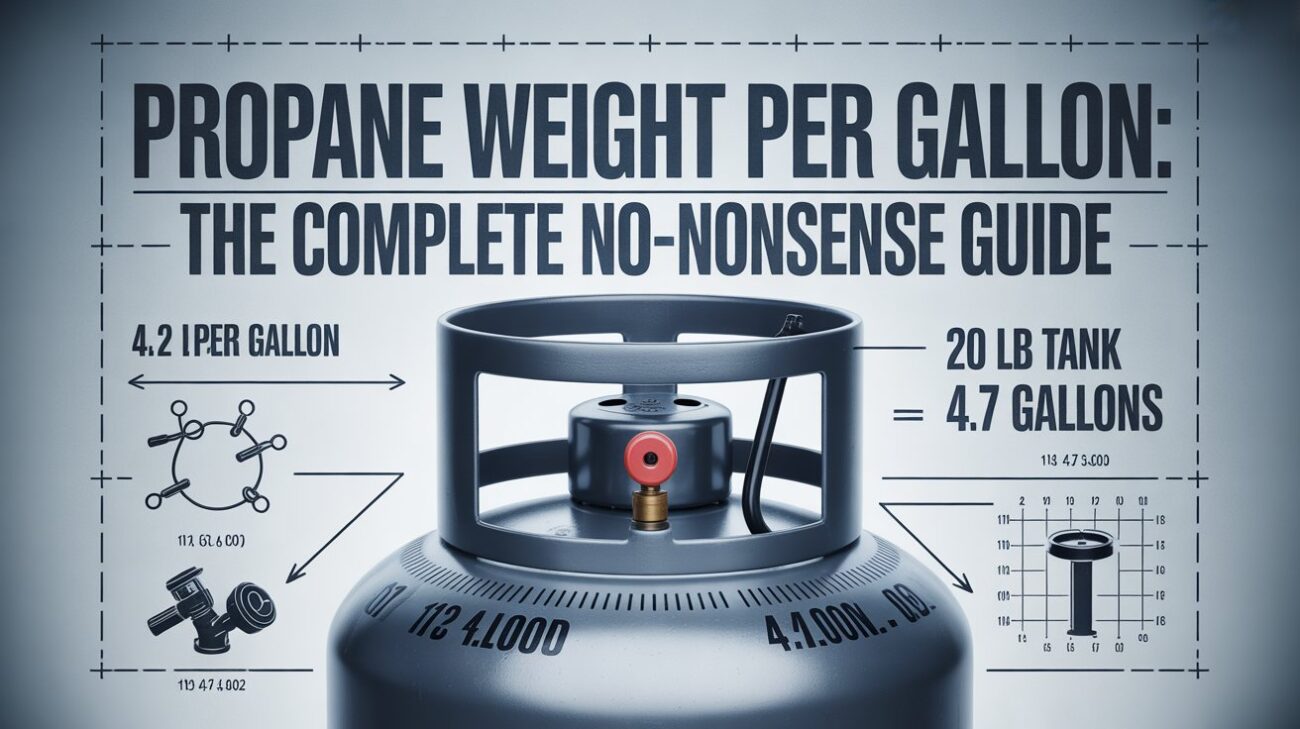
Quick Facts Table
| Category | Detail |
| Propane weight at 60°F (industry standard) | 4.24 lbs per gallon |
| Propane weight at 77°F (room temp) | 4.11 lbs per gallon |
| Propane weight in kilograms (per US gallon) | ~1.92 kg |
| Propane density at 77°F | 0.493 g/cm³ |
| Chemical formula | C₃H₈ |
| Boiling point | -44°F / -42.2°C |
| Compared to water (per gallon) | Water = 8.34 lbs — Propane = 4.11–4.24 lbs |
| Compared to air | Propane gas is ~1.5x heavier than air |
| BTU per gallon (liquid) | ~91,500 BTU |
| BTU per pound | ~21,548 BTU |
| 20 lb tank: propane inside | ~4.7 gallons |
| Full 20 lb BBQ tank total weight | ~37 lbs (tank + propane) |
| 80% fill rule | All tanks filled to max 80% capacity |
| Industry reference temp | 60°F / 15.6°C |
The Question More People Ask Than You’d Expect
You’re standing at the hardware store. You’re staring at a row of propane tanks and wondering — how much does this thing actually weigh? Is it 4 pounds of fuel? 20 pounds? More?
The answer depends on one key thing: temperature.
But before we get complicated, let’s start with the simple number everyone needs to know.
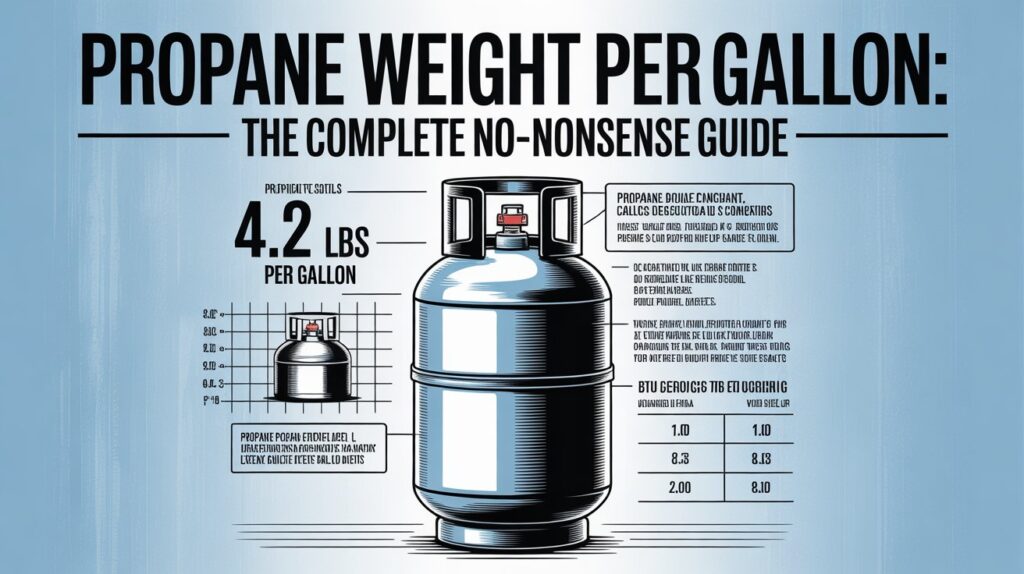
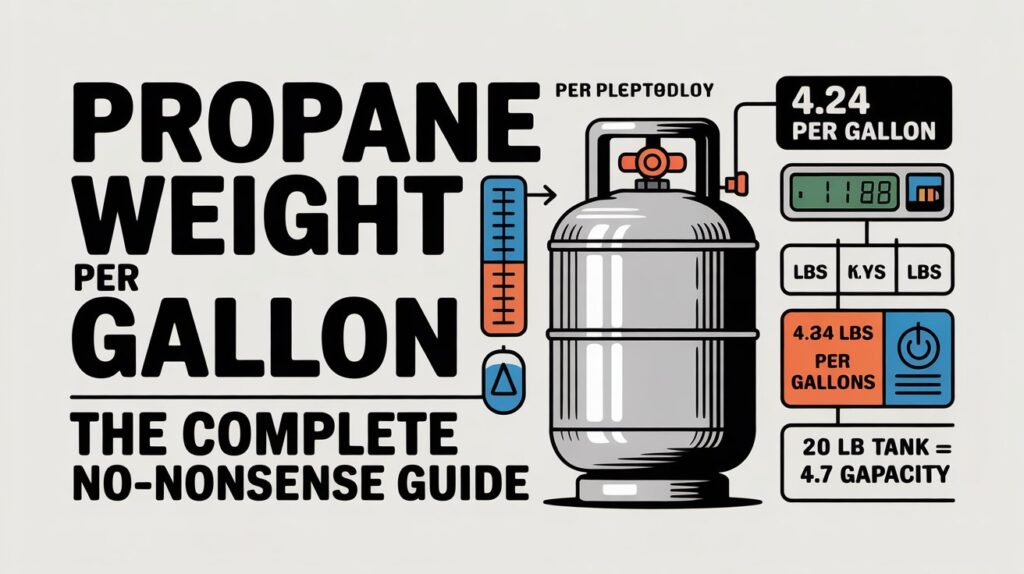
One gallon of liquid propane weighs approximately 4.24 pounds at the industry standard temperature of 60°F.
That is the number. Write it down. Tattoo it on your brain if you use propane regularly.
Now let’s talk about why that number exists, how it changes, and what it means every time you lug a tank to your backyard grill or heat your home through a cold winter.
See also “What is the Weight of a Gallon of Milk? Everything You Need to Know“
What Propane Actually Is (And Why It Comes in a Tank)
Propane is a gas. At room temperature and normal atmospheric pressure, it floats around just like air does. You cannot pour it. You cannot store it in a regular bottle.
But under pressure? Everything changes.
When you squeeze propane under enough pressure, it turns into a liquid. And liquid propane takes up dramatically less space than the gas form. According to the US Department of Energy, liquid propane under 150 psi holds about 270 times more energy per unit of space compared to its gas form.
That is why propane tanks exist. They keep propane squeezed under pressure so it stays liquid. When you open the valve, pressure drops, the liquid flashes back to gas, and that gas burns.
This liquid-to-gas nature is also exactly why the weight of propane changes with temperature. The tighter the molecules are packed — which happens in cold — the more weight you fit into one gallon. Heat them up, they spread out, and the same gallon holds less mass.
In its natural state, propane has no smell whatsoever. You would never know if it was leaking. So gas companies add a chemical that smells like rotten eggs on purpose — so your nose becomes your first line of defense in any leak situation.
Propane Is Much Lighter Than Water — Here’s Why That Matters
Pick up a gallon of water. It weighs 8.34 pounds.
Now picture a gallon of propane. Same size container. But it weighs only about 4.11 to 4.24 pounds — roughly half the weight of water.
Propane is one of the lightest liquid fuels you can buy. That is one reason it is so popular for portable use. A 20-pound tank of propane is genuinely manageable for one person to carry. A tank holding the same volume of diesel or water would be back-breaking.
But here is the twist that surprises a lot of people. While liquid propane is lighter than water, propane gas is heavier than air.
When propane gas escapes from a tank — through a leak or a loose fitting — it does not drift upward and disappear harmlessly. It sinks. It pools in low-lying areas. It settles in basements, under decks, and in the corners of garages.
This is why ventilation matters so much. A propane leak in an enclosed space is invisible, odorless (before the odorant is added), and dangerously flammable. If you ever smell that rotten-egg odor indoors, get out, get air, and call your gas company.
Why the Weight Changes With Temperature
Here is the part that trips people up when they first start learning about propane.
The weight of one gallon of propane is not fixed. It changes as the temperature changes.
Think of it this way. When it’s cold outside, propane molecules huddle together tightly. They are denser. One gallon holds more mass. When it’s hot, those molecules spread out and push apart. One gallon holds less mass.
Here is what that looks like in real numbers:
| Temperature | Propane Weight Per Gallon |
| 90°F (32°C) | 4.05 lbs |
| 80°F (27°C) | 4.09 lbs |
| 77°F (25°C) — room temp | 4.11 lbs |
| 70°F (21°C) | 4.17 lbs |
| 60°F (15.6°C) — industry standard | 4.24 lbs |
| -40°F (-40°C) | ~4.91 lbs |
That bottom number is wild. In extreme cold — like a brutal Canadian winter — one gallon of propane is nearly 21% heavier than at room temperature.
Propane actually expands at a rate of about 1.5% for every 10-degree rise in Fahrenheit. That does not sound like much. But across a 500-gallon residential tank sitting in the summer sun, that expansion adds up fast. It is the reason tanks are never filled all the way. More on that in a moment.
The 60°F Rule: Why the Industry Picked One Temperature
So if propane weight changes with temperature, how does anyone agree on prices and billing?
The propane industry solved this by picking one standard temperature and sticking to it forever. The temperature is 60°F (15.6°C).
At 60°F, one gallon of liquid propane weighs exactly 4.24 pounds.
Every delivery truck. Every billing system. Every exchange program at a hardware store. Every large commercial transaction. They all anchor to 4.24 pounds per gallon, measured at 60°F.
This number is not just a convenience — it is legally recognized. The National Institute of Standards and Technology (NIST) backs it. It comes directly from propane’s molecular weight of 44.097 grams per mole and its specific gravity of approximately 0.508 relative to water at the same temperature.
When a propane delivery truck pulls up to your house and fills your tank with 150 gallons, the meter calculates based on 4.24 lbs per gallon at 60°F. You are being charged for that. That is what you can hold them to.
Propane vs. Other Fuels: How Does It Stack Up?
Weight alone does not tell you much about fuel. What really matters is how much energy you get per pound or per gallon. Here is where propane genuinely shines.
| Fuel | Weight Per Gallon | BTU Per Gallon | BTU Per Pound |
| Propane | 4.24 lbs | ~91,500 | ~21,548 |
| Water | 8.34 lbs | — | — |
| Gasoline | 6.1 lbs | ~125,000 | ~20,500 |
| Diesel | 7.1 lbs | ~138,700 | ~19,300 |
| Heating Oil | 7.2 lbs | ~138,500 | ~19,200 |
Notice something interesting in that table. Propane has more BTU per pound than gasoline, diesel, or heating oil. By weight, it is actually the most energy-dense common liquid fuel.
The reason gasoline has more BTU per gallon is simply that a gallon of gasoline is heavier — you are getting more mass per container. But gram for gram, propane punches hard.
This is why propane is a popular vehicle fuel. Fleet trucks and forklifts running on propane carry less total fuel weight for the same energy output. That matters enormously in commercial settings.
The 80% Rule: Why Your Tank is Never Completely Full
Every propane tank — from a tiny camping cylinder to a massive 1,000-gallon residential tank — is filled to a maximum of 80% of its water capacity.
That 20% empty space has a name: ullage. And it exists for a very important reason.
Remember how propane expands 1.5% for every 10-degree rise in temperature? Propane actually expands about 17 times faster than water for the same temperature increase.
Picture this. You fill a tank completely full on a cool October morning. The afternoon heats up. The propane inside starts to expand. There is nowhere for that expanding liquid to go. The pressure inside the tank spikes. If it spikes high enough, the pressure relief valve opens and vents propane into the air — which is both wasteful and dangerous.
The 80% rule is mandated by NFPA 58, the Liquefied Petroleum Gas Code. It is not a suggestion. It is a safety requirement that every licensed propane dealer must follow.
So when someone tells you their “full” 20-pound tank does not seem totally full — they are right. A 20-pound tank at 80% capacity holds about 4.7 gallons of propane, weighing roughly 20 pounds of fuel.
Understanding Tank Sizes: From a Backyard Grill to a Full Home System
Once you know that one gallon of propane weighs 4.24 pounds, every tank size calculation becomes simple multiplication.
The 20-Pound BBQ Tank This is the small white cylinder under your grill. Almost everyone has seen one. It weighs about 17 pounds when completely empty — that empty weight is called the tare weight (TW), and it is stamped right on the collar of the tank.
Fill it with propane (4.7 gallons × 4.24 lbs = ~20 lbs of fuel), and the full tank weighs about 37 pounds total.
A full 20-pound BBQ tank holds roughly 430,000 BTU of energy. On a standard 40,000 BTU/hour grill running at medium heat, that is about 10 hours of grilling. Some sources calculate up to 18-20 hours on lower heat settings.
The 30-Pound Tank Common on camper trailers and RVs. Holds about 7 gallons of propane. Weighs around 55 pounds when full. One of these can run a medium-sized RV furnace, water heater, and stovetop for a weekend camping trip easily.
The 100-Pound Tank Often used indoors for space heaters, commercial cooking, or as a backup power source. Holds about 23 to 25 gallons of propane. Weighs roughly 170 pounds when full — definitely a two-person lift.
The 100-Gallon Residential Tank Can hold 80 gallons of propane (80% rule). That is 80 × 4.24 = 339 pounds of propane. Add the empty tank weight of about 212 pounds and a full 100-gallon tank weighs over 550 pounds. Contains about 7.3 million BTU — enough to run a 10,000 BTU heater for about a month straight.
The 500-Gallon Residential Tank The workhorse for home heating in rural areas. Holds 400 gallons of propane at 80% capacity. That is 400 × 4.24 = 1,696 pounds of fuel alone. The empty tank weighs around 950 pounds. Full? Close to 2,650 pounds — heavier than a small car.
The 1,000-Gallon Tank For large homes, farms, or small commercial operations. Holds 800 gallons of propane. At 4.24 lbs per gallon, that is 3,392 pounds of pure propane inside. Contains roughly 73 million BTU — enough to heat a large home for an entire winter.
How to Figure Out How Much Propane Is Left in Your Tank
This is the point at which understanding the weight per gallon becomes actually helpful in day-to-day living.
Method 1 — The Scale Method (Most Accurate) Look at the TW (tare weight) stamped on the collar of your tank. Weigh your tank on a bathroom or kitchen scale. Deduct the TW from the overall weight. The leftover number is the pounds of propane remaining. Divide that by 4.24 to get gallons.
Example: TW = 17 lbs. The tank weighs 25 lbs on the scale. 25 – 17 = 8 lbs of propane left. 8 ÷ 4.24 = roughly 1.9 gallons remaining.
Method 2 — The Warm Water Trick (Fast and Surprisingly Effective) Pour warm water slowly down the outside of the tank. Then drag your hand down the metal surface. The spot where the metal suddenly turns cold? That is the exact level of propane sitting inside. Propane absorbs heat, so the liquid line shows itself clearly as a cool band on the tank.
Method 3 — A Propane Gauge Clip a dial gauge between the tank valve and your grill hose. It reads the pressure inside the tank and gives you a rough percentage. Not as precise as weighing, but perfectly good for everyday grilling.
Method 4 — Smart Monitors Newer Bluetooth and WiFi-connected propane gauges can sync with your smartphone and show you real-time weight, volume, and estimated remaining usage time. These are especially popular for people who heat homes with propane and want to schedule deliveries before running empty.
Propane Weight and Your Safety
The weight of propane is not just a trivia question. It has direct safety implications.
Never transport a tank lying on its side. Propane tanks are designed with the valve at the top for a reason. On its side, liquid propane can press against the valve and create pressure situations the valve was not designed to handle.
Never store propane tanks indoors or in enclosed spaces. If a small leak develops and the gas pools in your garage or basement, one spark — from a light switch, a water heater igniter, anything — could ignite it.
Never overfill. Filling beyond 80% leaves no room for thermal expansion. If a propane supplier offers to fill your tank “a little extra,” decline firmly. The 80% rule exists in code because people have been hurt ignoring it.
Know your BTU demand. A tank that weighs 37 pounds full sounds like plenty. But if you are running a high-output outdoor kitchen with multiple burners at once, that same tank might only last a few hours. Knowing 1 gallon = 91,500 BTU lets you match your fuel supply to your actual needs.
Propane Weight in Commercial and Industrial Use
Beyond the backyard grill, propane weight calculations keep entire industries running.
Dairy farms use large propane tanks to heat barns and water during winter. Construction sites heat enclosures with propane to pour concrete in cold weather. Forklifts in warehouses run on propane because it is cleaner than diesel in enclosed spaces.
In all of these settings, propane is bought and sold by the hundredweight — that is 100 pounds. A delivery of 200 gallons works out to about 848 pounds of propane at the industry standard weight.
Transportation rules also kick in. A vehicle carrying propane must comply with Department of Transportation regulations. Knowing the weight of propane in the cylinders on board affects total load weight, fuel efficiency, and legal compliance on public roads.
Final Words
One gallon of liquid propane weighs 4.24 pounds at the industry standard of 60°F. At room temperature, that drops slightly to 4.11 pounds.
These are small numbers. But they carry enormous importance for everyone who grills, heats their home, camps, or runs a business powered by this fuel.
Understanding propane weight helps you estimate how much fuel is left. It helps you lift and transport tanks safely. It helps you calculate how long your fuel will last before the grill goes cold or the house gets chilly. And it helps you know whether you got a fair fill at the exchange station.
The next time someone hands you a propane tank and asks what is inside — now you know.
FAQs
Q1. How much does one gallon of propane weigh?
At the industry standard temperature of 60°F, one US gallon of liquid propane weighs 4.24 pounds (approximately 1.92 kg). At room temperature (77°F), that drops slightly to about 4.11 pounds. The difference is caused by thermal expansion — warmer propane takes up more space per pound.
Q2. Why does propane weigh less than water?
Propane and water are chemically very different substances with different molecular structures. Water’s molecules pack together more densely than propane’s do. A gallon of water weighs 8.34 pounds — nearly double a gallon of propane at 4.11 to 4.24 pounds.
Q3. How many gallons of propane are in a 20-pound tank?
When a 20-pound BBQ tank is filled to the standard 80% safe limit, it can contain about 4.7 gallons of propane. You can verify this: 4.7 gallons × 4.24 lbs/gallon = roughly 20 pounds of fuel.
Q4. How much does a full 20-pound propane tank weigh in total?
A fully filled 20-pound BBQ cylinder weighs about 37 pounds in total. That includes approximately 17 pounds for the empty steel tank (the tare weight) plus 20 pounds of propane inside.
Q5. What does “tare weight” mean on a propane tank?
Tare weight (stamped as “TW” on the collar of the tank) is simply the weight of the empty tank with nothing inside it. You use it to calculate how much propane remains: weigh the full tank, subtract the TW, and what is left is the pounds of propane still in there.
Q6. Does temperature affect how much propane fits in my tank?
Yes, meaningfully so. Cold propane is denser, so more pounds fit per gallon. Hot propane is less dense and expands, meaning fewer pounds per gallon — and higher pressure inside the tank. This is exactly why the 80% fill rule exists: to allow room for that expansion without dangerous over-pressure.
Q7. How many BTU does one gallon of propane produce?
One gallon of liquid propane produces approximately 91,500 BTU of heat energy. One pound of propane produces about 21,548 BTU. A full 20-pound BBQ cylinder therefore holds roughly 430,000 BTU — enough for many hours of grilling.
Q8. Is propane heavier than air?
In its gas form, yes. Propane gas is about 1.5 times heavier than air at the same temperature. This means a propane gas leak does not rise and dissipate — it sinks and pools in low areas like basements, under floors, and in pits. Proper ventilation is essential anywhere propane is used or stored.
Q9. How do I check how much propane is left in my tank without a gauge?
The most reliable way is to weigh the tank and subtract the tare weight stamped on the collar. A faster trick: pour warm water slowly down the side of the tank, then feel the metal surface. Where it turns noticeably cool is the current propane fill level inside.
Q10. Why are propane tanks only filled to 80%?
Because propane expands significantly as temperature rises — roughly 1.5% for every 10 degrees Fahrenheit. Filling to only 80% leaves a safety buffer (called ullage) for that expansion. Without it, a tank filled full on a cold morning could build dangerous internal pressure on a hot afternoon. This 80% maximum is legally mandated by NFPA 58.
Q11. At full capacity, what is the weight of a 500-gallon propane tank?
A full residential 500-gallon tank weighs approximately 2,650 pounds total. The tank itself weighs about 950 pounds empty. At the 80% fill rule, it holds 400 gallons of propane — and 400 × 4.24 lbs = 1,696 pounds of fuel added to the tank weight.
Q12. Can I transport a propane tank in my car?
Small tanks (20 to 40 pounds) can be transported in a car or truck bed if secured upright and well-ventilated — never in an enclosed trunk. Larger tanks (100 pounds and above) require proper securing equipment and compliance with local transportation regulations. Always keep tanks upright; never lay them on their side.
Q13. How do propane gallons relate to how I am billed?
Propane deliveries are measured and billed based on the industry-standard density of 4.24 pounds per gallon at 60°F. Delivery meters calculate volume at that benchmark temperature. If the propane in your tank is colder or warmer than 60°F when delivered, there may be a slight variance in actual energy content — but billing is always calculated against that 60°F standard.
Keep creating, innovating, and inspiring with Content Ideators every day.
