
Wait — Is It Still Called the ACFT?
Here’s something a lot of people don’t know yet.
The Army Combat Fitness Test — the ACFT — officially became the Army Fitness Test (AFT) on June 1, 2025.
New name. New structure. Some new rules.
But if you’re searching for the ACFT score chart, you’re in the right place. Almost everything still applies. The scoring logic, the events, the 60-point minimum — it’s all still there, just cleaned up and updated. This guide covers both so you don’t miss anything.
Let’s start simple and build from there.
Quick Bio
| Item | Detail |
| Full Name | Army Combat Fitness Test (ACFT) → now Army Fitness Test (AFT) |
| Name Changed | June 1, 2025 |
| Number of Events | 5 (was 6 — standing power throw removed) |
| Points Per Event | 0 to 100 |
| Maximum Total Score | 500 points |
| Minimum Per Event | 60 points (no exceptions) |
| General Standard Total | 300 points minimum |
| Combat MOS Total | 350 points minimum |
| Events | Deadlift, Hand-Release Push-Up, Sprint-Drag-Carry, Plank, Two-Mile Run |
| Scoring Basis | Age group + gender (general) or age group only (combat roles) |
| Age Groups | 17–21, 22–26, 27–31, 32–36, 37–41, 42–46, 47–51, 52–56, 57–61, 62+ |
| Test Frequency | Active duty: twice per year. Reserve/Guard: once per year |
| Time to Complete | Around 70 minutes |
| Previous Test | APFT (Army Physical Fitness Test), replaced in October 2020 |
| First Perfect Score | Recorded August 2019 by a soldier from 22nd Chemical Battalion |
Why the Army Replaced the Old Test
Picture the old fitness test. Push-ups. Sit-ups. A two-mile run. That was basically it.
For decades, that was how the Army judged whether soldiers were physically ready. And honestly? It worked okay for a while.
But then researchers started looking at injury data from Iraq and Afghanistan. What they found was surprising. More soldiers were getting evacuated from the battlefield because of muscle and joint injuries than from actual combat wounds. The Army realized something was off.
The old test just wasn’t preparing soldiers for what combat actually looks like. Carrying heavy gear. Lifting an injured teammate. Sprinting and stopping and changing direction fast. Those things aren’t measured by sit-ups.
So starting around 2013, the Army began developing something new. By 2019, the ACFT was being tested across units. By October 2022, it was the official test of record. And by June 2025, it became the AFT with a few more refinements.
The whole redesign was built on real data — including analysis of nearly one million actual test results collected by RAND Corporation. That’s not a guess. That’s science.
See also “How to Add Someone to GitHub Repository: The Complete Guide (2026)“
The Five Events You Need to Know
This is the heart of the score chart. Each event tests something different. Together, they test everything.
1. Three-Repetition Maximum Deadlift (MDL)
You load a hex bar. You lift it three times. Your score is based on how much weight you moved.
Think of 60 as your floor. You can’t go below it in any single event — not even if you crush every other one. For the deadlift, that minimum weight is around 140–150 pounds depending on your age group and whether you’re in a combat or general role.
The maximum? That requires lifting somewhere north of 300 pounds for younger male soldiers. That’s not easy. That’s the point.
2. Hand-Release Push-Up (HRP)
This one trips people up because it’s not a standard push-up.
You drop all the way to the ground. Then you lift your hands off the floor — completely — before pushing back up. That tiny detail makes it significantly harder. It removes the bounce most people use to cheat a standard push-up.
Younger soldiers in combat roles now need 15 reps just to hit the 60-point mark. Before the 2025 updates, the minimum was 10 for almost everyone. So yes, the bar moved up.
3. Sprint-Drag-Carry (SDC)
This one looks strange if you’ve never seen it. But once you understand what it’s copying, it makes total sense.
You sprint 25 meters, drag a 90-pound sled back, shuffle sideways, carry two 40-pound kettlebells, shuffle back, and finish with another sprint. All of it done in sequence, twice, as fast as you can.
The whole point of this test is to copy what soldiers actually do in real life — drag a heavy sled, sprint in gear, lift weight off the ground. It’s chaotic. It’s exhausting. It’s also exactly what happens when things go wrong in the field.
4. Plank (PLK)
Hold a straight-line position on your forearms and toes. Don’t move. Keep going.
The plank replaced the leg tuck event, which required soldiers to hang from a bar and pull their knees up repeatedly. A lot of soldiers struggled with that. The plank measures core strength in a way most people can train for more consistently.
Time requirements vary by age and role, but the standards didn’t dramatically change in the 2025 updates.
5. Two-Mile Run (2MR)
The classic. Run two miles. Run it as quickly as you can.
Your time gets converted into points. Faster equals more points. Younger soldiers need faster times for the same score. The scoring adjusts as you get older — a 50-year-old and a 20-year-old have different benchmarks for the same point value.
If you’re injured and can’t run, alternate aerobic events exist — like swimming or walking. But you can only use those with a medical profile. And they won’t count for your scored test until you’re cleared.
How the Score Chart Actually Works
Your age group matters. A 45-year-old soldier and a 20-year-old aren’t judged the same way. That’s not unfair — that’s just smart.
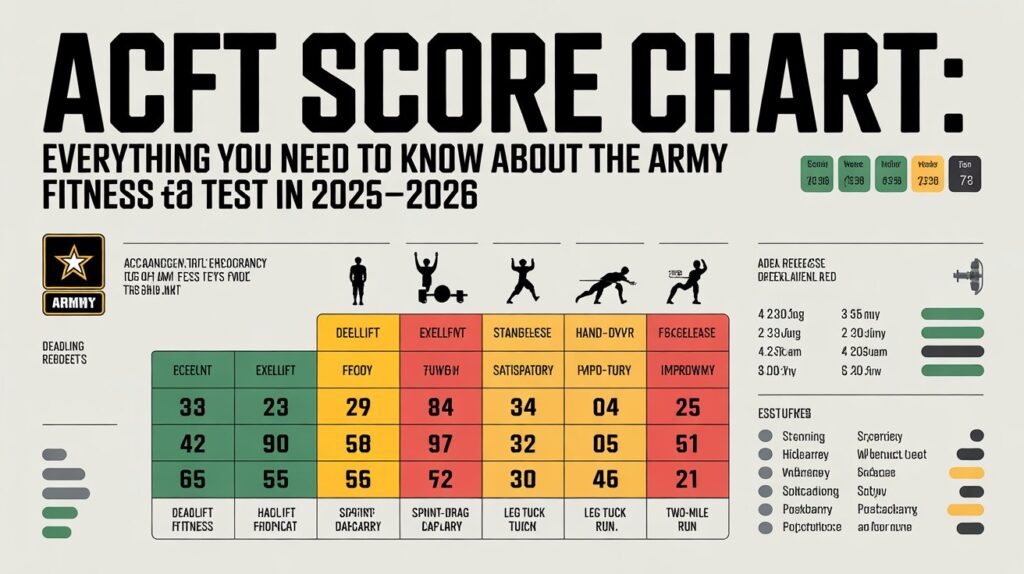
The Army divides soldiers into age brackets: 17–21, 22–26, 27–31, and so on all the way up to 62 and over. Each bracket has its own performance standards for each event.
Within those brackets, your gender also plays a role — but only in the general soldier category. If you’re in a combat role, the scoring becomes gender-neutral. Same standards for men and women in those jobs. That’s a major shift from how the Army used to do things.
Here’s how the math works:
- Every event has a point value between 0 and 100.
- You need at least 60 in every single event
- Your total must hit 300 (general soldiers) or 350 (combat roles)
- Fail even one event and you fail the whole test — no matter how high your other scores are
That last rule is important. A soldier who scores 100-100-100-100-55 has failed. Full stop. You can’t borrow points from strong events to cover a weak one.
The Scoring Breakdown by Event
Let me walk you through the real numbers in each event. These reflect the standards effective June 1, 2025.
Deadlift Score Examples (General Standard, Male, Age 17–21):
- 60 points: approximately 150 lbs
- 80 points: approximately 230 lbs
- 100 points: approximately 340 lbs
Hand-Release Push-Up Examples (General Standard, Male, Age 17–21):
- 60 points: 15 reps
- 80 points: approximately 35 reps
- 100 points: approximately 60 reps
Two-Mile Run Examples (General Standard, Male, Age 17–21):
- 60 points: approximately 18:00 minutes
- 80 points: approximately 15:30 minutes
- 100 points: approximately 13:30 minutes
Female standards are lower in general roles. For example, a female soldier aged 17–21 needs approximately 120 lbs for 60 points on the deadlift versus 150 lbs for males in the same group.
In combat roles, those female adjustments go away. Everyone lifting, running, and pushing to the same benchmark.
What Changed in 2025 — and Why It Matters
One event got quietly dropped — the medicine ball throw, which soldiers had nicknamed the “yeet event.” It’s gone now.
That leaves five events instead of six. The maximum score dropped from 600 to 500 as a result. Everything else remained largely intact.
The bigger change was the dual-standard system.
Before 2025, all soldiers used the same general scoring model with age and gender adjustments. Now there are two separate frameworks:
General Standard — For most soldiers. Age and gender adjustments apply. Total minimum: 300 points.
Combat Standard — For the 21 combat military occupational specialties (MOS) — think Infantry, Armor, Combat Engineer. No gender adjustments. Total minimum: 350 points.
This change came partly from a congressional mandate requiring higher combat fitness standards. It also came from Defense Secretary Pete Hegseth’s 2025 push to review fitness requirements across all branches.
Some people praised it as overdue. Others questioned how some roles — like cannon crew members and medics — were excluded from the combat category. The debate is real and ongoing.
Military Occupational Specialty (MOS) Categories — Explained Simply
Your job in the Army determines which scoring track you fall into.
For most of the ACFT’s original run, there were three tiers:
- Heavy — Most physically demanding jobs (originally required 70+ per event)
- Significant — Moderately demanding (65+ per event)
- Moderate — Less physically demanding (60+ per event)
The 2025 AFT simplified this into two tracks: Combat and General. But the principle is the same — not every soldier does the same job, and not every job has the same physical demands.
An infantry soldier might carry a 60-pound pack through rough terrain for hours. A signal technician might not. The test tries to reflect that reality without letting anyone completely off the hook for basic fitness.
Age Groups and Why They’re Fair
This is the part people misunderstand most often.
Some assume that different standards for different ages mean older soldiers get a free pass. That’s not right.
A 52-year-old soldier who scores 80 points on the run has put in comparable effort to a 22-year-old who scores 80 points. Their raw times will be different — the 22-year-old probably ran faster. But the point value reflects fitness relative to what’s biologically reasonable.
The Army looked at massive amounts of data to set those age-specific curves. A soldier at 55 who runs a 19-minute two-mile has genuinely worked for that score. The system respects that.
The ten age brackets cover soldiers from age 17 all the way to 62 and beyond. That range reflects the reality of modern military service — people serve for decades, and the Army needs a way to assess them fairly throughout.
What Happens If You Fail
Failing the ACFT or AFT has real consequences. Let’s be honest about that.
If you miss the minimum 60 points in any event, you fail. Your unit will be notified. You’ll get additional training support. And you’ll have a chance to retest.
But fail two consecutive recorded tests? The Army can move toward separating you from service. That’s in the official guidance and it’s not a bluff.
During the June 2025 transition period, the Army created a protection window. No administrative flags for failing the AFT through December 31, 2025. That gave soldiers time to adjust from ACFT standards to AFT standards.
Starting January 1, 2026, those protections went away for most situations. And starting that same date, combat MOS soldiers who don’t meet the higher combat standard face counseling and possible mandatory reclassification if they don’t improve.
For promotions: ACFT scores recorded before May 31, 2025 stayed valid through September 30, 2025. After October 1, 2025, only AFT scores count.
How Scores Affect Your Career
Most soldiers don’t think about this enough until it’s too late.
Your fitness score appears on your record. Promotion boards see it. School selection boards see it. Special assignment consideration involves it.
A high score — say, 450 out of 500 — sends a message. It says this soldier is disciplined, physically capable, and takes standards seriously.
A borderline score — hovering near 300 — doesn’t get you separated, but it might not help you stand out either.
One guide noted that a 570/600 ACFT score was worth highlighting in a résumé — civilian employers hiring veterans sometimes view that as proof of exceptional discipline and physical readiness. That logic holds for the AFT too. Exceptional fitness doesn’t just help your Army career. It travels with you.
Alternate Events: When Life Gets in the Way
What if you’re injured? What if a permanent medical condition stops you from running?
The Army has alternate aerobic events for exactly this situation. Swimming is one option. Walking is another. These kick in when a medical provider approves them.
Here’s the key rule: if you’re dealing with a temporary injury, you can use alternate events to train. But your score, official AFT, has to wait until you’re medically cleared. You don’t get a formal score — one that counts for records and promotions — until you can take the real test.
For permanent conditions, alternate events become part of your test. They’re assessed on a go/no-go basis rather than a point system in many cases.
Tips for Training Smart
Knowing the score chart is half the battle. Knowing how to train for it is the other half.
For the deadlift: Progressive overload is your best friend. Add small amounts of weight consistently over weeks. Your body adapts. The lift gets stronger. Don’t try to jump 50 pounds in a week.
For the push-ups: Practice the hand-release version specifically. Standard push-ups don’t carry over as well as people expect. Work on volume at first — lots of reps at lower intensity — then shift to quality.
For the sprint-drag-carry: This one needs both strength and speed. Train them separately, then combine. Sled drags build the pulling power. Sprint intervals build the speed. Do both.
For the plank: Daily practice works here. Hold your plank. Rest. Hold again. Over time, the baseline improves. Core stability transfers to every other event.
For the two-mile run: Interval training beats steady jogging for most soldiers trying to improve their time fast. Run hard for short bursts. Recover. Repeat. Your overall pace improves faster this way.
Mix in rest. Eat enough protein. Sleep. The Army’s Holistic Health and Fitness (H2F) system exists precisely because fitness isn’t just about grinding through workouts — recovery is part of the test.
The Bigger Picture
Here’s something worth thinking about.
The old APFT test — the push-ups, sit-ups, run test that ran from 1983 to 2020 — wasn’t changed because soldiers were failing it. Most soldiers passed it fine. It was changed because passing it wasn’t enough anymore.
Modern warfare is physically brutal in specific ways. Moving under load. Pulling injured teammates. Carrying equipment in body armor. The old test didn’t capture any of that.
The ACFT, and now the AFT, tries to measure whether a soldier can actually do what combat demands. That’s a harder test to build. It took years of research, millions of data points, congressional input, and real disagreement within the Army to get there.
Is the current test perfect? No test ever is. The debate about combat standards, gender-neutral scoring, and which jobs belong in which category will keep going. That’s healthy.
But the direction is right. A test designed around what soldiers actually face is better than one designed around what’s easy to measure on a track.
Final Words
The ACFT score chart — now the AFT score chart — is more than a table of numbers.
It’s a map of what the Army thinks physical readiness actually means. It changed from a simple three-event test to a five-event assessment because what soldiers need to survive in combat changed too.
Your 60-point floor in every event is non-negotiable. Your 300 or 350 total is your ceiling goal. Your age group shapes what those numbers look like in practice. Your job determines which standard you’re chasing.
If you’re preparing for the test, start with the event where you’re weakest. That’s where your score lives. Improve that first. Everything else is a bonus.
And if you’ve already passed — you’ve cleared a standard that was designed by looking at a million real soldiers in real conditions. That means something. Keep building.
FAQs
1. Is the ACFT still used in 2025?
Not exactly. The ACFT officially became the Army Fitness Test (AFT) on June 1, 2025. The structure is similar, but the standing power throw event was removed, and a new dual-standard system (combat vs. general) was introduced. ACFT scores recorded before May 31, 2025 remained valid through September 30, 2025.
2. What is the minimum score to pass the ACFT / AFT?
Every soldier must score at least 60 points in every single event. For general (non-combat) soldiers, the total minimum is 300 points. For soldiers in combat military occupational specialties, the total minimum is 350 points.
3. What is the maximum possible score?
The maximum total is 500 points under the AFT — 100 points per event across five events. Under the old six-event ACFT, the maximum was 600. The first perfect score under the ACFT was recorded in August 2019 by a soldier from the 22nd Chemical Battalion.
4. How many events are in the current test?
Five: the three-repetition maximum deadlift, hand-release push-up, sprint-drag-carry, plank, and two-mile run. The standing power throw (informally called the “yeet event”) was removed when the test became the AFT in June 2025.
5. Does the score chart change based on age?
Yes. Soldiers are placed into age brackets — 17–21, 22–26, 27–31, up to 62 and older — and each bracket has its own performance thresholds. The same point value corresponds to different raw performances across age groups.
6. Are scoring standards different for men and women?
It depends on your role. General standard soldiers have gender-adjusted scoring — women have lower raw performance requirements for the same point values. Combat MOS soldiers use gender-neutral standards, meaning the same requirements apply regardless of gender.
7. What happens if you fail one event but do well in the others?
You fail the entire test. There is no averaging or borrowing between events. A failing score in even one event — no matter how high your other scores are — means the whole test counts as a failure.
8. How often do soldiers take the test?
Active duty and active guard reserve soldiers take it twice per year. Soldiers in the National Guard and Reserve take it once a year.
9. What is the H2F system and how does it connect to the ACFT?
H2F stands for Holistic Health and Fitness. It’s the Army’s broader wellness framework that combines physical training with nutrition, sleep, mental health, and spiritual readiness. It’s the Army’s official approach to helping soldiers improve their fitness test performance through comprehensive health — not just gym work.
10. What are alternate aerobic events and who can use them?
Soldiers with medical conditions that prevent running can use alternate aerobic events — like swimming or walking — for the two-mile run portion. A medical provider must approve the alternative. Soldiers with temporary conditions can train with alternates but must take the official scored test once medically cleared.
11. Can you retake the ACFT / AFT if you fail?
Yes. The Army provides additional training support and a chance to retest. The retest must happen within a specific timeframe approved by your commander. Failing two consecutive recorded tests can lead to separation from the Army.
12. Does your ACFT score affect promotions?
Yes, directly. Promotion boards review fitness scores. ACFT scores from before May 31, 2025 were valid for promotions through September 30, 2025. After October 1, 2025, only AFT scores count for promotion consideration. Higher scores can improve your competitive standing.
13. What was the APFT and how is it different from the ACFT/AFT?
The APFT (Army Physical Fitness Test) was the Army’s fitness standard from 1983 until October 2020. It consisted of push-ups, sit-ups, and a two-mile run. The ACFT replaced it to better reflect combat-relevant physical demands. The biggest differences are the event types — deadlift, sled drag, and sprint-carry events simulate real combat tasks in ways that sit-ups never did.
Keep creating, innovating, and inspiring with Content Ideators every day.
