
Let’s Start With a Simple Picture in Your Head
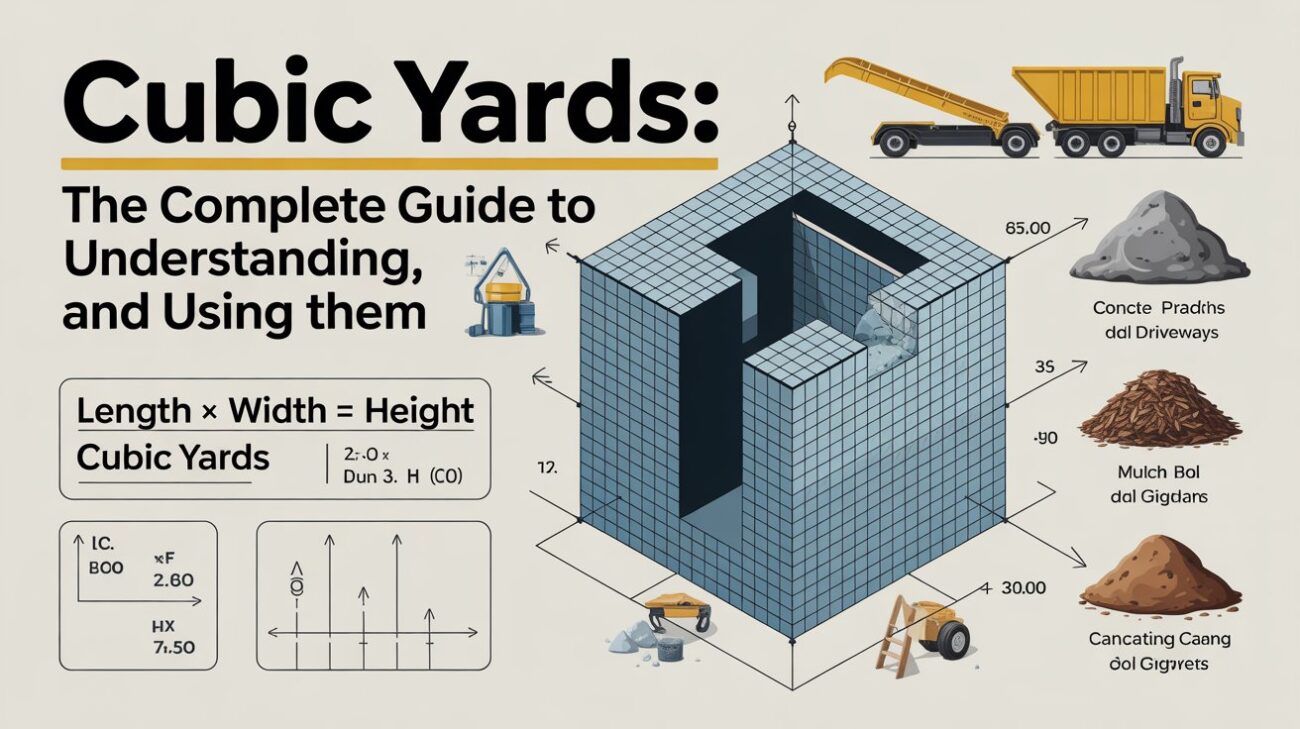
Imagine a big cardboard box sitting on your lawn.
This box is three feet tall. Three feet wide. Three feet deep. That’s it.
That box — that exact sized box — holds exactly one cubic yard.
That’s all a cubic yard is. It’s not complicated. It’s just a way of measuring how much space something fills up. And once you get it in your head, everything else clicks into place fast.
Quick Facts
| Fact | Detail |
| What it measures | Volume (how much space a material fills) |
| Equals in cubic feet | 27 cubic feet |
| Equals in cubic inches | 46,656 cubic inches |
| Equals in gallons | About 202 US gallons |
| Equals in liters | About 764.6 liters |
| Visual size | A cube that is 3 ft × 3 ft × 3 ft |
| Common comparison | About the size of a washing machine |
| Main formula | Length × Width × Depth (in feet) ÷ 27 |
| Used in | Construction, landscaping, concrete work, gardening, waste removal |
| Who uses it | Builders, landscapers, contractors, homeowners doing DIY projects |
| Weight of concrete per cubic yard | ~4,050 lbs |
| Weight of dry soil per cubic yard | ~1,944 lbs |
| Weight of gravel per cubic yard | ~2,700–3,400 lbs |
| Weight of dry mulch per cubic yard | ~400–800 lbs |
| Coverage at 3 inches deep | One cubic yard is equivalent to one hundred square feet. |
Why Does Anyone Need to Know This?
Great question. You might be wondering why this even matters.
Here’s the thing. When you go to a landscape supply yard and ask for topsoil, they’re not going to sell it to you by the bucket. They’re going to ask how many cubic yards you need.
The same goes for concrete. When a contractor pours your driveway, they don’t count bags. They order from a concrete truck by the cubic yard.
Mulch. Gravel. Fill dirt. Sand. Compost. Almost every bulk material sold outdoors is priced and measured by the cubic yard.
If you don’t know your cubic yards, you either overpay or run short. And running short in the middle of a project is truly frustrating.
See also “What Does ASL Mean in Text? Everything You Need to Know (2026)“
Where Does the Number 27 Come From?
This is the part a lot of people get confused about. Why do you divide by 27?
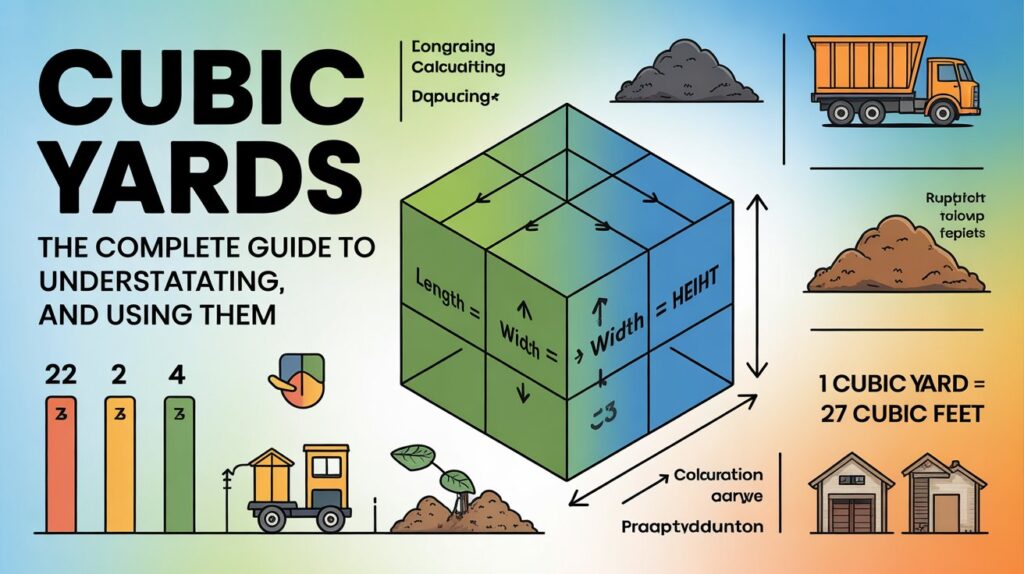
Here’s the answer in a nutshell. One yard equals three feet. So if you want to find the volume of a cube that is one yard on every side, you multiply 3 × 3 × 3. That gives you 27. So one cubic yard always equals exactly 27 cubic feet.
Every time you convert, that number 27 is your best friend.
You measure your area in feet. You multiply those feet together. Then you divide by 27. Boom. Cubic yards.
The Simple Formula — No Math Degree Needed
Ready? This is the whole formula:
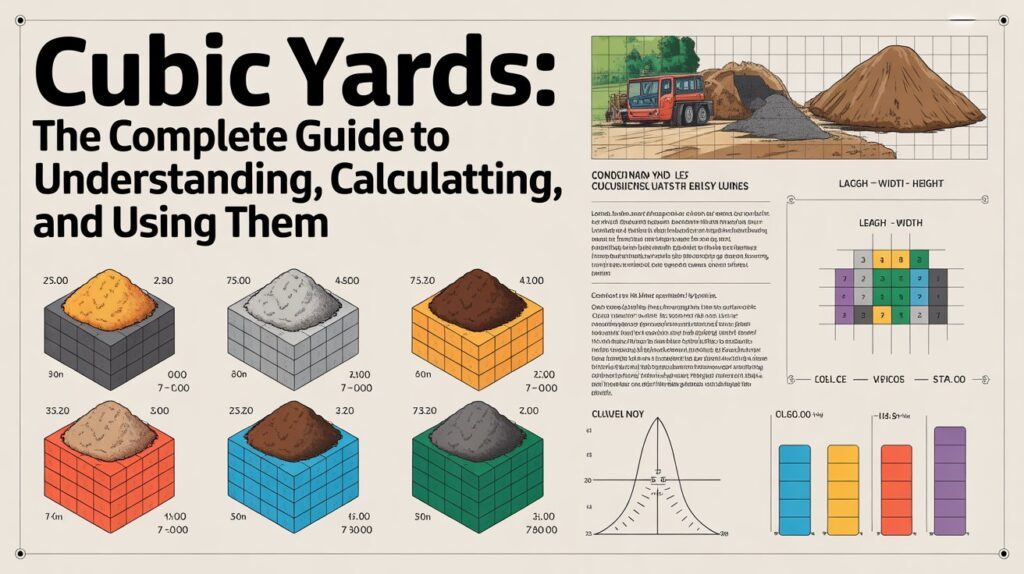
Cubic Yards = Length (feet) × Width (feet) × Depth (feet) ÷ 27
That’s the whole thing. That’s what every calculator on the internet is doing behind the scenes.
Let’s say you want to fill a garden bed. It’s 12 feet long, 6 feet wide, and you want the soil to be 6 inches deep.
First thing — convert those 6 inches to feet. Six inches is half a foot. So your depth is 0.5 feet.
Now multiply: 12 × 6 × 0.5 = 36 cubic feet.
Divide by 27. That’s 1.33 cubic yards.
So you’d order about one and a half cubic yards to be safe.
What If My Measurements Are in Inches?
This trips people up all the time. And honestly, it’s easy to fix.
Just divide your inch measurement by 12. That turns it into feet. Then use the formula like normal.
So if your depth is 4 inches, divide 4 by 12. That’s 0.33 feet. Easy.
And if your measurements are all in inches — everything, not just the depth — you’d divide by 46,656 at the end instead of 27. That’s because 36 × 36 × 36 = 46,656. But most people just convert to feet first and divide by 27. Way less confusing.
The Washing Machine Test
Here’s a fun thing to do next time you’re standing in your kitchen.
Walk over to your washing machine. Look at it. A standard top-loading washing machine is roughly the size of one cubic yard.
That’s your mental image from now on. When someone says “I need three cubic yards of gravel,” picture three washing machines worth of stone sitting in your driveway. Suddenly it becomes real. It’s a lot of stuff.
This matters because people drastically underestimate how much material they’re ordering. Or they overestimate. Having that washing-machine picture in your head helps a lot.
What Different Materials Weigh Per Cubic Yard
Now here’s something really important that a lot of beginners miss.
A cubic yard of mulch and a cubic yard of gravel take up the same amount of space. Same size box. But they do NOT weigh the same. Not even close.
That difference matters when you’re loading your truck. Pile in the wrong stuff and you can blow out your suspension, damage your vehicle, or get ticketed for being overloaded on the road.
Here’s what common materials weigh per cubic yard:
- Concrete (fresh, wet): About 4,050 lbs — heavier than most cars
- Gravel (dry): About 2,700–2,900 lbs — still extremely heavy
- Gravel (wet): Can climb to 3,375 lbs
- Sand (dry): About 2,700 lbs
- Topsoil: Around 2,000–2,200 lbs depending on moisture
- Fill dirt (dry): About 1,944 lbs — gets heavier fast when wet
- Compost: Around 1,000–1,300 lbs
- Bark mulch (dry): Only about 400–800 lbs — the lightest common material
Notice how mulch is basically a fraction of what concrete weighs. Same volume. Completely different weight.
Fresh, wet concrete in that three-foot cube? You’re looking at over two tons of weight sitting in your driveway. That’s heavier than most cars. You cannot hand-mix that. You cannot haul much of it in a pickup. Concrete trucks exist for a reason.
How Much Can Your Truck Actually Carry?
This is where people make expensive mistakes. Let’s be very clear.
Your standard full-size pickup truck — an F-150, a Silverado, that kind of thing — can safely carry maybe one to two cubic yards of soil before you’re pushing your luck on the suspension. For gravel or stone, you really want to stay at about one cubic yard and call it good.
But mulch? Your truck can handle two to three cubic yards of dry mulch without breaking a sweat. It’s just not that heavy.
Here’s a rough guide for hauling:
- Small pickups (Ranger, Tacoma, small truck): About 1 cubic yard of soil or gravel; 2–3 cubic yards of mulch
- Full-size pickups (F-150, Silverado, Ram): 1–2 cubic yards of soil; 2–4 cubic yards of mulch; 1 cubic yard of gravel max
- Heavy-duty trucks (F-250, 2500 series): 2–3 cubic yards of heavy material
- Small dump truck: About 5–8 cubic yards
- Large dump truck: 10–14 cubic yards or more
When in doubt, call your supply yard before you load up. They’ve seen every type of vehicle and they’ll tell you what’s safe.
What Can One Cubic Yard Actually Cover?
The majority of homeowners genuinely seek an answer to this question. . Great news — there’s a simple rule you can remember.
One cubic yard spread three inches deep covers about 100 square feet. That’s a 10-foot by 10-foot patch of ground.
But the depth changes everything. Here’s how coverage shifts:
- 1 inch deep: 1 cubic yard covers 324 square feet
- 2 inches deep: 1 cubic yard covers 162 square feet
- 3 inches deep: 1 cubic yard covers about 100–108 square feet
- 4 inches deep: 1 cubic yard covers about 81 square feet
- 6 inches deep: 1 cubic yard covers about 54 square feet
So if you’re laying mulch for a garden bed that’s 20 feet × 15 feet at 3 inches deep, you’ve got 300 square feet to cover. Three cubic yards should do it. Maybe order a little extra just to be safe.
Real-World Projects Where Cubic Yards Matter Most
Let’s walk through the situations you’re most likely to encounter.
Concrete driveways and sidewalks. One cubic yard of concrete covers about 81 square feet at 4 inches thick. A typical two-car driveway might need anywhere from 8 to 15 cubic yards depending on size. Concrete comes in trucks, and most companies have minimum order requirements. Understand this before you call.
Garden beds and mulch. Mulch is usually laid 2–4 inches deep. Three inches is the sweet spot for weed control without suffocating your plants. For a 10×10 bed at 3 inches, you need about 1 cubic yard. Easy to pick up yourself in a truck or even order delivery.
Topsoil for lawns. Spreading new topsoil 4 inches deep over a 500 square foot area takes about 6 cubic yards. That’s a significant order. Plan ahead and check delivery times during spring rush season — supply gets tight fast.
Gravel for driveways. A 20-foot driveway that’s 10 feet wide and 3 inches deep needs about 1.85 cubic yards. Round up to 2. Gravel is heavy, so you’ll likely need delivery rather than hauling it yourself.
Fill dirt for leveling. If you’re filling a hole or leveling a yard, calculate the depth carefully. Uneven areas need you to measure at multiple spots and take the average depth. One bad measurement can throw the whole order off.
Concrete foundations. This is where getting the math right really matters. Too little concrete and you stop the pour mid-job. Too much and you’re paying for material sitting in a truck. Always add a small buffer — about 5–10% extra — to account for spills and uneven forms.
The Most Common Mistakes People Make
Let me save you some real headaches. These mistakes happen all the time.
Forgetting to convert inches to feet. You measure your depth as 4 inches and just type 4 into the formula without converting. Suddenly your calculation is wildly off. Always convert inches to feet first. Divide by 12.
Mixing up square yards and cubic yards. Square yards measure area — like a flat surface. Cubic yards measure volume — including depth. They’re completely different. A 10×10 yard area is 100 square yards. But to fill that same area 3 inches deep, you need about 0.93 cubic yards. Very different numbers.
Ordering exactly what you calculated. Order a little extra. Always. Material settles, spills, and fills unevenly. Ordering exactly what you calculated and nothing more is a great way to end up making two trips. A 10–15% buffer is standard advice from every contractor worth their salt.
Overloading your vehicle. This has already been discussed, but it’s important to reiterate. . Gravel and soil are brutally heavy. Know your payload limit before you drive to the supply yard.
Not checking with your supplier. Suppliers often won’t sell fractional yards — like 0.93 cubic yards. They might round up to a full yard. Ask before you order so you know what you’re paying for.
How Wet vs. Dry Changes Everything
Here’s something almost nobody thinks about until it bites them.
The same material weighs dramatically more when it’s wet.
Dry fill dirt? About 1,944 lbs per cubic yard. After rain soaks in? That same cubic yard can hit 2,500–3,000 lbs. That’s a 50% weight jump just from moisture.
This affects your truck load. It affects what your ground can handle. And if you’re having heavy material delivered, the delivery truck parked on your lawn after a rainstorm can leave tire ruts that take the whole summer to fix.
Always ask your supplier about the current moisture conditions of the material before you pick it up or have it delivered.
A Note on Price and Buying Smart
Material prices vary quite a bit by location and season. But here are rough ballparks so you know what to expect:
- Topsoil: $25–$55 per cubic yard
- Mulch: $20–$40 per cubic yard
- Gravel: $35–$75 per cubic yard
- Concrete (delivered): $100–$150 per cubic yard or more
Buying in bulk is almost always cheaper per cubic yard than buying bags. But delivery fees can change that math if you only need a small amount.
Call local suppliers and compare. Get quotes from two or three places. And ask about minimums — some suppliers won’t deliver fewer than 5–10 cubic yards. Small projects might be cheaper if you pick up yourself.
Cubic Yards vs. Cubic Meters: A Quick Note for Metric Users
If you’re used to metric measurements, here’s the bridge between the two worlds.
One cubic yard equals about 0.7646 cubic meters. One cubic meter equals about 1.308 cubic yards.
If you’re working with metric measurements like centimeters or meters, multiply them together in meters and you’ll get cubic meters. Then multiply by 1.308 to convert to cubic yards.
Most construction material in the US is sold in cubic yards. Most of the rest of the world uses cubic meters. Just know which system your supplier uses so there’s no confusion at the supply yard.
Different Shapes — Not Everything Is a Rectangle
Here’s something useful if your project isn’t a simple rectangle.
Cylinder (like a circular planter or round pool): Volume = π × radius² × depth (in feet) ÷ 27
Triangle-shaped areas: Volume = (½ × base × height × depth) ÷ 27
Irregular shapes: Break the area into sections. Calculate each section’s cubic yards separately. Add them together.
It sounds complicated but it really isn’t that bad once you break things into smaller pieces. The key is always converting everything to feet before multiplying, then dividing by 27 at the very end.
Final Words
Cubic yards might sound like contractor talk. But once you spend five minutes with the formula, it’s just basic multiplication.
Measure your length. Measure your width. Measure your depth. Convert everything to feet. Multiply the three numbers. Divide by 27.
That’s a cubic yard. That’s the washing machine in your head. That’s the number you call into your landscape supply yard with confidence.
Get the math right and you save money. You make one trip instead of three. You finish the project on time. And your driveway, garden bed, or concrete slab looks exactly the way you planned.
It’s worth learning. Not just once — but every time you start a project. Because everything changes when you know your numbers.
FAQs
1. What is a cubic yard exactly?
A cubic yard is a unit of volume. It’s the space inside a cube that measures three feet on every side — height, width, and depth. That works out to 27 cubic feet. Think of it as roughly the size of a standard top-loading washing machine.
2. How do I calculate cubic yards?
Measure your area in feet — length, width, and depth. Multiply all three numbers together. Divide that result by 27. The answer is your cubic yards. If your depth is in inches, divide the inches by 12 first to convert to feet.
3. One cubic yard is equivalent to how many cubic feet?
Exactly 27 cubic feet. This is because one yard equals three feet, and 3 × 3 × 3 = 27. Every cubic yard conversion comes back to that number.
4. How much does one cubic yard weigh?
It completely depends on the material. Dry mulch weighs about 400–800 lbs. Topsoil weighs around 1,944–2,200 lbs. Dry gravel runs about 2,700–2,900 lbs. Wet concrete is the heaviest common material at around 4,050 lbs per cubic yard.
5. How much area does one cubic yard cover?
At three inches deep, one cubic yard covers about 100 square feet — a 10×10 patch. At two inches deep it covers about 162 square feet. At four inches deep, about 81 square feet. The shallower you spread, the more ground it covers.
6. Can I haul a cubic yard in my pickup truck?
Maybe — but it depends on the material. One cubic yard of dry mulch? No problem for most trucks. One cubic yard of gravel or soil? You’re near or at the limit for a standard half-ton pickup. Wet soil or concrete is too heavy to haul safely for most consumer trucks. Always check your truck’s payload rating first.
7. What is the difference between square yards and cubic yards?
Square yards measure flat area — like how much carpet covers a floor. Cubic yards measure volume — how much material fills a three-dimensional space. You need to know the depth to go from square yards to cubic yards.
8. Why do suppliers sell in cubic yards instead of pounds or bags?
Bulk materials are easiest to price and transport by volume. Weighing out thousands of pounds for every customer order would be impractical. Cubic yards give suppliers and buyers a consistent, easy-to-estimate unit that works for trucks, delivery, and job planning.
9. Should I order more than my calculation says?
Yes. Always add 10–15% extra. Material settles, compresses, spills, and fills unevenly. If your project calculates to exactly 3 cubic yards, order 3.3 or 3.5. The small extra cost is worth never running short halfway through.
10. How does moisture affect cubic yard weight?
Significantly. Dry fill dirt might weigh around 1,944 lbs per cubic yard. After heavy rain, that same material can hit 2,500–3,000 lbs. That’s a 25–50% weight increase. Always ask your supplier about moisture conditions, especially if you plan to haul it yourself.
11. What distinguishes a ton from a cubic yard?
A cubic yard measures volume. A ton measures weight. They are not interchangeable. The relationship between the two depends entirely on the density of the material. Mulch and gravel are both sold by the cubic yard, but mulch weighs a fraction of what gravel does per cubic yard.
12. How many cubic yards does a dump truck hold?
It varies by truck size. Small dump trucks typically carry 5–8 cubic yards. Large dump trucks handle 10–14 cubic yards or more. If you’re ordering a big delivery, confirm the truck capacity with your supplier so you know how many loads the project will take.
13. Can I use a cubic yards calculator for irregular shapes?
Yes — but you need to break the shape into smaller sections first. Calculate the cubic yards for each rectangular, circular, or triangular section separately. Then add all the results together. Online calculators handle rectangles and cylinders directly, but irregular shapes require splitting the area into manageable pieces.
Keep creating, innovating, and inspiring with Content Ideators every day.
