
Quick Facts
| Detail | Info |
| Date of Sinking | April 14–15, 1912 |
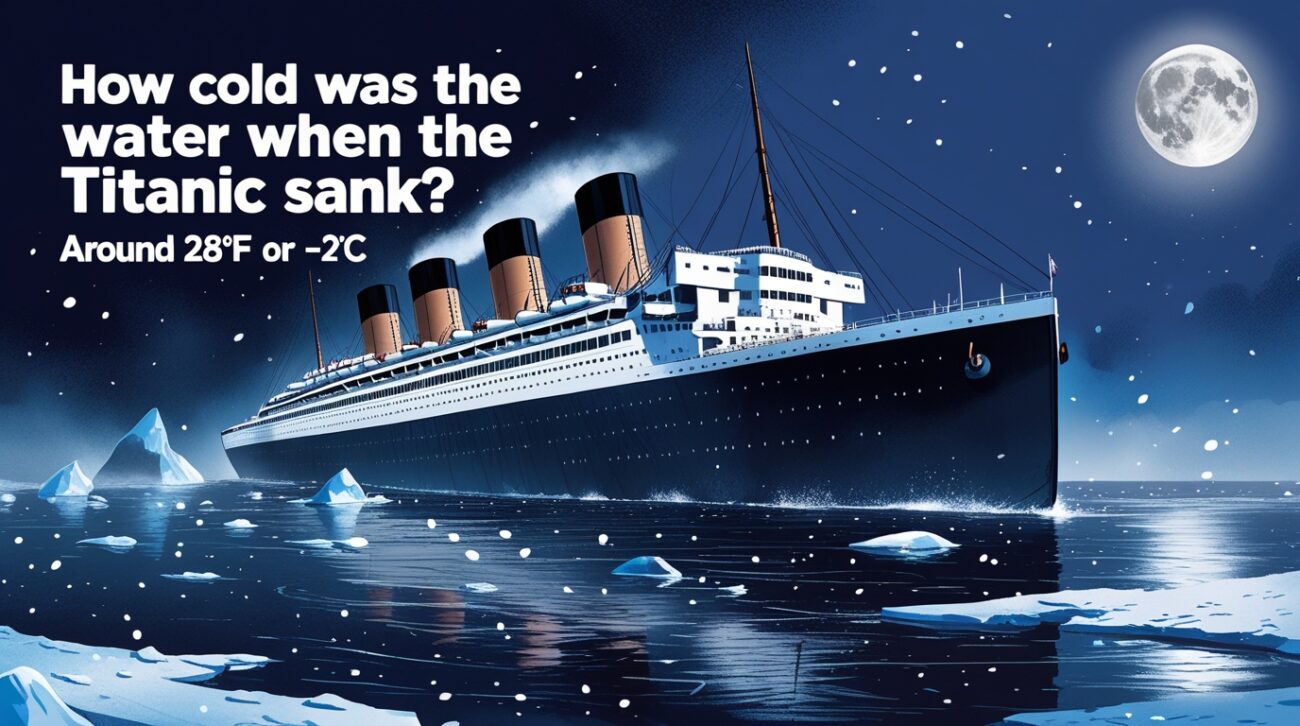
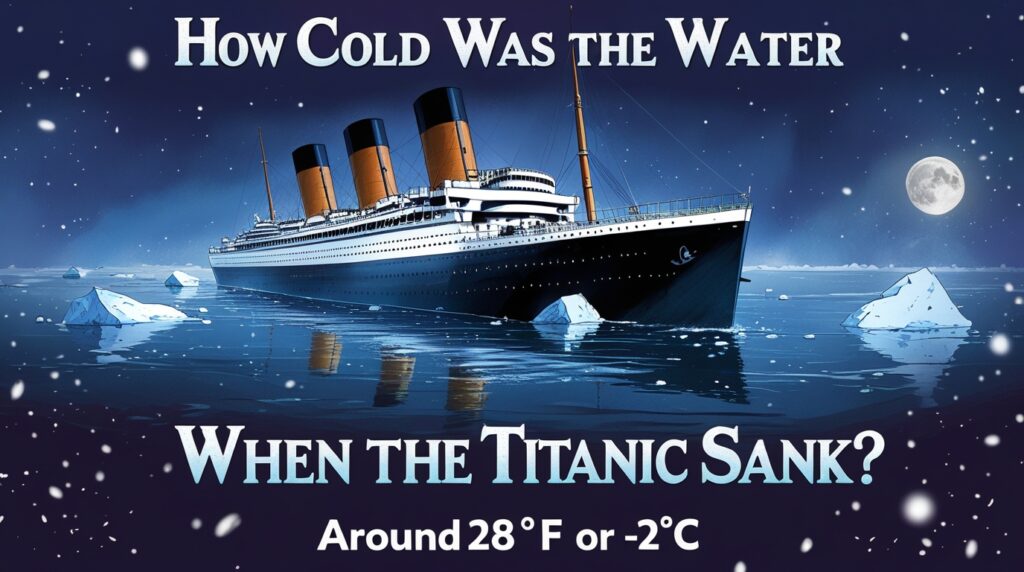
| Water Temperature | 28°F / -2°C |
| Air Temperature | 39°F / 4°C |
| Location | North Atlantic Ocean |
| Time Iceberg Was Hit | 11:40 PM |
| Time Ship Fully Sank | 2:20 AM |
| People On Board | ~2,224 |
| People Who Died | ~1,500 |
| People Rescued | ~710 |
| Rescue Ship | RMS Carpathia |
| Carpathia’s Arrival | ~4:00 AM (about 1.5 hrs after sinking) |
| Lifeboats Available | 20 (needed ~64 for everyone) |
| Time to Lose Consciousness in That Water | 15–30 minutes |
The Number That Changed Everything
28 degrees Fahrenheit.
That’s the temperature of the water the night the Titanic went down.
Sit with that for a second. Your freezer at home is probably set around 0°F. The water those 1,500 people fell into was only 28°F. Below freezing. Below the point where fresh water turns to ice.
And yet it was still liquid. Not frozen. Just dark, black, and silent — and cold enough to kill you in minutes.
That one number — 28°F — tells you almost everything you need to know about why so many people died that night.
See also “Illinois Public Act 101-0038 Task Force: The Law That Said Enough Is Enough“
Why Was the Water So Cold? It Wasn’t Just Bad Luck
People often assume the water was cold because of the iceberg. But that’s not quite right.
The North Atlantic Ocean near Newfoundland is just naturally that cold in April. It’s one of the coldest stretches of open ocean on the entire planet during spring. The Titanic was sailing through a region where icebergs drift south from Greenland and the Arctic, dragging frozen temperatures with them.
On top of that, weather records from that night show that temperatures were running 8 to 14 degrees colder than normal for that time of year. A powerful cold front was sweeping down from eastern Canada and pushing temperatures even lower than usual. The air on deck that night was only about 39°F. Passengers who stepped outside said it felt sharp and biting.
The iceberg the ship hit around 11:40 PM? That wasn’t the cause of the cold water. The cold water was already there, waiting.
Why Didn’t the Water Freeze Solid?
This is something a lot of people wonder about.
If the water was below freezing, shouldn’t it have been ice?
No. And here’s why: seawater has salt in it. Salt changes the rules.It reduces the freezing point of water. At precisely 32°F, ordinary fresh water turns into ice. Before saltwater freezes, its temperature must decrease somewhat, closer to 28°F.
The ocean that night was right on the edge. But it stayed liquid. And that actually made things worse for the people in it. Solid ice couldn’t kill you the way liquid water at 28°F could. Cold water pulls heat out of a human body 25 times faster than cold air does.
You could stand outside in 28°F air for hours. You couldn’t survive in 28°F water for even 30 minutes.
What Happened to Your Body the Second You Hit That Water
Here’s the part that most people don’t fully understand.
When your body hits water that cold, the first danger isn’t hypothermia. It’s a shock.
The moment someone went under or even just touched the surface, their body screamed. Every nerve fired at once. The cold hit the skin like broken glass. Second Officer Charles Lightoller — one of the most famous survivors — said it felt like a thousand knives being driven into his body all at once. He was a tough, experienced sailor. That was his description.
The body reacts violently. Without any control or choice, you gasp. Hard. You hyperventilate. Your heart rate shoots up. This is called cold shock, and in those first 30 to 90 seconds, it can kill you just by making you inhale water.
Many people who had life jackets on died face-down in the water within minutes — not from the cold, but from that initial gasp. Their lungs took in water before they could do anything about it.
Here’s something even stranger: at the same time your heart is racing from the shock, cold water touching your face sends a different signal to your brain. A reflex called the diving response tells your heart to slow down. So your heart is getting two completely opposite orders at once — speed up, slow down, speed up, slow down. Researchers call this autonomic conflict. For some people, that alone causes cardiac arrest.
Stage 1: Cold Shock (0–3 minutes) Gasping, hyperventilating, panic. Risk of drowning or cardiac arrest.
Stage 2: Cold Incapacitation (3–30 minutes) Your muscles stop obeying you. Your fingers go numb first. Then your arms. Then your legs. Even experienced swimmers cannot stay afloat once this sets in.
Stage 3: Hypothermia (after 30 minutes) Your core body temperature starts dropping below 95°F. Shivering. Confusion. Drowsiness. Then unconsciousness.
In water at exactly 28°F, most people would lose consciousness within 15 to 30 minutes. Death would follow within an hour or so. But many passengers didn’t even make it past stage one.
Most People Didn’t Die of Hypothermia — They Died Faster
This surprises a lot of people, but doctors and scientists have largely agreed on it.
Hypothermia — where your body temperature slowly drops — takes time. It’s what happens when you’re slowly exposed to cold. But at 28°F, the ocean wasn’t slowly doing anything. It was immediate and violent.
Professor Michael Tipton from Portsmouth University, who has spent his career studying cold water survival, says most Titanic victims died from cardiac arrest or from inhaling water during the initial cold shock. The official hypothermia theory has been reassessed. Death came faster than that.
Survivors in the lifeboats reported hearing screaming from the water. Hundreds of voices. Some researchers estimate the screams lasted about 40 to 45 minutes, then went silent. That silence wasn’t everyone being rescued. That was everyone dying. Very fast. All at once.
Think about what it was like to be in one of those lifeboats, listening to that.
How We Know the Water Was Exactly 28°F
This is actually a fascinating piece of history.
The SS Californian was another ship sailing through the same stretch of North Atlantic that night. It was close enough to the Titanic that some experts believe it could have helped if it had responded to distress signals. Its captain, Stanley Lord, was taking water temperature readings throughout the evening and reported them to investigators afterward.
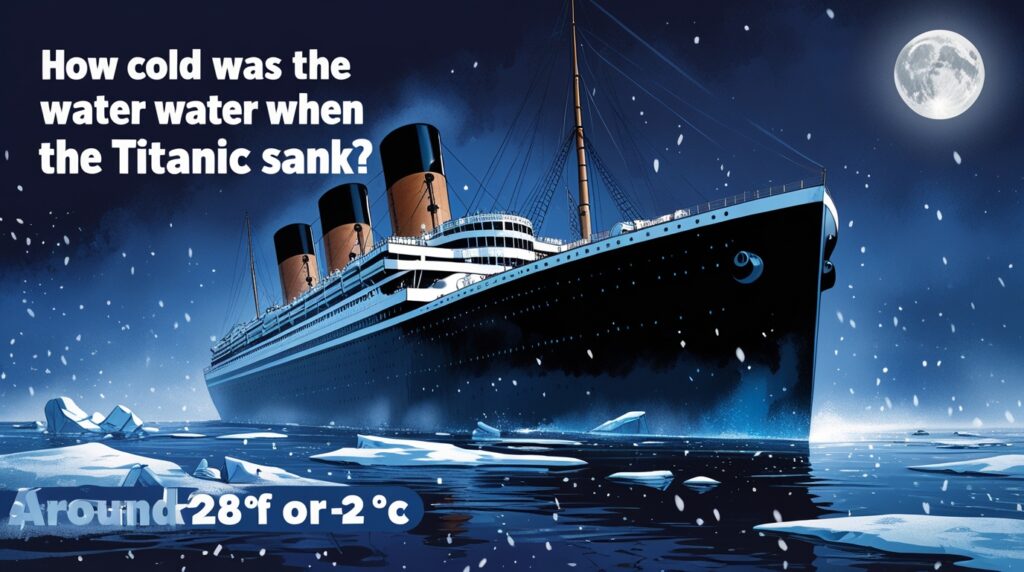
Those readings — 28°F, or -2°C — became the official record of what the water temperature was when the Titanic sank.
Captain Rostron of the Carpathia, the ship that eventually rescued survivors, described arriving at dawn to a scene of icebergs everywhere. He counted around 20 icebergs that were over 200 feet tall. The ocean was a minefield. And every drop of it was almost impossibly cold.
The Lifeboats Were Half Empty
Now here’s something that makes the story even more tragic.
The Titanic had 20 lifeboats. Those 20 boats could hold about 1,178 people combined. But the ship was carrying over 2,200 people, so not everyone could get into a boat even if things had gone perfectly.
Things did not go perfectly.
Because passengers initially didn’t believe the ship was really sinking, many refused to get into the lifeboats. The first lifeboat launched had space for 65 people. It left with 28. Barely half full. That happened repeatedly throughout the night.
Some experts believe that if the lifeboats had simply been filled to capacity, hundreds more people would have survived.
But even those lucky enough to get into a lifeboat weren’t safe from the cold. People sat in open wooden boats in 39°F air, soaking wet, for hours. Some were wearing just their nightclothes. By the time the Carpathia arrived, some lifeboat passengers had mild hypothermia themselves.
Survival Time: A Cold Guide
To put the temperature in perspective, here’s how survival times compare in different water temperatures:
- 28°F (-2°C): 15–30 minutes before unconsciousness; death within 1 hour
- 32°F (0°C): Up to 45 minutes before unconsciousness
- 50°F (10°C): 1–2 hours survival possible
- 70°F (21°C): 2–7 hours; hypothermia risk still real
- 75–85°F (24–29°C): Many hours; Caribbean water range
The Titanic went down in about the coldest open ocean water humans can survive in at all. Even 10 degrees warmer would have saved countless lives. Even the Caribbean, at 80°F, gives a person hours instead of minutes.
If the Titanic had somehow sunk in tropical water, almost everyone with a life jacket probably would have made it. The Carpathia arrived about 1.5 hours after the ship went under. In warm water, that would have been enough. In 28°F North Atlantic water, it was far too late for most.
The Carpathia: Racing Through Ice to Get There
The RMS Carpathia was about 58 miles away when it picked up the distress signal just after midnight.
Its captain, Arthur Rostron, knew the risks. His ship’s top speed was about 14.5 knots. He ordered extra stokers to fire the boilers and cut off heating and hot water to all passenger areas to channel every ounce of steam to the engines. The ship pushed to 17 knots — faster than it had ever gone.
He also ordered rockets fired every 15 minutes so Titanic survivors would know help was on the way. He set up doctors, blankets, soup, and warm coffee. Officers gave up their own cabins.
The Carpathia arrived at 4:00 AM. The Titanic had gone under at 2:20 AM. That’s one hour and forty minutes in the water.
By 4:00 AM, there was almost nobody alive in the water to rescue.
The Carpathia spent the next four and a half hours pulling lifeboat after lifeboat alongside and hoisting people aboard. It rescued 706 people. When crews looked at the water itself — where over a thousand people had gone in — Captain Rostron reported seeing only one body.
Where had they all gone? The cold had taken them. Most bodies had sunk or drifted away in the dark.
The Baker Who Survived Two Hours in That Water
His name was Charles Joughin, and his story is one of the most unbelievable in the whole disaster.
Joughin was the head baker on the Titanic. On the night of the sinking, before going into the water, he had been drinking. He helped load women and children into lifeboats. He threw about 50 deck chairs into the ocean so people would have something to cling to. He stayed on the ship until the very end, then stepped into the water almost casually as the stern went under.
He then treaded water for approximately two hours.
Two hours. In 28°F water. While everyone around him died within 30 minutes.
How? Nobody is completely certain. The most popular theory is that the alcohol in his blood kept him calm, prevented the panic-induced hyperventilation that kills most people in the first minutes, and may have slowed the progression of his cold shock response. Eventually he found an overturned lifeboat and clung to the side until morning.
When he was pulled onto the Carpathia, his only medical complaint was swollen feet.
He wasn’t trembling with hypothermia. He wasn’t unconscious. He walked around the Carpathia helping other survivors and assisted the ship’s bakers in making food.
Doctors have studied his case for decades. While nobody recommends drinking whiskey as a survival strategy, the combination of his calm, his movement (treading water generates some warmth), and the timing all came together in a way that almost defies explanation.
Between 44 and 48 people survived being in the actual water that night. Joughin was the most remarkable of all of them.
What If the Titanic Had Sunk Somewhere Warmer?
This is a thought that’s hard to shake.
Almost all of the passengers who went into the water had life jackets on. If the water had been warmer — say, 70°F like somewhere off the coast of Florida — most of them would still have been alive when the Carpathia arrived. They would have been rescued.
But here’s the cruel irony: if the water had been warmer, there would have been no iceberg. Icebergs exist because the water is cold enough to form and carry them. No cold water means no iceberg. No iceberg means no sinking.
The cold killed the ship. The cold killed the people. They were connected from the very beginning.
What Changed After the Titanic
The disaster shocked the entire world. Over 1,500 people died in a single night — in a ship that was supposed to be the safest ever built.
Within two years, the International Convention for the Safety of Life at Sea (SOLAS) was signed. This agreement, which still guides maritime safety today, changed the rules forever:
- There must be enough lifeboats on board for every passenger.
- Lifeboat drills became mandatory for passengers and crew
- 24-hour radio watches became required on ships at sea
- The International Ice Patrol was created to track icebergs in the North Atlantic
The cold water of that April night in 1912 changed how the whole world thinks about safety at sea.
Final Words
The Titanic didn’t just sink because of an iceberg.
It sank into water that was barely above the freezing point of the ocean itself. Water was so cold that a healthy adult couldn’t stay conscious in it for more than half an hour. Water that turned a maritime disaster into an almost total slaughter.
Every now and then, visitors to the Titanic Museum in Pigeon Forge, Tennessee can stick their hand into a tank of water kept at exactly 28°F. Just their hand. Just for a moment. Most people can’t keep it in for more than 30 seconds.
Over 1,500 people were submerged in that, in the dark, in the middle of the night, in the middle of the ocean, with no help coming for hours.
The cold is the part of this story that never gets talked about enough. It’s the silent, invisible killer behind the famous iceberg. And it was more efficient at taking lives than anything the ship’s designers had ever imagined facing.
FAQs
1. How cold was the water when the Titanic sank?
The water was 28°F (-2°C). That’s below the freezing point of fresh water but just above the freezing point of saltwater. It was about as cold as open ocean water gets on Earth without actually turning solid.
2. Why didn’t the water freeze if it was below 32°F?
Salt lowers the freezing point of water. Seawater needs to reach around 28°F or lower before it freezes, compared to 32°F for fresh water. The North Atlantic that night was right at that edge — liquid, but just barely.
3. How long could a person survive in 28°F water?
Most people would lose consciousness within 15 to 30 minutes. Death would follow within an hour. However, many Titanic victims died much faster than that — within minutes — due to cardiac arrest or inhaling water during the initial cold shock.
4. Did the majority of Titanic fatalities perish from cold or drowning?
Neither, in the traditional sense. Modern research suggests most victims died of cardiac arrest or cold shock within the first few minutes. Those who survived longer would then face hypothermia. Actual slow-onset hypothermia had little time to set in before most people were dead.
5. How do we know the exact water temperature?
Captain Stanley Lord of the SS Californian was sailing through the same stretch of North Atlantic that night and took water temperature readings. He later provided those readings — 28°F / -2°C — to investigators.
6. Why didn’t the Carpathia get there faster?
The Carpathia was already pushing its engines beyond their rated limit, going 17 knots instead of its usual 14.5. It was also navigating through ice fields in the dark. It traveled 58 miles and arrived in about 1 hour and 40 minutes after the Titanic sank. That was genuinely heroic speed. It just wasn’t fast enough to save those in the water.
7. How many people survived being in the actual water?
Between 44 and 48 people are believed to have survived after going into the ocean. Most were pulled into lifeboats very quickly.Few remained in the water for any considerable amount of time.
8. Who was Charles Joughin and how did he survive so long?
Joughin was the Titanic’s head baker. He treaded water for approximately two hours in 28°F water and emerged with nothing worse than swollen feet. The leading theory is that alcohol in his system kept him calm and may have delayed the initial cold shock response. He was also continuously moving, which helps generate some body heat.
9. Would more people have survived if the water was warmer?
Almost certainly yes. Nearly all passengers had life jackets. If the water had been 70°F instead of 28°F, most could have survived for hours until rescued. However, if the water had been warm enough, there would have been no iceberg — so the ship likely wouldn’t have sunk at all.
10. Why did so many lifeboats leave half empty?
Many passengers initially refused to board because they didn’t believe the ship was really sinking. It looked, felt, and sounded more stable than expected in the first hour. By the time people realized it was truly going down, some boats had already departed. The first lifeboat left with only 28 people in a boat designed for 65.
11. What were the air temperature and weather conditions that night?
The temperature of the air was around 39°F (4°C), which is frigid but normal for the open North Atlantic. No breeze was present, and the sky was clear. The sea was perfectly calm and flat, which actually made matters worse because calm water doesn’t warn of approaching icebergs because there aren’t any waves crashing into it.
12. What safety changes came from the Titanic disaster?
The International Convention for the Safety of Life at Sea (SOLAS), signed in 1914, required ships to carry enough lifeboats for everyone aboard, mandated 24-hour radio watches, created the International Ice Patrol, and made lifeboat drills compulsory. These rules still govern ocean travel today.
Keep creating, innovating, and inspiring with Content Ideators every day.
