

The Sunday night dread is a familiar feeling for many business owners. It starts around 7:00 PM, just as the reality of the coming week settles in. You remember the pile of receipts in your glove box, the unreconciled transactions in your bank feed, and that lingering doubt about whether you actually made money on that last project. Instead of preparing for a high-level strategy meeting or spending time with family, you find yourself squinting at a spreadsheet, trying to remember if a specific Amazon purchase was for office printer toner or a birthday gift. When your evenings and weekends are consistently consumed by financial admin, looking into outsourcing bookkeeping services is often the first step toward reclaiming your role as a CEO rather than a data-entry clerk.
Many founders treat bookkeeping like a chore that just needs to be “done,” but this perspective overlooks the foundational role that financial data plays in scaling. As a business grows, the distance between the owner and the actual numbers tends to widen. This gap creates a specific kind of operational friction. You stop making decisions based on real-time data and start relying on “gut feel” or bank balances that haven’t been updated in three weeks. This is where growth starts to feel like a burden rather than a victory.
Why Does Bookkeeping Become a Major Time Drain?
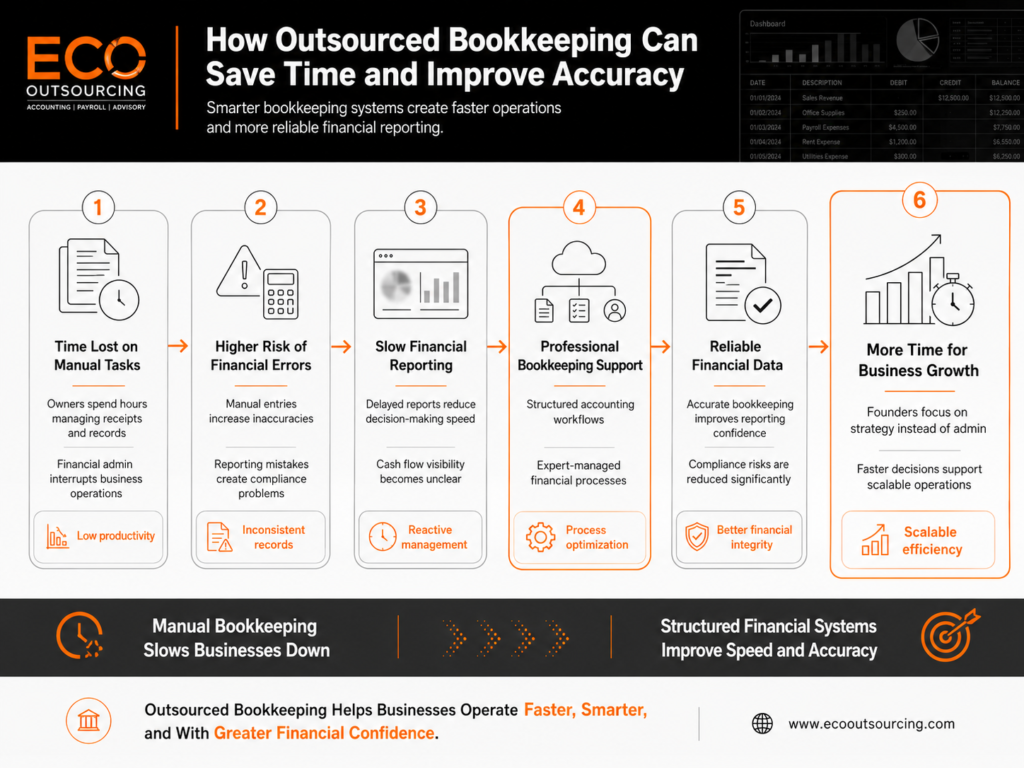
Bookkeeping is a sneaky thief. It doesn’t usually become overwhelming overnight; it creeps up on you. In the early days, managing five invoices and ten expenses a month feels manageable. However, as transactions increase and your operations expand, the sheer volume of data begins to outpace your available hours. VAT responsibilities become more complex, especially if you deal with international clients or various tax rates, and the administrative “admin creep” begins.
Think about the specific tasks that eat your time. Manual invoice tracking, chasing missing records from employees, and the tedious process of bank reconciliation are not high-value activities. Have you ever spent two hours hunting for a £20 discrepancy in a bank feed? That is two hours you could have spent on sales, product development, or customer relationships. When you delay these tasks until a deadline approaches, the stress compounds. The “tax season panic” is almost always the result of months of neglected records, turning what should be a routine filing into a week-long crisis.
Founders often fall into the trap of updating records late at night. The problem with this approach, aside from the obvious burnout, is that tired people make mistakes. A misplaced decimal point or an incorrectly categorized expense might seem minor at 11:00 PM on a Tuesday, but those errors ripple through your reports, leading to a distorted view of your business health.
Why Financial Accuracy Matters More Than Most Businesses Realize?
Most business owners understand that accuracy is “good,” but they don’t always appreciate how expensive inaccuracy can be. When we talk about precision, we aren’t just talking about being tidy for the sake of it. We are talking about risk mitigation and strategic clarity.
Inaccurate bookkeeping creates immediate financial risks, such as incorrect VAT submissions that can trigger HMRC penalties. It also leads to duplicate expenses paying the same software subscription twice because no one noticed the overlap and missing transactions that could have been valuable tax deductions. However, the operational risks are even more dangerous. How can you set a marketing budget if you don’t know your true net margin? How can you decide to hire a new senior manager if you aren’t sure about your three-month cash runway?
When your books are messy, your decision-making slows down. You become hesitant because you don’t trust the numbers on your screen. This lack of confidence often leads to missed opportunities. If a prime piece of equipment or a strategic acquisition comes your way, you need to know now if you can afford it. If your bookkeeping is sixty days behind, that opportunity will likely go to a competitor who has their financial house in order.
Signs Your Business Has Outgrown DIY Bookkeeping
How do you know when you’ve officially crossed the line from “managing” to “drowning”? Usually, the signs are emotional as much as they are financial. If you find yourself avoiding your financial reports because they feel like a source of stress rather than a source of insight, you’ve reached the tipping point.
Check your current reality against these common red flags:
- Your bank balance never quite matches what you think you should have.
- VAT deadlines feel like an unexpected ambush every three months.
- Your accountant spends the first three weeks of the new year fixing your mistakes rather than planning your taxes.
- You are making large purchases based on “feeling” rather than a forecast.
- You have a shoebox or a digital folder full of “to be filed” receipts that hasn’t been touched in a month.
If this sounds like your business, you aren’t failing as a founder. You are simply experiencing the natural growing pains of a successful company. The systems that got you to £100k won’t get you to £1m, and the systems that got you to £1m certainly won’t get you to £10m.
What Professional Bookkeeping Actually Handles?
There is a common misconception that a bookkeeper just enters data. While transaction recording is part of the role, a professional service offers much more comprehensive operational support. They handle the “plumbing” of your financial life accounts payable, accounts receivable, expense tracking, and payroll coordination.
They also manage the complex stuff you likely want to avoid: CIS (Construction Industry Scheme) compliance, multi-currency reconciliations, and detailed VAT preparation. At a more advanced level, they provide management reporting and KPI tracking. This means instead of just a list of what you spent, you receive a clear, visual dashboard showing your profitability by project, your customer acquisition costs, and your upcoming cash flow obligations. This isn’t just compliance work; it is the dashboard for your business engine.
How Outsourced Bookkeeping Saves Your Time?
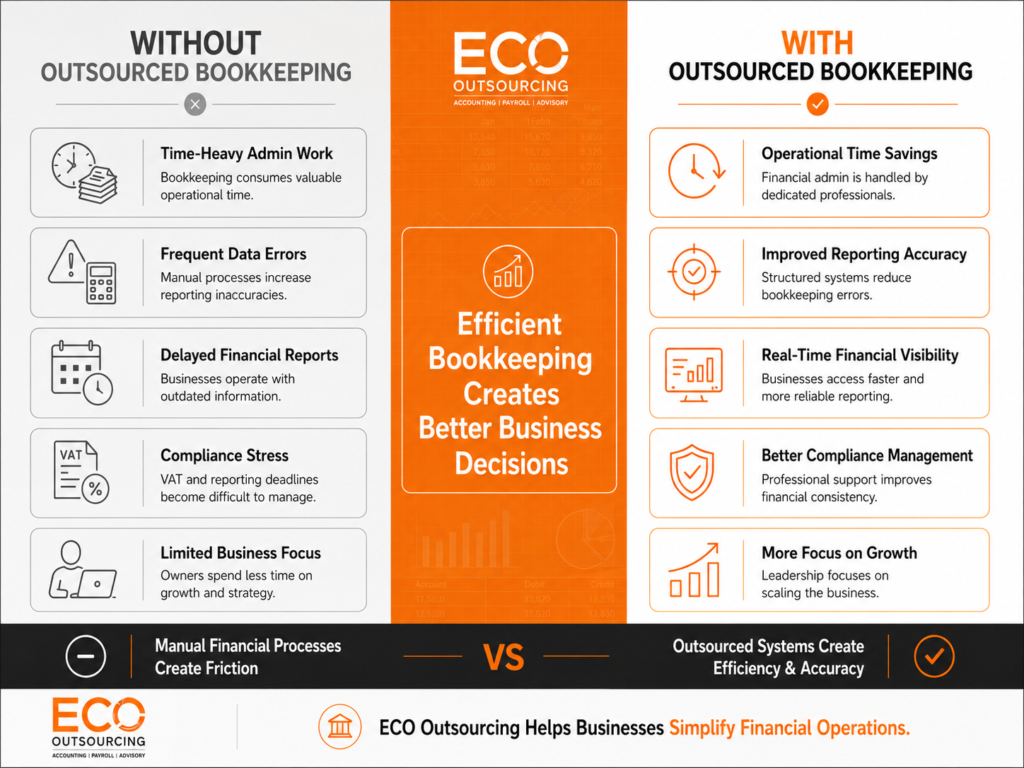
The most immediate benefit of a professional partner is the sudden disappearance of the administrative burden. By outsourcing bookkeeping services, you effectively buy back ten to twenty hours of your life every month. But the time savings go deeper than just offloading data entry.
Professional bookkeepers use automated workflows and cloud integrations to streamline everything. They set up tools like Dext or Hubdoc so you can snap a photo of a receipt and be done with it. No more spreadsheets, no more manual entries, and no more chasing missing invoices. Because they are doing this daily or weekly, the “reconciliation mountain” never has a chance to form.
Think about the time you currently spend correcting mistakes, fixing duplicate entries or hunting for that missing £50. Professional systems drastically reduce these errors from the start. When the processes are standardized and professionally managed, the entire financial cycle moves faster. Your VAT return is ready in days, not weeks, and your year-end accounts become a non-event because the data has been clean all year.
Why Professional Oversight Improves Accuracy?
Accuracy improves when bookkeeping moves from a “when I have time” task to a systematic professional process. A dedicated provider isn’t distracted by sales calls or staff meetings; their sole focus is the integrity of your data.
They implement standardized categorization, ensuring that your expenses are treated consistently month-over-month. This consistency is vital for meaningful reporting. If you categorize a software expense as “IT” one month and “Subscriptions” the next, your year-on-year comparisons become useless. Professional bookkeepers also perform regular, disciplined reconciliations, identifying discrepancies like a bank error or a fraudulent charge the moment they happen, rather than six months later.
Furthermore, cloud accounting tools allow for better collaboration. Both you and your bookkeeper are looking at the same real-time data. This transparency reduces the “human error” factor common in offline spreadsheets, where a single broken formula can hide a massive financial hole.
Why Do Business Owners Stop Trusting Their Financial Reports?
Have you ever looked at a profit and loss statement and thought, “There is no way we made that much money”? This skepticism usually arises because the reports are outdated or the categorization is inconsistent. When you stop trusting your numbers, you stop using them. You go back to checking the bank app on your phone to decide if you can afford a new hire.
Trust is built on two things: accuracy and recency. If your reports are sixty days old, they are essentially historical artifacts. They tell you where you were, not where you are. Outsourced bookkeeping ensures that your data is “live.” When you know that every transaction up to last Friday has been reconciled and categorized, your confidence returns. You start making data-driven decisions again, which is the hallmark of a mature, successful business.
What Happens When Bookkeeping Falls Behind?
A bookkeeping backlog is a weight on your shoulders. It creates a “reporting delay” that makes it impossible to see current trends. Are your margins shrinking because of rising supplier costs? You won’t know until the books are caught up.
If you are months behind, don’t despair. Professional services offer “cleanup” or “catch-up” bookkeeping. They dive into the mess, restore accurate records, and rebuild your financial visibility from the ground up. This process is like a detox for your business. Once the historical issues are corrected and the reconciliations are balanced, you can move forward with a clean slate and a professional system that prevents the backlog from ever returning.
Do You Still Need a Bookkeeper If You Use Xero or QuickBooks?
The software companies have done a brilliant job of marketing the “automated” nature of their tools. While it’s true that Xero and QuickBooks can automate invoice capture and transaction feeds, software does not replace oversight.
A hammer doesn’t build a house, and Xero doesn’t build a financial strategy. You still need a human to review the anomalies, ensure compliance with evolving VAT rules, and most importantly interpret the reports. Automation is great for the how, but human expertise is required for the why. A bookkeeper catches the things an algorithm misses, such as a double-billed invoice that looks “valid” to the software but is actually an error.
How Accurate Bookkeeping Improves Business Decisions?
Ultimately, the goal of all this effort is to help you make better choices. Accurate, timely bookkeeping allows for sophisticated forecasting. You can run “what-if” scenarios: “What if we lose our biggest client?” or “What if we increase our prices by 10%?”
It allows for deep profitability analysis. You might discover that while your “biggest” client brings in the most revenue, they are actually your least profitable because of the amount of support they require. Good bookkeeping creates operational clarity. It allows you to plan your hiring, manage your pricing strategy, and approach lenders or investors with total confidence.
Choosing the Right Partner
When you decide to transition, look for a provider that understands your specific industry. A construction business has very different needs (like CIS and project costing) than a digital agency or an ecommerce store. Ask about their communication process. How often will you hear from them? How quickly do they respond to queries? Most importantly, ensure they are experts in the cloud tools you use. You want a partner who will challenge your current messy processes and implement a streamlined, modern system.
FAQ Section
How does outsourced bookkeeping save time for small business owners?
Outsourced bookkeeping removes the burden of financial admin entirely from your plate, freeing up hours every week previously spent on transaction recording, bank reconciliations, and chasing missing receipts. Cloud platforms like Xero and QuickBooks automate data entry and bank feeds, meaning your bookkeeper works efficiently without constantly interrupting your day. Instead of spending evenings catching up on accounts, you reclaim that time to focus on growing your business. For most small business owners, outsourcing bookkeeping is one of the single most impactful time-saving decisions they ever make.
How does outsourced bookkeeping improve the accuracy of financial records?
Professional bookkeepers bring specialist knowledge and structured processes that most business owners simply cannot match while simultaneously running a business. They reconcile transactions regularly, catch errors quickly, and ensure every expense is correctly categorised in line with HMRC requirements. Unlike DIY bookkeeping where mistakes accumulate unnoticed for months, outsourced bookkeepers identify and correct discrepancies immediately. The result is financial records that are consistently accurate, fully up to date, and always ready for tax season.
What specific bookkeeping tasks take up the most time for small business owners?
The most time-consuming tasks are bank reconciliations, VAT return preparation, invoice management, expense categorisation, and chasing outstanding payments. Many owners also spend significant time correcting errors from previous months, creating a frustrating cycle of financial catch-up that never fully resolves. When these tasks are handled by a professional outsourced bookkeeper the entire process becomes systematic, efficient, and far less stressful. Business owners who outsource consistently report reclaiming between five and fifteen hours of productive time every month.
Can outsourced bookkeeping reduce the risk of HMRC penalties and compliance errors?
Professional bookkeepers stay updated on the latest VAT rules, Making Tax Digital requirements, and HMRC filing deadlines ensuring your returns are always accurate and submitted on time. Mistakes that commonly trigger HMRC scrutiny, incorrect VAT classifications, missing receipts, and unreconciled bank accounts are virtually eliminated when a specialist manages your books. Outsourced bookkeeping significantly reduces compliance errors that attract penalties and investigations. Prevention is always far cheaper than the cost of corrections and the stress of dealing with HMRC after the fact.
How does real-time bookkeeping improve business decision-making?
When your books are maintained accurately in real time, you always have an up-to-date picture of your cash position, profitability, and outstanding liabilities. Many business owners make costly decisions based on outdated financial data simply because DIY bookkeeping cannot keep pace with business activity. With outsourced bookkeeping you receive timely management reports that highlight trends, flag concerns, and identify opportunities before they pass. This shift from reactive guesswork to proactive data-driven decision-making is one of the most transformative benefits outsourced bookkeeping delivers.
Conclusion:
Deciding to outsource your bookkeeping is about more than offloading a boring task; it is about choosing to run a professional organisation. When you remove the administrative burden, you gain the freedom to focus on growth, strategy, and leadership. The businesses that scale effectively are the ones with a clean engine room, predictable cash flow, accurate reporting, and a total lack of tax-season drama.
That is exactly what Eco Outsourcing delivers. From daily transaction processing and bank reconciliations to VAT returns, payroll, and management reporting, their experienced team ensures your books are always accurate, up to date, and fully HMRC compliant so you can move away from the Sunday Night Dread and toward a business that is not just more profitable but more enjoyable to run.
Clarity is the ultimate competitive advantage. Partner with Eco Outsourcing and start looking ahead.
