
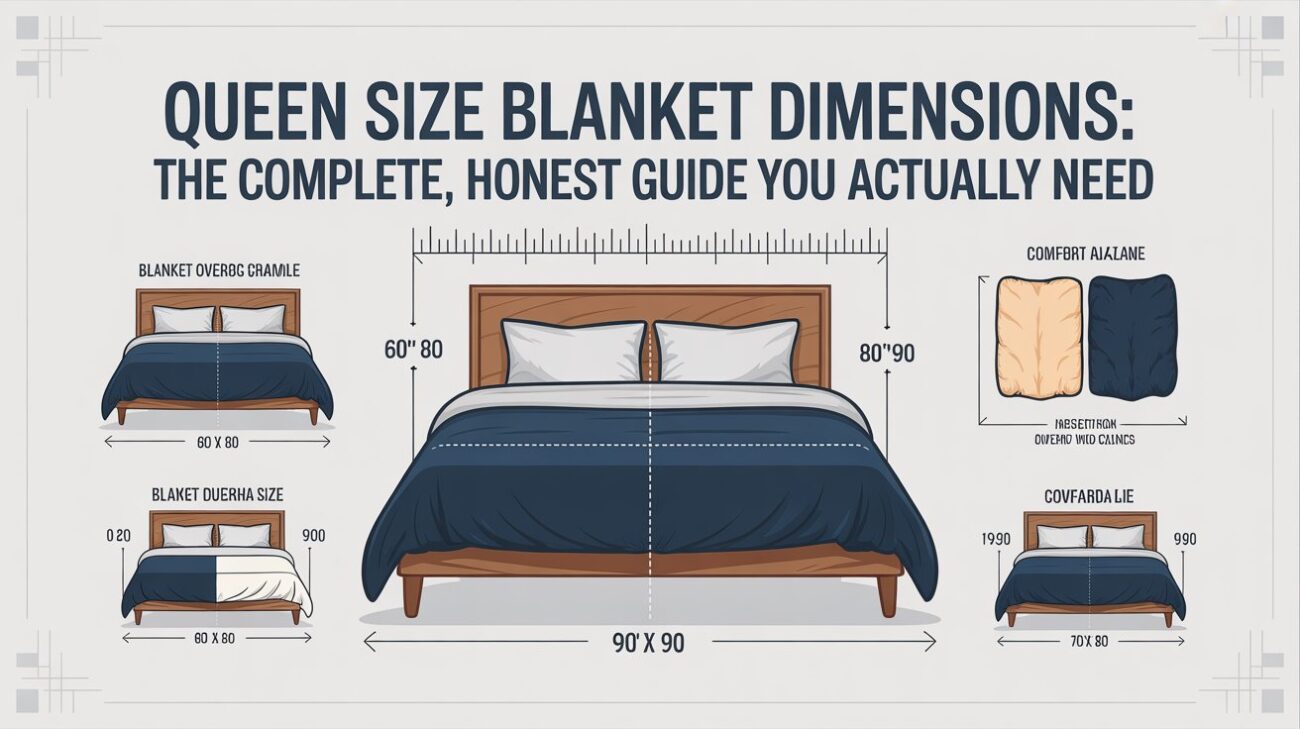
Ever bought a blanket, brought it home, spread it over your bed — and felt something was just off? Maybe the sides barely reached the edge. Maybe it pooled on the floor like a puddle. Maybe you and your partner spent the whole night yanking it back and forth like it was a game of tug-of-war.
That’s a sizing problem. You might be surprised to learn how frequent it is.
This guide is going to fix that for you. We’ll talk about every measurement, every material, every weird situation — and by the end, you’ll know exactly what to buy.
Quick Facts
| Detail | Measurement |
| Standard Queen Blanket Width | 90 inches (229 cm) |
| Standard Queen Blanket Length | 90–100 inches (229–254 cm) |
| Most Common “Sweet Spot” Size | 90 x 96 inches |
| Queen Mattress Size (for comparison) | 60 x 80 inches |
| Side Drape Per Side (standard) | About 15 inches on each side |
| Oversized Queen Blanket | 96 x 100 to 98 x 108 inches |
| Size in Feet | Roughly 7.5 x 8.3 feet |
| Cotton Blanket Shrinkage After Wash | 3–5% |
| Electric Queen Blanket | 84 x 90 to 90 x 100 inches |
| Weighted Blanket (adult) | 60 x 80 inches (body-sized, not bed-sized) |
Why Your Blanket Can’t Be the Same Size as Your Mattress
Here’s the thing most people get backwards.
Your queen mattress is 60 inches wide and 80 inches long. Those are its exact numbers. But if someone sold you a 60 x 80 blanket, you’d be furious when you got it home.
Why? Because a blanket that matches your mattress exactly just sits there on top. Flat. Like a postage stamp on an envelope. The second you roll over, your feet stick out. Your partner shifts, and suddenly half the blanket is under them.
A blanket needs to be bigger than the mattress on purpose. It has to drape down the sides. It has to have some length at the foot so your toes stay warm. It needs a little room for error when someone steals it at 2 a.m.
That’s why a queen blanket lands somewhere between 90 x 90 and 90 x 100 inches. That extra fabric is not wasted. It’s doing real work every single night.
See also “NFL Minimum Salary: The Complete Guide for 2025 and Beyond“
The Exact Numbers: What “Queen Size” Actually Means
Let’s be honest — nobody fully agrees.
Different brands cut their blankets slightly differently. But most land in this range:
- Width: 90 inches (about 7.5 feet)
- Length: 90 to 100 inches (about 7.5 to 8.3 feet)
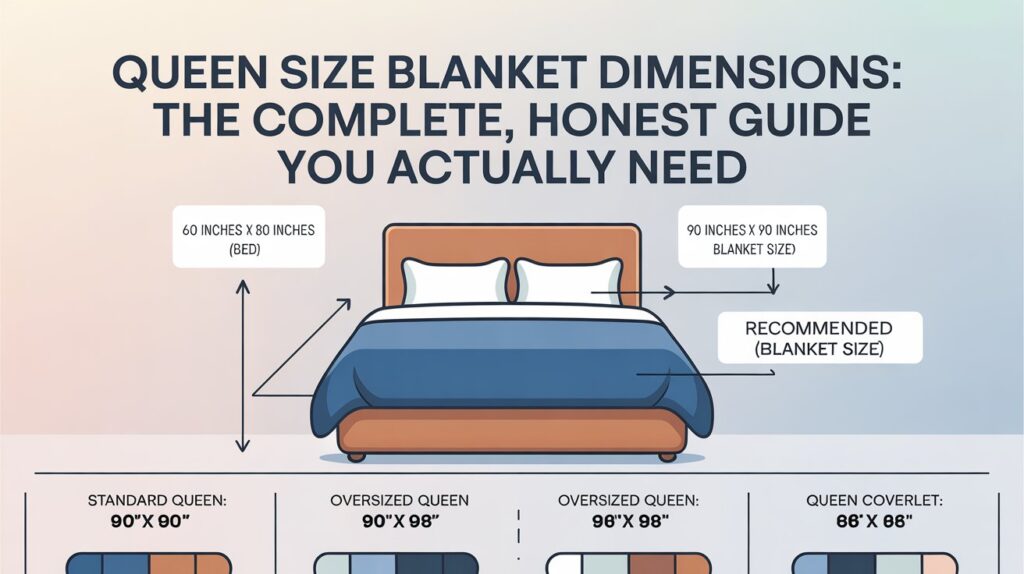
The most popular size you’ll see on store shelves is 90 x 90 inches. It gives you a balanced drape on all sides without going overboard.
Some brands go with 90 x 100 inches. That extra 10 inches of length is great if you like to tuck the blanket under the foot of the mattress. It also helps if you’re tall and your feet tend to push everything loose.
A few brands offer 92 x 96 inches or even slightly wider. These are built for deeper mattresses — the kind with thick pillow tops that eat up several extra inches just in height.
Here’s the side math for a standard 90-inch-wide blanket on a 60-inch-wide mattress:
90 minus 60 equals 30 extra inches. Split that in half, and each side gets about 15 inches of drape. That’s a solid, comfortable hang on both sides.
Queen Blanket Size in Centimeters and Meters
If you shop from international brands or just think in metric, here’s the conversion:
- 90 x 90 inches = about 229 x 229 centimeters = 2.3 x 2.3 meters
- 90 x 100 inches = about 229 x 254 centimeters = 2.3 x 2.5 meters
One important note: if you see a listing that says 180 x 220 cm, that’s a European queen. It’s smaller than the US standard. Verify again before selecting “add to cart.”
How a Thick Mattress Changes Everything
Here’s something nobody talks about enough.
Your mattress height matters just as much as its length and width.
A basic mattress might be 8 to 10 inches tall. That’s fine — a standard 90 x 90 blanket handles it easily.
But modern mattresses with pillow tops, memory foam layers, and built-in toppers can be 14, 16, even 18 inches tall. Every inch of height your mattress gains means your blanket has to travel further down the side before it even starts to drape.
A thicker mattress “eats” more of your blanket’s width. What should be a 15-inch drape on each side becomes maybe 7 or 8 inches. Suddenly it looks stingy.
If your mattress is 14 inches or taller, go up a size. Look for 92 x 96 or 96 x 100 inches. You’ll thank yourself.
All the Blanket Sizes, Side by Side
It helps to see everything together. Here’s how a queen blanket fits among its neighbors:
| Blanket Type | Dimensions | Best For |
| Throw Blanket | 50 x 60 inches | Couch, chair, reading nook |
| Twin Blanket | 65 x 90 inches | Twin or Twin XL mattress |
| Full/Double Blanket | 80–85 x 90 inches | Full mattress, solo sleeper |
| Queen Blanket | 90 x 90–100 inches | Queen mattress, couples |
| King Blanket | 108 x 90–100 inches | King mattress, extra-coverage lovers |
| California King Blanket | 104 x 108 inches | Cal King mattress |
Notice something? A full blanket (80–85 inches wide) technically fits on a queen bed. But the drape will be small — only about 10 to 12 inches total across both sides. It works in a pinch, but it’s not comfortable for two people.
What Happens When You Have Two People Sharing the Bed
This is the real conversation.
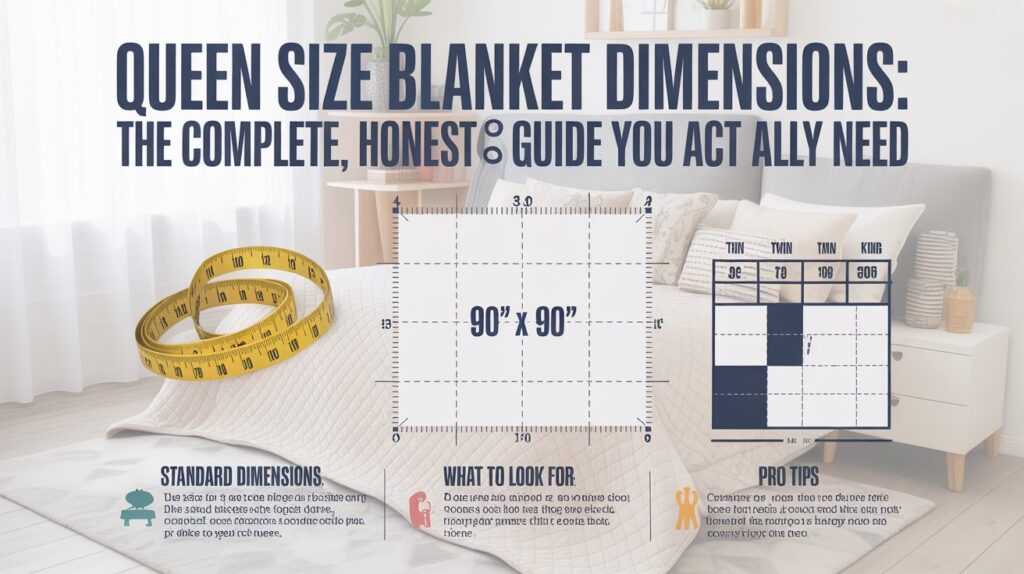
A 90-inch-wide blanket on a 60-inch-wide mattress gives each person roughly 45 inches if the blanket stays perfectly centered. That sounds like a lot — until your partner is a blanket thief.
Any movement at all shifts the blanket. One person rolls over and suddenly pulls a foot of blanket with them. By morning, one person has a tent and the other has nothing.
A lot of couples solve this by going up to a king-size blanket on their queen bed.A king blanket’s width is 108 inches.. On a 60-inch mattress, you get 24 inches of drape per side instead of 15. Nobody’s stealing anything because there’s enough for everyone.
Yes, it looks a little extra on the sides. Some people love that luxurious, hotel-style look. Others find it too much. It’s a personal call — but if midnight blanket battles are ruining your sleep, it’s worth trying.
Queen Blanket Dimensions by Material Type
This is where it gets interesting — because not all materials behave the same way.
Cotton Queen Blankets
Cotton blankets typically come in 90 x 90 to 90 x 96 inches before you ever wash them.
Here’s the problem: cotton shrinks. After the first wash on warm or hot settings, a 90-inch cotton blanket can come back at 86 or 87 inches. That’s 3 to 5 percent shrinkage — enough to lose noticeable drape.
Tips for cotton buyers:
- Wash cold, always
- Buy pre-washed cotton if you can find it
- Or just buy one size up to account for shrinkage
Fleece Queen Blankets
Fleece is made from polyester, which means it holds its size really well.
A fleece queen blanket stays close to its original 90 x 90 inches for a long time. The downside is that fleece pills after 15 to 25 washes — those tiny little balls of fiber that make the surface look rough. It still keeps you warm, but the feel changes over time.
Oversized fleece options can run up to 90 x 108 inches, which is great if you love coverage at your feet.
Wool Queen Blankets
Wool is tricky.
A wool blanket feels thicker than its measurements suggest, because wool has natural loft — it fluffs up. So a 90 x 90 wool blanket feels bigger and cozier than a 90 x 90 cotton blanket.
But wool has a dark secret: it can shrink dramatically if you toss it in the dryer. We’re talking 5 to 10 percent. That’s not a little. Always dry-clean wool, or hand-wash cold and lay flat to dry.
Weighted Blankets
Weighted blankets play by completely different rules.
Don’t buy one based on bed size. Buy one based on body size. A typical weighted blanket runs 60 x 80 inches — about the size of a twin bed. That’s intentional. It’s meant to cover your body, not drape off the sides of your bed.
They come in different weights — usually 10 to 25 pounds. The general guideline is to pick a weight that’s roughly 10 percent of your body weight.
Electric Blankets
Electric queen blankets usually measure 84 x 90 or 90 x 100 inches.
One thing to check before buying: where are the cord and controller positioned? Make sure they land on your preferred side of the bed. Also know that the internal wiring makes these blankets a bit stiffer — they don’t drape as softly as cotton or fleece.
Seasonal Sizing: Do You Need Different Blankets for Summer and Winter?
You don’t need two sets. But having two is genuinely wonderful.
For summer, a lighter cotton or linen blanket in that 90 x 90 range does the job. Loose weaves let air move through. You stay covered without sweating.
For winter, a heavier wool or thick fleece blanket — ideally slightly larger at 90 x 96 or 90 x 100 — gives you real warmth. Some people layer two blankets in very cold climates, which lets you adjust without buying a whole new bedding set every season.
One practical trick: if it’s hot and you want less coverage, a queen blanket on a king bed gives you thinner side drape. If it’s freezing and you want maximum coverage, a king blanket on a queen bed wraps you like a burrito.
Washing and Caring for Your Queen Blanket
Size matters at the laundry, too.
Cotton: Machine wash cold, tumble dry on low. Avoid hot settings — you already know why.
Fleece: Machine wash warm. Low heat dry. Never use fabric softener on fleece — it damages the fibers and reduces how well the blanket breathes.
Wool: Hand wash with wool-specific soap or dry-clean. Never put it in the dryer.
Weighted blankets: Most come with a removable cover — wash that weekly. The inner part often needs a commercial washer because a standard home machine struggles with the weight.
Storage tip: Fold your queen blanket into thirds lengthwise, then into thirds again. It keeps the shape, prevents deep permanent creases, and takes up less space in your linen closet.
Full vs. Queen vs. King: Which Is Right for Your Bed?
Let’s keep this simple.
You have a queen bed and sleep alone: A standard 90 x 90 queen blanket is perfect. Easy to wash, easy to manage, does the job.
You have a queen bed and share it with a partner: Go for 90 x 100 or even jump to a king size. The extra width prevents the midnight tug-of-war.
You have a tall or pillow-top mattress over 14 inches: Get 92 x 96 or 96 x 100. Standard sizing will leave you with not enough drape.
You have a full mattress but want extra coziness: A queen blanket on a full bed gives you more drape than you need — and that can feel lovely.
You have a king mattress: A queen blanket will technically fit on top, but the drape is so thin it looks awkward. Get a proper king blanket.
A Word on RV and “Short Queen” Beds
RV owners, listen up.
A short queen mattress is typically 60 x 75 inches — five inches shorter than a standard queen. A regular queen blanket (90 x 100 inches) will be too long. You’ll either have to fold the extra fabric under the foot, or buy a custom-sized blanket.
Some RV supply shops carry purpose-built short queen bedding. It’s worth searching specifically for “RV queen blanket” rather than just “queen blanket.”
How to Measure Before You Buy
Take two minutes to do this before spending money:
- Measure your mattress width and length.
- Measure the mattress height (how tall it is off the ground, not counting the bed frame).
- Decide how much drape you want on each side — 12 inches is minimal, 15 to 18 inches feels comfortable.
- Do the math: mattress width + (drape × 2) = minimum blanket width you need.
- Add a few extra inches for safety and washing.
For a standard 60 x 80 queen mattress with a 15-inch drape goal:
- Width needed: 60 + 30 = 90 inches ✓
- Length needed: 80 + 15 (foot tuck) = 95 inches — so 90 x 100 is your ideal
Final Words
Buying a blanket sounds easy until you’re standing in a store holding two options that look the same but measure differently.
Here’s the truth: a queen blanket is not a single fixed number. It’s a range. Most land between 90 x 90 and 90 x 100 inches. Your job is to figure out where in that range you belong — based on your mattress height, whether you share the bed, and how you like your blanket to look and feel.
Don’t just grab any queen blanket and assume it’ll work. Check the tag. Check the material. Think about washing. And if you share the bed with someone who hogs covers — just go ahead and size up to king. Your relationship will thank you.
Sleep well. You’ve earned it.
FAQs
1. What is the standard size of a queen blanket?
Most queen blankets measure 90 inches wide and between 90 and 100 inches long. The exact number varies slightly by brand and material, but this is the range you’ll see most often.
2. Is a queen blanket bigger than a queen mattress?
Yes, always. Your queen mattress is 60 x 80 inches. Your blanket needs to be bigger than that so it can hang down the sides. A blanket that matched the mattress exactly would have no drape and feel too small immediately.
3. Can I use a queen blanket on a king bed?
Technically yes, but it’s not ideal. On a king bed (76 inches wide), a 90-inch queen blanket leaves only about 7 inches of overhang per side — barely enough. For two people on a king bed, it’ll feel cramped. Buy a king blanket instead.
4. Can I use a king blanket on a queen bed?
Absolutely. Many couples do this on purpose. A 108-inch king blanket on a 60-inch queen mattress gives each side about 24 inches of drape. Nobody hogs it. It looks luxurious and feels generous.
5. What size is a queen blanket in centimeters?
A standard 90 x 90 inch queen blanket is about 229 x 229 cm. A 90 x 100 inch version converts to roughly 229 x 254 cm.
6. Will a queen blanket shrink after washing?
Cotton blankets can shrink 3 to 5 percent in the first wash on warm settings. That can mean losing 2 to 4 inches of width. Wash cold to minimize this. Fleece and polyester hold their size much better. Wool can shrink significantly if dried with heat.
7. What size weighted blanket should I get for a queen bed?
Weighted blankets aren’t sized by bed — they’re sized by body. A typical adult weighted blanket is about 60 x 80 inches. Pick the weight (usually 10 to 25 lbs) based on around 10 percent of your body weight, not based on your mattress size.
8. What’s an “oversized queen blanket”?
An oversized queen runs from 96 x 100 to 98 x 108 inches. These are great for extra-thick mattresses, couples who both want generous coverage, or anyone who just loves that wrapped-up, cozy feel with fabric to spare.
9. Does mattress thickness affect what blanket size I need?
Yes, significantly. A 14-inch or taller mattress (common with pillow tops) uses up more of your blanket’s width just covering the sides. Go one size up — toward 92 x 96 or 96 x 100 — if your mattress is extra thick.
10. What’s the difference between a queen blanket and a queen comforter?
Size and purpose are different. Comforters are decorative outer layers designed to hang dramatically over the sides — sometimes 12 to 18 inches past the mattress. A blanket is for functional warmth and typically fits closer to the bed. You can use both: blanket for sleeping warmth underneath, comforter on top for style.
11. What size blanket works best for couples sharing a queen bed?
Start with a full 90 x 100-inch queen blanket. If blanket-stealing is still a problem, upgrade to a king-size blanket (108 x 100 inches) on your queen mattress. The extra width is a relationship saver.
12. What is the correct way to store a queen blanket?
Lengthwise, fold it into thirds, then back into thirds. This keeps the shape, avoids deep permanent fold lines, and fits neatly in a linen closet or drawer.
13. How big is a short queen blanket for an RV?
Short queen mattresses in RVs are usually 60 x 75 inches — five inches shorter than a standard queen. A regular queen blanket will be too long. Look specifically for “RV short queen” sizing when shopping.
14. How do different materials affect queen blanket dimensions?
Cotton shrinks after washing. Fleece holds size but pills with time. Wool feels bulkier than its measurements due to natural loft. Electric blankets are slightly stiffer due to internal wiring. Always read the care label and measure after the first wash.
15. Can one queen blanket work for all four seasons?
One blanket can technically work year-round, but most people are more comfortable with two. A lightweight cotton blanket for spring and summer, and a heavier fleece or wool one for fall and winter, gives you more control over your sleep temperature all year long.
Keep creating, innovating, and inspiring with Content Ideators every day.
