
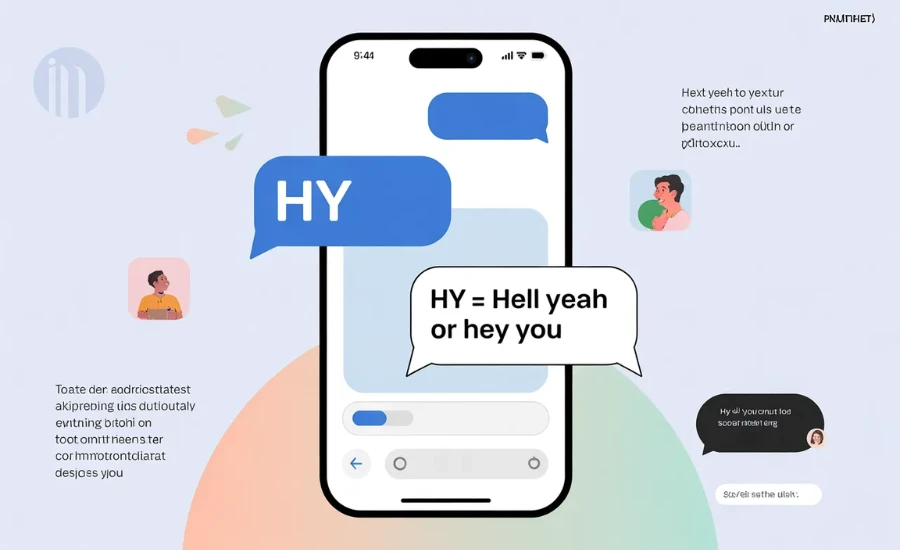
Picture this. Your phone lights up. Someone sent you one message. Just two letters: HY.
You stare at it. You read it again. Still confused.
Don’t worry — you’re in really good company. This tiny abbreviation trips people up all the time. And the tricky part? It can mean more than one thing depending on who sent it and what mood they’re in.
Let’s clear up every single meaning right now.
Quick Reference Table: HY at a Glance
| Feature | Details |
|---|---|
| Most Common Meanings | Hell Yeah / Hell Yes, Hey You |
| Other Possible Meanings | Hi, Hey, Hype You, Hope You |
| Type | Internet slang / texting abbreviation |
| Origin Period | Early 2010s (popularized through smartphones and Snapchat) |
| Primary Users | Gen Z, Millennials, younger online communities |
| Tone | Excited, casual, friendly — sometimes flirty |
| Platforms | Snapchat, TikTok, Instagram, WhatsApp, gaming chats, SMS |
| Formal Use? | Absolutely not — casual only |
| Related Terms | YOLO, LFG, YH, HBU, LOL, OMG |
| Emoji That Often Come With It | 🔥 💕 😎 👀 |
The Big One: HY Most Often Means “Hell Yeah”
Let’s start with the meaning you’ll run into the most.
In the majority of everyday texts, group chats, and social media comments — HY stands for “Hell Yeah.”
It’s a burst of pure excitement packed into two letters. Think of it as the texting version of jumping up with your fist in the air.
Someone asks: “Wanna grab pizza tonight?” You reply: “HY 🔥”
That’s it. No overthinking needed. You’re saying yes — but not a quiet, polite yes. You’re saying yes with everything you’ve got.
“Hell Yeah” has been a part of spoken American slang for decades. Long before phones existed, people said it out loud when they were pumped about something. Then texting arrived, and typing the full phrase felt slow and clunky. Two letters were all anyone needed.
The Second Meaning: “Hey You” — A More Personal Kind of Hello
HY doesn’t always mean excitement. Sometimes it’s softer than that.
In certain conversations — especially ones that feel more personal, warm, or a little flirty — HY means “Hey You.”
Imagine someone typing: “HY, been thinking about you 😊”
That’s not excitement. That’s a gentle tap on the shoulder through a screen. It’s saying hello, but with a little extra warmth baked in.
The “Hey You” meaning shows up most in one-on-one conversations. Between people who already know each other well. Between friends who haven’t talked in a while, or between two people who are maybe just a little interested in each other.
It has a cozy, personal feel that plain “hey” sometimes doesn’t quite capture.
The Other Meanings — Real But Rare
Okay, so “Hell Yeah” and “Hey You” are the big two. But HY has a few other faces worth knowing.
HY as “Hi” or “Hey” Some people — especially younger users who love experimenting with spelling — just use HY as an alternative way to write “hi.” It’s not common. But you’ll occasionally see it in casual greetings, especially from people who like typing fast and creatively.
HY as “Hype You” This one’s growing. Some people use HY to mean they’re there to lift you up, encourage you, cheer you on. “I’m here to HY all day!” is someone saying they’ve got your back. This meaning lives mostly in the Gen Z world.
HY as “Hope You” A rarer one, but it shows up. Someone might write “HY are doing okay!” as a shortcut for “Hope you are doing okay.” It’s uncommon, but not unheard of in casual, quick messages.
HY on New Year’s In some social media posts around January 1st, HY briefly stands for “Happy (New) Year.” You’ll see it in captions: “HY 2026! Let’s go 🎉” — but this is very seasonal and specific.
The takeaway? Context is always your best clue.
How HY Grew Into the Slang It Is Today
Nothing in language just appears out of thin air. HY has a backstory.
Back in the early days of texting, phones were small and keyboards were even smaller. Abbreviations were a survival tool. Words like “OMG,” “LOL,” and “BRB” started popping up everywhere because typing full sentences on a tiny keyboard was genuinely painful.
“Hell Yeah” was a perfect candidate to get shortened. It happened the same way “Oh My God” became “OMG” — people just took the first letters and ran with them.
As smartphones got smarter and apps like Snapchat blew up, HY started spreading fast. Snapchat in particular pushed short, punchy communication. You have seconds to reply before a snap disappears. There’s no time for long words. HY fit the format perfectly.
Then TikTok arrived and changed everything again. Comment sections move at a hundred miles an hour. Creators drop new content every day. Fans respond in the fastest, most expressive way they can. And HY became a staple reaction — short, energetic, full of feeling.
How HY Looks Different on Every Platform
Here’s something interesting. The same two letters behave differently depending on where you’re typing them.
On Snapchat: HY almost always means “Hell Yeah.” Snapchat is a fast, high-energy platform. People are firing off quick replies between streaks and snaps. “HY 🔥” under a photo is the digital version of cheering.
On TikTok: HY is pure hype fuel. You’ll see it in comment sections under trending videos. “HY this is incredible!” or just “HY 🔥🔥” — it’s shorthand for “I’m absolutely into this.”
On Instagram: It splits evenly between “Hell Yeah” and “Hey You.” In DMs, it often works as a flirty opener or a warm personal greeting. In comments, it’s usually excitement. “HY, loved this post!” can mean either one depending on who sent it.
On WhatsApp: In group chats, HY is almost always excited agreement. In personal one-on-one chats, it might swing toward “Hey You” — more intimate, less performative.
In gaming chats: Gamers love short, sharp communication. HY in a gaming session almost always means enthusiastic agreement or excited reaction. “We won?! HY!!” — everyone understands exactly what that means.
The Emoji Connection — Why Those Little Pictures Matter So Much
Here’s a thing most people overlook: emojis completely change how HY lands.
“HY” alone reads as pretty neutral. You’re not quite sure if someone’s excited or just greeting you.
But add one emoji and everything shifts:
- HY 🔥 = pure excitement, high energy, “Hell Yeah” vibes
- HY 💕 = soft, warm, affectionate — probably “Hey You”
- HY 😎 = casual and cool, slightly showing off
- HY 👀 = flirty, suggestive, a little mysterious
- HY 😊 = genuinely friendly, warm, probably a greeting
Two letters plus one tiny picture can completely change the emotional tone of a message. That’s the magic of modern digital language. It’s not just words anymore — it’s a whole visual system.
Is HY Ever Flirty?
Short answer: yes, sometimes.
When HY is used as “Hey You” in a personal message, it can carry a flirty edge. Especially when combined with the right emoji or sent late at night to someone you’re into.
“HY 👀” from someone you have a crush on? That’s loaded with intention. It’s playful. It’s an invitation to respond.
But context saves the day here. HY from your best friend means something completely different from HY from someone who’s been texting you a lot lately. Same letters, totally different weight.
The rule of thumb: pay attention to the conversation history, the emoji, and the time of day. Those three things together tell you everything about what someone actually means.
When HY Can Be Misread — And How to Avoid It
Here’s where things get a little tricky.
Generational confusion: Some older millennials and adults who aren’t deep into texting culture might read HY as “How’s Your” — like the beginning of “How’s your day?” This can create genuinely awkward misunderstandings. “HY 🔥” makes zero sense as “How’s your 🔥.” But it still happens.
Sarcasm: Most of the time HY is full of genuine energy. But every now and then, someone uses it sarcastically. “Oh yeah, HY, I’m thrilled.” You’ll know by the tone of the full message. Watch for cues like ellipses or dry punctuation.
Professional disasters: This is the biggest pitfall. Sending HY to your boss, your client, or anyone in a formal setting is a mistake. It looks careless. It can seem disrespectful even when you didn’t mean it that way. In any professional context, write full words. Always.
HY vs. Similar Slang — What’s the Difference?
It helps to know the neighborhood HY lives in. Here are its closest relatives:
YH — “Yeah” — simple agreement, no extra excitement LFG — “Let’s F***ing Go” — even more intense than HY, more aggressive energy YASSS — dragged-out yes, enthusiastic, often comedic AYE — excited affirmation, has a party-like feel HBU — “How About You?” — completely different vibe, a question not an answer OMG — shock or excitement, but about something surprising LOL — laughter, not agreement
HY lives in the energetic agreement zone. It’s louder than “yes,” more casual than “absolutely,” and faster than typing anything else.
Real Conversation Examples — See HY in Action
Let’s walk through some actual chat scenarios so it clicks completely.
Scenario 1 — The Enthusiastic Yes: Friend: “There’s a concert this weekend. You in?” You: “HY!! Can’t wait 😎” Meaning: Hell Yeah — total excitement
Scenario 2 — The Warm Greeting: Old friend: “HY stranger! It’s been forever” You: “I know!! How have you been?!” Meaning: Hey You — personal, warm, nostalgic
Scenario 3 — The Hype Support: Friend: “I’m so nervous about my exam tomorrow” You: “Don’t be! I’m here to HY all week” Meaning: Hype You — encouraging, supportive
Scenario 4 — The Social Media Comment: TikTok creator posts a new dance video. Comment: “HY this is everything 🔥🔥” Meaning: Hell Yeah — high-energy praise
Scenario 5 — The Flirty Opener: Someone you’ve been talking to sends: “HY 👀” Meaning: Hey You — playful, possibly flirty
See how one abbreviation can live in five totally different emotional spaces? That’s why reading context is everything.
Why Gen Z Loves HY — The Psychology Behind Short Slang
There’s actually something interesting going on beneath the surface here.
Modern communication — especially among younger people — moves at a speed that full sentences can’t keep up with. You’re watching TikToks, replying to Snapchats, jumping between three group chats, all at the same time.
In that world, longer words actually slow you down emotionally. By the time you finish typing “Hell Yeah, I’m so excited about this!” — the moment has already moved on.
HY arrives like a spark. It’s instant. It carries the emotion without the delay. And in a world where attention is the scarcest thing around, that matters.
There’s also something community-like about knowing the slang. When you use HY correctly and confidently, you’re signaling that you belong — that you’re part of the conversation, not just watching from the outside.
Language has always worked this way. Slang builds identity. It creates belonging. HY is just a very small, very modern example of something humans have been doing forever.
Should You Use HY? A Simple Guide
Wondering if HY is right for your situation? Here’s an honest breakdown:
Use HY freely when:
- You’re texting close friends
- You’re replying to a group chat
- You’re commenting on social media
- Someone invites you somewhere and you’re genuinely excited
- You want to greet someone in a warm, playful way
Think twice before using HY when:
- You’re texting someone much older who might not know it
- The conversation is already serious in tone
- You want to make sure your enthusiasm comes across clearly (spell it out instead)
Never use HY when:
- Writing professional emails
- Messaging a teacher, professor, or employer
- Reaching out to a client or someone you want to impress formally
- In any situation where full, clear language matters for respect
Releated Article: TY Meaning
Final Words
Two letters. At least five meanings. Countless situations.
That’s the beautiful, maddening thing about modern texting slang. A tiny abbreviation can be a shout of excitement, a personal greeting, a flirty opener, or a word of encouragement — all depending on who’s sending it and what’s happening around it.
“HY” isn’t complicated once you know what to look for. Read the person. Read the context. Check the emoji. And nine times out of ten, the meaning becomes obvious almost instantly.
What this little piece of slang really shows us is something bigger. Language doesn’t stand still. It bends and stretches to fit the speed we need it to move at. And right now, we need it to move very fast.
So next time your phone lights up with just “HY” — you’ll know exactly what to do.
What Does HY Mean in Text — Real Questions Answered
1. What does HY mean in a text message?
Most commonly it means “Hell Yeah” — a strong, excited agreement. It can also mean “Hey You” as a warm personal greeting depending on context.
2. Is HY always about excitement?
Not always. When used as “Hey You,” it’s more of a soft, friendly hello than an energetic outburst. Tone and emoji are your guides.
3. What does HY mean on Snapchat?
On Snapchat, HY almost always means “Hell Yeah.” Snapchat’s fast, casual format makes it a perfect fit for short, high-energy replies.
4. What does HY mean on TikTok?
On TikTok, HY is mostly used as excited approval in comment sections. Think of it as the quickest way to say “this is amazing.”
5. Can HY be flirty?
Yes. When used as “Hey You” in a personal message, especially with emojis like 👀 or 💕, it can have a distinctly flirty tone. Context and who sent it matters a lot here.
6. Is HY the same as “hey”?
Not exactly. “Hey” is just a greeting. HY specifically signals more personal attention — like “Hey You” — or strong excitement. They’re close but different.
7. What’s the difference between HY and YH?
“YH” means “yeah” — a simple, calm agreement. “HY” carries much more energy and enthusiasm. HY is the louder, more pumped-up version.
8. Can HY mean “Happy New Year”?
Occasionally, around New Year, some people use HY in posts or captions to mean “Happy (New) Year.” But this is seasonal and rare — it doesn’t carry over into regular texting.
9. Is HY offensive or rude?
No. HY is always positive in intent. It expresses excitement, agreement, or friendly greeting. Just don’t use it in formal or professional settings where it would seem out of place.
10. What does “hyyy” mean (with extra y’s)?
Stretching a word out is how people add extra energy in text. “Hyyy” is just a more dramatic, drawn-out version of “hey” — very playful and attention-grabbing, mostly on TikTok.
11. How should I respond when someone sends me HY?
If it’s “Hell Yeah” energy, match it — “HY!! Let’s go!” If it feels more like a greeting, just say “hey!” back, or start talking naturally. Match the energy they brought.
12. Do older generations understand HY?
Often not. Millennials above a certain age and older adults may read HY as “How’s Your” or just feel confused by it. It’s safer to use full words when texting someone who isn’t deep into internet culture.
13. Is HY used globally or just in the US?
It started in American online culture but has spread globally through platforms like TikTok and Snapchat. English internet slang travels fast, so you’ll find HY in chats from users around the world.
Keep creating, innovating, and inspiring with Content Ideators every day.
