
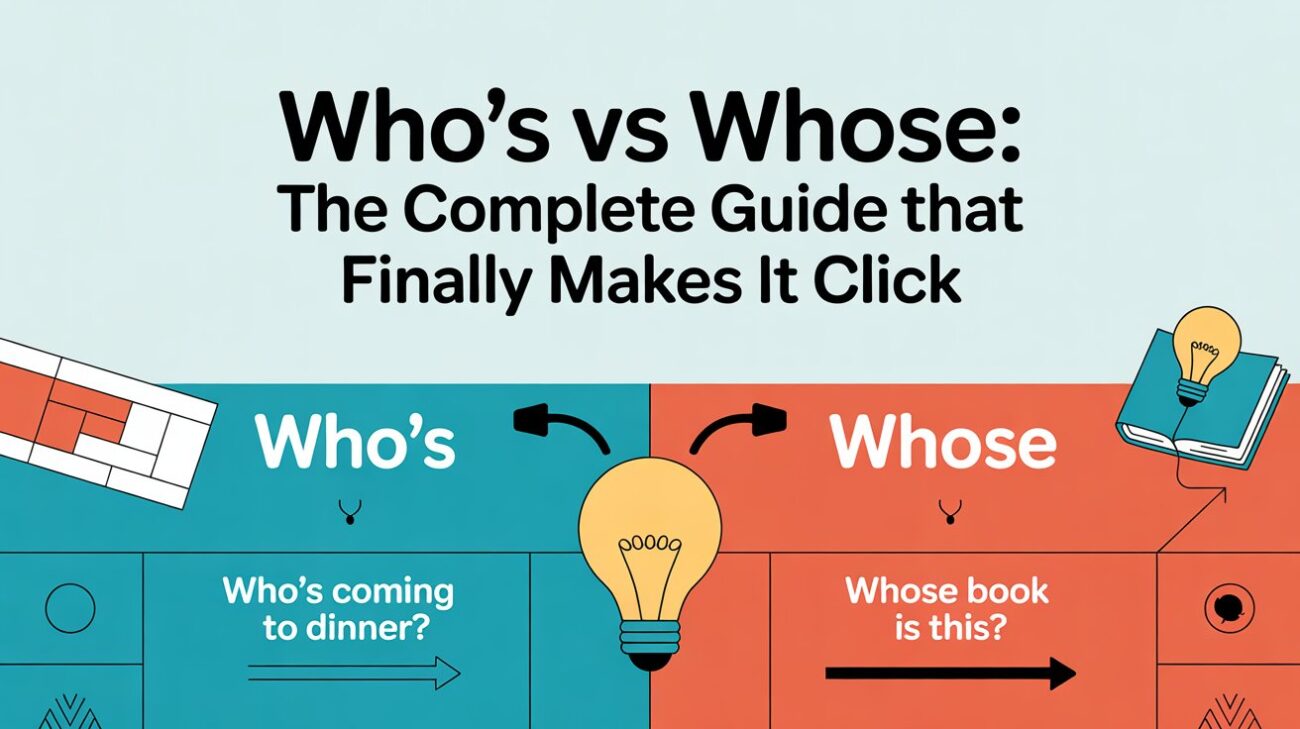
Picture this. You’re typing a quick message to your boss. You write: “I spoke to the employee who’s desk faces the window.”
You hit send.
Two seconds later, something feels wrong.
Was that right? Was it who’s or whose? You’re not sure. You can’t take it back. That tiny little word just made your stomach drop.
It happens to everyone. Even good writers. Even people who teach English. These two words are sneaky. They sound identical. They look almost the same. But they mean completely different things.
Today, that confusion ends.
Quick Reference Table
| Feature | who’s | whose |
| What it is | A contraction | A possessive pronoun / adjective |
| Full form | who is OR who has | No expansion — it stands alone |
| Has apostrophe? | Yes | No |
| Shows ownership? | No | Yes |
| Example | Who’s at the door? | Whose jacket is this? |
| Swap test | If it works, use who’s instead of who is or who has. | If swapping breaks the sentence, use whose |
| Used in formal writing? | Avoid contractions in formal writing | Yes, perfectly formal |
| Origin | Contraction of who + is/has | Old English hwæs (possessive of hwā) |
| Belongs to same family as | he’s, she’s, it’s | his, her, its, their, your |
| Common mistake | Writing who’s when you mean ownership | Writing whose when you mean who is |
Two Words That Sound Like Twins But Are Not
Say both out loud. Who’s. Whose.
They are completely identical to the ear. Not close — identical. Your brain cannot hear any difference. Zero.
This is the whole problem. English is full of words like this. It’s and its. Your and you’re. Their and there and they’re. Our ears betray us constantly. We type what we hear, not what we mean.
But here’s the good news. Once you understand what each word actually does, you will never mix them up again. Not in an email. Not in a text. Not in a school essay. Not anywhere.
Let’s take them one at a time.
See also “Twin Bed Measurement: The Complete Guide You Actually Need“
What Is “Who’s”? (The Contraction)
Who’s is not one word doing one job. It is two words squeezed into one.
That little apostrophe? It’s not decoration. It is standing in for missing letters. Someone grabbed the full phrase, crossed out some letters, and the apostrophe marks the spot where those letters used to live.
Who’s = who is
Who’s coming to dinner? → Who is coming to dinner? ✓
The man who’s always late just walked in. → The man who is always late just walked in. ✓
Who’s = who has
Who’s eaten my sandwich? → Who has eaten my sandwich? ✓
Find the person who’s been sending these emails. → Find the person who has been sending these emails. ✓
Both expansions work perfectly. That’s all who’s ever does. It is a shortcut. A time-saver. A way of combining two words into one.
Nothing mysterious. Nothing complicated.
The apostrophe here is exactly like the apostrophe in can’t (cannot), don’t (do not), or I’ve (I have). It signals a shortcut, not ownership.
What Is “Whose”? (The Possessive)
Whose shows that something belongs to someone — or is connected to someone.
Think of it like this. His shoes. Her bag. Their house. Your opinion. All of these show belonging. Whose belongs in that exact same family.
Whose shoes are those by the door? → You’re asking: who do these shoes belong to?
The woman whose car I borrowed called this morning. → The car belongs to the woman.
He’s a writer whose books I love. → The books belong to the writer.
No apostrophe. None. Whose has never needed one and never will.
Here’s a helpful pattern to notice. Think of all the possessive pronouns in English: my, your, his, her, its, our, their. Not one of them has an apostrophe. Whose follows exactly the same rule. Possessive pronouns do not get apostrophes. Full stop.
The Apostrophe Trap — Why Everyone Falls For It
Let’s be honest about why this mistake is so common.
English has a rule that normally works brilliantly. To show that something belongs to someone, you add apostrophe-s to a name or noun.
Sarah’s phone.
The dog’s bone.
The teacher’s desk.
This rule is so reliable that our brains memorize it. See an apostrophe before an s? Ownership. Every time.
Except not every time.
When it comes to pronouns — he, she, it, they, who — English plays a completely different game. Pronouns get their own special possessive forms. And those special forms carry zero apostrophes.
He → his
She → her
It → its
They → their
Who → whose
None of them need an apostrophe to show possession. They just are possessive. They were born that way.
So when you see who’s, your brain yells “ownership!” But your brain is wrong. That apostrophe means something completely different. It means letters are missing.
Once you understand this pattern, everything clicks.
The One Test That Never Fails
You never have to guess between who’s and whose. There is a test that gives you the answer in three seconds flat.
Try substituting who is or who has into your sentence.
If the sentence still makes complete sense → use who’s.
If the sentence falls apart or sounds absurd → use whose.
Let’s practice:
“____ bag is on my chair?”
Swap test: “Who is bag is on my chair?” — That’s gibberish. ✗
Answer: Whose bag is on my chair? ✓
“____ going to pick up the kids?”
Swap test: “Who is going to pick up the kids?” — Perfectly fine. ✓
Answer: Who’s going to pick up the kids? ✓
“The chef ____ food made me cry called over to say hello.”
“The chef who is food made me cry…” is a swap test that doesn’t work. That’s broken. ✗
Answer: The chef whose food made me cry called over to say hello. ✓
“Find out ____ been using the printer.”
Swap test: “Find out who has been using the printer.” — That works perfectly. ✓
Answer: Find out who’s been using the printer. ✓
This test works every single time. Teach it to your kids. Teach it to your colleagues. It takes three seconds and it is foolproof.
How Each Word Works Inside a Sentence
Grammar has official names for what these words do. You don’t need to memorize the names. But understanding the role each word plays helps things make sense.
How who’s works
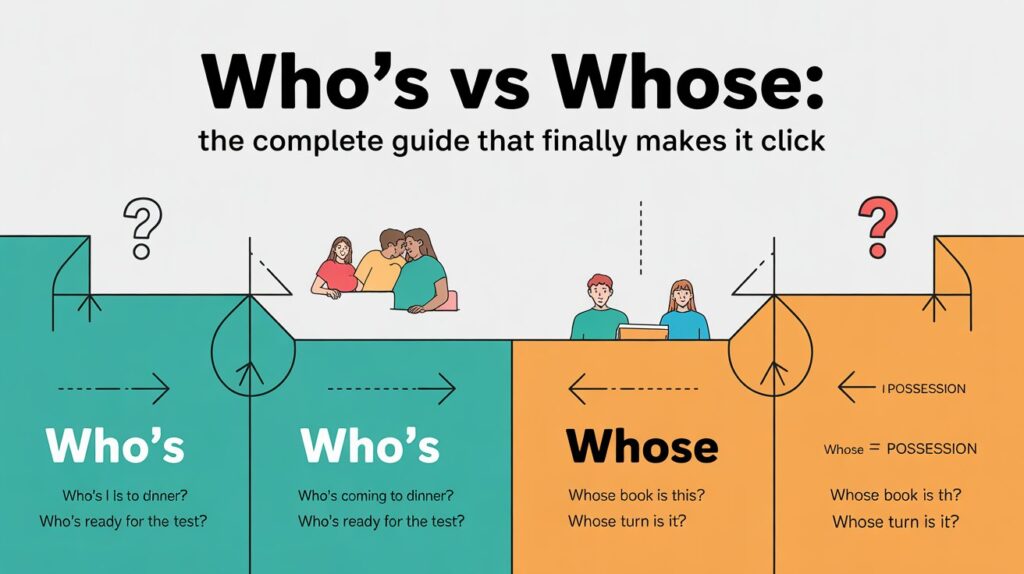
Who’s functions like a verb phrase inside a sentence. It tells you what someone is or what someone has done.
When used at the start of a question:
- Who’s the new manager? (= Who is the new manager?)
- Who’s finished their homework? (= Who has finished their homework?)
When used mid-sentence to describe a person:
- She’s the one who’s always smiling. (= who is always smiling)
- He’s a coach who’s trained three champions. (= who has trained)
Notice that who’s always has a verb idea tucked inside it — either is or has. It describes an action or a state of being.
How whose works
Whose connects a thing to a person (or sometimes to a place, animal, or object). It answers the question: “who does this belong to?”
When used to ask a direct question:
- Whose idea was this?
- Whose turn is it?
When used to describe or identify someone in the middle of a sentence:
- The student whose project won the prize got a scholarship.
- We hired someone whose experience was exactly right.
When the answer to “whose” is already known and you’re using it as a pronoun alone:
- “Somebody left an umbrella — I’m not sure whose
- .”Everyone turned in work, but which one was the best?
Can “Whose” Refer to Things? (The Big Debate)
Here’s a question that confuses even advanced writers.
Whose originally comes from who, and who traditionally refers to people. So some people wonder: can you use whose when talking about a building, a country, a book — a thing?
The answer is: yes, and it’s perfectly accepted.
English simply doesn’t have a good possessive form for which. Technically you’d say “of which” — but that often sounds stiff and awkward.
Compare:
“The city, the economy of which depends on tourism, is struggling.”
vs.
“The city whose economy depends on tourism is struggling.”
The second version flows so much better. And most grammar experts, from Merriam-Webster to Grammarly to university style guides, agree that whose for objects is completely acceptable in modern English.
In very formal or academic writing, some editors still prefer of which. But in everyday writing — including professional writing — using whose for things is fine.
The Old English Connection
Here’s something genuinely interesting that almost nobody knows.
Whose isn’t a new word. It’s ancient.
It comes directly from Old English hwæs — the possessive form of hwā, which meant who. Old English had an entire system of word endings that showed ownership, direction, and relationship. Hwæs was one of those endings.
Over centuries, the language changed. Most of those endings disappeared. English simplified. But whose survived, carrying that ancient possessive meaning all the way to today.
The apostrophe controversy also has history. In the 1600s and 1700s, its was actually sometimes written with an apostrophe — it’s — to show possession. People hadn’t fully settled the rules yet. But by the early 1800s, the apostrophe-free possessive pronouns had won. Its. Whose. No apostrophe needed.
That history explains everything. The pattern was set centuries ago. We’re just following it today.
Formal vs. Informal Writing
There’s one more thing worth knowing — especially for students and professionals.
Whose is fine in any type of writing. Formal essays. Business letters. Academic papers. Casual texts. It fits everywhere.
Who’s, however, is a contraction. And contractions carry a slightly casual tone. This matters depending on where you’re writing.
In a text to a friend: “Who’s bringing snacks tonight?” — Perfect.
In a job application: “I am seeking a role whose responsibilities align with my skills” — Professional and correct.
In a formal academic paper, you’d want to write out the full form: “The student who is most prepared will perform best” — instead of “The student who’s most prepared.”
This doesn’t mean contractions are wrong. It just means they carry a conversational flavor. Know your audience. Adjust accordingly.
Side-by-Side Examples to Make It Stick
Nothing locks in grammar knowledge like seeing real examples. Here are ten, right next to each other.
| Whose (possession) | Who’s (contraction) |
| Whose cat keeps climbing my fence? | Who’s the owner of that cat? |
| I know a teacher whose lessons are legendary. | I know a teacher who’s been here for 20 years. |
| Whose handwriting is this? | Who’s been writing on the walls? |
| A company whose values I respect. | A company who’s hiring right now. |
| She’s someone whose opinion I trust. | She’s someone who’s worked in the field for a decade. |
| They found a dog whose collar had no name tag. | They found the person who’s lost a dog. |
| The book whose cover I designed just launched. | The author who’s signing copies arrives at noon. |
| Nobody knew whose car was blocking the gate. | Nobody knew who’s coming to fix the gate. |
| He’s the professor whose class changed my life. | He’s the professor who’s won three teaching awards. |
| That’s the city whose food scene I love most. | That’s the city who’s hosting the world cup next year. |
Study these for a few minutes. The pattern becomes automatic fast.
The Most Typical Errors and How to Prevent Them
There are really just two mistakes people make. Both are easy to stop.
Mistake 1: Using who’s to show possession
Wrong: “Who’s jacket is this?”
Right: “Whose jacket is this?”
The apostrophe is the trap here. You see -‘s and your brain says “possession!” But with pronouns, apostrophes always mean contraction. Ask yourself: could I say who is jacket? No. So it must be whose.
Mistake 2: Using whose when you mean who is
Wrong: “Whose going to the meeting?”
Right: “Who’s going to the meeting?”
If you can plug who is into the sentence and it reads fine, you need the apostrophe. Who is going to the meeting? — yes, that works. So write who’s.
The memory shortcut:
Who’s has an apostrophe because something is missing (letters).
Whose has no apostrophe because nothing is missing — it already means what it means.
The its/it’s Connection — You Already Know This Pattern
If you’ve ever learned the difference between its and it’s, congratulations. You’ve already learned the pattern for whose and who’s.
It is exactly the same logic.
It’s = it is or it has (contraction, apostrophe, verb idea inside)
Its = belonging to it (possessive, no apostrophe)
Who’s = who is or who has (contraction, apostrophe, verb idea inside)
Whose = belonging to whom (possessive, no apostrophe)
One is a shortcut for a verb phrase. The other is a ownership word. Neither one has to be confusing once you see the system.
The same logic appears in your/you’re and their/they’re. English is actually very consistent here. Once you crack the pattern in one pair, the others fall into place.
A Note for Parents and Teachers
If you’re helping a child with this, here is the simplest possible explanation:
“Who’s is who is with the letters squished together. Whose means it belongs to someone.”
Then use real life. Ask them: “Whose shoes are by the door?” “Who’s hungry for a snack?” is the next question. Let them hear the difference in context. Context beats rules every time for kids.
For a slightly older student, introduce the substitution test. Show them they can solve the problem every time rather than guess. Solving feels much better than guessing. It builds real confidence.
Final Words
Two words. One tiny apostrophe between them. But that apostrophe changes everything.
Who’s carries two words inside it — who is or who has. The apostrophe is doing real work, marking missing letters. It is a shortcut, not a sign of ownership.
Whose stands alone. It belongs to the possessive pronoun family — along with his, her, its, their — and none of those words ever carry an apostrophe. Whose just quietly shows that something belongs to someone.
The test is always the same. Three seconds. Swap in who is or who has. If it reads naturally, go with who’s. If it falls apart, go with whose.
You’ll get this right from now on. Not sometimes. Every time.
FAQs
Q1: What is the simplest way to remember the difference between who’s and whose?
Who’s means either who has or who is. Always. If you can plug one of those into your sentence and it still makes sense, write who’s. If it breaks the sentence, write whose.
Q2: Does “whose” always refer to a person?
Mostly yes, but not always. Whose can also describe things — animals, places, buildings, books, ideas. “The country whose capital I visited” is grammatically correct and widely accepted. In very formal writing, some editors prefer “the capital of which,” but whose is perfectly fine in most contexts.
Q3: Why doesn’t “whose” have an apostrophe if it shows possession?
Because it’s a possessive pronoun, not a possessive noun. In English, adding apostrophe-s shows possession for nouns (Sarah’s coat, the dog’s leash). But pronouns — his, her, its, their, whose — have their own possessive forms that never need apostrophes. They just are possessive.
Q4: Is “who’s” ever used to show possession?
Technically, there is an extremely rare literary use of who’s as a possessive, but it is almost never seen and considered archaic. In any normal, modern writing — formal or informal — who’s means who is or who has, and whose shows possession. Keep them separate.
Q5: Can I use “who’s” in a formal essay or business document?
It’s best to avoid it. Who’s is a contraction, and contractions tend to sound conversational. In formal academic writing or professional documents, write out the full form: “who is” or “who has.” Save who’s for emails, messages, and informal writing.
Q6: Which is accurate, “whose name” or “who’s name”?
Always whose name. You are talking about a name that belongs to someone. That’s ownership. Whose. Never who’s name — that would mean “who is name,” which makes no sense.
Q7: How do I use “whose” to describe something mid-sentence?
Use it to introduce a relative clause that shows something belongs to the person just mentioned. “She’s the architect whose building won the award.” The architect owns the structure. Whose connects them.
Q8: What is the Old English origin of “whose”?
Whose comes from hwæs, the genitive (possessive) case of the Old English word hwā, meaning who. Old English was a heavily inflected language — meaning word endings carried a lot of grammatical meaning. Hwæs was the “belonging to who” ending. It survived all the way to modern English, while most other Old English case endings disappeared.
Q9: How is the whose/who’s confusion similar to its/it’s?
Exactly parallel. It’s = it is. Apostrophe = letters missing. Its = belonging to it. No apostrophe = possessive pronoun. Same logic, different words. Master one pair and you’ve practically mastered both.
Q10: Can “whose” appear at the very end of a sentence?
Yes. When whose is used as a standalone pronoun (meaning “the one belonging to whom”), it can end a sentence. “Somebody left a coat — I’m not sure whose.” Here, whose stands in for whose coat it is.
Q11: Is it ever correct to write “who’s” without referring to “who is” or “who has”?
No. In modern standard English, if who’s is not expandable into who is or who has, it is an error. There is no third meaning for who’s.
Q12: What’s the quickest way to proofread this mistake in my own writing?
Do a “Find & Replace” search in your document for both who’s and whose. Pause at each one. For who’s, expand it to who is. Does it still make sense? Good. For whose, ask: is this showing ownership or connection? If yes, it’s correct.
Q13: My teacher/boss corrected my use of who’s/whose but I still don’t see why. What’s the clearest way to check?
Read the sentence aloud and replace the word with who is. If it sounds right, you need who’s. If it sounds wrong or broken, you need whose. That test has zero exceptions. Trust it every time.
Keep creating, innovating, and inspiring with Content Ideators every day.
