
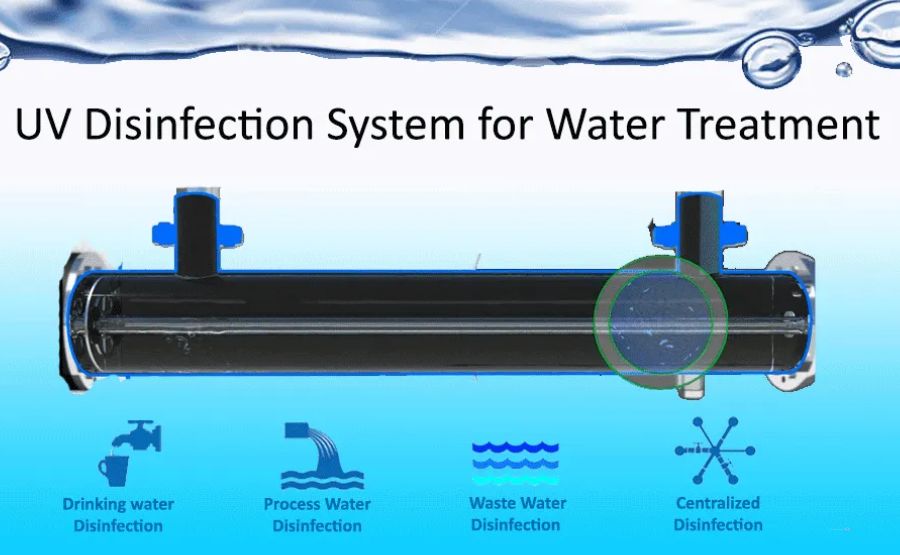
Commercial water demand is a different problem category from residential. A hotel processes thousands of litres daily through cooling towers, kitchens, laundries, and guest rooms. A food processing facility needs pathogen-free water at multiple points across a production line. A hospital requires water that will not cause opportunistic infections in immunocompromised patients. The stakes in each case are not just financial. They are regulatory and human. UV water treatment systems for commercial use are engineered to meet these demands at flow rates and reliability levels that domestic systems are never designed to handle.
What Flow Rates Do Commercial UV Systems Handle?
Residential UV systems typically handle 10 to 50 litres per minute. Commercial systems range from 100 litres per minute for small hospitality operations to over 10,000 litres per minute for municipal and large industrial applications. The UV dose delivered must remain consistent across the entire flow range. This is achieved through hydraulic design of the reactor chamber, which ensures uniform water velocity and even UV exposure time regardless of the demand at any given moment. Variable flow is one of the hardest engineering challenges in UV system design.
How Are Commercial UV Systems Validated for Performance?
Validation is the process of testing a UV system’s actual performance against its claimed performance using biological challenge organisms. The standard protocol, developed by the Water Research Foundation and endorsed by the US EPA, uses MS-2 coliphage as a surrogate virus. The test verifies log reduction values at minimum, average, and maximum flow rates across the lamp’s useful life. Only systems with third-party biodosimetry validation testing can be specified for applications where regulatory compliance requires documented performance.
What Role Do UV Systems Play in Legionella Control?
Legionella bacteria thrive in warm water systems between 20 and 45 degrees Celsius. Commercial cooling towers, hot water systems, and spa pools are all high-risk environments. Australian Work Health and Safety legislation requires risk management of Legionella in certain commercial premises. UV disinfection at doses above 40 mJ/cm2 achieves significant log reduction of Legionella pneumophila. In combination with thermal management and water treatment programs, UV is a recognised control measure in Australian Standard AS/NZS 3666 for air-handling and water systems.
What Pre-Treatment Is Required Before UV in Commercial Applications?
Commercial water sources vary enormously in quality. UV transmittance, the measure of how much UV light passes through one centimetre of water, must be above 75% for most commercial systems to deliver rated performance. Municipal water typically has UV transmittance above 90%. Bore water with iron, tannins, or suspended solids may have transmittance as low as 50%. Pre-treatment options include sediment filtration, iron removal media, activated carbon for organics, and reverse osmosis for dissolved solids. The pre-treatment train is often as important as the UV system itself.
How Does UV Treatment Support Food Safety Compliance?
Australia’s food safety standard FSANZ 3.2.2 requires food businesses to use water that is safe and suitable. For manufacturers using bore water or tank water in food contact applications, UV treatment provides documented pathogen reduction that supports HACCP plan requirements. Regulatory auditors increasingly expect evidence of water treatment validation, not just system installation. A UV system with data logging that records UV intensity, flow rate, and alarm events provides an auditable record of water treatment performance over time.
What Happens When a Commercial UV System Fails?
Commercial facilities cannot stop water supply while a UV lamp is replaced. Premium commercial UV systems use parallel or redundant configurations, where two UV chambers operate simultaneously. If one fails, the other maintains full treatment capacity while the fault is addressed. Monitoring systems generate immediate alarms when UV intensity drops below the setpoint. Building management system integration allows UV system status to be monitored remotely. Downtime planning is built into the engineering from the design stage in serious commercial applications.
What Is the Total Cost of Ownership for Commercial UV Systems?
Capital cost is only the first number. Lamp replacement every 12 to 18 months, quartz sleeve replacement and cleaning, ballast maintenance, and energy consumption all contribute to operating cost. A commercial UV system treating 500 litres per minute consumes approximately 2 to 5 kilowatts of electricity continuously. Annual lamp costs for a mid-sized commercial system typically run $500 to $2,000 depending on lamp count and specification. Compare that to chemical dosing costs, storage, handling, and the regulatory overhead of chlorine management, and UV often wins on total lifecycle cost.
Which Commercial Sectors Are Mandating UV Treatment Right Now?
Aged care is one of the fastest-growing sectors for commercial UV adoption. NDIS and aged care quality standards create strong obligations around infection prevention. Hospital-grade water quality in aged care facilities is becoming a practical expectation even where it is not yet a strict regulatory requirement. The aquaculture industry is mandating UV at hatchery and broodstock stages to prevent viral haemorrhagic septicaemia and other waterborne pathogens that devastate fish populations. Commercial beverage production, including craft brewing, also increasingly specifies UV because it eliminates chlorine interference with fermentation processes.
