Quick Facts
| Measurement | Amount |
| 4 quarts = cups (US) | 16 cups |
| 1 US quart | 4 US cups |
| 1 US quart in fluid ounces | 32 fl oz |
| 1 US quart in milliliters | 946.35 mL |
| 1 US cup in fluid ounces | 8 fl oz |
| 1 US cup in milliliters | 236.59 mL (≈240 mL for labeling) |
| 1 US quart in pints | 2 pints |
| 1 US quart in gallons | ¼ gallon |
| 1 Imperial quart | 4 Imperial cups / 1,136.52 mL |
| 1 Imperial cup | 284.13 mL / 10 Imperial fl oz |
| 1 Metric cup | 250 mL |
| 4 Imperial quarts to US cups | Approximately 19.2 US cups |
| US quart vs Imperial quart | Imperial is ~20% larger |
| Conversion formula | Quarts × 4 = Cups |
| Reverse formula | Cups ÷ 4 = Quarts |
The Answer in One Line
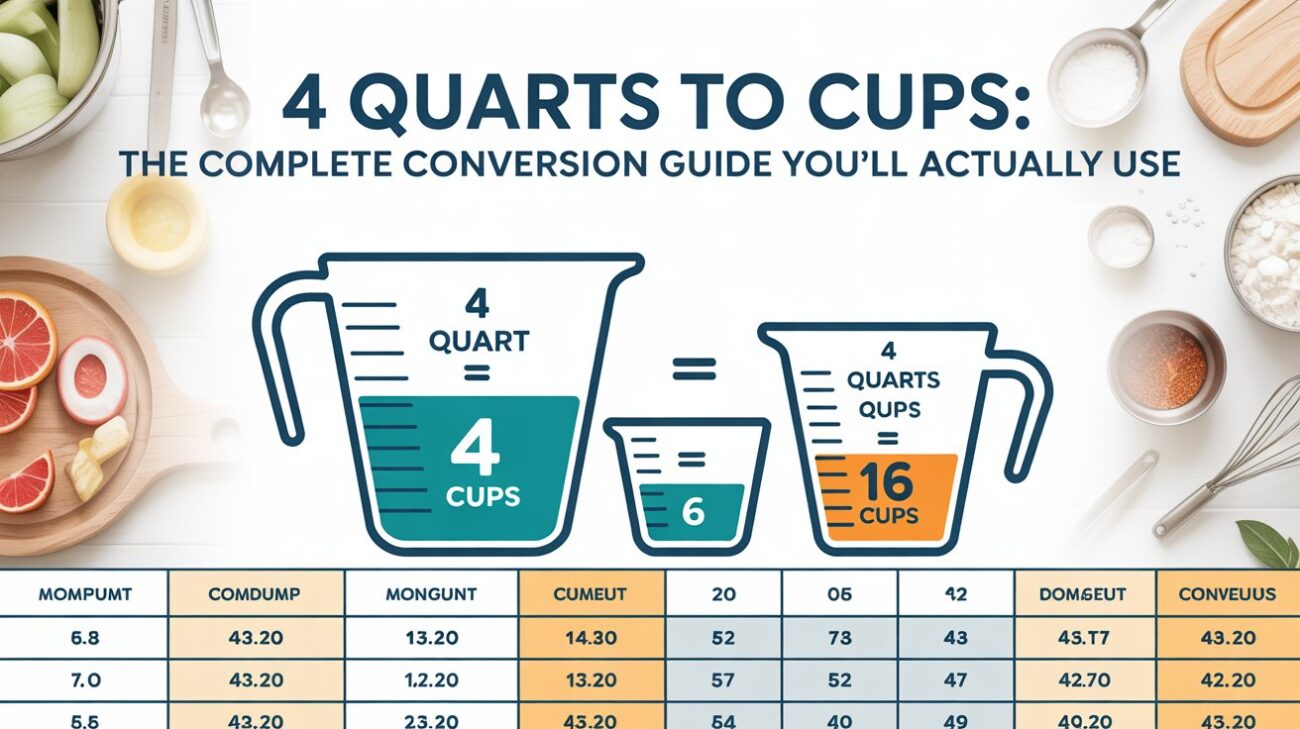
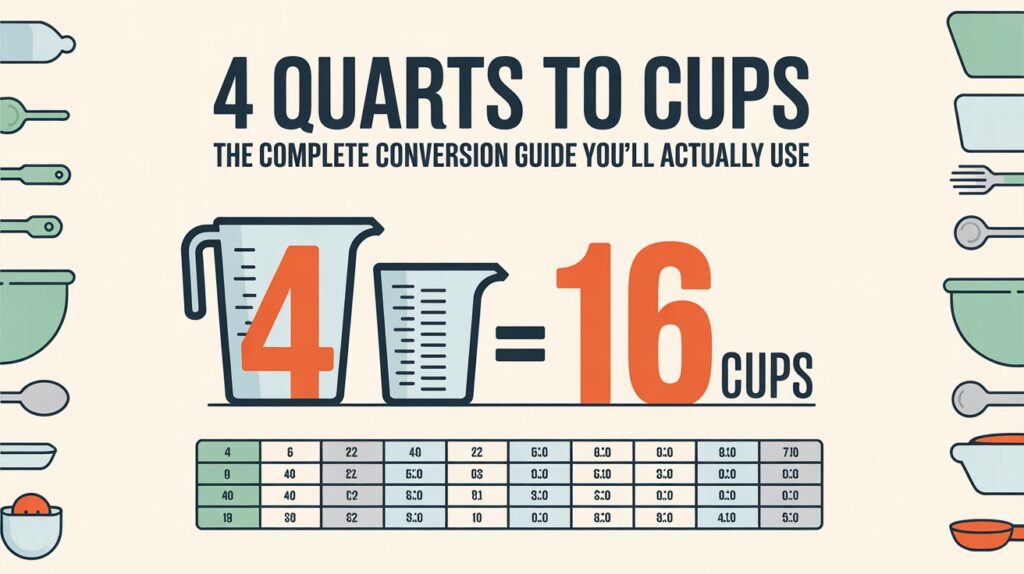
4 quarts equals 16 cups.
That’s it. That’s the answer. And it took you five seconds to find out.
But if you’re reading this article, you probably want more than five seconds. Maybe you’re scaling a recipe. Maybe you’re cooking for a crowd and need to convert the whole thing. Maybe you’re teaching a kid how measurements work and you want to explain the whole system properly.
Whatever the reason, let’s walk through all of it — slowly, clearly, and without making it more complicated than it needs to be.
See also “Duaction: The Idea That’s Quietly Changing How We Work, Learn, and Live“
How the Math Works (And Why It’s Simple)
Here’s the only rule you need to remember.
1 quart = 4 cups.
That’s your anchor. Everything else is just multiplication or division.
So when the question is 4 quarts, you multiply:
4 quarts × 4 cups = 16 cups
Done. If someone asks you how many cups are in 4 quarts, you say 16. You don’t need a calculator. There’s no need to search it up. You just hold that anchor — 1 quart equals 4 cups — and multiply.
And if you have to turn around? Divide instead.
16 cups ÷ 4 = 4 quarts. Same answer, different direction.
Why Is a Quart Called a Quart?
This is the question that comes up whenever someone thinks about it for more than a minute.
A quart is literally a “quarter.” It’s one quarter of a gallon. The word comes from the Latin “quartus” meaning fourth. This is where the name came from centuries ago and it stuck.
That same logic runs through the whole system in a beautiful way:
- 1 gallon contains 4 quarts
- 1 quart contains 2 pints
- 1 pint contains 2 cups
- 1 cup contains 8 fluid ounces
So when you hold 4 quarts in your head, you’re actually holding 1 whole gallon. That’s a useful thing to know when you’re buying milk, filling a pot for pasta, or measuring broth for a soup.
The Full Conversion Chart: Every Quart Amount You Might Need
You came for 4 quarts. But let’s give you the whole range so you never have to search again.
| Quarts | Cups |
| ¼ qt | 1 cup |
| ½ qt | 2 cups |
| ¾ qt | 3 cups |
| 1 qt | 4 cups |
| 1.5 qt | 6 cups |
| 2 qt | 8 cups |
| 2.5 qt | 10 cups |
| 3 qt | 12 cups |
| 3.5 qt | 14 cups |
| 4 qt | 16 cups |
| 5 qt | 20 cups |
| 6 qt | 24 cups |
| 8 qt | 32 cups |
| 10 qt | 40 cups |
| 12 qt | 48 cups |
Keep this table handy when you’re scaling recipes. Cooking for a crowd is so much easier when you can glance at a chart rather than recalculate from scratch every time.
US Cups vs. Imperial Cups vs. Metric Cups — The Difference That Trips People Up
Here’s where it gets a little interesting.
A “cup” doesn’t mean exactly the same thing everywhere in the world. If you’re using an American recipe, you’re using US cups. If you’re using a British recipe, Australian recipe, or Canadian recipe, the cup measurement might be slightly different.
Let’s break it down:
US customary cup = 236.59 milliliters (about 240 mL). This is the cup used in American recipes, American measuring tools, and American kitchens.
Metric cup = exactly 250 milliliters. Used in Australia, Canada, New Zealand, and other countries that follow the metric system. Slightly larger than a US cup.
Imperial cup = approximately 284 milliliters. Technically used in the UK, though modern British recipes rarely call for “cups” — they tend to use grams and milliliters.
For most US home cooks, this won’t matter. Your measuring cup set is calibrated for US cups and your recipes are written for US cups. The two match up perfectly.
But if you’re cooking from an Australian recipe that says “4 cups of flour,” be aware that their cup is 250 mL instead of 236 mL. For small amounts, the difference is negligible. For larger amounts, it can add up.
US Quarts vs. Imperial Quarts — Why the Gap Matters
The quart comparison is even more significant.
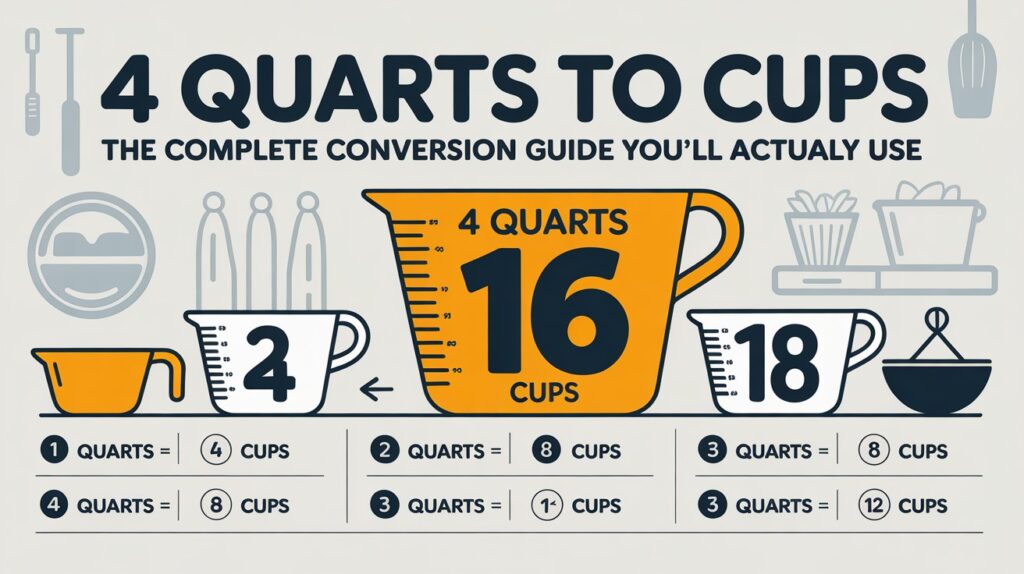
A US liquid quart holds 946.35 milliliters — roughly 32 fluid ounces.
A British Imperial quart holds 1,136.52 milliliters — roughly 40 fluid ounces.
The Imperial quart is about 20% bigger than the US quart. That’s not a small difference when you’re cooking.
Here’s how this plays out in practice. A UK recipe that calls for 4 Imperial quarts is actually asking for the equivalent of about 4.8 US quarts or roughly 19.2 US cups. If you measure 16 US cups (4 US quarts) instead, you’re coming up about 3 cups short.
The fix is simple though. When in doubt about the origin of a recipe, check whether it’s using US measurements or metric/Imperial ones. Most modern recipes specify this. If they don’t, the rule of thumb is: American recipes use US cups and US quarts. Everything else often uses metric.
Where You’ll Actually Use This Conversion in the Kitchen
Let me bring this out of the abstract and into a real kitchen.
Making a big batch of soup or stock. Many homemade stock recipes call for 4 quarts of water. That’s your whole large pot. Knowing that 4 quarts is 16 cups helps you fill the pot correctly using your measuring cups if you don’t have a quart-marked container.
Doubling or tripling recipes. A recipe that makes 2 quarts suddenly needs to become 4 quarts when you’re feeding double the people. You instantly know you’re going from 8 cups to 16 cups without doing any math.
Brining poultry. Brine recipes often call for quarts of water. A standard turkey brine might need 2 quarts of water and 1 quart of ice. Knowing the cup equivalent helps you measure without a quart-specific container.
Batch cooking and meal prep. Large casseroles, soups, sauces, and drinks are often measured in quarts. When you’re portioning into cups for individual servings, you need this conversion constantly.
Making drinks for parties. A punch bowl recipe might call for 2 quarts of juice. You now know that’s 8 cups without hesitating.
The Full US Volume Hierarchy — The Big Picture
Understanding quarts and cups is easier when you see the entire measurement ladder at once.
Here’s how the US volume system fits together from smallest to largest:
- 1 teaspoon — the smallest standard measure
- 3 teaspoons = 1 tablespoon
- 2 tablespoons = 1 fluid ounce
- 8 fluid ounces = 1 cup
- 2 cups = 1 pint
- 2 pints = 1 quart
- 4 quarts = 1 gallon
Everything connects. And notice something beautiful near the bottom: 4 quarts equals 1 gallon. So when we say 4 quarts is 16 cups, we’re also saying that 1 gallon is 16 cups.
That’s a useful double fact to carry around. One gallon of milk? That’s 16 cups. A one-gallon pot filled to the brim? Sixteen cups of liquid.
Liquid Quarts vs. Dry Quarts — Yes, There’s a Difference
Most home cooks use the word “quart” and mean liquid quart. But technically, there’s also a dry quart.
A US liquid quart measures fluid volume. It holds 946.35 milliliters of water, juice, broth, or any liquid.
A US dry quart is used for measuring dry goods like grains, berries, and produce. It’s slightly larger at 1,101.22 milliliters.
In most kitchen contexts, the word “quart” means liquid quart. If you’re measuring blueberries to sell at a farmers market, you might encounter the dry quart. For soup, broth, cooking liquids, and recipes, assume liquid quart unless told otherwise.
The cup measurements in this article — 1 quart = 4 cups and 4 quarts = 16 cups — refer to liquid quarts and standard measuring cups as used in American home cooking.
Converting to Metric: Milliliters and Liters
Sometimes you need to cross over into metric measurements entirely. Here’s how 4 quarts translates.
4 US quarts × 946.35 mL per quart = 3,785.4 milliliters
That rounds to approximately 3.785 liters — which is also exactly 1 US gallon in metric.
So 4 quarts = 16 cups = 1 gallon = roughly 3.785 liters.
If you’re working in a country that uses liters and you see an American recipe calling for 4 quarts of water, just measure out 3.75 to 3.8 liters. You’ll be perfectly accurate for any cooking purpose.
Measuring Tips That Prevent Mistakes
Even knowing the conversions perfectly doesn’t help if you measure wrong. Here are the practical techniques that matter.
Use the right type of measuring cup for liquids. Liquid measuring cups are usually made of clear glass or plastic with a pour spout. They’re designed to be filled to a line. Dry measuring cups are solid cups you fill and level off. Using a dry cup for liquids (or vice versa) can introduce small errors that add up in large recipes.
Check at eye level. When measuring liquids, crouch down so your eyes are exactly level with the measuring line. Looking down from above makes the liquid appear fuller than it is. The meniscus — that slight curve at the surface of the liquid — should sit right on the line when viewed at eye level.
Don’t confuse your coffee mug with a measuring cup. A coffee mug might hold 10, 12, or even 16 fluid ounces depending on its size. There are precisely eight fluid ounces in a conventional measuring cup.These are not interchangeable for baking or recipe measurements.
When scaling up significantly, use a large liquid measuring cup. Many kitchen stores sell 2-quart (8-cup) measuring pitchers. If you’re working with 4 quarts regularly, a 4-quart pot or large container with quart markings on the side is worth having.
Common Real-Life Containers and What They Hold
Knowing abstract measurements is useful. Knowing what’s actually in your fridge and pantry is even more useful.
- A standard half-gallon milk carton = 2 quarts = 8 cups
- A one-gallon water jug = 4 quarts = 16 cups
- A standard 32 oz carton of broth = 1 quart = 4 cups
- A 64 oz juice bottle = 2 quarts = 8 cups
- A standard quart of motor oil = 1 quart = 4 cups (same size, different purpose)
- A large stock pot (8 quarts) = 32 cups capacity
- A typical instant pot (6 quart) = 24 cups maximum
When a recipe says “use a 4-quart pot,” you now know that’s asking for a pot with a 16-cup capacity. If your pot holds 20 cups, you have plenty of room. If it holds 12 cups, you’re going to have overflow issues.
Final Words
4 quarts is 16 cups. Full stop.
That single conversion is enough for most of the situations you’ll encounter in a kitchen. But now you also have the context around it — how the US measurement system connects from teaspoons to gallons, why the Imperial quart is bigger, how cups differ across countries, and exactly how to measure accurately once you know the numbers.
Measurement conversions don’t have to feel like a math test. Once you see the pattern — everything in the US system is built on factors of 2 and 4 — it becomes something you can reconstruct from memory whenever you need it.
One quart equals four cups. Four quarts equals sixteen cups. One gallon equals sixteen cups. The system makes sense. And the next time someone asks, you’ll know before they finish the question.
FAQs
Q1: How many cups is 4 quarts?
4 quarts equals exactly 16 cups. This is based on the US standard where 1 quart = 4 cups. Multiply 4 quarts × 4 cups = 16 cups.
Q2: How many quarts is 16 cups?
16 cups equals 4 quarts. Divide by 4: 16 cups ÷ 4 = 4 quarts. This is the same as 1 gallon.
Q3: Is 4 quarts the same as 1 gallon?
Yes. In the US measurement system, 4 quarts equals exactly 1 gallon. And 1 gallon equals 16 cups.
Q4: How many fluid ounces is 4 quarts?
4 quarts equals 128 fluid ounces. Each US quart holds 32 fluid ounces, so 4 × 32 = 128.
Q5: How many milliliters is 4 quarts?
4 US liquid quarts equals approximately 3,785.4 milliliters — or roughly 3.785 liters, which is exactly 1 US gallon in metric.
Q6: Does the answer change if I use Imperial quarts?
Yes. 4 Imperial quarts (used in the UK) equals approximately 19.2 US cups because the Imperial quart is about 20% larger than the US quart. Always check which system your recipe uses.
Q7: How many pints is 4 quarts?
4 quarts equals 8 pints. There are 2 pints in every quart, so 4 × 2 = 8.
Q8: What does a 4-quart pot look like?
A 4-quart pot holds 16 cups of liquid. It’s a medium-sized saucepan — big enough for a family-size soup, pasta sauce, or stew but not a giant stockpot. Common in most home kitchens.
Q9: Is a US cup the same as an Australian cup?
No. A US cup is 236.59 mL. A 250 mL metric cup is used in Australia. They’re close but not identical. For small amounts this rarely matters; for large recipe volumes, adjust accordingly.
Q10: Why does a recipe sometimes say “1 quart” and sometimes “4 cups”?
They mean exactly the same amount — 4 cups or 1 quart are interchangeable. Recipe writers choose whichever term matches the measuring tool most people would use. Broth often comes in quart cartons, so quarts make sense. Baking usually references cups.
Q11: How do I measure 4 quarts if I only have cups?
Simply fill your 1-cup measuring cup 16 times. Or fill a 2-cup (1 pint) measuring cup 8 times. Or fill a 4-cup (1 quart) measuring pitcher 4 times.
Q12: Is a dry quart the same as a liquid quart?
No. A US dry quart (1,101 mL) is slightly larger than a US liquid quart (946 mL). For cooking with liquids, always assume the measurement refers to a liquid quart.
Q13: How do I convert quarts to cups quickly in my head?
Multiply the number of quarts by 4. That’s it. 3 quarts = 12 cups. 5 quarts = 20 cups. 4 quarts = 16 cups. One rule, infinite applications.
Keep creating, innovating, and inspiring with Content Ideators every day.
