
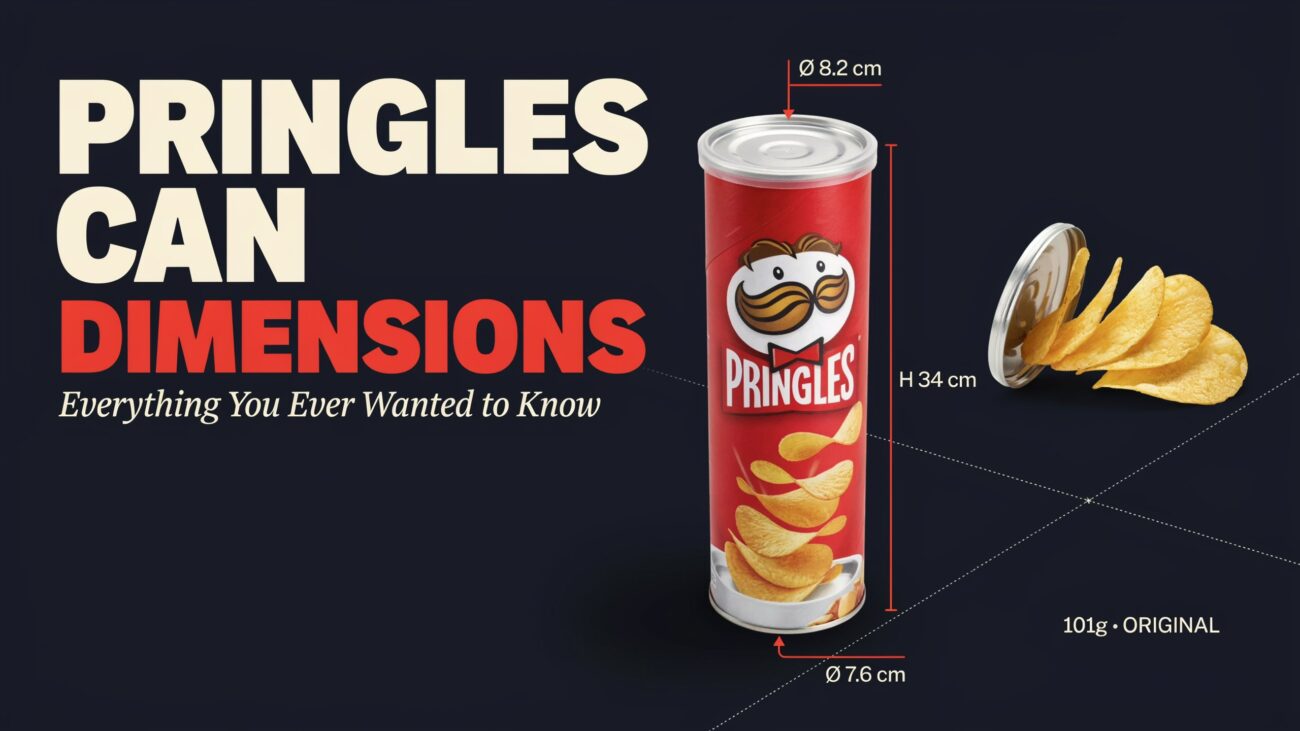
Quick Facts
| Detail | Measurement |
| Standard Can Height | 10 inches / 25.4 cm |
| Outer Diameter | 3.125 inches / 7.94 cm |
| Inner Diameter | ~2.87–2.9 inches / ~7.3 cm |
| Circumference | ~9.82 inches / 24.9 cm |
| Radius | ~1.56 inches / 3.96 cm |
| Standard Weight | 5.5 oz / 156 grams |
| Chips Per Can | ~90 to 100 chips |
| Volume | ~750 ml / 25 fl oz |
| Body Material | Spiral-wound cardboard + foil lining |
| Bottom Material | Thin metal base |
| Lid Material | Resealable plastic |
| Inventor | Fredric Baur |
| Year Introduced | 1968 |
| Patent Year | 1970 |
| Chip Shape | Hyperbolic paraboloid (saddle shape) |
The Can You’ve Held a Hundred Times
You know exactly what it feels like to hold a Pringles can.
That cool, smooth cardboard in your palm. The little pop of the plastic lid. The first crunch echoing up through your fingers.
Most of us have held that tube hundreds of times in our lives. But has anyone ever really stopped to ask — what exactly is this thing? How tall is it? Why is it that width? Why a tube at all?
These are actually great questions. And the answers are more interesting than you’d expect.
See also “MyReadibgMsngs: The Full, Honest Guide for 2026“
Where Did This Can Even Come From?
Before Pringles existed, chips were a mess. Literally.
You’d open a bag and find half the chips were already crumbs. The bag was mostly air. The chips were greasy and often stale by the time you got to them.
A chemist named Fredric Baur thought this was ridiculous. He worked at Procter & Gamble in Cincinnati, Ohio, and in the mid-1960s, he sat down and decided to fix it.
Baur didn’t just redesign the packaging. He designed the whole system — the chip shape, the tube, the stacking method, all of it together. He filed his patent in 1966 and it was granted in 1970. The product first went on sale in 1968 under the name “Pringles Newfangled Potato Chips.”
It did not take off right away. But once it did, it became one of the most recognizable food packages on the planet.
Baur was so proud of what he created that when he passed away in 2008 at 89 years old, he had one final request for his family. He wanted part of his ashes buried inside a Pringles can.
His children stopped at a Walgreens on the way to the funeral home and picked one up. They chose Original flavor.
That story tells you everything you need to know about how much this can mean to the man who made it.

The Standard Can: Exact Numbers
Let’s talk about real measurements now.
The can you see in almost every grocery store — the 5.5-ounce one — is the standard. It’s been the flagship size for decades.
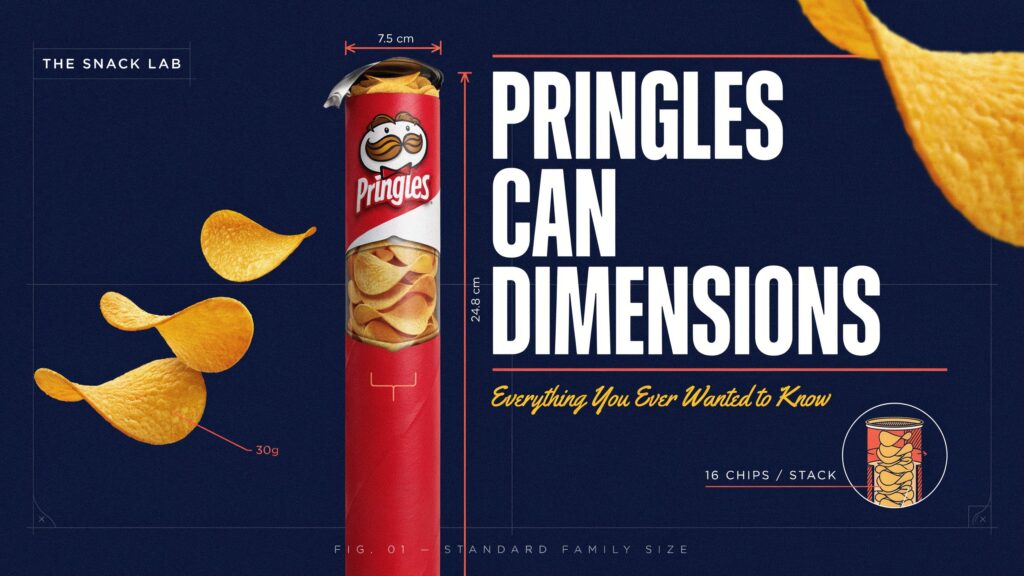
Height: 10 inches tall, or 25.4 centimeters. That’s roughly as tall as a standard school ruler.
Outer Diameter: 3.125 inches, or about 7.94 centimeters. This is the widest point, measured with the plastic lid on.
Inner Diameter: Around 2.87 to 2.9 inches. The cardboard walls take up that small gap between outside and inside.
Circumference: Just under 9.82 inches, or about 24.9 centimeters if you wrapped a tape measure around it.
Radius: About 1.56 inches. That’s half the diameter — just basic math, but useful to know for craft projects.
Chip count: 90 to 100 chips per standard can.
These numbers didn’t come from guesswork. Engineers picked every single one of them on purpose.
Why 10 Inches Tall? Why 3 Inches Wide?
This is the part most people never think about.
That tall, slim shape is a very specific choice. If the can were shorter and fatter, fewer chips would stack before you ran out of height. That means more air, more movement, more broken chips in shipping.
If the can were taller and narrower, it would start to buckle under its own weight. The cardboard walls would bend.
Ten inches is the sweet spot. It holds a full satisfying stack of chips, it fits in most backpacks and pantry shelves, and it’s stiff enough to stay strong through shipping.
The 3-inch width was chosen to match the chips themselves. The chips are shaped to fit snugly inside without too much wiggle room. If chips shift around in transit, they break. The tight fit keeps them locked in place.
Studies suggest the rigid tube design cuts chip breakage by over 60 percent compared to regular bags. That’s not a small number.
What the Can Is Actually Made Of
A Pringles can look simple from the outside. It’s not.
Peel back the layers and here’s what you find:
- The main body is a spiral-wound cardboard tube. Think of how a paper towel roll is wound — same idea, but much sturdier.
- The inside lining is a thin foil layer. This blocks moisture, light, and air. Without it, your chips would go soft within days.
- The bottom is a thin metal disc. It gives the can stability and stops the cardboard from getting wet or mushy if the can sits on a damp surface.
- The lid is a snap-on plastic cap. It creates an airtight seal and lets you close the can between snacking sessions.
- The foil seal is that thin pull-tab on a fresh can. Once you break that, you’ve opened the freshness barrier for the first time.
All these layers work together. Each one has a job. Take one away and the whole system gets worse.
The Chip Shape Is Part of the Size Story
You can’t talk about the can without talking about the chip.
Each Pringle is shaped like a saddle. Scientists call this a hyperbolic paraboloid — a curved surface that bends in two opposite directions at the same time.
That shape isn’t just for looks. It’s why every chip can rest perfectly on the chip below it. Each one nests into the next, like a stack of identically curved bowls.
Each chip measures about 2.5 to 2.8 inches long, roughly 1.75 inches wide, and just 0.09 inches thick. They’re made from a mixture of dried potato flakes, rice, wheat, and corn that gets pressed into molds and fried.
Because every chip is exactly the same shape and size, they stack with almost no wasted space. That’s why 90 to 100 chips fit into a single 10-inch tube.
A bag of regular chips has random shapes and sizes. You’d never pack them as efficiently.
All the Different Sizes
The standard 5.5-ounce can is what most people picture. But Pringles actually comes in several sizes.
Mini / Travel Size
- Height: About 4 to 4.5 inches (roughly 10–11.4 cm)
- Diameter: Around 2.5 to 3 inches
- Weight: 1.3 to 1.4 ounces (about 37–40 grams)
- Chips: Around 28 to 34
- Perfect for: Lunchboxes, travel, kids’ snacks
Snack Stack (Grab & Go)
- Height: About 5.5 to 6 inches
- Diameter: Same 3-inch standard
- Weight: Around 2.5 ounces (71 grams)
- Chips: Around 15 to 18 per pack
- Perfect for: Quick snacks, car trips, vending machines
Standard Can
- Height: 10 inches
- Diameter: 3.125 inches
- Weight: 5.5 ounces (156 grams)
- Chips: 90 to 100
- Perfect for: Everyday snacking at home
Party / Family Size
- Height: 11.5 to 13 inches (roughly 29–33 cm)
- Diameter: Around 3.1 to 3.2 inches (slightly wider)
- Weight: 12.3 to 13.5 ounces or more
- Chips: Up to 300 for the biggest sizes
- Perfect for: Parties, game nights, big families
One thing stays the same across almost all these sizes: the diameter barely changes. That keeps the chips at the same size no matter which you can buy.
How Does It Compare to Other Brands?
Pringles was not the only company to try a tube-style chip container.
Lay’s Stax is the most well-known competitor. Their cans measure about 3.1 inches in diameter — just slightly wider. You’d never notice without a ruler, but engineers notice.
Generic store brands vary anywhere from 2.8 to 3.2 inches. They tend to be inconsistent across batches.
Pringles holds tighter to its exact 3.125-inch standard than anyone else in the category. Their quality control reportedly rejects any can that deviates by more than 0.05 inches from the spec.
That consistency is part of the brand identity. When you grab a Pringles can anywhere in the world, it feels the same in your hand.
Different Markets, Slightly Different Cans
Here’s something most people don’t realize.
The can changes slightly depending on where in the world you buy it.
In the United States, the standard weight is 5.5 ounces. In the UK and much of Europe, Pringles switched to grams — common sizes there are 165 grams or 185 grams. The height adjusts slightly to match.
There’s also a 200-gram metric can sold internationally that stands about 10.5 inches tall — just a half-inch taller than the US standard.
The diameter stays almost identical across all markets. The chip size doesn’t change. It’s the height and weight that shifts.
The Recycling Problem No One Likes Talking About
Here’s where the story gets less cheerful.
That beautiful, multi-layered can — the cardboard body, the foil lining, the metal bottom, the plastic lid — is a recycling nightmare.
To recycle each part, you’d need to tear the can apart and separate every layer. The cardboard, the foil, the metal, the plastic all go to different facilities. And the inner foil lining is bonded so tightly to the cardboard that separating them is nearly impossible.
In 2017, a recycling trade group in the UK called out the Pringles can as the number-one recycling villain in the snack food world. Their chief executive said sorting it was “virtually impossible.”
Imagine trying to unglue a foil-lined cardboard tube bonded to a metal bottom and then separate each layer for recycling. Most recycling plants don’t have the technology to do it.
So for now, in most places, the whole can ends up in the trash.
The good news: Pringles and its parent company Kellogg’s have been working on a fix. They tested a new tube design made from 90 percent paper, with a recyclable paper bottom instead of a metal one. In trial runs at select UK stores, early results looked promising.
The lid and the foil inner lining are still the tough parts. But the direction is better than it was.
If you want to do something useful with your empty can right now — read the next section.
What People Do With Empty Pringles Cans
People are incredibly creative with these.
The tube is sturdy, water-resistant, and exactly the right size for a long list of things. Here are some popular uses:
- Pencil holder or desk organizer — Wrap the outside in paper or fabric and it looks like something you bought at a store.
- Pasta storage — Uncooked spaghetti fits perfectly inside a standard can. Pop the lid on and it’s airtight.
- Speaker amplifier — Cut a hole in the side, slide your phone in, and the cardboard tube amplifies the sound surprisingly well.
- Cookie gift tin — Fill it with homemade cookies, tie a ribbon around the lid, done.
- Advent calendar — Stack 24 decorated mini cans, fill each with a small treat, open one a day.
- Craft supply storage — Perfect for paintbrushes, markers, rulers, or small bottles.
- Time capsule — A sealed Pringles can is actually one of the better household items for this. Airtight, waterproof outer lid, rigid walls.
The 3-inch diameter is also the perfect fit for most car cup holders. People on road trips discovered this years ago.
Why the Can Feels the Same Everywhere
There’s something a little magical about the Pringles staying basically unchanged for decades.
The core measurements — roughly 10 inches tall, 3 inches wide — have held steady since Fredric Baur designed them in the 1960s. The lid snaps the same way. The foil pull-tab tears the same way. The chips stack the same way.
In a world where product packaging gets redesigned every few years, Pringles has barely touched the formula.
Part of that is branding. When billions of people worldwide already know exactly what the can feels like, you don’t mess with it.
Part of it is engineering. The design just works. It protects the chips better than anything else. It stacks on shelves efficiently. It fits in your bag. It fits in your hand. The 3-inch diameter is narrow enough that even a child can grip it.
Fredric Baur spent years perfecting this. He was proud enough of it to be buried in one.
That kind of confidence in a design doesn’t come along often.
Final Words
At the end of the day, a Pringles can is just packaging. It’s a cardboard tube with a plastic lid.
But look a little closer and it’s actually a pretty impressive piece of engineering. Every measurement was chosen deliberately. The height protects chips. The width matches the chip shape. The materials lock out moisture. The stacking system cuts breakage dramatically.
One chemist in Cincinnati sat down in the 1960s and designed a system so good that it barely needed to change for more than 50 years.
The next time you pop that lid and reach inside, you’re holding the result of that work. Ten inches of thought, care, and chip protection.
And now you know exactly how much space that is.
FAQs
Q1. How tall can a standard Pringles can?
A standard Pringles can stand about 10 inches tall, which is 25.4 centimeters. This is the size you’ll find in most grocery stores and convenience shops across the US.
Q2. What is the diameter of a Pringles can?
The outer diameter is 3.125 inches (about 7.94 cm) when measured with the lid on. The inner diameter where the chips sit is slightly smaller — around 2.87 to 2.9 inches.
Q3. How many chips fit in a standard Pringles can?
Most standard cans hold between 90 and 100 chips. The exact number can vary slightly by flavor, since thicker flavors like BBQ might pack a few fewer than the original.
Q4. Why is the Pringles a tube and not a bag?
The tube locks chips into a neat stack so they can’t move around during shipping. It also creates a rigid wall that resists being crushed. This reduces breakage by over 60 percent compared to standard chip bags.
Q5. Can the Pringles can size change in other countries?
The diameter stays almost the same worldwide, but the height and fill weight can vary. The US standard is 5.5 ounces. UK and European versions are often sold in grams — 165g, 185g, or 200g — with slightly adjusted heights.
Q6. What is the mini Pringles can size?
Mini cans are about 4 to 4.5 inches tall and hold around 1.3 ounces — roughly 28 to 34 chips. They’re sized for one sitting, and they fit easily in school lunch bags or jacket pockets.
Q7. What are the Pringles can made of?
The body is spiral-wound cardboard with a foil lining inside. The bottom is thin metal. The lid is plastic. A foil pull-tab seals the top before first opening. Each material has a specific job in keeping the chips fresh.
Q8. Are Pringles cans recyclable?
It’s complicated. The mix of cardboard, foil, metal, and plastic makes them very difficult to recycle at standard facilities. In most areas, the whole can goes to landfill. Pringles has been testing a new 90% paper tube design in some markets that’s much easier to recycle.
Q9. Who invented the Pringles can?
Fredric Baur, an organic chemist and food scientist who worked at Procter & Gamble in Cincinnati, Ohio. He filed the patent in 1966 and it was granted in 1970. He designed both the chip shape and the tube together as one system.
Q10. Does the Pringles can fit in a car cup holder?
Yes. The 3-inch diameter lines up almost perfectly with standard cup holders in most cars. This is completely intentional — portability was always part of the design goal.
Q11. What is the party size Pringles can reach?
Party size cans typically stand 11.5 to 13 inches tall, depending on the exact product. The diameter stays close to 3 inches, so the chips remain the same size. These cans can hold up to 300 chips.
Q12. What shape is a Pringle chip, exactly?
Each chip is a hyperbolic paraboloid — a saddle shape that curves upward on two opposite sides and downward on the other two. This shape allows chips to stack perfectly into each other, which is what makes the entire can system work.
Keep creating, innovating, and inspiring with Content Ideators every day.
