
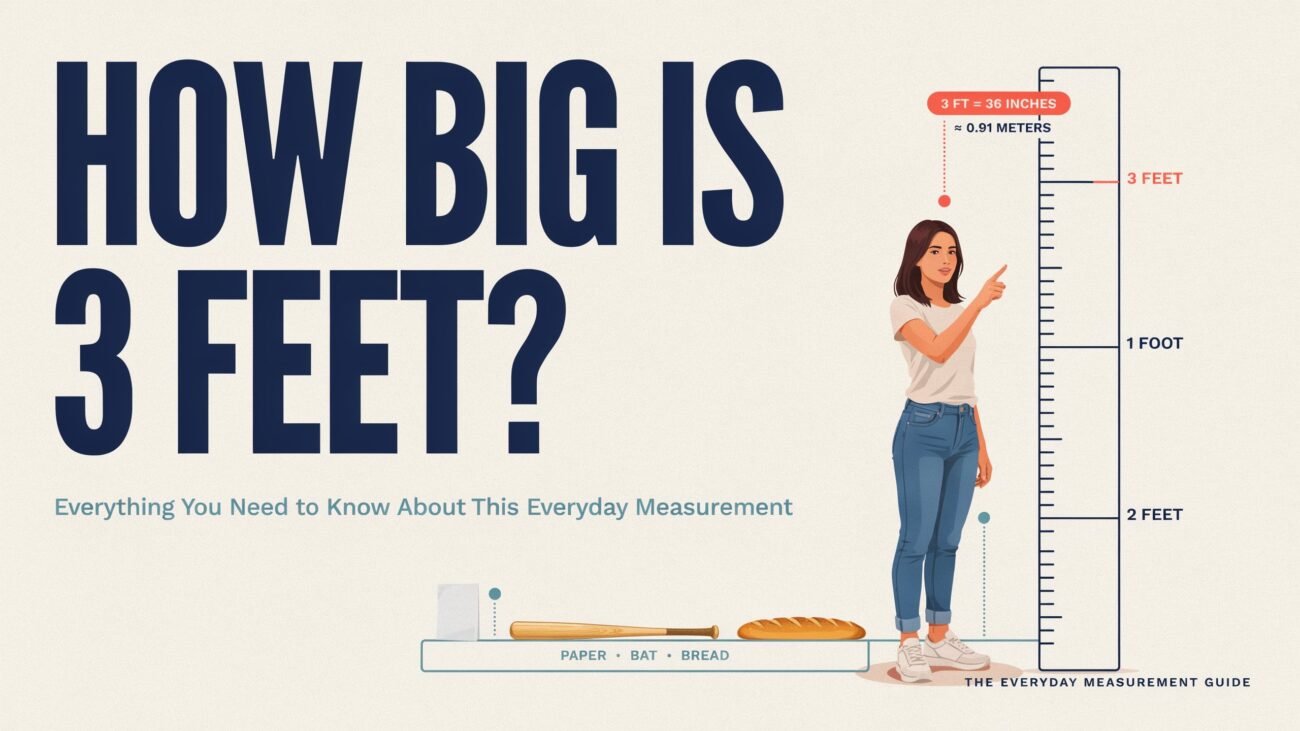
Quick Facts
| Detail | Value |
| 3 feet in inches | 36 inches |
| 3 feet in centimeters | 91.44 cm |
| 3 feet in meters | 0.9144 m (just under 1 meter) |
| 3 feet in millimeters | 914.4 mm |
| 3 feet in yards | Exactly 1 yard |
| 3 feet in miles | 0.00057 miles |
| Another name for 3 feet | 1 yard |
| Common body reference | Hip height for most adults |
| Child reference | Height of a 3–4 year old |
| Kitchen counter height | 36 inches — exactly 3 feet |
| Standard exterior door width | 36 inches — exactly 3 feet |
| When yard was standardized | 1959 (international agreement) |
The Measurement That’s All Around You
Here’s a funny thing about 3 feet.
You interact with it dozens of times every single day. You’ve touched it, walked through it, leaned against it, cooked on top of it. And yet if someone asked you right now to point to something that’s 3 feet, you might hesitate.
That gap between knowing and seeing is what this article is here to fix.
Three feet is not a huge distance. It’s not tiny either. It’s exactly the kind of measurement that lives in the middle of everyday life — practical, common, easy to underestimate.
Once you know what 3 feet actually looks like, you’ll start spotting it everywhere. And you’ll wonder how you ever missed it.
See also “Inseam Measurement: The One Number That Fixes Your Pants Forever“
The Basic Numbers First
Let’s get the math out of the way cleanly.
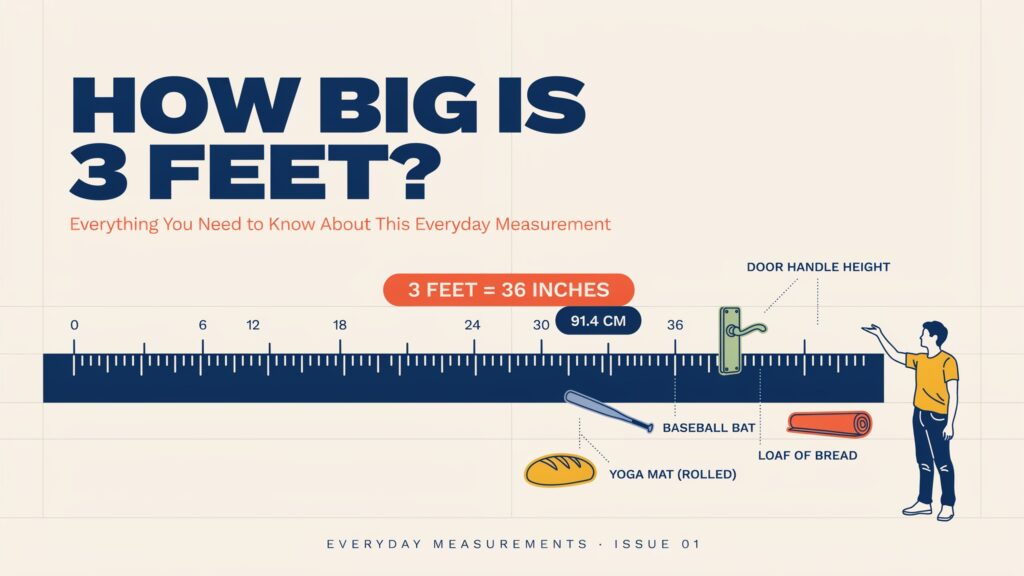
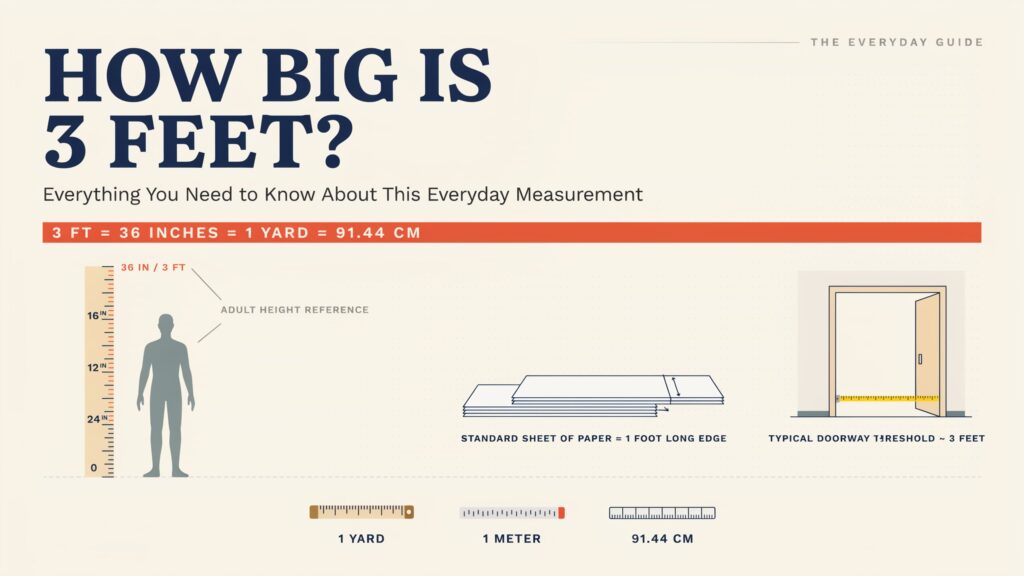
Three feet equals 36 inches. Each foot has 12 inches. So 12 times 3 gives you 36 — easy to remember.
Three feet also equals exactly one yard. In fact, the yard and 3 feet are the same thing. Different words, identical distance.
In metric terms, 3 feet works out to 91.44 centimeters. That’s just barely under one full meter (which is 100 cm). So when someone says “about a meter,” they’re describing something close to 3 feet.
In millimeters, 3 feet is 914.4 mm. That number matters more in engineering and manufacturing than in everyday life.
The one you’ll use most often: 3 feet = 36 inches = 1 yard = 91.44 cm = just under a meter.
Where Did 3 Feet Even Come From?
This is the part most people never think about. Where did the foot — and the yard — come from?
The honest answer is: from human bodies.
Thousands of years ago, people didn’t carry rulers. So they used themselves as measuring tools. The “foot” was literally the length of a person’s foot from heel to toe. Convenient? Yes. Consistent? Not at all, because feet come in different sizes.
Over time, kings tried to standardize things. King Henry I of England reportedly stretched out his arm from his nose to his fingertip and declared that stretch to be one yard — 3 feet. A king’s arm decided a unit of measurement that billions of people still use today.
Later, in 14th-century England, King Edward II formally tied the foot to 12 inches. An old statute from around that era declared that three barleycorns (dry, round grain) placed end to end made one inch, 12 inches made a foot, and 3 feet made one yard.
It wasn’t until 1959 that the US, UK, Australia, Canada, and several other countries finally agreed on an exact international definition: one yard equals precisely 0.9144 meters. That made one foot exactly 0.3048 meters. No more regional variations.
All that history, and it still goes back to someone’s arm.
How Big Is 3 Feet Using Your Own Body?
You don’t need a tape measure to picture 3 feet.
For most adults, 3 feet reaches from the floor to somewhere around your hip or waist. Stand up right now and think about the height where your hands naturally rest at your sides — that’s approximately 3 feet off the ground.
Your walking stride is another quick guide. A typical adult step covers roughly 2.5 to 3 feet. So one solid walking step forward takes you almost the entire distance.
Want a faster trick? Hold out one arm and bend it at the elbow. From your elbow to the tips of your fingers is roughly 15–18 inches. Do that twice — elbow to fingertip, repeated — and you’re at about 3 feet.
These body-based estimates aren’t perfectly precise. But they’re close enough for everyday life.
Things in Your Home That Are Exactly 3 Feet
This is where 3 feet stops being abstract and starts being real.
Your kitchen counter. Every single morning, without realizing it, you rest your hands on something that is exactly 3 feet tall. Kitchen counters are standardized at 36 inches by the National Kitchen and Bath Association — a height chosen because it works comfortably for most adults standing to prepare food. Whether you’re in a tiny apartment kitchen or a sprawling restaurant, that counter is almost certainly 3 feet high.
Your front door. The standard exterior door in the United States is 36 inches wide — exactly 3 feet. You walk through a 3-foot-wide opening dozens of times a day without ever registering it. This width is also the minimum required by the Americans with Disabilities Act (ADA) to allow wheelchair access, which is why it became the gold standard in residential construction.
A yardstick. This one is almost too obvious, but worth saying — a yardstick is literally named for this measurement. It’s exactly 3 feet, usually made of wood or plastic, and sold in every hardware store. People who need a quick physical reference for 3 feet should just grab one.
A standard guitar. Most acoustic and electric guitars measure between 38 and 42 inches in body length, but many classical guitars sit right around 36 inches. If you’ve ever propped a guitar against the wall, you’ve been looking at roughly 3 feet.
A baseball bat. Youth and adult baseball bats commonly range from 30 to 36 inches. A regulation adult bat lands right at 3 feet. It’s heavier than you expect for something so short — which actually helps you feel the length in a way a tape measure doesn’t.
A small coffee table. The width of many apartment-sized coffee tables is about 36 inches. It’s chosen specifically to fit in front of a sofa without crowding the space. The next time you prop your feet up, you’re staring at 3 feet.
A closet rod. Compact reach-in closets often have rods that span 36 inches across. One section of hanging clothes — that’s 3 feet of rod.
A traffic cone. Those bright orange safety cones you see on road construction sites stand about 36 inches tall. That height makes them visible from a distance without being a hazard. Three feet of safety, in a cone.
3 Feet Compared to a Young Child
Think about the last time a small child ran up to hug you around the knees.
That kid — probably three or four years old — was almost certainly 3 feet tall. Child growth charts commonly use the 3-foot mark as a major milestone, and most healthy kids hit it somewhere between their third and fourth birthdays.
This makes 3 feet one of the most emotionally familiar measurements in parenting. Parents track it, celebrate it, photograph it against the kitchen door frame.
For a toddler, being 3 feet tall means they can just peek over the edge of a dining table. They can reach a standard light switch — barely. They’re almost exactly half the height of most adult parents.
If someone asks you to picture 3 feet and you’re around children, just think of that.
Animals That Stand About 3 Feet Tall
Nature has some impressive 3-foot residents.
The Emperor Penguin is the tallest and heaviest penguin alive, standing around 3 to 3.5 feet tall. These birds live in Antarctica in brutal cold and are remarkable creatures — males stand for months in freezing temperatures, balancing a single egg on their feet while the females hunt at sea. Seeing one in a photo, you might assume it’s small because it’s a bird. But standing next to one would be startling. It comes up to your waist.
The Snow Leopard reaches about 3 feet at the shoulder. These pale, spotted big cats live in the mountain ranges of Central Asia and are famously elusive. Despite being 3 feet tall, they can weigh between 60 and 120 pounds, and their tails alone can stretch longer than their entire body height.
The Three-Toed Sloth measures about 3 feet in body length. These slow-moving mammals spend nearly their entire lives hanging upside down from trees in Central and South American rainforests. They move so slowly that algae sometimes grows on their fur.
The Dwarf Cassowary, one of the world’s largest flightless birds, grows to around 3 feet and lives in mountainous forests across Papua New Guinea. It’s a shy bird, though with claws that can do serious damage.
All of these animals carry 3 feet differently. Some carry it vertically. Some horizontally. Same number, wildly different creatures.
3 Feet in Sports and Equipment
Sports are where 3 feet becomes surprisingly precise.
A standard cricket bat measures right around 36 inches in length. The dimensions are tightly governed by cricket’s official rules — the bat cannot exceed 38 inches, and most professional bats hover just below that, with many sitting near the 36-inch mark.
In football, the end zones are 10 yards deep. That’s 30 feet — exactly 10 times 3 feet. Every measurement on an American football field ultimately connects back to yards, which means it connects back to multiples of 3 feet.
Volleyball nets for official play are positioned at 7 feet 11 5/8 inches for men — nearly 8 feet. That’s just over two and a half sets of 3 feet stacked together.
Many gymnastics balance beams stand at exactly 4 feet off the ground — barely above our 3-foot mark. Understanding one helps you anchor the other.
3 Feet in the World Around You
Beyond homes and animals, 3 feet shows up in places you might not expect.
Social distancing guidelines during health emergencies have often referenced 3 feet as one of the minimum recommended distances between people. It’s considered enough separation to reduce direct droplet exposure in many settings.
Garden bed width. Many gardening guides recommend raised garden beds be no wider than 3 feet across. The reason is simple — most adults can comfortably reach the center of a 3-foot-wide bed from either side without stepping into the soil.
Traffic safety barriers and construction cones are commonly 3 feet tall because this height is proven to catch the eye of approaching drivers without blocking sightlines beyond what’s needed.
Countertops in commercial kitchens and workshops follow the same 36-inch standard as home kitchens. Ergonomics studies show that 3 feet is close to the ideal working height for most standing adults — enough height that you’re not hunching over, not so tall that you’re reaching up uncomfortably.
How to Estimate 3 Feet Without a Ruler
Sometimes you need a quick answer and have no tools nearby.
Here are four reliable ways to estimate 3 feet on the spot:
- Hip check: Stand naturally. The height from the floor to your hip is close to 3 feet for most average-height adults.
- One big step: Walk forward one deliberate, long adult stride. That gets you very close to 3 feet.
- Kitchen counter: Find the nearest kitchen counter and visually compare. That surface is exactly 3 feet from the floor.
- Arm trick: Extend one arm straight out. From your shoulder to your fingertips is roughly 2 feet for most adults. Add the length of your forearm (elbow to wrist), about 1 foot. That stack gets you to 3 feet.
None of these are measurements. But they’re good enough for furniture shopping, hanging a picture, spacing plants in a garden, or checking if something will fit.
3 Feet vs. 1 Meter — What’s the Difference?
A lot of people wonder if 3 feet and 1 meter are basically the same thing.
They’re close, but not identical.
Three feet is 91.44 centimeters. One meter is 100 centimeters. So a meter is about 8.56 cm longer than 3 feet — roughly the length of three fingers.
In practice, if someone says “about a meter,” they could mean anything from 90 to 105 cm. Three feet fits comfortably inside that range. For casual conversation, treating 3 feet as “basically a meter” is fine.
For anything precise — construction, engineering, ordering materials — the difference matters. Use the actual conversion: 3 feet = 91.44 cm, not 100.
Why 3 Feet Became Such a Common Standard
It’s worth pausing to ask: why does 3 feet keep showing up as a standard?
The answer is mostly ergonomics and history combined.
Humans are roughly 5 to 6 feet tall. We reach comfortably at about half that height — which lands close to 3 feet. Working surfaces placed at 3 feet don’t require hunching or reaching. Our arms hang naturally at our sides at roughly that height. Even the doorway width of 3 feet was chosen because most people can pass through comfortably with a little room to spare.
Add in centuries of trade, construction, and manufacturing built around yard-based measurements, and 3 feet became deeply baked into the physical world.
Change it and you’d have to redesign kitchens, doorways, furniture, sports fields, and safety equipment all at once. So it stayed.
Final Words
Three feet is one of those measurements that proves how much is hiding in plain sight.
Your kitchen counter has been 3 feet tall your whole life. Every door you’ve walked through has been roughly 3 feet wide. The baseball bat you picked up in gym class was 3 feet long. The toddler you watched learn to walk hit 3 feet before they said a full sentence.
It’s not a dramatic measurement. It doesn’t span rooms or cross cities. It’s personal. Human-scaled. Built into furniture and architecture and sport because it fits the way people actually move and work and live.
Now that you’ve read this, you’ll never unsee it. Three feet is everywhere — and you just learned to look.
FAQs
Q1. How many inches is 3 feet?
Exactly 36 inches. Each foot has 12 inches, so three times 12 equals 36. This is one of the most useful conversions to memorize because it shows up constantly in furniture dimensions, door widths, and fabric measurements.
Q2. Is 3 feet the same as 1 meter?
Close, but not exact. Three feet is 91.44 centimeters. One meter is 100 centimeters. So a meter is about 8.5 centimeters longer than 3 feet. For rough estimates, you can treat them as similar. For precise work, always use the actual number.
Q3. What is 3 feet in centimeters?
Three feet equals 91.44 centimeters. You get that by multiplying 3 by 30.48 (since each foot is 30.48 cm).
Q4. How tall is 3 feet compared to a person?
For most adults, 3 feet reaches somewhere around the hip or waist. It’s roughly half the height of a typical adult. A child who is 3 feet tall is usually about 3 to 4 years old.
Q5. What common objects are 3 feet tall?
Kitchen counters are the most universal — standardized at exactly 36 inches in most homes and restaurants. Other examples include traffic cones, yardsticks, standard exterior door widths, many guitar body lengths, and adult baseball bats.
Q6. How do I estimate 3 feet without a ruler?
Try any of these: stand and note where your hip falls from the floor; take one full adult stride forward; find a kitchen counter and compare visually; or hold out your arm and estimate your shoulder-to-fingertip distance plus a bit more.
Q7. Why is the yard called a yard?
The word “yard” comes from Old English and has been recorded since at least the 7th century. One popular story says King Henry I of England defined it as the distance from his nose to his outstretched fingertip. Whether true or legendary, the measurement stuck and was eventually standardized at exactly 3 feet in 1959.
Q8. What animals are 3 feet tall?
The Emperor Penguin stands about 3 to 3.5 feet tall. Snow leopards reach about 3 feet at the shoulder. The three-toed sloth is about 3 feet in body length. The dwarf cassowary also reaches approximately 3 feet in height.
Q9. Is a standard door 3 feet wide?
The standard exterior door in the US is 36 inches (3 feet) wide. Interior doors vary more — commonly 28 to 32 inches — but many interior passage doors are also 36 inches, particularly in newer builds and any space built to ADA accessibility standards.
Q10. How does 3 feet compare to a yard in sports?
They’re identical — 3 feet is 1 yard. In American football, every yard-line marker represents 3 feet of field. A 10-yard gain is 30 feet. A 100-yard football field is 300 feet from end zone to end zone.
Q11. How many steps does it take to walk 3 feet?
For most adults, roughly one stride. A typical adult walking step covers about 2.5 to 3 feet. A confident stride often lands right at 3 feet.
Q12. Is 3 feet a good height for a work surface?
For most adults of average height (around 5’6″ to 5’10”), yes. A 36-inch work surface allows you to work with your elbows slightly bent and your wrists at a comfortable angle. Taller people sometimes prefer counters slightly higher; shorter people sometimes prefer them lower.
Q13. How do I convert 3 feet to other units quickly in my head?
Remember three anchor points: 3 feet = 36 inches, 3 feet = 1 yard, 3 feet ≈ 91 cm (close to 1 meter but not quite). Those three facts cover almost every situation where you’d need to convert on the fly.
Keep creating, innovating, and inspiring with Content Ideators every day.
