
Quick Facts Table
| Detail | Fahrenheit | Celsius |
| Full Name | Daniel Gabriel Fahrenheit | Anders Celsius |
| Born | May 24, 1686 — Gdańsk, Poland | November 27, 1701 — Uppsala, Sweden |
| Died | September 16, 1736 — The Hague, Netherlands | April 25, 1744 — Uppsala, Sweden |
| Profession | Physicist, instrument maker, glassblower | Astronomer, mathematician, physicist |
| Scale Created | 1724 | 1742 |
| Freezing Point of Water | 32°F | 0°C |
| Boiling Point of Water | 212°F | 100°C |
| Used Where | USA, Bahamas, Cayman Islands | Almost everywhere else |
| Part of the Metric System? | No | Yes |
| Degrees Between Freeze & Boil | 180 | 100 |
Two Men, Two Ideas, One Confusing World
Imagine you’re standing in the snow. You pull out your phone. One app says “32°F.” Another says “0°C.” Same weather. Same frozen fingers. Two completely different numbers.
That’s the world we live in. And it all started with two stubborn, brilliant men who had very different ideas about how to measure heat.
One was a German-Polish physicist who lost both parents to poisoned mushrooms when he was just 15. The other was a Swedish astronomer who measured the shape of the Earth by trudging through the Arctic. Both left behind something we use every single day.
Their names? Daniel Gabriel Fahrenheit and Anders Celsius. And their rivalry — even from beyond the grave — still confuses millions of people at breakfast when they check the weather.
See also “How to Clear Cache of Website: The Complete, No-Jargon Guide“
The Formula: Let’s Get This Done First
Before the stories, before the history — let’s give you the formula you came for.
To convert Celsius to Fahrenheit:
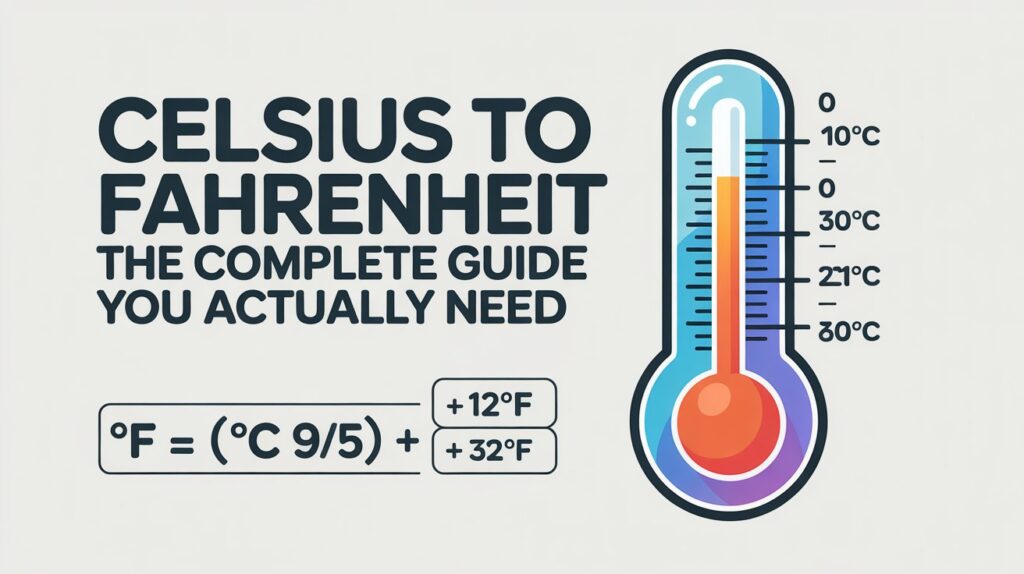
°F = (°C × 9/5) + 32
Or the same thing written differently:
°F = (°C × 1.8) + 32
Step by step — easy as making tea:
- Take your Celsius number.
- Multiply it by 1.8 (or 9/5).
- Add 32 to the result.
- That’s your Fahrenheit number.
Example: You want to convert 25°C.
- 25 × 1.8 = 45
- 45 + 32 = 77°F
Done. A warm spring day.
To go the other way — Fahrenheit to Celsius:
°C = (°F − 32) × 5/9
That’s it. Two formulas. One for each direction. Write them on a sticky note and put it on your fridge if you need to.
The Quick Trick When You Have No Calculator
Let’s say you’re traveling, your phone is dead, and someone says “It’s 20 degrees outside.” You want a rough idea fast.
Here’s the cheat:
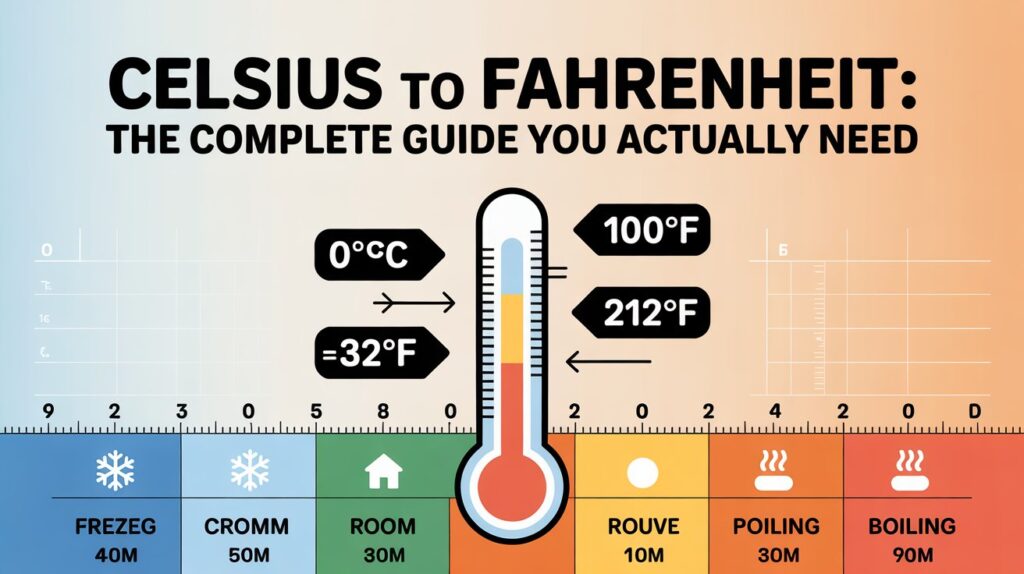
Double the Celsius number, then add 30.
So 20°C → 40 + 30 = 70°F. The real answer is 68°F. Close enough to know you don’t need a coat.
This trick is not exact. But for everyday weather? It does the job.
Going the other way? Subtract 30 from the Fahrenheit number, then cut it in half.
80°F → 80 − 30 = 50 → divide by 2 = 25°C. Real answer: 26.7°C. Again, close enough for daily life.
Why There Are Two Different Scales At All
This is the question everyone secretly wants answered.
Why couldn’t the world just pick one? One thermometer. One number. Life would be simpler.
To understand that, you have to go back about 300 years. Because that’s when two different people, in two different countries, looked at the same problem and came up with two different answers.
The world was a messier place back then. There were dozens of temperature scales floating around Europe. No one agreed. Every city, every scientist, every workshop had their own system. Measuring temperature was about as consistent as measuring distance with your feet — literally, since the “foot” as a unit was once based on an actual human foot.
Someone had to clean up this chaos. Two people tried. Both succeeded. And neither won completely.
Daniel Fahrenheit: The Runaway Who Changed Science
Picture a 15-year-old boy in 1701, standing in a house in Amsterdam, suddenly an orphan. His parents had just eaten poisonous mushrooms and died on the very same day. He was placed with guardians and sent to work as a bookkeeper’s apprentice.
He hated it.
Instead of counting coins, young Daniel kept sneaking off to tinker with thermometers and physics equipment. His guardians were furious. They wanted him to repay a debt he’d inherited. They actually plotted to have him arrested and shipped off to work as a sea laborer in present-day Indonesia. When the arrest warrant came through, Fahrenheit had already vanished into the night.
He spent years wandering across Europe — Germany, Denmark, Sweden — learning from instrument makers. He became obsessed with one problem: why didn’t thermometers agree with each other? Two thermometers in the same room could give completely different readings.
The answer was that most thermometers used alcohol, which was inconsistent and sticky. Fahrenheit figured out how to use mercury instead, and crucially, how to clean it so it moved smoothly inside the glass tube.
By 1714, he had built his first reliable mercury thermometer. By 1724, he had his scale.
He needed fixed reference points — anchor numbers. He used three:
- 0°F: The coldest temperature he could create in his lab — a mixture of water, salt, and ice.
- 32°F: The point at which pure water freezes.
- 96°F: His own body temperature, measured by holding the thermometer under his arm.
Later, after his death, scientists noticed water boils at exactly 180 degrees above the freezing point on his scale — 212°F. That’s a tidy number, so they kept it. His body temperature shifted slightly to 98.6°F because of the scale refinement. But the structure he built stayed.
He was admitted to the Royal Society of London in 1724 — a massive honor. He died at just 50, possibly from mercury poisoning, though that’s never been confirmed. He never had much money. He was buried in a church graveyard in The Hague as a “pauper.”
And yet his name is on a scale that 330 million Americans use every single morning.
Anders Celsius: The Astronomer Who Flipped Everything
While Fahrenheit was making thermometers in Amsterdam, a very different kind of man was growing up in Sweden.
Anders Celsius came from a family that practically breathed science. His father was an astronomy professor. His grandfather was also an astronomy professor. His other grandfather was a mathematician. The University of Uppsala, where he would eventually teach, had been home to his family for generations.
By age 29, Anders Celsius was already a professor of astronomy at that same university.
He loved precision. He loved measurement. He thought every instrument should be as accurate as possible. And when he traveled through Europe in the early 1730s — visiting observatories in Germany, France, and Italy — he grew increasingly annoyed at the mess of temperature systems he encountered everywhere.
He joined an expedition to northern Sweden in 1736 to measure the shape of the Earth. Trudging through Arctic conditions, freezing and exhausted, he kept careful notes. Those extreme temperatures gave him a sharper view of what a temperature scale should look like.
In 1742, he presented his thermometer to the Royal Society of Sciences in Uppsala. His scale had exactly 100 steps between two fixed points — the boiling and freezing points of water.
Here’s the funny bit: his original scale was upside down. He put 0 at the boiling point and 100 at the freezing point. He did this to avoid negative numbers during Swedish winters. Makes sense, really — nobody wants to say it’s “minus 20” outside every January morning.
After Celsius died of tuberculosis in 1744 at just 42 years old, the botanist Carl Linnaeus flipped the scale. Zero became freezing. One hundred became boiling. The modern Celsius scale was born.
The name “Celsius” wasn’t even officially adopted until 1948, at an international conference. Before that, it was usually called “Centigrade” — meaning “hundred steps.”
Why Does the Formula Look So Complicated?
Okay, so (°C × 9/5) + 32 looks a bit awkward. Why not something simpler?
The answer is that the two scales don’t share the same starting point or the same step size. They’re like two rulers that measure the same thing but use different marks.
Think about it this way.
On the Celsius scale, there are 100 degrees between the freezing point and boiling point of water.
On the Fahrenheit scale, there are 180 degrees between those same two points.
So a 1-degree change in Celsius is bigger than a 1-degree change in Fahrenheit. To account for that, you multiply by 180/100, which simplifies to 9/5 (or 1.8).
But there’s also the offset. Celsius starts at 0 for freezing. Fahrenheit starts at 32 for freezing. Those extra 32 degrees have to get added in. That’s where the “+32” comes from.
Two adjustments. One for the different step sizes. One for the different starting points. That’s the whole formula.
Key Temperatures You Should Know By Heart
These come up constantly. Memorize them and you’ll be ahead of most people:
| Celsius | Fahrenheit | What It Means |
| -40°C | -40°F | The one temperature where both scales meet |
| 0°C | 32°F | Water freezes |
| 20°C | 68°F | A pleasant room temperature |
| 25°C | 77°F | A warm, comfortable day |
| 37°C | 98.6°F | Healthy human body temperature |
| 38°C | 100.4°F | A fever begins |
| 100°C | 212°F | Water boils |
The -40 crossing point is one of those weird little facts that sticks with you. At exactly -40, both scales give the same number. Below that, Fahrenheit readings are higher than Celsius. Above that, Fahrenheit readings are higher too — just for different reasons.
Temperature in Cooking: Real-World Examples
If you’ve ever tried to follow a British recipe while living in the United States, you know the pain. The recipe says “bake at 180°C.” Your American oven shows Fahrenheit. What do you do?
Here are the oven temperatures every baker should know:
| Celsius | Fahrenheit | Oven Description |
| 150°C | 302°F | Very slow / low heat |
| 160°C | 320°F | Slow oven |
| 180°C | 356°F | Moderate (most baking) |
| 190°C | 374°F | Moderately hot |
| 200°C | 392°F | Hot oven |
| 220°C | 428°F | Very hot |
| 230°C | 446°F | Extremely hot (pizza, bread) |
The most common baking temperature is 180°C or 350°F. That’s where most cakes, cookies, and casseroles live. If a recipe says 180°C, just remember: set your American oven to 350°F.
For roasting meats, things get hotter. For delicate custards, things stay lower. But 180°C / 350°F is the sweet spot for most home baking.
Weather: How to Read Celsius Like a Local
If you’re traveling to Europe, Asia, Africa, or Australia, weather reports will be in Celsius. Here’s a simple cheat sheet for what different Celsius temperatures actually feel like:
- Below 0°C: Freezing. Ice on the roads. Dress like an Arctic explorer.
- 0–5°C: Very cold. Thick coat weather. Your breath shows.
- 5–10°C: Cold. You need a proper jacket and maybe gloves.
- 10–15°C: Chilly but manageable. A light jacket does the job.
- 15–20°C: Mild. A long-sleeve shirt is fine.
- 20–25°C: Warm and pleasant. T-shirt weather in most places.
- 25–30°C: Hot for some, comfortable for others. The beach calls.
- 30–35°C: Very hot. Drink water. Don’t stand in the sun too long.
- Above 35°C: Dangerously hot. Air conditioning is a necessity, not a luxury.
When someone from London says “It’s a lovely 22 degrees today,” they mean a comfortable 72°F. When someone in Karachi says “It’s only 38 today,” they mean a scorching 100°F. Same word — “degrees” — very different experiences.
Body Temperature: When It Really Matters
This is where Celsius-to-Fahrenheit knowledge becomes genuinely important. Not just for curiosity. But for your health.
Normal human body temperature is 37°C or 98.6°F.
A temperature of 38°C (100.4°F) is generally considered a fever.
At 39°C (102.2°F), a fever is moderate. You should rest and drink fluids.
At 40°C (104°F), a fever is high. Medical attention is wise.
Above 41°C (105.8°F), it becomes dangerous. Get to a doctor fast.
This matters enormously when you’re reading medical advice written in a different system than the one your thermometer uses. A parent given a dosing chart in Fahrenheit but checking their child’s temperature on a Celsius thermometer must know how to convert accurately. Getting this wrong isn’t just inconvenient — it can be serious.
The Great Scale War: Why the USA Stuck With Fahrenheit
Here’s the question that makes people from other countries smile and shake their heads.
Why does one of the world’s most technologically advanced nations still use a temperature scale that the rest of the planet abandoned decades ago?
The honest answer is: habit, history, and stubbornness.
When the British Empire spread across the globe in the 1700s and 1800s, it brought Fahrenheit with it. The Fahrenheit scale was already in wide use among English-speaking countries. America, as a former British colony, kept it.
Meanwhile, France and the rest of continental Europe built the metric system during the late 1700s. Celsius fits neatly into that system. Countries that adopted the metric adopted Celsius along with it.
Britain itself switched to Celsius in 1961. Canada switched in the 1970s. Australia switched. New Zealand switched.
America tried. In 1975, Congress passed the Metric Conversion Act, which made switching to metric — and therefore Celsius — an option. But it was voluntary. Nobody had to do it. And most people chose not to.
Today, the United States stands alongside a small group of countries that still officially use Fahrenheit: the Bahamas, the Cayman Islands, and a handful of other small island nations.
There is one interesting argument in Fahrenheit’s favor, by the way. Because its scale has 180 steps between freezing and boiling compared to Celsius’s 100, each Fahrenheit degree represents a smaller change in actual temperature. That gives it slightly more precision for everyday human experience. The difference between 70°F and 71°F is a genuinely noticeable change. The gap between 21°C and 22°C is the same physical change, just expressed in one larger step.
Whether that advantage justifies the confusion is a different question entirely.
The Magic Number: -40
Here’s a fun fact worth remembering at your next dinner party.
At exactly -40 degrees, Celsius and Fahrenheit show the same number.
Check the math:
°F = (-40 × 1.8) + 32 = -72 + 32 = -40
That’s the only point on the entire temperature scale where both systems agree. Below -40 and above -40, they diverge in opposite directions.
Why does this happen? It’s pure math — a consequence of the different starting points and step sizes of the two scales.The lines never reunite after crossing at -40.
Common Conversions Quick Reference
Here’s a practical table for everyday use:
| Celsius | Fahrenheit |
| -20°C | -4°F |
| -10°C | 14°F |
| 0°C | 32°F |
| 5°C | 41°F |
| 10°C | 50°F |
| 15°C | 59°F |
| 20°C | 68°F |
| 25°C | 77°F |
| 30°C | 86°F |
| 35°C | 95°F |
| 37°C | 98.6°F |
| 40°C | 104°F |
| 50°C | 122°F |
| 100°C | 212°F |
Celsius and Fahrenheit in Science and Medicine
Scientists around the world — including American scientists — use Celsius in their work. It connects directly to the Kelvin scale, which is the scientific standard for measuring absolute temperature.
Kelvin starts at absolute zero — the coldest anything in the universe can ever get. That’s -273.15°C or -459.67°F. Nothing moves at absolute zero. All particle motion stops.
The Kelvin scale uses the same step size as Celsius. To convert Celsius to Kelvin, just add 273.15. So water freezes at 273.15K and boils at 373.15K.
For chemistry, physics, and astronomy, Kelvin is the gold standard. But Celsius is the practical everyday version of the same scientific logic. That’s why labs, hospitals, and research institutions everywhere use Celsius, even in Fahrenheit-using countries.
Final Words
Two men who I have never met. Two scales that never fully merged. One world that still hasn’t agreed on how to talk about warmth and cold.
Fahrenheit was a runaway teenager who turned grief and debt into one of the most important inventions in human history. Celsius was a careful, precise astronomer who wanted the world to share a language for temperature — and mostly got his wish.
Their scales are not just numbers. They carry history, culture, and a little stubbornness on both sides. When you convert 37°C to 98.6°F to check your child’s temperature, you’re doing something two brilliant 18th-century minds made possible.
The formula is simple: °F = (°C × 9/5) + 32.
The story behind it? That’s a little more interesting.
FAQs
1. What is the formula to convert Celsius to Fahrenheit?
The formula is: °F = (°C × 9/5) + 32. You multiply the Celsius temperature by 1.8 and then add 32. That gives you the exact Fahrenheit equivalent.
2. What is 100°C in Fahrenheit?
100°C is 212°F. This is the boiling point of water at sea level. A handy one to remember.
3. What is 37°C in Fahrenheit?
37°C equals 98.6°F. This is normal human body temperature. If your thermometer reads 37°C, you’re doing fine.
4. What is 0°C in Fahrenheit?
0°C equals 32°F. This is the freezing point of water. Both scales agree that water freezes here — they just express it differently.
5. Is there a quick way to convert Celsius to Fahrenheit without a calculator?
Yes. Double the Celsius number and add 30. It’s not perfectly accurate, but it gives a good enough estimate for weather and everyday use. Example: 25°C → 25×2 = 50, plus 30 = 80°F. The real answer is 77°F, so it’s close.
6. At what temperature are Celsius and Fahrenheit the same?
They are equal at -40 degrees. Both -40°C and -40°F describe exactly the same temperature. It’s the only point where the two scales intersect.
7. Why does the United States use Fahrenheit instead of Celsius?
Mainly because of historical habits. America adopted the Fahrenheit scale when it was a British colony. When most other countries switched to Celsius in the 1960s and 1970s, the United States chose not to. The 1975 Metric Conversion Act made switching voluntary, and most Americans voted with their feet by not switching.
8. What is a normal fever in Celsius and Fahrenheit?
A fever generally begins at 38°C (100.4°F). A temperature above 39°C (102.2°F) is a moderate fever. Above 40°C (104°F) is a high fever and warrants medical attention.
9. Who invented the Celsius scale?
Anders Celsius, a Swedish astronomer, created his 100-point scale in 1742. Interestingly, his original scale was inverted — 0 was boiling and 100 was freezing. After his death, Carl Linnaeus reversed it to the scale we use today.
10. Who invented the Fahrenheit scale?
Daniel Gabriel Fahrenheit, a physicist born in Poland of German descent, introduced his temperature scale in 1724. He also invented the mercury thermometer in 1714, which made accurate temperature reading possible for the first time.
11. What is 20°C in Fahrenheit?
20°C equals 68°F. This is a comfortable room temperature and a pleasant outdoor day in most climates.
12. What is 180°C in Fahrenheit for baking?
180°C converts to 356°F, which most people round to 350°F. This is the most common baking temperature in recipes from European and Australian cookbooks.
13. How many countries still use Fahrenheit?
Only a small number — the United States, the Bahamas, the Cayman Islands, and a few other small island nations officially use Fahrenheit for everyday temperatures. Nearly every other country in the world uses Celsius.
14. What does Celsius mean as a word?
The name “Celsius” is a Latinized version of the name of the family’s estate in Sweden — “celsus” means “mound” or “high” in Latin. The scale was actually called “Centigrade” for most of its history. It was officially renamed “Celsius” at an international conference in 1948.
15. Can I convert Celsius to Fahrenheit in my head accurately?
For an exact conversion, you really need the formula. But for a quick mental estimate, multiply by 2 and add 30. For temperatures in the normal weather range (0–40°C), this gives results within 2–3 degrees of the actual Fahrenheit value — good enough for deciding what to wear outside.
Keep creating, innovating, and inspiring with Content Ideators every day.
