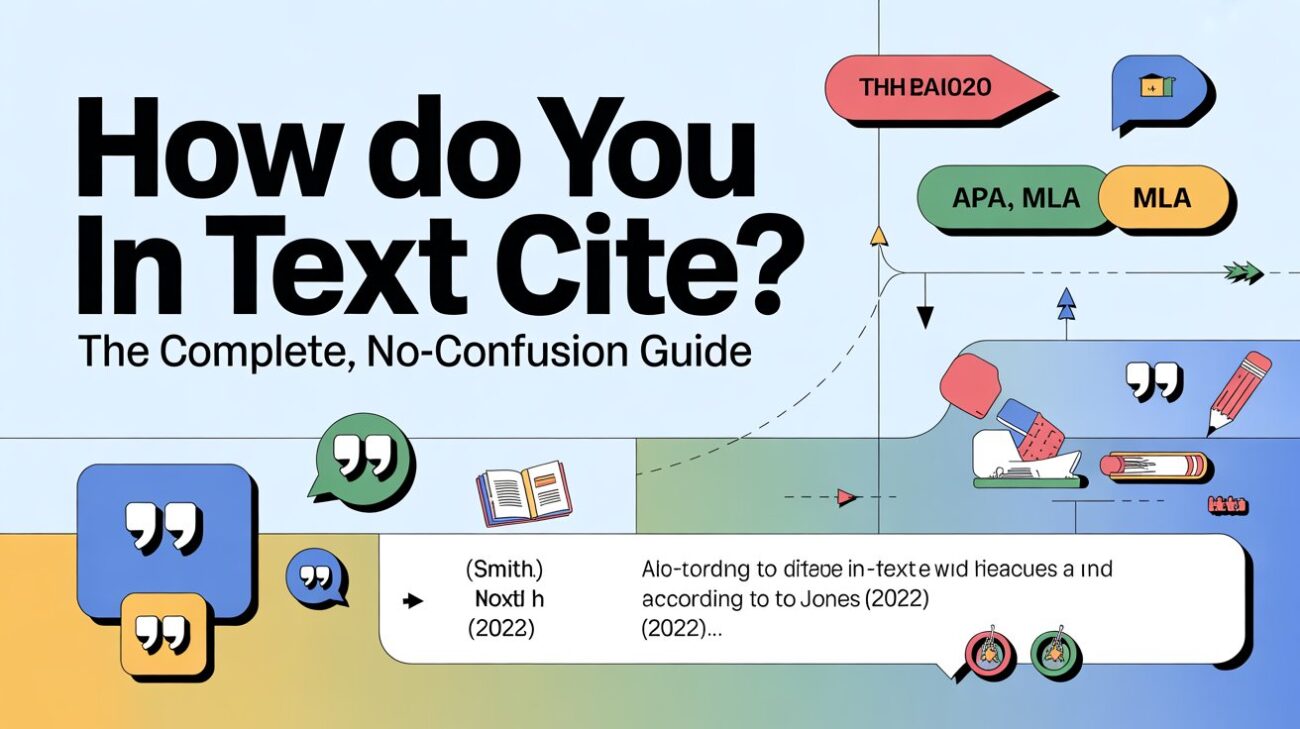
Quick Reference Table
| Feature | APA | MLA | Chicago |
| Full Name | American Psychological Association | Modern Language Association | Chicago Manual of Style |
| Mainly Used In | Psychology, Education, Sciences | Literature, Humanities, Languages | History, Arts, Business |
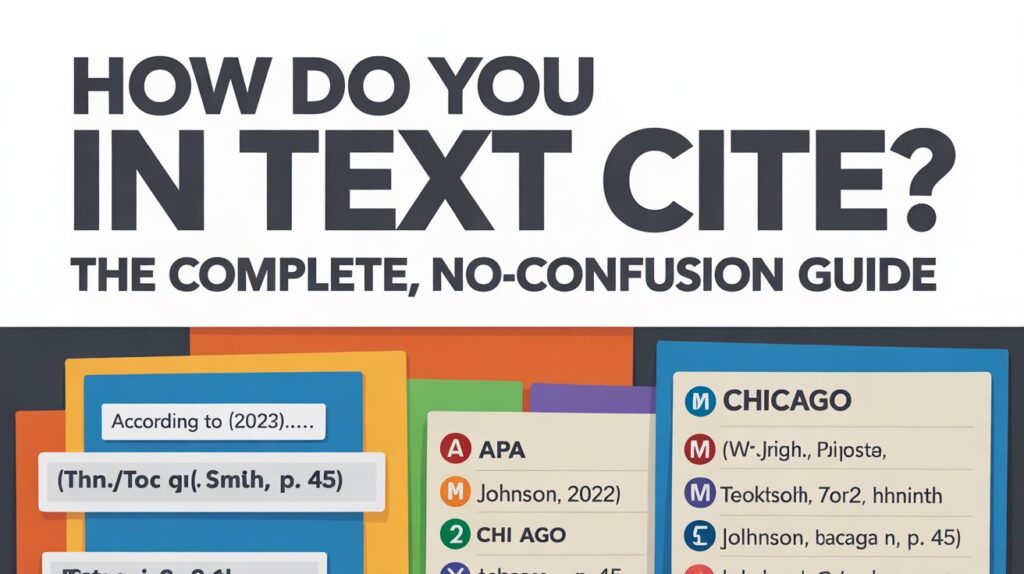
| In-Text Format | (Author, Year) | (Author Page#) | Footnotes or (Author, Year) |
| Page Numbers | Required for direct quotes | Always included | Included in footnotes |
| End List Name | References | Works Cited | Bibliography |
| Multiple Authors (3+) | First author + et al. | First author + et al. | First author + et al. |
| No Author | Use title | Use title | Use title |
| No Date | Use n.d. | Omit | Omit |
Why This Matters More Than You Think
Imagine you write a brilliant paper. You worked on it for days. Your ideas are sharp, your writing is clean. Then your teacher hands it back with a big red zero.
Why? You forgot to cite your sources.
That stings. Especially when you actually did the research. You read the books, visited the websites, and took notes. But you didn’t tell your reader where those ideas came from. And in academic writing, that’s a problem that has a name: plagiarism.
Here’s the thing — most students who get accused of plagiarism didn’t mean to steal anything. They just didn’t know the rules about in-text citations. This guide is going to fix that.
See also “Celsius to Fahrenheit: The Complete Guide You Actually Need“
So What Exactly Is an In-Text Citation?
Picture a footnote, but instead of sitting at the bottom of the page, it lives right inside your sentence.
That’s an in-text citation.
Whenever you borrow a fact, an idea, a quote, or a statistic from someone else’s work, you place a tiny piece of information right next to it — inside the sentence itself. That little note tells your reader: “This idea isn’t mine. Here’s who it belongs to.”
The full details — the complete title, publisher, year, web address — all of that goes at the very end of your paper in a separate list. The in-text citation is just a short pointer that leads the reader to that full list.
Think of it like a breadcrumb trail. The in-text citation is the breadcrumb. The reference list at the end is the whole loaf of bread.
When Do You Actually Need One?
This is the question everyone gets wrong at some point.
An in-text reference is required each time you use:
- A direct quote — the exact words someone else wrote, placed in quotation marks.
- A paraphrase — someone else’s idea, rewritten in your own words.
- A summary — a condensed version of a longer piece of someone else’s work.
- A statistic or data point you found in a source.
- A specific theory or argument created by another person.
You do NOT need a citation for common knowledge. If you write “the Earth orbits the Sun” or “Abraham Lincoln was the 16th US president,” no citation is needed. Everyone knows that. Nobody invented that idea.
But the moment you say “Studies show that students who sleep less than six hours score lower on tests” — that came from somewhere. Cite it.
When you’re unsure? Cite it anyway. Citing too much is far, far better than not citing enough.
The Two Big Types of In-Text Citations
Before we go style by style, here’s one concept that will unlock everything else.
There are two ways to insert a citation into a sentence. Understanding this changes how you write.
Type 1 — Parenthetical Citation: All the source information goes inside parentheses at the end of the sentence. Your reader’s name doesn’t appear in your writing. It just shows up in the brackets.
Teenagers who use social media heavily tend to report lower self-esteem (Nguyen, 2021, p. 44).
The whole citation is tucked in at the end. Clean and simple.
Type 2 — Narrative Citation (also called a Signal Phrase): Here, you introduce the author by name inside your actual sentence. The date and page number still go in parentheses, but the name is now part of your writing.
Nguyen (2021) found that teenagers who use social media heavily tend to report lower self-esteem (p. 44).
Both are correct. Both point to the same source. The narrative style flows more naturally in a conversation. The parenthetical style is quick and efficient. Good writers use both.
Signal phrases are the words you use to lead into a source — phrases like “According to,” “Smith argues,” “Johnson noted,” “Research by Williams suggests.” They’re transition words for borrowed ideas.
How to In-Text Cite in APA Format
APA style is used mainly in the sciences, education, and social sciences. Its big obsession is when something is published, because in science, recent research matters.
The basic APA formula is: (Author’s last name, Year)
For paraphrases:
Many students struggle with writing research papers because they don’t understand citation rules (Broussard, 2020).
For direct quotes, add the page number:
“The process of writing requires constant revision and reflection” (Broussard, 2020, p. 12).
For a narrative/signal phrase version:
Broussard (2020) argues that “the process of writing requires constant revision and reflection” (p. 12).
APA with two authors: Always list both, every time.
(Kim & Patel, 2019)
APA with three or more authors: Use only the first author’s name, then add “et al.” (which means “and others” in Latin).
(Martinez et al., 2022)
APA with no author: Use a shortened version of the title instead. Put it in quotation marks if it’s an article, or in italics if it’s a book.
(“Rising Sea Levels,” 2023) or (Ocean Science Review, 2023)
APA with no date: Replace the year with “n.d.” — stands for “no date.”
(Wilson, n.d.)
APA for websites with no page numbers: Use a paragraph number instead.
(Field, 2019, para. 3)
APA for very long quotes (40+ words): Don’t use quotation marks. Instead, indent the entire passage half an inch from the left margin. Put the citation in parentheses after the final period. This is called a block quote.
How to In-Text Cite in MLA Format
MLA is the style used for literature, language, and the humanities. Instead of caring about when something was published, MLA cares about where — specifically, what page number.
The basic MLA formula is: (Author’s last name Page number)
Notice: no comma, no “p.” — just the name and the page number, side by side.
For a paraphrase:
Many college students find that citing sources properly reduces the anxiety around plagiarism (Broussard 8).
For a direct quote:
“Students are frustrated and confused by the research process, but this is not always laziness” (Broussard 8).
For a narrative/signal phrase version:
As Broussard explains, “students are frustrated and confused by the research process” (8).
Notice how when the author’s name appears in the sentence, it drops out of the parentheses. You only include what the reader still needs to find the source.
MLA with two authors:
(Kim and Patel 34)
MLA with three or more authors:
(Martinez et al. 19)
MLA without an author: Make use of the title’s opening word or two.
(“Rising Sea” 1) or (Ocean Review 22)
MLA for websites with no page numbers: Just include the author’s name with no page number.
(Garelli)
MLA for one long quote (more than four lines of prose): Like APA, indent the block of text. But in MLA, the citation goes outside the final period, not inside it. That’s a detail many students miss.
MLA for a source quoted inside another source (secondary sources): Sometimes you’re reading an article by Kirkey, and Kirkey quotes someone named Smith. You want to use Smith’s quote. But you can’t find Smith’s original work.
You cite it like this:
According to a study by Smith (qtd. in Kirkey 14), almost half of all doctors reported reluctance.
“qtd. in” means “quoted in.” You’re being honest that you got the quote secondhand.
How to In-Text Cite in Chicago Format
Chicago style is the most flexible of the three. It lets you choose your method.
Option 1 — Notes and Bibliography (most common in history and arts): Instead of a parenthetical citation, you place a small raised number — called a superscript — directly after the borrowed idea. That number matches a footnote at the bottom of the page, which contains the full source information.
It looks like this in your text:
The outbreak of the First World War surprised many European leaders.¹
Then at the bottom of the page, footnote 1 would contain: full author name, title, publication details, and page number.
The second time you cite the same source, you can shorten the footnote to just the last name and page number.
Option 2 — Author-Date (common in sciences and social sciences using Chicago): This looks almost exactly like APA.
(Williams, 2018, 45)
That’s author, year, page number — all in one set of parentheses.
What Happens When You Don’t Cite
Let’s be honest for a moment.
Not citing your sources is called plagiarism. And plagiarism is treated as a form of theft in academic settings. You’re presenting someone else’s intellectual work as your own.
The consequences are real. They include failing the assignment, failing the course, academic probation, and in serious cases, expulsion.
But here’s something important: there’s a difference between wrong citations and missing citations. Getting the format slightly off — putting a comma in the wrong place, forgetting the “p.” abbreviation — is a formatting error. It’s not ideal, but it isn’t plagiarism.
Plagiarism is the complete absence of credit. It’s using someone’s ideas with zero acknowledgment whatsoever.
So if you tried to cite but got it imperfect, that’s a mistake worth correcting. If you didn’t cite at all, that’s a more serious problem.
The Most Common Mistakes Students Make
After looking at how students trip up, a few patterns show up every time.
Mistake 1 — Only citing direct quotes. This is the biggest one. Many students think citations are only for the exact words they copied. But paraphrasing still requires a citation. Rewriting someone’s idea in your own words doesn’t make the idea yours.
Mistake 2 — Citing but not using quotation marks. If you copy a sentence word for word, put it in quotation marks. A citation alone doesn’t fix the problem. You need both the quote marks AND the citation.
Mistake 3 — Forgetting the reference list entry. Every in-text citation must have a matching full entry at the end of the paper. If you cite (Martinez, 2020) in your text, there must be a Martinez 2020 entry in your References or Works Cited page. These must match exactly.
Mistake 4 — Switching citation styles mid-paper. Pick one style. Use it throughout. Mixing APA and MLA in the same paper is confusing and looks sloppy.
Mistake 5 — Citing from the wrong source type. Sometimes students read a news article that cites a study. They cite the news article but describe it as the original research. Whenever possible, find and cite the original source.
Mistake 6 — Missing citations for statistics. Any number that you didn’t calculate yourself needs a citation. “73% of students reported anxiety” — where did that come from? Always say.
A Quick Tip for Staying Organized
Here’s a habit that will save you from enormous pain.
Write down your sources as you research. Don’t wait until your paper is finished. The moment you pull a quote or a fact from somewhere, note the author, title, year, and page right then. Drop it into a running list at the bottom of your document.
It takes ten extra seconds at the moment. It saves an hour of panicked back-tracking later.
Another tip: your in-text citation must always match something in your final reference list. Cross-check them before you submit. Read through your paper, and for every parenthetical citation you see, make sure it has a matching entry in your list. Then flip it — read through your reference list and make sure every entry was actually cited in the text.
Final Words
Citations feel annoying. There’s no other way to say it. The rules are different depending on what style you’re using. The format changes depending on whether you have an author, a date, a page number. There are special cases for websites, videos, government documents, and sources with no author at all.
But here’s what all of that really comes down to:
Tell your reader whose idea it was and where they can find it.
That’s the whole philosophy. Author, location, enough information to trace the idea back to its origin. The specific format — whether a comma goes before the year or after, whether the title gets italicized or quoted — those are just conventions that different fields agreed on. They exist so everyone in a discipline can read each other’s papers without confusion.
Once you understand that the goal is traceability and honesty, the rules start making sense. You’re not jumping through hoops. You’re being a trustworthy writer. And that matters every time you put your name on a piece of work.
When in doubt — cite.Citing too much will never get you in trouble. But forgetting to cite just once can cost you everything you worked for.
FAQs
1. What is an in-text citation and why do I need one?
An in-text citation is a short note placed inside your writing — usually at the end of a sentence — that identifies the source of a borrowed idea or quote. You need one every time you use someone else’s words, ideas, statistics, or arguments. Without it, you’re claiming that work as your own, which is plagiarism.
2. Do I need to cite when I paraphrase, or only when I use direct quotes?
Both. Paraphrasing means you put someone else’s idea into your own words. But the idea still belongs to them. You must cite paraphrases just as you would a direct quote. The only thing you skip is the quotation marks.
3. How do APA and MLA in-text citations differ from one another?
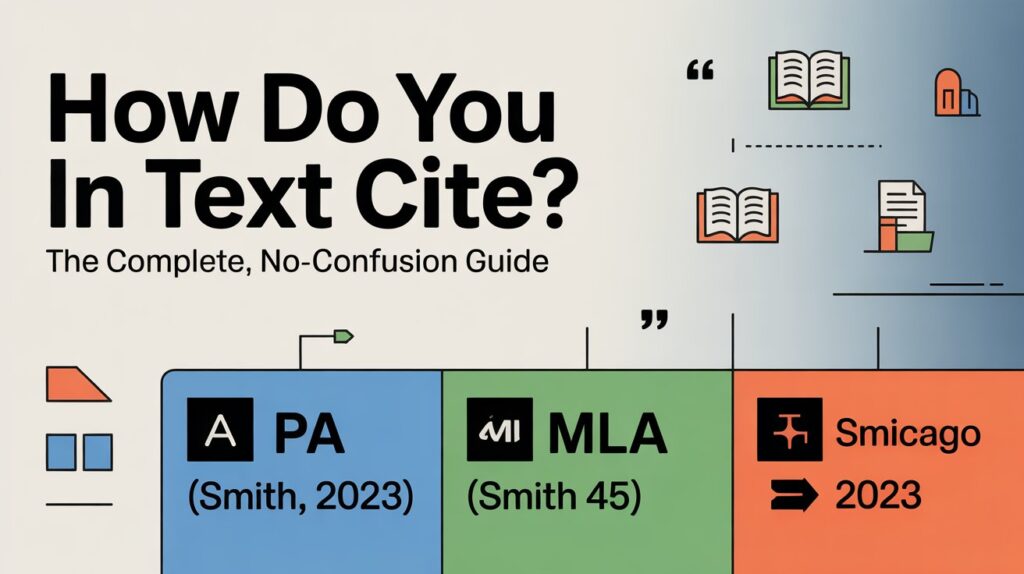
APA uses the author’s last name and the publication year: (Smith, 2021). MLA uses the author’s last name and the page number: (Smith 45). APA focuses on when something was published. MLA focuses on where — the page location. The discipline you’re writing in usually determines which one you use.
4. How do I cite a source with no author?
Use a shortened version of the title instead of the author’s name. If it’s an article, put the title in quotation marks. If it’s a book or website, italicize it. Example in APA: (“Climate Change Report,” 2022)MLA example: (“Climate Change Report” 3).
5. How do I cite a source with no page numbers, like a website?
In APA, use a paragraph number instead: (Kim, 2020, para. 4). In MLA, just include the author’s name with no number: (Kim). For videos or audio, APA lets you use a timestamp instead: (Kim, 2020, 3:14).
6. What’s a signal phrase, and should I use one?
A signal phrase introduces a source by naming the author in your sentence before you give the quote or paraphrase. Example: “According to Torres (2019), sleep deprivation affects memory formation.” Signal phrases make your writing smoother and show your reader that you’re engaging actively with your sources, not just dumping citations.
7. What happens if I cite incorrectly versus not citing at all?
Wrong formatting is an error — it may cost you points, but it’s not plagiarism. Missing a citation entirely — so the reader has no idea where your information came from — is plagiarism. The intent to acknowledge a source matters, even if your format is imperfect.
8. Can I cite the same source multiple times in one paragraph?
Yes. If you’re drawing several ideas from the same source throughout a paragraph, you can cite it multiple times. In APA, some guidelines suggest that after the first full citation, you can use just the author’s name for subsequent references within the same paragraph — but only if no other sources appear in between. When in doubt, repeat the full citation.
9. How do I cite a source I found inside another source?
This is called a secondary or indirect source. Always look for the original and give credit to it. If you truly cannot locate the original, use “as cited in” (APA) or “qtd.To indicate that the quote was taken from a secondary source, use “in” (MLA). Only list the source you actually read in your reference list.
10. Do I need a citation for common knowledge?
No. Facts that most educated readers would already accept without needing proof — like historical dates, scientific consensus, or widely known events — don’t need citations. But the line isn’t always obvious. If you’re unsure whether something counts as common knowledge, citing it will never hurt you.
11. How do I cite multiple authors?
In APA: list both names for one or two authors (Kim & Patel, 2020). For three or more, use only the first author’s name followed by “et al.” (Martinez et al., 2022). MLA uses “and” for two authors: (Kim and Patel 12). For three or more, MLA also uses “et al.” (Martinez et al. 12).
12. Where does the period go — before or after the citation?
In most cases, the period goes after the closing parenthesis of the citation, not before. Example: “This was a key finding (Jones, 2018).” The only exception is block quotes (long indented quotes), where the period goes before the citation.
13. What’s the difference between a References page (APA), a Works Cited page (MLA), and a Bibliography (Chicago)?
All three are lists at the end of your paper containing full information about every source you cited. The name changes by style, but the purpose is the same. A bibliography in some contexts can also include sources you read but didn’t directly cite — but only do this if your instructor asks for it.
14. Do I need an in-text citation for images, charts, or tables I found online?
Yes. Any visual material you did not create yourself needs a citation. The format varies by style, but in general you include the creator, the title or description, and where you found it. Treat it like any other borrowed content.
15. What’s the safest rule if I’m ever unsure whether to cite?
Cite it. The golden rule of academic writing is: when in doubt, include the citation. Over-citing is almost never penalized. Under-citing can get you accused of plagiarism. If something came from a source — any source — point to it. Your reader deserves to know where your ideas come from.
Keep creating, innovating, and inspiring with Content Ideators every day.
