
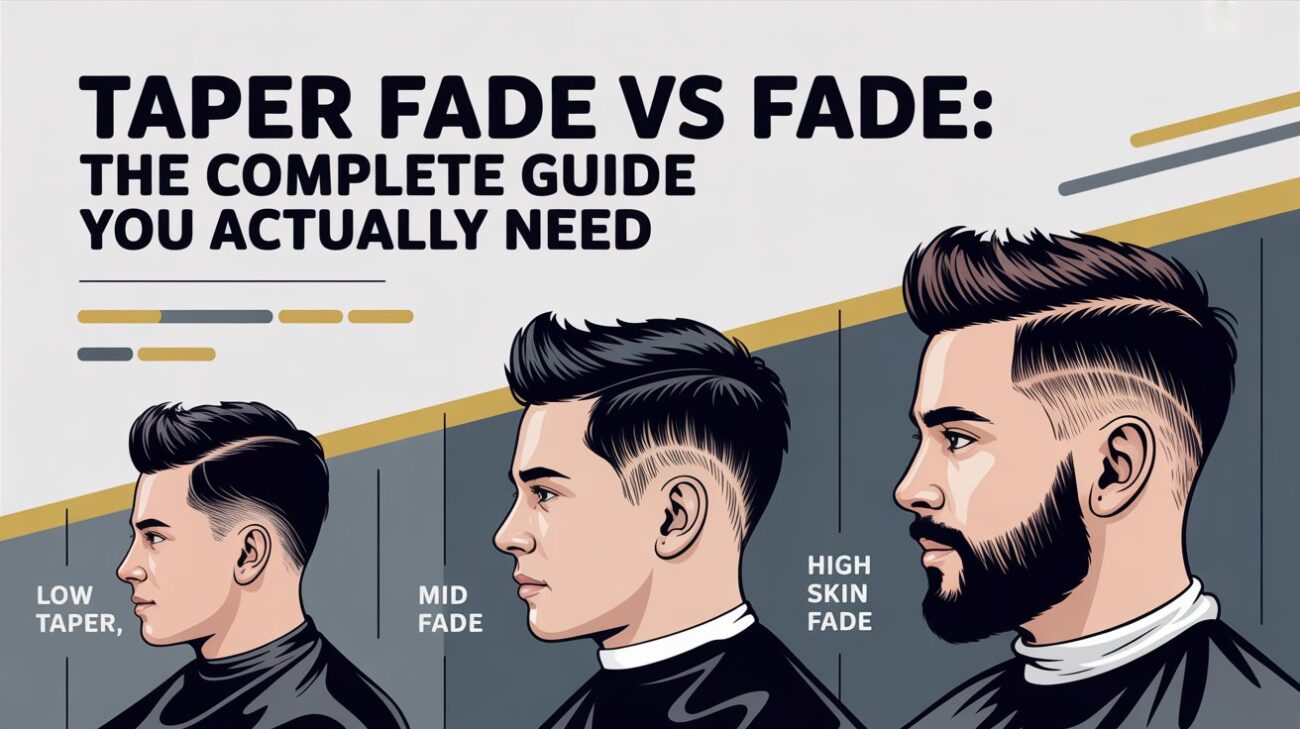
You sat down in the barber’s chair. You pointed at the sides of your head. You said something like “you know, just clean it up around here.” And your barber stared back at you waiting for a real answer.
We’ve all been there.
The truth is, two words separate a great haircut from a “close enough” haircut: taper and fade. Most guys use them like they mean the same thing. They don’t. And once you know the difference, you’ll never walk out of a barbershop scratching your head again.
Let’s talk about all of it. The history, the styles, the science of face shapes, and every question you’ve been too embarrassed to ask.
Quick Facts Table
| Feature | Taper | Fade |
| Hair length at bottom | Short but visible | Goes to skin (bare) |
| Blending height | Stays near neckline/sideburns | Rises up toward temples or crown |
| Look | Classic, clean, soft | Bold, sharp, high-contrast |
| Barber visits needed | Every 3–5 weeks | Every 1–3 weeks |
| Best for | Professional settings | Casual, trendy, statement looks |
| Works best on | Any hair type | Thick, coarse, or curly hair |
| Grows out | Very naturally | Loses shape fast |
| Origin | Military grooming, 1940s | Military → Black barbershop culture, 1950s–80s |
| Celebrity fans | David Beckham, Ryan Gosling | Drake, Zayn Malik, LeBron James |
| Also called | Classic taper | Skin fade, bald fade |
Where Did These Haircuts Even Come From?
Picture a military base in the 1940s. Hundreds of young soldiers, all with identical short hair. No exceptions. No personal style. Just clean, tight, disciplined cuts that said I mean business.
That’s where our story begins.
The US Army had rules written down about hair. It had to be short on the sides, slightly longer on top. The sides needed to blend smoothly — no dramatic lines, no sudden jumps in length. This gradual shortening of hair from top to bottom was called a taper. It was practical. Helmets fit better. Hair stayed out of the eyes. And the soldiers looked uniform.
When those soldiers came home after the war, they brought the haircut with them. Barbershops across America started cutting this style for everyday men. It was clean, professional, and looked great with a suit.
Then something interesting happened.
Black barbers in the 1950s and 60s took that military taper and started doing something special with it. They pushed it further. Instead of just softening the hair near the neck, they shaved it closer. Much closer. All the way to the skin in some cases. They created sharper lines, more dramatic contrasts, and added real artistry to the whole process.
By the 1980s, hip-hop culture exploded. Artists like Big Daddy Kane, Will Smith, and Kid ‘n Play wore the high-top fade like a crown. It was a statement. It said something about who you were and where you came from. The barbershop became more than a place to get a haircut — it became a gathering spot, a community center, a place where art happened on people’s heads.
The fade was no longer just a military detail. It was culture.
Through the 90s and 2000s, athletes and celebrities pushed it into the mainstream. Today, you’ll find fade haircuts on everyone from schoolboys in Lahore to CEOs in London to basketball players in Los Angeles.
See also “How Do You In Text Cite? The Complete, No-Confusion Guide“
So What Exactly Is a Taper?
This is the most straightforward method to approach things.
A taper is like a gradient. Long hair on top. Hair gets shorter as you move down. But it never disappears completely. When you look at the back of someone’s neck with a taper, you still see some hair right above the hairline.
It’s subtle. It’s quiet. It whispers “professional” without shouting it.
The taper mostly lives around two places: the sideburns and the neckline. It doesn’t climb high up the head. It just cleans things up at the edges. The bulk of the hair on the sides stays the same length — only the very bottom portion shortens.
Think of a classic gentleman’s cut. Think of David Beckham in his earlier years. That neat, put-together look where everything just flows naturally. That’s a taper.
Types of Tapers
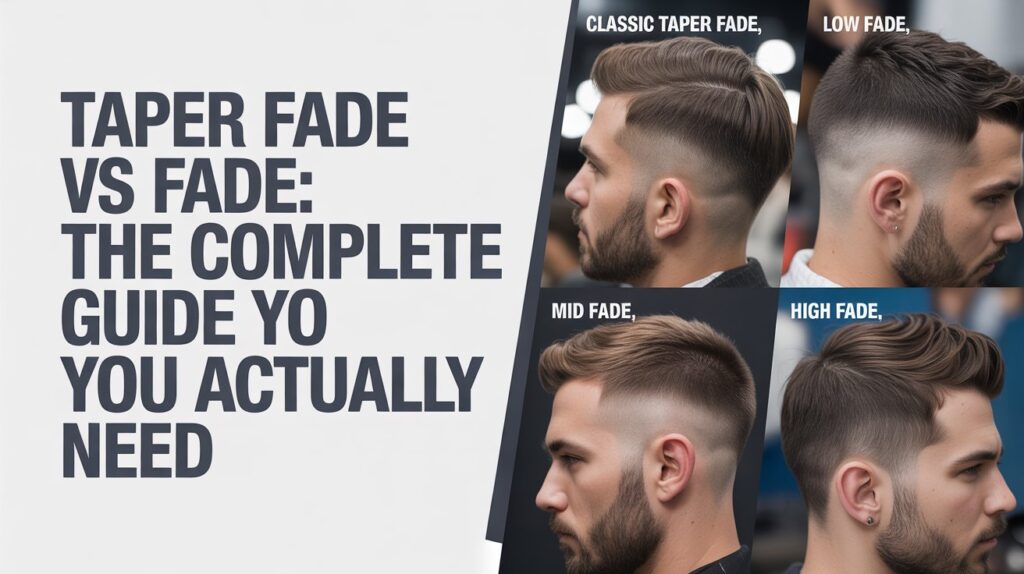
Low Taper: The most conservative option. Hair shortens only very close to the natural hairline. Barely noticeable from far away. Perfect for someone who wants a clean look without committing to anything dramatic.
Mid Taper: Starts a little higher up. The shortening begins somewhere around the middle of the side of the head. A nice middle ground between subtle and structured.
High Taper: The shortening begins much higher — near the temples. This gives more contrast and starts to resemble a fade. Good for people who want a sharper look but still prefer keeping some length.
Skin Taper: This one goes all the way down to the skin, but only near the very bottom edges. It’s more dramatic than a regular taper but not as bold as a full fade.
And What Is a Fade?
A fade is the louder, bolder version of the same idea.
It also shortens hair as you move down — but it goes much further. A fade often shaves the hair completely down to the skin at the very bottom. And it starts much higher up on the head, sometimes reaching all the way to the temples or even higher.
The result? A dramatic contrast between the longer hair on top and the near-invisible hair on the sides. It looks sharp. It looks modern. It turns heads.
A fade is a cliff, whereas a taper is a smooth slope.
Types of Fades
Low Fade: Starts just above the ear. Subtle compared to other fades, but still creates more contrast than a taper. Great starting point if you want to try a fade but don’t want to go extreme.
Mid Fade: Begins around the temple area. This is probably the most popular fad right now. It’s bold enough to look fresh, but not so extreme that it limits your hairstyle options.
High Fade: Starts above the temples, sometimes near the crown. Creates a dramatic look with lots of contrast. Best for people who want their haircut to make a statement.
Skin Fade (Bald Fade): The hair goes literally down to zero — bare skin at the bottom. Very sharp, very modern. Needs the most upkeep but looks incredibly clean when fresh.
Drop Fade: This one curves down behind the ear instead of going in a straight line. It follows the shape of the head. Gives the whole haircut a more rounded, artistic feel.
Temple Fade (Brooklyn Fade): Focuses the fading around the temple area only. Keeps length everywhere else but creates a sharp frame around the face.
The Real Difference: A Side-by-Side Look
Let’s be honest — when most people ask “what’s the difference,” they want something simple.
Here it is.
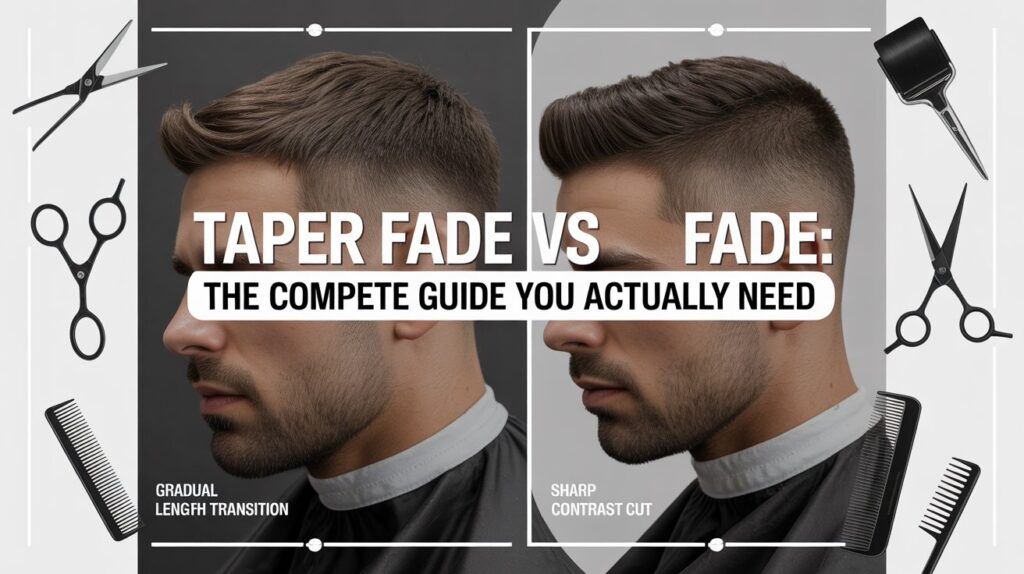
Some hair is kept at the bottom by a taper. It blends down near the neck and sideburns. It never fully disappears.
A fade removes the hair almost completely at the bottom. It blends much higher up the head. The contrast is sharp and obvious.
One more thing worth knowing: technically, all fades are tapers. But not all tapers are fades. A fade is simply an exaggerated version of a taper. This is why barbers sometimes look a little confused when someone asks for a “taper fade” — because that phrase combines both words and it’s a bit like saying “fast slow.” It means different things to different barbers.
If you want to be clear with your barber, describe what you actually want. How short? How high? Down to skin or not?
What About a Taper Fade? Isn’t That Its Own Thing?
Kind of.
A taper fade is a popular hybrid style. It takes the gradual, natural approach of a taper and adds the cleaner, closer blend of a fade — but typically at a lower, more controlled height. It gives you both the professional feel of a taper and the crisp sharpness of a fade.
Many guys who say “taper fade” actually mean a low or mid fade that doesn’t go all the way to the skin. A skilled barber will ask follow-up questions to figure out exactly what you want.
The easiest solution? Bring a photo.
Which One Is Right for Your Face?
Your face shape matters here. A lot.
Round face: Your face is roughly as wide as it is long. A mid or high fade is your best friend. Shaving the sides closer makes your face look slimmer and longer. Pair it with height on top — like a textured quiff — and your face instantly looks more balanced. A taper might actually work against you here by adding width to the sides.
Oval face: Lucky you — almost everything works. A taper will look clean and classic. A fade will look bold and modern. Pick based on your personality.
Square face: Strong jaw, defined angles. A taper will soften those edges slightly while still looking sharp. A skin fade can emphasize the jaw even more. Both look excellent; it’s about whether you want to highlight or soften your angles.
Oblong/Long face: Your face is longer than it is wide. Avoid extra height on top. A taper with more weight on the sides actually helps balance things out. A high fade might stretch your face even more.
Heart-shaped face: Wide forehead, narrow chin. A mid fade or low taper fade helps draw attention away from the forehead and balance the overall shape.
Diamond face: Narrow forehead and narrow chin, wide cheekbones. A mid fade helps balance out those wide cheekbones beautifully.
Hair Type Matters Too
Your hair texture plays a big role in which style actually looks good on you.
Thick or coarse hair: Fades are your friend. All that bulk on the sides needs to go somewhere, and a good skin fade or high fade removes it cleanly. The contrast looks striking on thick hair.
Fine or thin hair: Go with a taper. A skin fade on thin hair can expose the scalp in ways that look unintentional. A taper keeps more length and gives the illusion of density.
Curly or coily hair: Both styles can look amazing. A high fade with curls on top creates one of the most iconic looks in men’s grooming. The fade frames the curls and lets them shine.
Wavy hair: Tapers work beautifully with wavy hair. The natural texture flows well with the softer gradients of a taper.
The Maintenance Question Nobody Wants to Answer Honestly
Fades look better when they’re fresh. The problem? They go stale fast.
A skin fade at two weeks looks noticeably less sharp than at day three. The contrast disappears. The clean line blurs. The whole point of the cut gets lost. That’s why most barbers recommend coming back every 1–3 weeks for a fade.
A taper is more forgiving. Because it keeps more length and doesn’t rely on sharp contrast, it grows out gracefully. You can often go 3–5 weeks before it starts looking untidy. For busy guys, or anyone watching their budget, that’s a real advantage.
Taper: Low maintenance. Good for 3–5 weeks.
Mid Fade: Moderate maintenance. Stay sharp for 2–4 weeks.
Skin/High Fade: High maintenance. Needs a touch-up every 1–2 weeks.
Lifestyle Match: Which One Fits Your Life?
This might actually be the most practical question of all.
You work in an office: Probably go taper. It’s clean, professional, and nobody will look at your haircut and think twice. It pairs beautifully with formal wear.
You’re a student or creative type: Either works, but a fade gives you more edge. It pairs well with streetwear, athletic gear, and any look where you want your haircut to be part of your style statement.
You’re always on the go: Taper. Less barber time, more time for everything else.
You love the barbershop experience: Fade. You’ll be back every couple of weeks anyway, and each visit is a chance to clean it up and feel fresh.
You’re about to have a job interview: Taper. Safe, sharp, and universally respected.
You want to stand out: Fade. Especially a skin fade with some design work. Nobody’s ignoring that.
How to Talk to Your Barber Like You Know What You Want
Walk in with these three pieces of information:
1. Where should the fade/taper start?
Low (near the ear), mid (at the temple), or high (above the temple)?
2. How short is the bottom?
Keep some hair (taper) or go to skin (fade)?
3. What’s happening on top?
Short all over, long on top, textured, slicked back?
And always, always bring a photo. Barbers are visual people. A clear reference photo eliminates 90% of miscommunication. Screenshot something from Instagram that looks like what you want and hold it up. Your barber will thank you.
Can You Combine a Beard With These Styles?
Absolutely — and it often looks fantastic.
A fade pairs incredibly well with a full beard. The sharp contrast of a skin fade connects seamlessly with a well-shaped beard line. It creates a complete look from chin to crown.
A taper also works with a beard, but the pairing feels slightly softer. The gradual blending of the taper matches the more relaxed feel of a natural beard.
If you’re growing a beard, make sure your barber shapes the beard line too. That line where the fade meets the beard is where the magic happens — or where it falls apart.
Famous People Known for These Styles
Taper fans: David Beckham (classic side part tapers throughout his career), Ryan Gosling (clean and polished), Chris Evans (always neat, always sharp), Chris Hemsworth.
Fade fans: Drake (high fades that helped define an era), LeBron James, Zayn Malik, Odell Beckham Jr., and countless NBA and NFL players who make fresh fades look like part of the uniform.
Final Words
Here’s the honest truth after all of this.
Neither cut is better than the other. They’re just different tools for different goals.
A taper says: I’m put-together. I care about how I look but I don’t need to prove it.
A fade says: I’m sharp. I’m current. I take my haircut seriously.
Both are great. Both can look amazing. The right one is the one that fits your face, your hair, your job, and most importantly — your personality.
Stop second-guessing. Walk into your barber shop knowing exactly what you want. Show a photo. Ask questions. Great haircuts start with clear communication.
And remember: the best haircut in the world is one you actually feel good wearing.
FAQs
Q1: What’s the simplest way to explain the difference between a taper and a fade?
A taper keeps some hair visible near the bottom. A fade shaves it down to the skin. Taper = softer. Fade = sharper.
Q2: Is a taper fade the same as a taper?
No. A taper fade is a hybrid — it combines the gradual shortening of a taper with the closer shave of a fade. It’s its own thing, sitting between the two styles.
Q3: Which style lasts longer without looking messy?
A taper. Because it keeps more length and doesn’t rely on high contrast, it grows out naturally and stays tidy for longer. A fade needs more frequent touch-ups.
Q4: Can I get a fade if I have thin or fine hair?
You can, but be careful with skin fades — they can reveal the scalp in ways that look unintentional. A taper or a low fade with some length kept is usually a better choice for thin hair.
Q5: Is a taper more professional than a fade?
Generally speaking, yes — especially in formal workplaces. A taper is more conservative and fits almost any dress code. That said, a clean low fade is also very professional and widely accepted.
Q6: How often do I need to visit the barber for each style?
For a taper: every 3–5 weeks. For a mid or low fade: every 2–4 weeks. For a skin fade or high fade: every 1–2 weeks to keep it looking fresh.
Q7: Does a fade work for curly hair?
Yes, and it often looks spectacular. A high or mid fade with curly or coily hair on top is one of the most popular and striking looks in modern barbering.
Q8: I asked for a taper fade and my barber gave me a regular taper. What happened?
The term “taper fade” is vague to many barbers. Some will default to a taper when they hear it. Next time, be specific: say exactly how high you want it, how short at the bottom, and whether you want skin or some hair left at the base.
Q9: Can I get a fade with longer hair on top?
Yes. A fade doesn’t say anything about the top — it only refers to the sides and back. You can have a long pompadour, a textured crop, or even a man bun on top with a fade on the sides.
Q10: Which style works better with a beard?
Both work well with a beard, but a skin fade creates a more dramatic and polished connection with a shaped beard line. A taper with a beard gives a softer, more relaxed overall look.
Q11: Do fades only look good on younger men?
Not at all. Clean, well-maintained fades look great at any age. Many men in their 40s and 50s wear low or mid fades that look sharp and contemporary without looking like they’re trying too hard.
Q12: What should I say to my barber to make sure I get exactly what I want?
Tell them: where you want the fade to start (low/mid/high), how short at the bottom (some hair vs. skin), and what you want on top. Better yet — show a reference photo. It’s the single most effective thing you can do for a great haircut.
Keep creating, innovating, and inspiring with Content Ideators every day.
