
Quick Facts
| Category | Detail |
| Full name | Empanada Gallega (Galician Empanada) |
| Origin | Galicia, northwest Spain |
| Earliest written record | 7th century CE |
| Cathedral evidence | Carved into Pórtico de la Gloria, Santiago de Compostela (12th century) |
| Word origin | “Empanar” — to wrap or encase in bread/dough |
| Dough type | Leavened wheat dough with white wine, olive oil, lard/butter |
| Classic filling | Tuna + zaragallada (sofrito of onions, peppers, tomato) |
| Other fillings | Cod, octopus, scallops, sardines, chorizo, pork, chicken |
| Shape | Large rectangular pie, cut into slices |
| Serving temperature | Warm or room temperature |
| Best wine pairing | Albariño (white wine from Galicia) |
| Where to find it | Spanish restaurants, tapas bars, Latin bakeries, specialty food shops |
| Home-bake difficulty | Moderate — achievable for a confident home cook |
| Global reach | Spain, Portugal, Argentina, other Latin American countries |
The Search That Starts With Hunger
You have heard about empanada gallega. Maybe from a Spanish friend who got a little emotional describing the one they ate in Santiago de Compostela. Maybe from a food video that made you pause and stare. Maybe from a tapas menu that listed it and you ordered it without fully knowing what was coming.
And then it arrived.
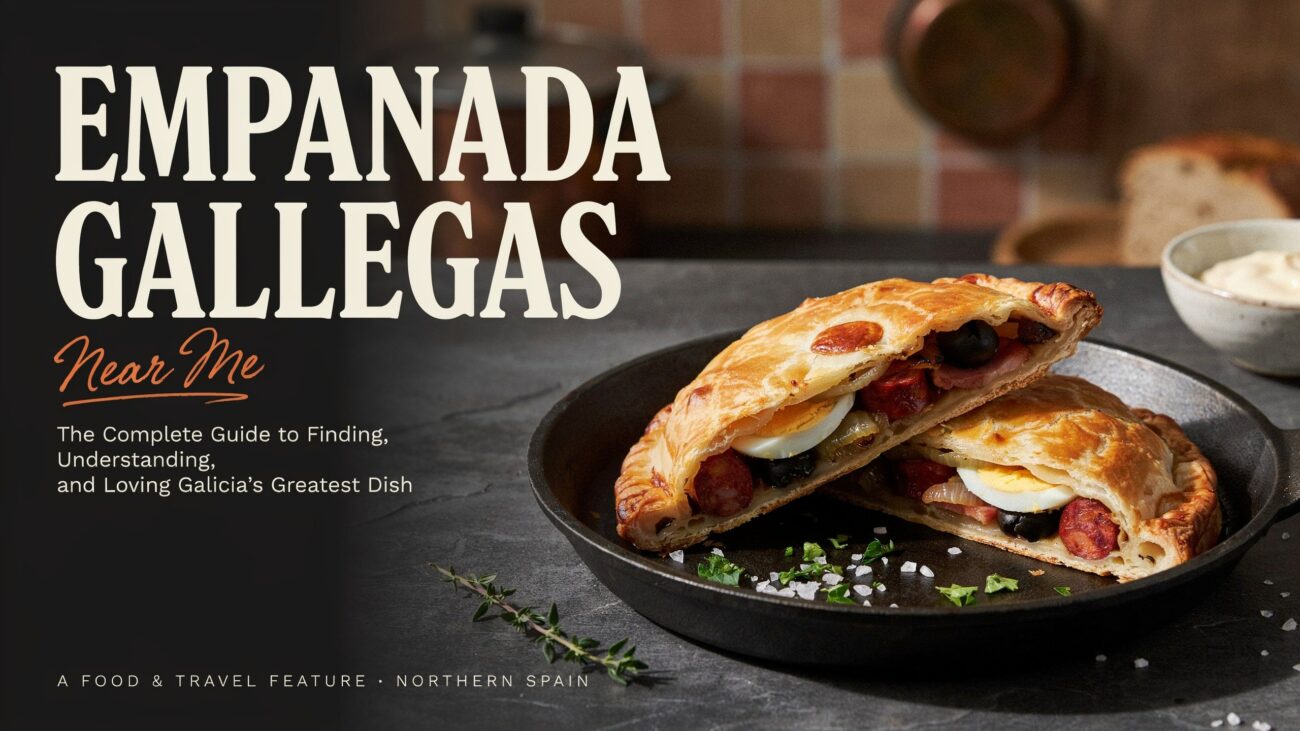
A thick, golden-brown slice. The pastry is just thin enough to shatter slightly when you press it. The inside is warm and fragrant — softened onions, sweet peppers, tuna or meat bound together in a glistening, perfectly seasoned filling.
One bite and you understood immediately why this dish has survived unchanged for over a thousand years.
Now you are here, searching for empanada gallega near you, and this guide is going to help you find it, identify the real thing when you do, understand its extraordinary history, and even make it at home if nothing nearby delivers.
See also “Oncepik: The Complete Guide of the Visual Platform Everyone Is Switching To“
What Empanada Gallega Actually Is
Before you can find one, you need to know exactly what you are looking for. Because empanada gallega is a specific dish — not a generic term for any Spanish pastry.
The word empanada comes from the Spanish verb empanar, which means to wrap something in bread or dough. That is the whole idea. A filling — seasoned, cooked, carefully prepared — enclosed completely between two layers of dough and baked until golden.
But the Galician version has qualities that set it apart from every other empanada tradition on earth.
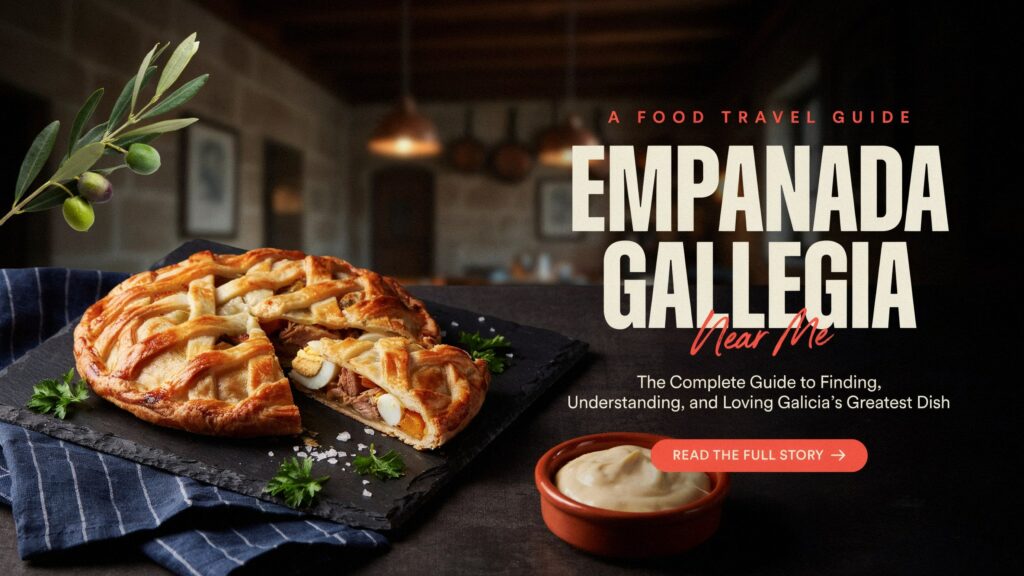
It is a large, flat, rectangular pie. Not a folded hand-sized pouch. Not a crescent shape. A wide, flat slab that gets cut into squares or rectangles for serving, like a savory cake or quiche brought to the table for sharing.
The dough is leavened. White wine, olive oil, sometimes lard or butter, and yeast go into the dough. After resting and rising, it develops a texture that is somewhere between pastry and bread — flaky enough to be satisfying, soft enough to hold the moisture from the filling without turning soggy.
The filling always starts with something called zaragallada. Galician cooks have a dedicated word for this. It is a slow-cooked, gently fried base of onions, bell peppers, and sometimes tomato that forms the flavor foundation before any protein is added. Think of it as a sofrito with a specific identity and a Galician name. Without the zaragallada, you do not have an empanada gallega — you have something else.
The protein varies by region. Tuna is the most universally recognized. But cod, octopus, scallops, sardines, cockles, chorizo, pork, chicken, and rabbit all appear across different parts of Galicia depending on what the coast or the land provides.
The History: 1,400 Years in a Pastry
Written records of this dish go back to the 7th century. That is before pizza conquered Italy, before tacos existed in their modern form, before most of the world’s beloved comfort foods had taken shape.
The Visigoths — Germanic peoples who swept through Spain from Northern Europe in the early medieval period — are sometimes credited with introducing the concept of food enclosed in dough to the Iberian Peninsula. Whether that specific origin story is accurate or not, it is clear that by the time the Christian kingdoms of northwest Spain were establishing themselves, the empanada gallega was already an established part of daily life.
The most famous piece of evidence is carved in stone.
At the Cathedral of Santiago de Compostela — the endpoint of the famous Camino de Santiago pilgrimage — there is a 12th-century stone portico called the Pórtico de la Gloria. The sculptures on this grand entrance include figures that appear to be preparing and handling an empanada. A dish so central to Galician life that its makers deemed it worthy of carving into the facade of their most sacred building.
There is a beautiful theory that pilgrims walking the Camino de Santiago carried empanadas in their bags — not just as a quick snack, but as a preservation technique. The sealed dough casing kept the filling fresh on multi-day walks through the mountains and valleys of northwest Spain. The empanada as travel food. The empanada as sustenance for the journey.
The dish eventually travelled far beyond Galicia’s borders. In the late 18th century, as the Spanish crown opened up emigration to the Americas, Galicia — one of Spain’s poorest regions — sent enormous numbers of people to the New World. Those emigrants carried their food traditions with them. In Argentina today, the word for any Spaniard — regardless of their actual region — is “gallego” (Galician). And the Argentine empanada, beloved across Latin America, traces its direct lineage to the version made in the green hills of northwest Spain.
The Zaragallada: The Secret That Nobody Talks About Enough
If you ask a Galician cook what makes their empanada different, they will probably point to the zaragallada.
This is the sofrito specific to the empanada. Onions — sliced thin and cooked very slowly in plenty of good olive oil until they become almost translucent and sweet. Bell peppers added in, cooked down the same way. Sometimes tomatoes are added at the end.
The key word is slow. A rushed zaragallada produces a sharp, raw-tasting filling. A proper one — cooked gently for twenty to thirty minutes until every piece of vegetable has softened and sweetened — gives the filling a depth that no shortcut can replicate.
Everything else in the empanada sits on top of this base. Tuna breaks apart in the warm oil. Chorizo gives up its paprika and fat. Fish absorbs the sweetness of the onion. Whatever protein you choose becomes integrated with the vegetables, not just stacked on top of them.
Galicians even have a word for the combined filling — protein plus zaragallada. They call it amoado. The fact that both the base and the complete filling have dedicated Galician names tells you something about how seriously this dish is taken in its home region.
The Regional Variations: One Dish, Many Identities
Empanada gallega is not one recipe. It is a family of recipes connected by a shared structure and philosophy.
On the Galician coast, seafood rules completely. Empanada de bonito (fresh tuna) is a summer special, made when the Atlantic bonito runs. Empanada de berberechos features cockles — small, intensely flavored bivalves from Galicia’s famous estuaries. Empanada de calamares uses squid. In the most celebrated version, empanada de zamburiñas, the filling is small scallops.
In Lugo province, eel is traditional. The long Atlantic eel — caught in rivers that run through Lugo’s hills — makes for a filling that is rich, slightly earthy, and unlike anything you will find anywhere else.
In the interior, away from the sea, pork dominates. Empanada de carne features minced pork seasoned with paprika and garlic. Sometimes there is chorizo. Sometimes rabbit, traditionally cooked with a hint of aniseed.
In coastal areas where corn flour grows, some bakers substitute a portion of wheat flour with cornmeal. The resulting dough is yellower, slightly more dense, with a different texture — more crumbly, less chewy. Corn empanadas are a regional identity in themselves.
All of these are empanada gallega. All of them are authentic. The variation is the point.
How to Find Empanada Gallega Near You
Here is the practical part. You want to eat this dish today and you are not in Galicia.
The good news is that empanada gallega has spread far from its origins. The bad news is that finding a genuinely traditional version requires knowing where to look.
Spanish restaurants are the obvious starting point. Not every Spanish restaurant serves empanada gallega — it is a specifically Galician dish and not every Spanish restaurant focuses on Galician cuisine. But many do, especially those that lean into regional Spanish cooking rather than generic pan-Spanish menus. Specifically, look up “Galician restaurant” or “tapas bar” together with the name of your city.
Latin American bakeries and restaurants are often the best bet outside of major cities with large Spanish communities. Because Argentine, Chilean, and Uruguayan food traditions carry empanada in their DNA from Galician immigrants, Latin American bakeries frequently make large empanadas that closely resemble the Galician original. The fillings may be adapted for local tastes but the technique and format are often faithful.
Spanish delis and specialty food shops in cities with significant Spanish expat communities — New York, Miami, Chicago, Los Angeles, London, Amsterdam — often stock prepared empanada gallega. Some import frozen versions. Others bake fresh ones on specific days of the week.
Farmers markets and food festivals in cities with strong food cultures increasingly feature empanada vendors. Particularly in areas with Latin American populations, empanada stalls are common and sometimes specialize in regional Spanish versions.
Online delivery has expanded options dramatically. Several Spanish food businesses now ship frozen empanada gallega nationally in the US and UK. Thaw, warm in the oven, and the result is genuinely close to fresh-baked.
The best search terms to use: “Galician empanada,” “empanada gallega,” “Spanish pie,” or simply “empanada” combined with your city. Yelp, Google Maps, and TripAdvisor all return useful results. Read reviews specifically looking for mentions of the large rectangular format — that confirms you are finding a Galician-style version rather than individual folded empanadas.
What Makes a Good Empanada Gallega: How to Judge One
You find a place. They have empanada gallega on the menu. How do you know if it is the real thing?
The crust should be thin and slightly crisp. A good empanada gallega does not have thick, bready walls. The dough should be just substantial enough to hold the filling without being the primary experience. When you press the top crust gently, it should give a little resistance and then a slight crackle.
The filling should be moist but not wet. There should be enough liquid from the filling to keep each bite tender. But the bottom crust should not be soggy or collapse when you lift a slice. The line between perfectly juicy and sadly wet is where the skill lies.
The flavors should be integrated. In a properly made empanada, you should not be able to separate the taste of the tuna from the taste of the onions or peppers. They should have cooked together long enough that they are one unified filling.
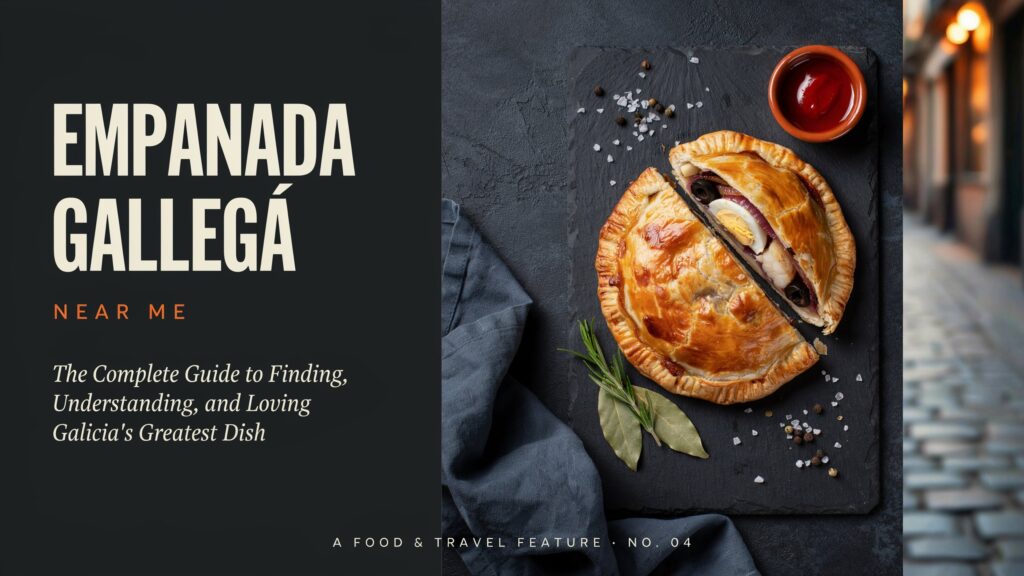
It should be served in a slice. If it arrives as an individual folded pastry, it is not empanada gallega — it is an empanadilla (small empanada), which is a different thing. Empanada gallega is a large pie cut into portions.
Room temperature should be excellent. A mark of a well-made empanada gallega is that it tastes just as good at room temperature as it does warm from the oven. If it only works hot, the dough construction was not quite right.
Making Empanada Gallega at Home
If you cannot find it near you, making it yourself is genuinely achievable for anyone comfortable in a kitchen.
The dough needs flour, white wine, olive oil, a small amount of yeast, and either lard or butter. Combine them, knead until smooth, let it rest for an hour. It will become soft and slightly elastic — easier to work with than most pastry doughs because the fat content keeps it forgiving.
The zaragallada takes time but no skill. Slice onions and peppers thinly. Cook them in generous olive oil over the lowest heat you can maintain. Stir occasionally. After twenty to twenty-five minutes, they will be silky, sweet, and deeply fragrant. Add a spoonful of tomato paste or chopped canned tomatoes. Cook for another five minutes. Remove from heat. Let it cool.
Add your protein. Drained canned tuna, flaked well, mixed into the cooled zaragallada, gives you the classic version. Salt and black pepper. Some recipes add a pinch of sweet paprika. Hard-boiled eggs, sliced and layered over the filling before the lid goes on, are traditional and add richness.
Divide the dough. Roll the bottom layer thin — a few millimeters — and lay it on a baking sheet lined with parchment. Spread the filling evenly. Roll the top layer and cover. Seal the edges tightly by pressing and folding. Brush with beaten egg. Cut a small hole or decorative vent in the center to let steam escape.
Bake at 375°F (190°C) for thirty-five to forty minutes until deeply golden.
Let it rest fifteen minutes before cutting. That rest time matters — it allows the filling to settle and the juices to redistribute through the dough.
Albariño: The Wine That Was Made for This Dish
If you are eating empanada gallega, you should be drinking Albariño.
This is not a suggestion. This is Galician cultural law.
Albariño is a white wine produced in Galicia — specifically in the Rías Baixas denomination along the Atlantic coast. It is crisp, aromatic, slightly mineral, with a natural acidity that cuts through the richness of the empanada’s filling and cleanses the palate between bites.
The combination is one of those effortless regional pairings where the food and the wine were clearly designed for each other because they come from the same place, fed by the same Atlantic air.
Cold Albariño and warm empanada gallega is a lunch that has been happening in Galician kitchens for centuries. Join the tradition.
Final Words
Empanada gallega is not just a food. It is evidence that something made with care and purpose in the 7th century can travel through fourteen centuries of history, cross an ocean, settle into new cultures, and still retain the quality that made it worth eating in the first place.
Finding a good one near you might take some searching. But when you do find it — or when you pull one golden and fragrant from your own oven — you are participating in something that pilgrims on the Camino de Santiago carried in their bags, that carved itself into the stones of a medieval cathedral, and that sailed to the Americas with Galician families who took their best recipe with them into an uncertain future.
That is a lot of history in one slice of pie.
It tastes like it.
FAQs
Q1. What is empanada gallega?
Empanada gallega is a large, flat, savory pie from the Galicia region of northwest Spain. It consists of two layers of leavened dough encasing a filling built around a slow-cooked sofrito of onions and peppers — called zaragallada — combined with a protein, most commonly tuna, cod, chorizo, chicken, or seafood. It is cut into rectangular slices and served warm or at room temperature.
Q2. How is empanada gallega different from other empanadas?
The Galician version is larger — a full pie rather than individual folded pockets. Its dough is leavened with yeast and wine, giving it a texture closer to bread than to flaky pastry. The filling always includes the slow-cooked zaragallada base, which is specific to this tradition. Most Latin American empanadas are small, hand-sized, and individually folded; empanada gallega is meant for sharing.
Q3. What is the most traditional filling for empanada gallega?
The most universally recognized filling is tuna — usually canned tuna in olive oil — combined with the zaragallada of onions, peppers, tomato, and often sliced hard-boiled eggs. Coastal Galician versions favor fresh seafood including octopus, cockles, scallops, sardines, and cod. Interior versions lean toward pork-based fillings with chorizo or minced seasoned meat.
Q4. How do I find empanada gallega near me?
Search for Spanish restaurants with Galician menus, Latin American bakeries in your area, Spanish delis in cities with Spanish expat populations, or farmers market food vendors. Google Maps searches for “Galician empanada” or “empanada gallega” plus your city name typically surface the most relevant options. Online Spanish food retailers also ship frozen versions nationally in several countries.
Q5. Can I make empanada gallega at home?
Yes. The dough is forgiving and manageable for a confident home cook — it contains wine, olive oil, and lard or butter, which keep it soft and workable. The filling requires patience more than skill: slow-cooking the zaragallada for twenty to thirty minutes builds the flavor depth that defines the dish. Baking takes about forty minutes at moderate heat.
Q6. What wine pairs best with empanada gallega?
Albariño from Galicia’s Rías Baixas region is the traditional and ideal pairing. Its crisp acidity, mineral quality, and light fruit notes complement the richness of the filling and cut through the dough’s olive oil character. It is one of the most natural regional food-and-wine pairings in Spain.
Q7. Is empanada gallega served hot or cold?
Both, depending on context. Freshly baked, it is served warm. At room temperature, a well-made empanada gallega retains its quality and flavor excellently — which is one of the properties that made it so practical as travel food for pilgrims and workers historically. Refrigerated leftovers can be reheated in an oven for about ten minutes.
Q8. What is zaragallada?
Zaragallada is the Galician term for the specific sofrito base used in empanada gallega — a slow-cooked mixture of sliced onions, bell peppers, and often tomato, cooked in olive oil until completely softened and sweet. It is the flavor foundation of every traditional empanada gallega and what distinguishes it from simpler empanada traditions.
Q9. Is empanada gallega gluten-free or vegetarian-friendly?
Traditional empanada gallega is not gluten-free — the dough is wheat-based. Vegetarian versions are possible using vegetable fillings instead of meat or fish, and the zaragallada base itself is naturally plant-based. Gluten-free adaptations are made by some home bakers using alternative flours, though the dough texture differs significantly from the traditional version.
Q10. How long does empanada gallega keep?
At room temperature, a fresh empanada gallega keeps well for a few hours. Refrigerated in an airtight container, it keeps for two to three days without significant quality loss. Reheating in an oven rather than a microwave restores the crust’s texture. Frozen empanada gallega, properly stored, keeps for up to three months.
Q11. What is the connection between empanada gallega and Argentina?
During the 18th and 19th centuries, hundreds of thousands of people from Galicia, one of Spain’s poorest provinces, emigrated to Argentina. These Galician immigrants — known in Argentina as “gallegos” — brought their food traditions with them. The Argentine empanada tradition draws directly from the Galician original, adapting the fillings to local ingredients while preserving the fundamental technique of encasing savory filling in baked dough.
Q12. Why is empanada gallega carved into a cathedral?
The 12th-century Pórtico de la Gloria at the Cathedral of Santiago de Compostela features sculptural depictions that scholars interpret as people preparing an empanada. This reflects how central the dish was to Galician life by the medieval period — not a luxury food but a staple so fundamental to daily existence that stonemasons considered it worthy of immortalizing in the facade of their most important building.
Q13. What is the difference between empanada gallega and empanadilla?
Empanada gallega is a large pie designed for sharing, cut into slices. An empanadilla is a small, individually sized folded pastry — usually a half-moon shape — made from a similar or identical dough and filled with similar ingredients. The format is the primary difference. Empanadillas are common as tapas and snacks throughout Spain. Empanada gallega is the large-format, communal pie version specific to Galician tradition.
Keep creating, innovating, and inspiring with Content Ideators every day.
