
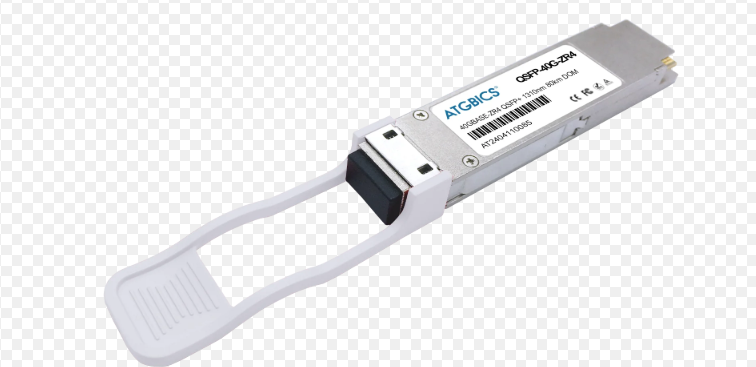
Not Every Network Needs to Move to 100G
Network technology is advancing quickly.
40GbE was once considered a major step forward for enterprise and data center networks. Today, 100G, 400G, and even 800G interfaces are increasingly common in new deployments. This rapid progression can make older networking equipment appear outdated almost overnight.
But real-world infrastructure rarely follows the same pace as technology development.
Many organizations still operate 40GbE switches, routers, servers, and storage systems that perform reliably. Replacing them simply because newer speeds are available may not make financial or operational sense.
In these environments, the goal is often not to achieve the highest possible bandwidth.
It is to keep existing infrastructure useful for as long as possible while improving the parts of the network that actually need attention.
This is where 40GBASE-ZR4 can provide a practical option.
Extending Existing Equipment Instead of Replacing It
A network upgrade does not always have to begin with a complete hardware refresh.
If existing switches still provide sufficient switching capacity, replacing the entire platform can create unnecessary costs. New equipment may also require changes to rack layouts, power systems, management software, and configuration procedures.
Optical connectivity offers a different approach.
By upgrading the transceivers used on existing 40GbE equipment, organizations can improve or extend network connectivity without immediately replacing the switching platform.
40GBASE-ZR4 is designed for long-distance 40GbE transmission over single-mode fiber, making it useful when existing 40G equipment needs to communicate across a greater physical distance.
Instead of treating older 40GbE hardware as a dead end, organizations can continue using it where it remains appropriate.
The Reality of Mixed-Generation Networks
Most production networks contain equipment from multiple generations.
A newly installed data center may use 400G switches in its core, 100G connections at aggregation layers, and 25G or 40G interfaces closer to servers.
This is not necessarily a problem.
Different network segments have different requirements, and replacing every component simultaneously would be both expensive and disruptive.
40GBASE-ZR4 fits naturally into this type of mixed environment.
A company can maintain 40GbE links where that bandwidth remains sufficient while introducing higher-speed equipment in areas where demand is growing faster.
The network therefore evolves gradually instead of being forced into a single technology generation.
When Long Reach Matters More Than Higher Speed
The networking industry often treats bandwidth as the primary measure of performance.
However, physical distance can be just as important.
A 40G connection may be more than adequate for a particular application, but a standard short-reach 40G optical module may not be capable of connecting two facilities separated by many kilometers.
Upgrading the entire network to 100G simply to obtain longer optical reach may not be the most economical solution.
40GBASE-ZR4 addresses the actual problem directly.
It combines 40GbE bandwidth with extended transmission capability over single-mode fiber, allowing existing 40G equipment to remain useful in longer-distance environments.
In other words, the upgrade is focused on reach rather than unnecessary capacity.
Making Better Use of Existing Fiber Routes
Fiber infrastructure can remain in service for many years.
Once a single-mode fiber route has been installed between two buildings, campuses, or network locations, replacing it simply because the active equipment has changed generations is rarely desirable.
The physical cable itself may still have significant remaining service life.
40GBASE-ZR4 allows organizations to make better use of this infrastructure by providing long-distance 40GbE connectivity over single-mode fiber.
This can be particularly useful for organizations that have already invested heavily in campus or metropolitan fiber routes.
Instead of rebuilding the optical path, network teams can focus their investment on the equipment at each end.
A More Gradual Approach to Network Modernization
Large network upgrades often take years to complete.
Budget cycles, equipment replacement schedules, application migrations, and facility expansion plans all influence the timing of modernization projects.
This makes gradual deployment an important strategy.
An organization may first upgrade its core network, then replace aggregation switches, and finally refresh access-layer equipment.
During this transition, older 40GbE infrastructure may remain operational for several years.
40GBASE-ZR4 can help maintain useful connectivity during this period, particularly when long-distance links need to remain operational while other parts of the network are being modernized.
This reduces pressure to complete the entire upgrade at once.
Reducing the Risk of Premature Hardware Retirement
Technology replacement has a hidden cost.
Every retired switch or router represents not only the purchase price of new equipment but also installation, configuration, testing, migration, and disposal work.
If existing hardware remains reliable and meets current requirements, extending its useful life can be a more sensible strategy.
Optical modules provide a relatively simple way to improve specific network capabilities without triggering a complete equipment refresh.
For organizations operating large numbers of 40GbE interfaces, this can make a meaningful difference to the overall network budget.
The objective is not to avoid modernization.
It is to modernize selectively.
Where 40GBASE-ZR4 Still Makes Sense
40GBASE-ZR4 is not intended to replace every modern 100G or 400G deployment.
Its value lies in situations where 40GbE remains sufficient but longer optical reach is required.
This may include older enterprise data centers, campus networks, research environments, storage networks, or specialized infrastructure that continues to rely on 40GbE equipment.
In these environments, upgrading to a higher-speed technology may offer limited practical benefits if the existing applications do not generate enough traffic to justify the investment.
Choosing a technology that matches the actual requirement can often produce better results than simply selecting the newest available standard.
Building a Transition Path to Higher Speeds
Keeping 40GbE equipment in service today does not mean an organization cannot move to higher speeds tomorrow.
A gradual migration strategy can allow different generations of technology to coexist.
40GBASE-ZR4 can serve the requirements of the current 40GbE infrastructure while new 100G or 400G equipment is introduced where needed.
Over time, individual network segments can be upgraded as traffic increases or equipment reaches the end of its service life.
This creates a transition path rather than a forced replacement cycle.
Conclusion
The continued value of 40GBASE-ZR4 is not simply about keeping an older Ethernet standard alive. It is about making practical use of infrastructure that still has useful life remaining. By combining 40GbE connectivity with extended single-mode fiber transmission, 40GBASE-ZR4 allows organizations to extend the reach of existing 40G equipment, reuse established fiber routes, and modernize networks gradually instead of replacing everything at once. In environments where 40GbE remains sufficient, this approach can protect existing investments while providing a realistic path toward future higher-speed networking.
