
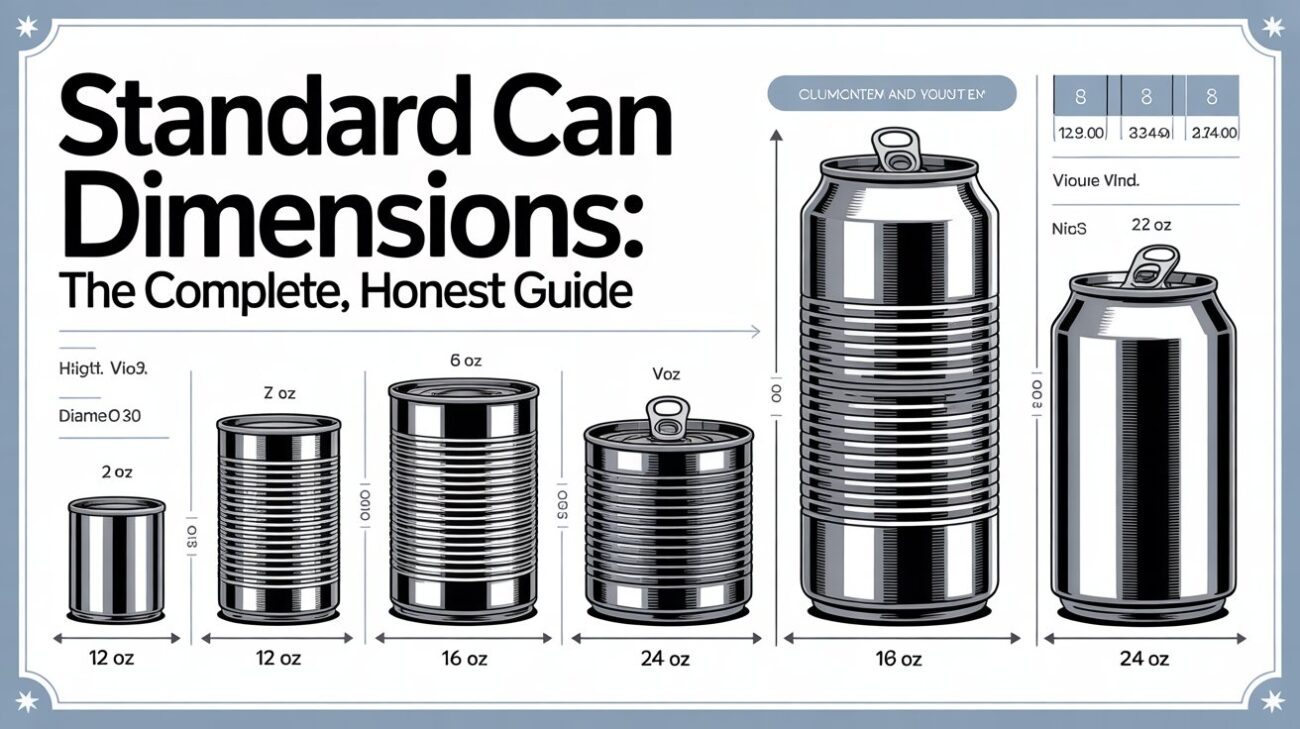
You probably hold a can every single day.
A cold soda at lunch. A can of beans for dinner. An energy drink at your desk. You crack it open, drink it, toss it in the recycling — and never once think about the remarkable precision that goes into that little metal cylinder.
Here’s the thing. Those cans didn’t happen by accident. Every millimeter of height, every fraction of an inch in diameter, every taper on the rim — all of it was engineered carefully. And once you understand the numbers, you start noticing things you never noticed before.
Let’s break it all down. Beverage cans. Food cans. The coding system. The history. All of it.
Quick Facts:
| Can Type | Diameter | Height | Volume |
| 12 oz Standard Beverage (US) | 2.60 in (66 mm) | 4.83 in (122.7 mm) | 355 mL |
| 16 oz Tallboy | 2.60 in (66 mm) | 6.19 in (157 mm) | 473 mL |
| 8.4 oz Slim (Red Bull style) | 2.09 in (53 mm) | 5.28 in (134 mm) | 250 mL |
| 330 mL European Standard | 2.60 in (66 mm) | 4.70 in (120 mm) | 330 mL |
| 500 mL Can | 2.60 in (66 mm) | 6.60 in (168 mm) | 500 mL |
| 24 oz Large Can | 2.60 in (66 mm) | ~7.50 in (190 mm) | 710 mL |
| Lid Diameter (standard 202 end) | 2.13 in (54 mm) | — | — |
| #1 Food Can (Picnic) | 2.75 in (70 mm) | 4.00 in (102 mm) | 10–12 oz |
| #2 Food Can | 3.25 in (83 mm) | 4.50 in (114 mm) | 20 oz |
| #2.5 Food Can | 4.00 in (102 mm) | 4.75 in (121 mm) | 28–29 oz |
| #10 Food Can (Bulk/Restaurant) | 6.19 in (157 mm) | 7.00 in (178 mm) | 102–117 oz |
| #300 Can | 3.00 in (76 mm) | 4.44 in (113 mm) | 14–16 oz |
| #303 Can | 3.19 in (81 mm) | 4.38 in (111 mm) | 16–17 oz |
| Wall Thickness (aluminum beverage) | ~0.10–0.15 mm | — | — |
| Wall Thickness (steel food can) | ~0.15–0.30 mm | — | — |
Why Can Dimensions Even Matter
Most people never think about this. But can dimensions affect your life more than you’d guess.
If you’ve ever tried to design a label for a product, the print area is completely determined by the can’s circumference. Get it wrong and your design wraps too far — or doesn’t wrap far enough.
If you’re a craft brewer or a small beverage startup, choosing the wrong can size means your product won’t fit into existing packaging lines at the co-packer. That’s an expensive mistake.
If you’re a restaurant chef ordering bulk ingredients, knowing the difference between a #2 can and a #10 can save you from wildly misjudging a recipe. The capacity of a #10 can is almost six times that of a #2 can.
And if you’re just a curious person who loves understanding how the everyday world was designed — this stuff is genuinely fascinating. So let’s start with what you probably touch most often.
See also “How Many Weeks Are in a Year? The Complete, Honest Answer“
The 12 oz Standard Beverage Can: America’s Most Recognized Container
Pick up any can of Coke, Pepsi, Budweiser, or Mountain Dew at a gas station right now. The one you’re holding almost certainly measures 4.83 inches tall and 2.60 inches wide at the body.
That’s 122.7 mm tall and 66 mm in diameter, for metric readers.
That single size — 12 fluid ounces, or 355 mL — accounts for more than 60 percent of all carbonated beverage cans sold in the United States every year. It’s not just common.It serves as the standard by which everything else is evaluated.
But here’s a detail most people miss. The top of the can is narrower than the body. Way narrower.
The body is 2.60 inches wide. The lid opening — what the industry calls the “202 end” — measures only 2.13 inches (about 54 mm) in diameter. That taper from body to rim isn’t decorative. It saves metal. Billions of cans means billions of lids. Making each lid slightly smaller than the body shaves a tiny amount of aluminum per unit — but at 95 billion cans filled in the US per year, those tiny savings add up to thousands of tons of material.
The whole can is surprisingly thin too. The wall of an aluminum beverage can is about 0.10 to 0.15 millimeters thick. That’s thinner than a human hair in places. Yet it holds carbonated liquid under pressure without buckling. The engineering behind that is genuinely impressive.
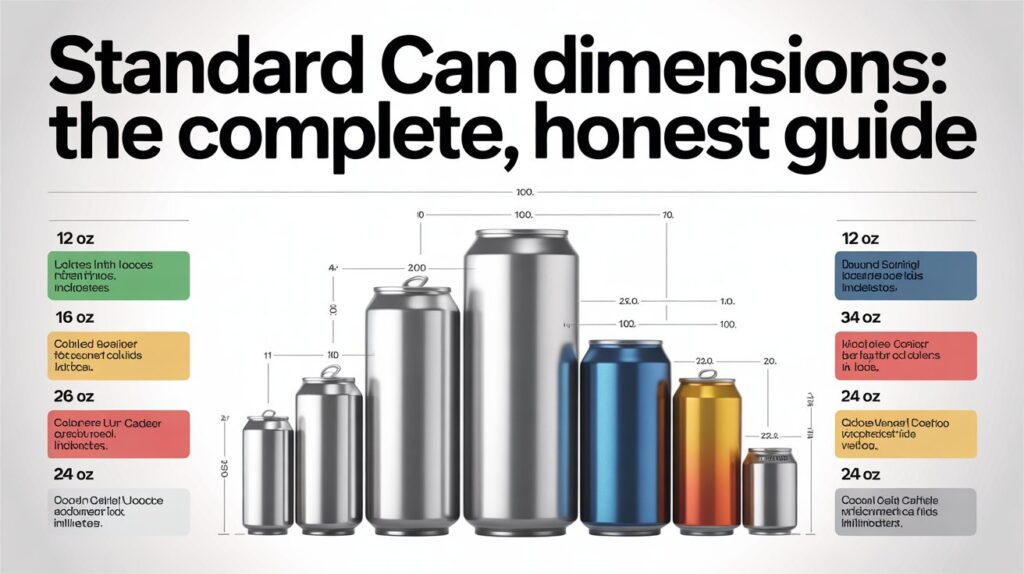
The Secret Coding System: What “211” and “202” Actually Mean
Here’s something that trips up a lot of newcomers to the packaging world.
When can manufacturers and beverage companies talk to each other, they use a three-digit code to describe can sizes. You’ll see codes like 211, 202, or 300 on spec sheets. These don’t mean millimeters. They don’t mean centimeters. They mean a very specific thing.
The first digit is the measurement in whole inches.
The next two digits are the remaining fraction, measured in sixteenths of an inch.
So 211 means 2 and 11/16 inches. That works out to 2.6875 inches — essentially the standard 2.60-inch body diameter of most beverage cans.
And 202 means 2 and 2/16 inches — which is 2.125 inches — the lid diameter.
Once you know the code, you can decode any can in about three seconds. A 307 can has a diameter of 3 and 7/16 inches. A 303 can is 3 and 3/16 inches across.
This system has been used by the canning industry for decades. It creates a universal language between can makers, food producers, labeling companies, and packaging engineers around the world.
Beverage Can Types: Standard, Sleek, and Slim
Not all beverage cans are the same shape. Walk down any store aisle and you’ll notice three distinct profiles. Each has a name, a purpose, and specific measurements.
The Standard Can
This is a classic. Short and wide. Comfortable in one hand.
The 12 oz version at 2.60 inches wide and 4.83 inches tall is the universal default. The 16 oz version uses the exact same diameter — 2.60 inches — but stretches to 6.19 inches tall. Same width. Just more room for liquid.
This is what most sodas, domestic beers, and mainstream energy drinks come in.
The Sleek Can
Sleek cans are taller and narrower than standard cans. They hold the same volume — 12 oz — but the different shape creates a very different impression.
A sleek 12 oz can might measure 6.125 inches tall with a diameter of only 2.25 inches. It looks more elegant. It feels lighter in the hand. Brands that want to project a premium or health-conscious image often choose sleek cans for exactly this reason.
Here’s the fascinating psychology behind it. A sleek can and a standard can hold identical amounts of liquid. But people consistently perceive the sleek can as containing more. The extra height tricks the eye into thinking there’s more in there.
The Slim Can
The slim is the tallest and narrowest of the three.
The most iconic example is the classic Red Bull can. It stands 5.28 inches (134 mm) tall with a body diameter of just 2.09 inches (53 mm). It holds 8.4 oz (250 mL) — less than a standard can — but feels like a handful due to its unusual proportions.
Slim cans are popular for energy drinks, premium sparkling waters, and specialty drinks where portion control matters. The narrow shape also fits comfortably in a car cupholder alongside a full-sized lid
Complete Beverage Can Size Reference
Here’s every common beverage can size in one place:
| Size | Height | Body Diameter | Volume |
| 7 oz (historical Coors) | ~3.75 in (95 mm) | 2.60 in (66 mm) | 207 mL |
| 8.4 oz Slim | 5.28 in (134 mm) | 2.09 in (53 mm) | 250 mL |
| 10 oz | ~4.30 in (109 mm) | 2.60 in (66 mm) | 296 mL |
| 12 oz Standard | 4.83 in (122.7 mm) | 2.60 in (66 mm) | 355 mL |
| 12 oz Sleek | 6.13 in (156 mm) | 2.25 in (57 mm) | 355 mL |
| 330 mL (European) | 4.70 in (120 mm) | 2.60 in (66 mm) | 330 mL |
| 16 oz Tallboy | 6.19 in (157 mm) | 2.60 in (66 mm) | 473 mL |
| 19.2 oz Stovepipe | 6.25–7.10 in (159–180 mm) | 2.60 in (66 mm) | 568 mL |
| 500 mL | 6.60 in (168 mm) | 2.60 in (66 mm) | 500 mL |
| 24 oz | ~7.50 in (190 mm) | 2.60 in (66 mm) | 710 mL |
One important thing to notice. Almost every can larger than 8.4 oz uses the same 2.60-inch body diameter. The industry standardized on this measurement because it fits vending machines, refrigerator door holders, cup holders, and packaging lines all designed around that same width. Change the diameter and everything downstream has to change with it.
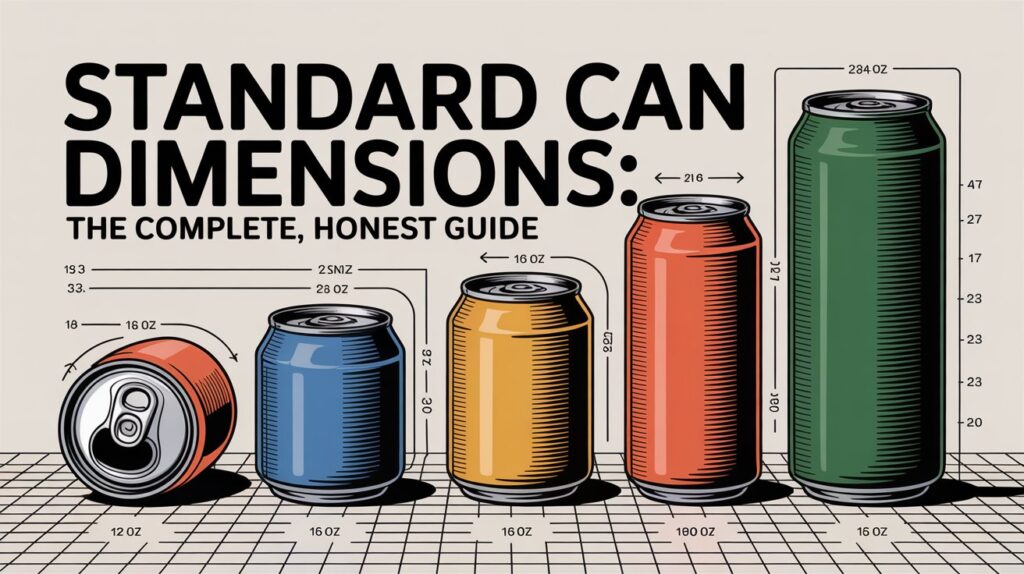
The 330 mL vs. 12 oz Difference: Why It Matters
This confuses a surprising number of people.
A 330 mL European can and a 12 oz American can look almost identical on a shelf. They’re both the same 2.60-inch diameter. They’re both roughly the same height. But they hold different amounts.
12 oz equals 355 mL. A 330 mL can hold 25 mL less — about a tablespoon and a half.
That gap exists because the US measure (12 fluid ounces) and the metric measure (330 mL) are different quantities that both happen to look right in the same general size can. European breweries and global beverage companies often use 330 mL cans. American companies typically use 355 mL.
When you’re ordering, labeling, or importing — this distinction matters. A 330 mL fill on a 355 mL can look underfilled. A 355 mL fill in a 330 mL can overflows. They are not interchangeable.
Food Cans: A Completely Different World
Beverage cans and food cans are cousins, not twins.
Food cans — the ones holding your soup, beans, tomatoes, and peaches — are made from steel rather than aluminum. Steel is thicker, heavier, and more appropriate for food products that are sterilized under pressure during the canning process. The walls of a steel food can range from 0.15 to 0.30 mm thick, meaningfully thicker than an aluminum beverage can.
Food can sizes also follow a completely different naming system from beverage cans. They employ a number-based system—#1, #2, #2.5, #3, #5, and #10—instead of fluid ounces, which has its roots in the American food industry’s standardization in the early 20th century.
The #1 Picnic Can
This is a small personal-size can. Diameter of 2.75 inches (70 mm), height of 4.00 inches (102 mm). Holds 10 to 12 oz. Single-serve soups, condensed broths, and small portions of fruit are common users.
The #2 Can
The most widely used food can in American home kitchens. Diameter 3.25 inches (83 mm), height 4.50 inches (114 mm). Holds about 20 oz. You’ll find corn, peas, green beans, diced tomatoes, and kidney beans in this exact shape on nearly every grocery shelf.
The #2.5 Can
Bigger than a #2. Diameter 4.00 inches (102 mm), height 4.75 inches (121 mm). Holds 26 to 29 oz. Sliced peaches, pie fillings, and whole tomatoes often come in this size — it’s enough for a family without going overboard.
The #300 Can
This is the one you’re most likely to pull out of your pantry right now without knowing its proper name. Diameter 3.00 inches (76 mm), height 4.44 inches (113 mm). Holds 14 to 16 oz. Kidney beans, green beans, tomato sauce — this is that size.
The #303 Can
Very slightly broader, but nearly identical to the #300. Diameter 3.19 inches (81 mm), height 4.38 inches (111 mm). Holds 16 to 17 oz. This is the format Progresso uses for its ready-to-eat soups.
The #10 Can
This is the giant. You’ve seen it in restaurant supply stores or school cafeteria kitchens. Diameter 6.19 inches (157 mm), height 7.00 inches (178 mm). Holds 102 to 117 oz — that’s roughly 12 to 13 cups.Twelve people might be served at a restaurant table with one #10 cans of crushed tomatoes.
Bulk buyers love the #10 for economics. Per ounce, it’s cheaper than buying smaller cans. The tradeoff is that once opened, you need to use it quickly or transfer the contents to a sealed container.
The Campbell’s Soup Can: A Cultural Icon with Specific Measurements
There’s one that is so recognizable that Andy Warhol turned it into fine art.
The classic Campbell’s condensed soup can — the red and white one you grew up looking at — measures approximately 3.00 inches in diameter and 4.50 inches tall. It holds 10.75 oz of condensed soup, which becomes two servings when you add a can of water.
That specific shape and proportion has been in American kitchens for over a century. The label wraps all the way around a 3-inch cylinder, which gives just enough room for the brand name, flavor, and ingredient information without overcrowding.
When Warhol painted 32 different Campbell’s soup cans in 1962, he was — whether he knew it or not — also documenting the genius of standardized packaging.
The History of the Modern Can: From War to Supermarket
The story of canned food starts with war.
In 1810, the British government needed a way to feed soldiers on long campaigns without food spoiling. A man named Peter Durand got a patent for preserving food in sealed tin containers. The technology was crude and the cans were heavy. But it worked.
For the next 150 years, food cans were made of steel with a tin coating. They were heavy, prone to rusting around the edges, and required a church key or can opener to open. Getting into one was a two-handed operation.
Then someone asked a different question: what if the can itself could be lighter?
The first all-aluminum beverage appeared commercially in 1958, introduced by the Hawaii Brewing Company for their “Primo Beer.” It was lighter than steel — roughly half the weight for the same volume. The mainland caught up quickly when Coors launched their aluminum can in 1959 — a 7-ounce design that weighed far less than any tin-plated steel can of similar size.
William “Bill” Coors reportedly spent two years solving manufacturing problems to make the aluminum can work at scale. When it did, he sold the entire engineering package to other manufacturers for $300,000 — practically giving away the invention because he wanted the aluminum can industry to grow faster.
Then in 1959, a toolmaker named Ermal Fraze from Kettering, Ohio was at a picnic. He forgot his can opener. After struggling to open a can with his car bumper, he went home and invented the pull-tab opener. The first stay-on-tab version — the kind we still use today — came along in 1975. No more detached rings littering parks and beaches.
By 1972, six-packs were born. Multi-packs changed how people bought beverages entirely. By the 1980s, aluminum completely replaced steel for beverage cans. The food industry kept steel, but the beverage world was aluminum forever.
Today the US fills over 95 billion beverage cans per year. The aluminum can market in America alone is valued at roughly $12.85 billion as of 2025.
Wall Thickness and Material: The Invisible Engineering
Here’s something worth appreciating for a moment.
A standard aluminum beverage can has walls that are roughly 0.10 mm thick. That’s thinner than a sheet of standard office paper. Yet it holds carbonated liquid under pressure, survives being stacked in cases, ships thousands of miles in trucks, and lands on a grocery shelf without deforming.
This is not an accident. The manufacturing process — called drawn and wall ironed (DWI) — starts with a flat aluminum disk and punches and stretches it into the can shape in one fluid motion. The metal thins as it’s stretched. The base stays slightly thicker for structural support. The walls taper just enough to be strong under internal pressure while using the least possible material.
Steel food cans are thicker at 0.15 to 0.30 mm, because food processing requires sterilization at high temperatures under pressure. Thinner walls would deform during that process.
Aluminum is naturally corrosion-resistant without needing a tin coating. This is why aluminum cans work perfectly for carbonated drinks — no metallic taste, no corrosion risk, no extra coating needed.
Steel food cans are typically coated internally with a lacquer layer specifically designed to prevent the metal from reacting with acidic foods like tomatoes, pineapple, or citrus. Without it, the food would taste metallic and the can would corrode from the inside.
Label Area: What the Dimensions Mean for Design
If you’ve ever wondered how brand designers know where to put the logo on a can, it comes down to simple geometry.
The label area on a cylindrical can is its circumference times its height.
For a standard 12 oz beverage can with a 2.60-inch diameter:
- Circumference = π × 2.60 = approximately 8.17 inches wide
- Height of printable area = roughly 4.30 inches (accounting for the top and bottom curves)
- Total label area = about 35 square inches
That’s the entire printable canvas. Every brand — from Coca-Cola’s red wave to craft brewery illustrations — works within those 35 square inches.
For slim and sleek cans with narrower diameters, the circumference is smaller. The label area is tighter. This is a real constraint that packaging designers account for. A visual concept that looks great on a standard can may feel cramped on a slim can.
Recycling and Why Can Size Affect Sustainability
Here’s a fact that surprises most people.
About 32 empty 12 oz aluminum cans weigh one pound. That’s how light they are. And that lightness matters enormously for recycling economics.
Aluminum is one of the most recycled materials on Earth specifically because it’s worth recycling. Melting down old aluminum to make new cans uses about 5 percent of the energy required to produce aluminum from raw ore. The can you throw in the recycling bin today could be back on a store shelf as a new can within 60 days.
Steel food cans are also highly recyclable. Steel holds its properties through repeated recycling cycles. The tin coating is removed during the recycling process and the steel is reused.
Understanding can dimensions connect directly to this story. The ongoing effort to thin can walls — going from 0.30 mm steel walls decades ago to 0.10 mm aluminum walls today — means less material per can. Less material means less energy to produce, less weight to transport, and less raw material needed per unit.
Every fraction of a millimeter shaved from a can wall, multiplied by 95 billion cans per year, adds up to something significant.
Final Words
The humble can — the one you open without thinking while watching TV, the one you find at the back of the pantry during a lazy dinner — carries an entire world of engineering in its thin metal walls.
Every measurement is deliberate. The 2.60-inch body diameter that fits in every vending machine and cupholder in America. The 202 end that saves aluminum on 95 billion lids each year. The three-digit coding system that lets manufacturers and engineers speak the same language without confusion. The #10 can that feeds a restaurant table and the #303 can feed a family of four.
And behind all of it is a history going back to British soldiers in the Napoleonic Wars, to a man who forgot his can opener at a picnic, to two years of engineering work by William Coors and his team in Colorado.
Next time you crack open a can, take one second to notice it. Hold it in your hand. Feel that thin wall flex slightly under your grip. That’s a century of engineering refinement you’re holding.
Worth appreciating, don’t you think?
FAQs
1. What are the dimensions of a standard 12 oz beverage can?
A standard 12 oz aluminum can measures 4.83 inches (122.7 mm) tall and 2.60 inches (66 mm) in body diameter. The lid narrows to 2.13 inches (54 mm) at the opening. This size holds 355 mL and represents the most common beverage can in the United States.
2. What is the difference between a slim can and a sleek can?
Both are narrower than a standard can, but they differ in volume. A sleek can holds the same 12 oz as a standard can but achieves it with a taller, narrower shape — roughly 6.13 inches tall by 2.25 inches wide. A slim can is even narrower, typically 2.09 inches wide, and usually holds a smaller volume like 8.4 oz (250 mL).
3. What does the code “211” mean on a can specification?
The three-digit code system used by the can industry reads the first digit as whole inches and the last two digits as sixteenths of an inch. So “211” means 2 and 11/16 inches — approximately 2.6875 inches. This code describes the body diameter of most standard beverage cans.
4. What size is a #10 food cans?
The dimensions of a #10 cans are 7.00 inches (178 mm) in height and 6.19 inches (157 mm) in diameter. It holds 102 to 117 oz of product — roughly 12 to 13 cups. This is the size used in restaurant kitchens and institutional food service operations.
5. What is the most common food can size in American homes?
The most popular domestic food can is the #2 cans, which is 3.25 inches broad by 4.50 inches tall and holds roughly 20 ounces. You’ll find corn, peas, beans, and tomatoes in this size at virtually every grocery store.
6. Why is the top of a beverage can narrower than the body?
The lid is narrower to save material. The standard body diameter is 2.60 inches, while the lid measures just 2.13 inches. Producing a smaller lid uses less aluminum per can. At billions of cans per year, this difference saves enormous quantities of metal and reduces production costs significantly.
7. How thick are the walls of an aluminum beverage can?
The walls are approximately 0.10 to 0.15 millimeters thick — thinner than a sheet of office paper. Despite this, the can holds carbonated liquid under pressure due to the structural design of the cylinder and the internal pressure itself.
8. What is a #300 cans and what foods come in them?
A #300 can is 3.00 inches in diameter and 4.44 inches tall, holding 14 to 16 oz. Common foods in this size include kidney beans, green beans, tomato sauce, and various canned vegetables. It’s one of the most recognizable sizes in any kitchen pantry.
9. Are 330 mL cans and 12 oz cans the same?
No. They look similar and share the same 2.60-inch body diameter, but they hold different amounts. A 12 oz can hold 355 mL. A 330 mL can hold 25 mL less. European products typically come in 330 mL; American products typically come in 355 mL (12 oz). They’re not interchangeable for filling purposes.
10. Why are food cans made of steel while beverage cans are aluminum?
Food canning requires high-temperature sterilization under pressure, which aluminum handles less efficiently than steel. Steel also holds its structure better during the processing of dense, heavy food products. Beverage cans use aluminum for lightness, corrosion resistance, and recyclability — properties that matter more for carbonated drinks than for shelf-stable food.
11. When was the modern aluminum beverage can invented?
The first commercial all-aluminum beverage can was introduced by the Hawaii Brewing Company in 1958 for their Primo Beer. Coors then brought it mainstream in 1959 with a 7 oz all-aluminum can. The pull-tab opener arrived in 1959, invented by Ermal Fraze, with the modern stay-on tab following in 1975.
12. How many 12 oz aluminum cans make one pound?
Approximately 32 empty 12 oz cans weigh one pound. This extremely light weight per unit makes aluminum recycling economically attractive and logistically efficient to transport.
13. What is the label area on a standard 12 oz can?
The printable surface area on a 12 oz standard can is approximately 35 square inches. This comes from the circumference (π × 2.60 inches ≈ 8.17 inches) multiplied by the usable print height (roughly 4.30 inches excluding the top and bottom curves).
14. What’s the difference between a #300 and #303 food cans?
A #300 can is 3.00 inches in diameter and 4.44 inches tall, holding 14 to 16 oz.A #303 can hold 16 to 17 ounces and has a diameter of 3.19 inches and a height of 4.38 inches, making it very slightly wider. The visual difference is subtle enough that older recipes sometimes list them interchangeably, but technically they are distinct sizes.
15. Can I fit different sized cans in a standard vending machine?
Most beverage vending machines in the US are built around the 2.60-inch standard diameter. Slim cans at 2.09 inches wide may rattle or jam. Cans taller than a 16 oz tallboy often don’t fit in the same column. Vending machine operators typically configure specific columns for specific can dimensions to prevent jams.
Keep creating, innovating, and inspiring with Content Ideators every day.
