
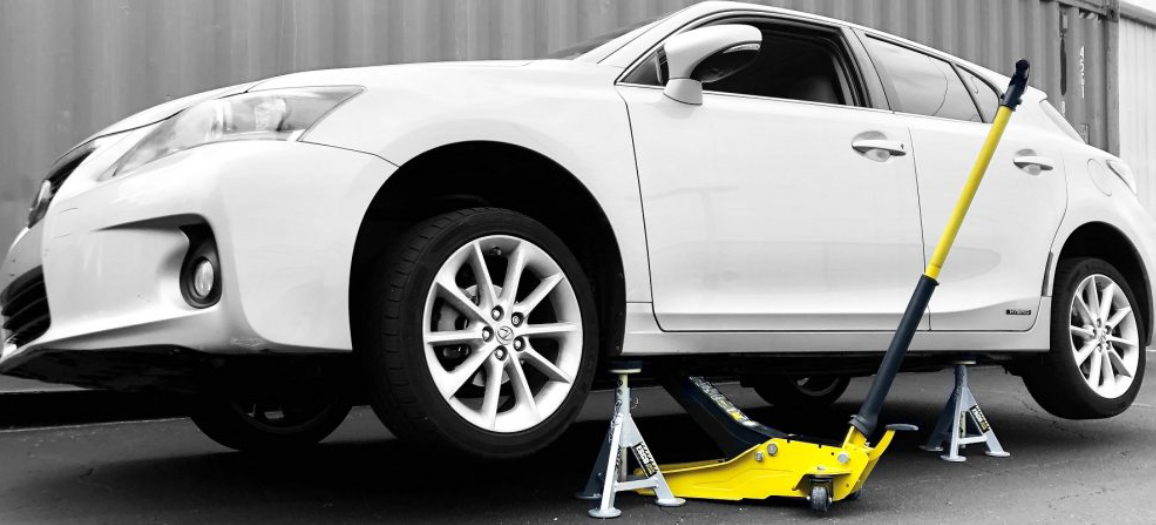
There is something strangely satisfying about watching heavy weight rise with smooth control. A machine that seems almost too small for the task slides under a vehicle, a handle moves, wheels shift, and suddenly several thousand pounds begin to ascend. It feels mechanical, yes, but it also feels a little magical. That is exactly why understanding the physics behind a trolley car jack matters. When you know what is happening beneath the steel frame and pumping arm, the lift stops being a mystery and becomes a lesson in force, motion, balance, and trust.
This guide breaks that lesson into simple terms. We will look at how rolling lifts work, why wheels matter so much, how hydraulic pressure multiplies effort, and what physics can teach you about using car jacks safely and effectively.
Why a Trolley Car Jack Feels So Powerful
At first glance, a trolley car jack does not look dramatic. It is low to the ground, compact, and unassuming. Yet the secret is not in size. The secret is in how force is redirected and amplified.
When you pump the handle, you apply a modest input force over a longer distance. Inside the jack, that force is transferred through a hydraulic mechanism. Hydraulic systems rely on Pascal’s principle, which tells us that pressure applied to a confined fluid is transmitted equally in all directions. In plain language, that means a small push in one part of the system can create a much larger lifting force somewhere else.
This is why you do not need superhuman strength to raise a vehicle. The jack trades distance for force. You move the handle through repeated strokes, and the lifting arm responds with slower but stronger upward motion. Physics is doing the heavy emotional labor here, quietly turning your effort into controlled power.
The Rolling Advantage: Why Wheels Change Everything
The “trolley” part is not just a design flourish. It is essential. A rolling jack behaves differently from a fixed lift because the load does not rise perfectly straight upward without any shifting. As the lifting arm arcs, the saddle naturally wants to move slightly inward or forward relative to the vehicle’s frame.
That is where the wheels become brilliant.
Instead of forcing the metal body of the jack to resist that horizontal motion, the wheels allow the entire unit to roll as the vehicle rises. This reduces binding, lowers stress on contact points, and helps keep the load more stable. Without this rolling movement, the jack could fight against its own geometry, creating dangerous side loads.
Think of it as cooperation between machine and motion. The vehicle is not just being pushed up. The jack is also repositioning itself in response to the lift path. This is one reason trolley-style car jacks are so admired in workshops and garages. They work with physics rather than against it.
Mechanical Advantage and the Beauty of Leverage
Before hydraulic pressure even enters the story, leverage is already at work. The long handle gives you a mechanical advantage. A longer lever allows you to apply force over a greater distance, reducing how hard each pump feels.
This idea is ancient, elegant, and deeply human. We have always loved tools that let small actions create big results. The trolley car jack is one of the clearest everyday examples. The handle, pivot points, and lifting arm all interact to multiply force in stages. First through leverage, then through hydraulic pressure, then through the geometry of the lifting arm.
Years ago, a neighbor used the word ascend while helping raise an old sedan for a brake job. He smiled and said, “Funny how even rusty things can ascend with dignity.” It was a small moment, but it stayed with us. That is what physics often looks like in real life: not formulas on a page, but a heavy object rising with grace because the forces are finally in balance.
Pressure, Area, and the Heart of Hydraulic Lifting
Here is the core principle: pressure equals force divided by area. In a hydraulic jack, a small piston is connected to a larger piston through fluid. When pressure is created in the smaller chamber, the same pressure reaches the larger chamber. Because the larger piston has more area, it produces more lifting force.
This does not create energy from nowhere. You still put energy into the system by pumping the handle. But the system rearranges how that energy is delivered. You give more distance and repeated motion; the car-jack gives greater force over a shorter lifting range.
This is why patience matters. Fast pumping may feel productive, but controlled strokes often produce smoother pressure buildup. Good lifting is not just about muscle. It is about rhythm, consistency, and respect for the machine.
Stability, Center of Gravity, and Safe Use of Car Jacks
Lifting a vehicle is not only about generating upward force. It is also about controlling balance. The center of gravity of the vehicle must stay within a stable support region. If the lifting point is wrong, or the surface is uneven, the load can shift in ways that become dangerous very quickly.
That is why flat ground matters. That is why proper jack points matter. And that is why car jacks should never be treated casually.
A mechanic once spoke about needing to purge bad habits from the garage, especially the habit of rushing. He had seen too many people trust speed more than physics. That word, purge, sounded dramatic, but it fit. Unsafe lifting practices need to be removed completely, not reduced halfway. The laws of motion are not forgiving just because you are in a hurry.
Material, Friction, and Ground Contact
The performance of a jack also depends on what lies beneath it. Smooth concrete offers predictable rolling resistance. Soft asphalt on a hot day can deform. Gravel can shift. Dirt can compress unevenly. The base of the jack needs reliable contact, or the load path becomes uncertain.
There was once a rural repair yard with deeply argillaceous soil, the kind of clay-rich ground that looked firm until rain changed everything. A worker laughed at the fancy word, then pointed to a wheel sinking slowly into the earth. It was a perfect physics lesson. Material properties are never abstract when a heavy object is involved. Surface conditions change friction, rolling behavior, and stability all at once.
What You Should Remember Before You Lift
A trolley car jack works because several principles join forces: leverage, hydraulic pressure, rolling alignment, and stable load support. Each one matters. Remove one, and the system becomes less efficient or less safe.
When you use trolley-style car jacks, you are not just operating a tool. You are stepping into a relationship with real physical laws. That can feel empowering, even emotional, because the machine responds so clearly to good technique. You pump. It rises. You align. It rolls. You respect the setup, and the lift becomes smooth and confident.
Understanding this changes everything. A jack stops being just another garage item and becomes a practical demonstration of physics in motion. And once you see that, every lift tells a story: of force redirected, of weight managed, of motion carefully guided upward by design.
