
Quick Facts Table
| Detail | Information |
| Common name | Reborn dolls |
| What they are | Hyper-realistic handcrafted baby doll replicas |
| Materials | Silicone or vinyl |
| Price range | $200 to $8,000+ |
| Most expensive ever sold | ~$30,000 — made by artist Romie Strydom |
| Global market projection | Over $630 million by 2034 |
| Origins | United States, 1990s |
| Lead market | North America (China, Japan, Brazil growing fast) |
| How hair is added | Strand by strand — real goat or alpaca hair |
| Special features on high-end models | Heartbeat simulators, simulated breathing, weighted bodies |
| Cleveland Clinic study | 46 dementia patients — reduced agitation confirmed |
| Who buys them | Grief sufferers, collectors, hobbyists, Alzheimer’s caregivers, role-players |
| Largest recent event | Dolls of the World expo, Greensboro, North Carolina — 1,500+ attendees |
| Country of recent controversy | Brazil — 30+ proposed bills to restrict usage |
| Rio de Janeiro recognition | “Reborn Stork Day” celebrated every September |
| Online communities | Facebook groups, YouTube, Instagram, dedicated forums |
The Event That Caused the World to Take Notice
A young woman named Kelli Maple straps a baby into a Nuna car seat. She drives to the mall. She puts the baby — dressed in a onesie and a little hair bow — into a top-of-the-line stroller complete with a sound machine and a stuffed animal.
She shops for tiny outfits, giggling as she goes.
From across the mall, every single person walking past sees a mother and her infant.
But the baby isn’t real. Her name is Naomi. She’s a reborn doll. And Kelli paid thousands of dollars for her.
When that story appeared in the Wall Street Journal, it split the internet in two.
See also “Juntos Seguros: What It Is, How It Works, and Why It Matters“
So What Exactly Is a Reborn Doll?
The name sounds strange until you understand what it means.
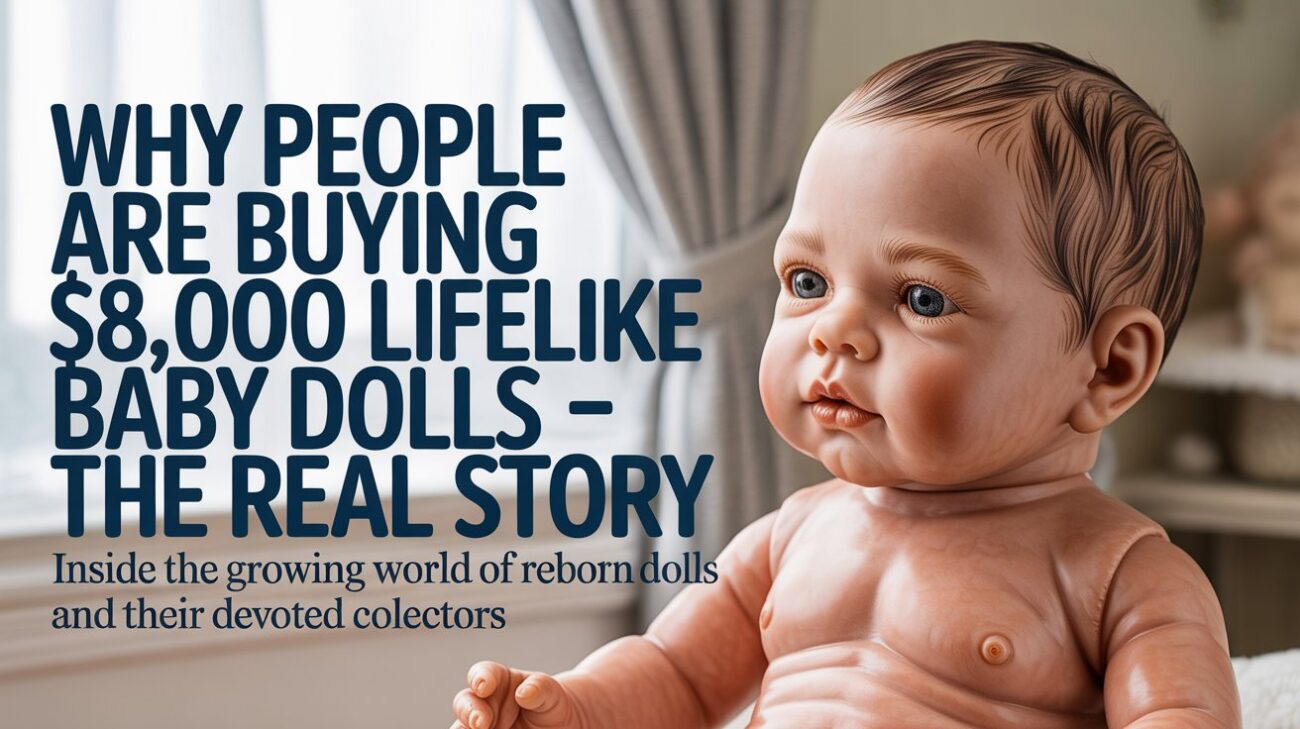
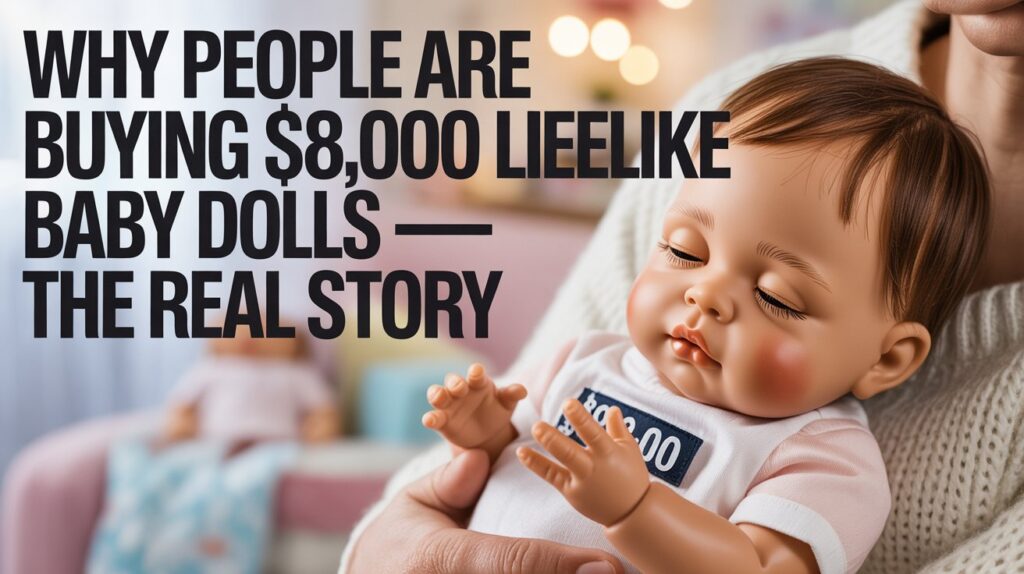
Artists take a factory-made vinyl or silicone doll kit and completely rebuild it from scratch. The transformation process is called “reborning.” By the time it’s done, the doll looks nothing like the blank starting point.
Every detail is done by hand. The artist paints layers of color onto the skin to create the look of translucent newborn complexion — with subtle blue veins showing through pale softness. Tiny wrinkles are added around the knuckles. Birthmarks are placed where real ones might appear.
The hair comes next. Artists root individual strands of real goat or alpaca hair into the scalp — one strand at a time. They treat the eyebrows in the same way. This process alone can take days.
The finished doll gets a weighted body to mimic the feel of holding a real infant. High-end models include a device that simulates a faint heartbeat. Some even have a soft mechanism inside the chest that rises and falls as if the baby is breathing.
When you hold one, the brain doesn’t immediately know the difference. That’s the whole point.
The Price Tag — And Why It Exists
An entry-level reborn costs around $200 to $400. These are decent pieces but won’t fool anyone in good lighting.
The mid-range silicone models start around $1,000. These are softer, more flexible, and more convincingly real.
At the top end, $6,000 to $8,000 gets you a commission from a highly skilled artist who might spend weeks on a single doll. Every feature is custom. The buyer might send in photos of their own child — or a child they lost. The artist works from those photographs until the resemblance becomes something close to painful.
One woman named Mia Martone attended the Dolls of the World fair in Greensboro, North Carolina, and paid $6,000 for a single reborn right there at the show. She has grandchildren who visit regularly. But she said sometimes she just wants something small and warm to hold that doesn’t cry at 2 a.m.
The most expensive reborn ever sold went for around $30,000. Artist Romie Strydom created it for a private collector. That number isn’t normal — but it tells you how serious this market has become.
Who Makes These Dolls?
Here’s what surprises most outsiders. Reborn making isn’t a factory operation.
It’s a cottage industry. Thousands of individual artists work in their homes — in basements, spare rooms, and small studios across the United States and beyond. Some have formal art training. Most are self-taught. All are obsessive about the details.
One artist told a journalist, “You have seen someone carrying a reborn in New York. You just thought it was a baby.”
That moment of honest pride says everything about the standard these artists hold themselves to.
The artists sell directly to buyers through personal websites, Facebook groups, and dedicated marketplaces. Buyers research them carefully before ordering. A good artist has a waitlist. A great artist has a waitlist that stretches years.
The Grief Connection
Let’s talk about the part that most critics miss entirely.
Not every person walking through a mall with a reborn doll is confused about reality. Most of them understand perfectly well that they’re holding silicone and paint. That’s not why they do it.
Some of these people buried a baby. Or survived a miscarriage. Or went through years of failed fertility treatments and never got to hold the child they planned for.
Grief like that doesn’t follow a schedule. It doesn’t resolve after a certain number of months. It lives in the body — in the arms that never got to hold someone.
Dr. Jessica Zucker, a psychologist specializing in reproductive mental health, has worked with women in exactly this situation. She says that American culture is deeply uncomfortable with grief around pregnancy and child loss. Moving on is what the world wants. There’s rarely space given to parents who lost babies they never brought home.
A reborn doll gives those arms something to hold. It doesn’t replace the child who died. But for many women, it releases something that has nowhere else to go. The brain experiences the physical act of nurturing. Dopamine responds. The sharp edge of grief softens, at least for a while.
One woman Dr. Zucker worked with had living children at home. She still grieved a stillborn. In her mind and heart, she considered the doll one of her babies. That wasn’t confusing. That was a human being processing the most painful kind of loss in the only way that felt right to her.
The Alzheimer’s Discovery
Here’s something that turned skeptics into supporters.
The Cleveland Clinic ran a pilot study on baby doll therapy with 46 patients suffering from dementia and Alzheimer’s disease. These patients ranged in age from 70 to 96.
They gave each patient a doll. Everyone was surprised by what transpired next.
The patients named the dolls — Violet, Daisy, Sweet Baby Jesus. They used tables as cribs. They held the dolls while they slept. They rocked them. They talked to them.
Nurses and family members reported something remarkable: the agitation scores on the Agitated Behavior Scale dropped. My mood improved. The patients were calmer, more engaged, less frightened.
Ashley Hall, the nurse manager who co-led the study, said the feedback from caregivers and families was unlike anything she’d seen from other interventions. She described being amazed by how consistently positive it was.
This wasn’t a minor effect. For people whose world has become confusing and frightening, a soft, warm baby they could hold and care for gave them back a sense of purpose. A familiar ritual. A reason to feel gentle rather than afraid.
PTSD, Anxiety, and the Calming Body
Holding something that feels like a baby does something specific to the human nervous system.
Even for people without grief or dementia, the act of cradling a weighted infant-shaped object triggers a calming response. Breathing slows. Heart rate drops. The brain settles.
This is why reborn dolls have quietly entered therapeutic settings for people with PTSD, severe anxiety, and autism spectrum conditions. They offer something no weighted blanket can quite replicate — a thing that looks back at you, that fits into your arms the way a baby does, that engages the nurturing instinct at a biological level.
Dr. Gail Saltz discussed this on the Today Show, making the point that many critics of reborn doll use are the same people who rely on denial and avoidance to handle their own difficult feelings. Using a tangible, symbolic object to process emotion is not a sign of delusion. It is a completely valid form of self-regulation.
The person on the park bench cradling what looks like a sleeping infant might have PTSD. They might have anxiety disorder. They might be processing infertility. Or they might simply find it calming. Any of those reasons is enough.
The Collector Side: Art, Not Therapy
Not everyone who spends $8,000 on a reborn doll needs emotional healing.
Some buyers are straight-up collectors. They treat reborns the way other people treat signed first-edition books or vintage watches — as beautiful, meticulously crafted objects worth preserving.
These collectors study the artists. They track which creators are producing the most innovative techniques. They discuss rooting methods, silicone formulas, and paint layering on forums with the same seriousness that art historians discuss brushwork.
For them, a reborn isn’t a baby. It’s a masterpiece from a skilled artist who spent three weeks creating something that looks more like a newborn than most factory photos of newborns do.
Some collectors never even handle their dolls. They display them carefully, protected from light and dust, preserving the work exactly as the artist intended it.
The Community That Formed Around Them
In 2025, the Dolls of the World expo in Greensboro, North Carolina drew over 1,500 attendees. Many of them arrived carrying their reborns — dressed, accessorized, treated like family members at an outing.
That event is one of dozens. There are Facebook groups with hundreds of thousands of members. YouTube channels with millions of views. Instagram accounts where owners share daily life with their dolls.
These communities give people something that goes beyond the dolls themselves. They give collectors a place where nobody laughs at them. Nobody says the thing they love is creepy. Nobody tells them their grief is too much, their hobby is too strange, their comfort object is embarrassing.
Many owners describe the community as the most accepting group of people they’ve ever found.
The Critics — and What They Usually Get Wrong
The backlash is real. Let’s be honest about that.
Some people find reborn dolls deeply unsettling. The uncanny valley effect — that specific discomfort when something looks almost human but not quite — is a genuine psychological response. The brain registers something just slightly off, and the result is unease.
Critics also sometimes assume that owners believe the dolls are real babies. This is the most common and most unfair mischaracterization.
LifeStance Health’s clinical team states clearly: most reborn owners know the dolls are symbolic. The grieving parent who holds a reborn understands it isn’t their child. The Alzheimer’s patient who names a doll Violet may not remember it’s a doll — but the person who chose to give them that doll does.
Some family members and online communities have targeted reborn owners with genuine cruelty. Called them mentally ill. Mocked them publicly. Shared their photos with captions designed to humiliate.
That cruelty says a great deal more about the people doing it than about the people holding dolls.
What Happened in Brazil
Brazil turned the reborn doll trend into a national conversation — and then a political one.
By 2025, Brazil had become one of the fastest-growing markets for reborn dolls. São Paulo hosts annual meetups that draw dedicated communities of collectors and artists. Rio de Janeiro officially designated a “Reborn Stork Day” in September to honor the artists who make them.
Then the backlash arrived.
More than 30 proposed bills appeared in Brazilian legislative bodies. Some sought to ban reborns from hospitals. Others proposed fines for anyone who brought a doll to a public service line, based on the claim that people had been “jumping the queue” by pretending their doll was a real baby who needed care.
Local health officials said that specific scenario had never actually happened.
A lawmaker from Amazonas brought a doll into the statehouse during a session and called for a ban. A woman in another state tried to take her former partner to court over custody of her reborn doll. One collector said on social media that she suffered physical attacks from strangers who mistook her doll for a real baby in distress.
Researchers and journalists pointed out that many of the proposed restrictions were proposed by right-wing lawmakers who appeared to be using the doll controversy to gain attention amid more serious political pressure around the Jair Bolsonaro coup trial.
The dolls themselves hadn’t changed. The politics had simply found them.
How to Buy One — and What to Watch Out For
The reborn market has scammers. This is worth saying clearly.
Because these dolls can cost thousands of dollars, some fraudulent sellers operate websites that look professional, take payment, and send nothing. Or they send a cheap factory doll nothing like what was photographed.
Before spending significant money on a reborn:
- Research the artist’s existing work and reviews
- Look for an active social media presence with real history
- Ask for reference photos from previous buyers
- Use secure payment methods that offer purchase protection
- Join a community group and ask for recommendations before committing
Legitimate artists take pride in their work. They’re happy to show you their process, their previous commissions, and testimonials from satisfied buyers. Anyone evasive about these things is worth skipping.
Final Words
A woman carries a doll through a shopping mall. Another one sits with a tiny weight in her arms in a hospital garden. A 78-year-old in a memory care unit holds something that reminds her hands what tenderness feels like.
None of these people are confused. None of them need your pity. Most of them have thought more carefully about their own emotional needs than their critics ever have.
The reborn doll is a strange, beautiful, and deeply human object. It costs what it costs because it takes weeks to make and because the person buying it has often spent years carrying something that had no physical form until now.
Whether they’re spending $200 or $8,000, what they’re really buying is the same thing: a way to hold something they love, or something they lost, or something they never quite got to have.
The world would do well to be a little less quick to call that creepy — and a little more willing to ask what grief actually looks like in someone else’s arms.
FAQs
Q1: What is a reborn doll?
It’s a handcrafted baby doll made from silicone or vinyl, transformed by an artist to look and feel as much like a real newborn infant as possible. Features include painted veins, rooted real hair, weighted bodies, and sometimes heartbeat or breathing simulators.
Q2: Why do people spend $8,000 on a doll?
At that price point, buyers are commissioning a highly skilled artist who may spend several weeks on a single piece. The doll might be modeled on a specific real baby — including children who died. The cost is a reflection of extensive work, hyper-realism, and handcrafted artistry.
Q3: Do reborn doll owners actually think the dolls are real babies?
Almost never. Most owners — including those using them for grief therapy — understand the doll is symbolic. LifeStance Health’s clinical team specifically addresses this: context and intent matter far more than behavior observed out of context.
Q4: What are the proven therapeutic benefits?
The Cleveland Clinic ran a pilot study with 46 Alzheimer’s and dementia patients and confirmed reduced agitation scores in participants. Beyond that, psychologists report reborns help with grief from infant loss, miscarriage, infertility, empty-nest syndrome, PTSD, and anxiety.
Q5: How are reborn dolls made?
Artists start with a factory-made vinyl or silicone kit and “reborn” it through layered painting, hand-rooting of individual hair strands, and adding weighted fabric bodies. High-end models include electronic heartbeat simulators and breathing mechanisms. The process is called “reborning.”
Q6: What’s the difference between silicone and vinyl reborns?
Silicone dolls are softer, more flexible, and more realistic in feel — they’re also significantly more expensive. Vinyl dolls are firmer, more durable, and more affordable. Both can be made to extremely realistic standards.
Q7: Are reborn dolls used in hospitals or care homes?
Yes. Baby doll therapy is used in memory care and dementia wards. The Cleveland Clinic study specifically confirms the benefit in reducing agitation among patients with Alzheimer’s. Some nursing schools also use them for training purposes.
Q8: Why is Brazil so in the news about this?
Brazil became one of the fastest-growing reborn markets by 2025. Alongside celebrations like Rio’s “Reborn Stork Day,” over 30 legislative bills proposed restrictions on reborn dolls. Most researchers found the political panic was not supported by evidence of actual harm.
Q9: Can children use reborn dolls?
Yes, with appropriate supervision. They’re made from non-toxic materials. Some children use them for imaginative play in the same way other children use regular baby dolls. They’re considered safe and can also teach empathy and nurturing behaviors.
Q10: Is owning a reborn doll a sign of mental health problems?
No. Mental health professionals consistently say that owning realistic dolls is not inherently harmful. The behavior is judged by context. Using a doll for comfort while understanding it isn’t real is a valid coping tool, not a symptom.
Q11: Where can I buy an authentic reborn doll?
Through individual artists’ websites, dedicated Facebook groups, specialty marketplaces, and events like the Dolls of the World expo. Always research the artist’s history, reviews, and previous work before purchasing. Scam operations exist in this space.
Q12: How big is the reborn doll market?
The global silicone doll market is projected to exceed $630 million by 2034, with North America leading demand and significant double-digit growth in Brazil, China, and Japan. It is no longer a specialized pastime.
Q13: What’s the most expensive reborn doll ever made?
Artist Romie Strydom sold a reborn painting for approximately $30,000 — roughly 22,000 euros — to a private collector. While $8,000 is considered the upper range for most commissions, exceptional artists and extremely detailed pieces can command prices well above that figure.
Keep creating, innovating, and inspiring with Content Ideators every day.
