

Quick Facts
| Category | Detail |
| Total length (all dynasties) | 21,196.18 km / 13,170.7 miles |
| Ming Dynasty wall (most famous) | 8,851.8 km / 5,500.3 miles |
| Construction period | 7th century BCE to 1644 CE (~2,000+ years) |
| Provinces covered | 15 provinces and regions |
| Dynasties that built it | Qin, Han, Northern Wei, Ming, and more |
| Total heritage sites catalogued | 43,721 individual relics |
| Watchtowers identified | 29,510 |
| Passes and forts | 2,211 |
| Survey completed | 2012 (5-year official study) |
| Comparison to equator | About half the Earth’s equatorial length |
| Section lost to time | Roughly one third of the total |
| Best preserved section | Ming Dynasty wall (Badaling, Mutianyu, etc.) |
| Eastern end (Ming wall) | Hushan, Liaoning Province |
| Western end (Ming wall) | Jiayuguan Pass, Gansu Province |
| Visible from space? | No — a persistent myth |
The Question That Sounds Easy Until You Dig Into It
Someone asks you how long the Great Wall of China is. Easy question, right?
You might say something like “thousands of miles” and feel confident. However, most individuals begin to realize they have no idea what they are talking about if someone presses you for the actual amount.
And honestly? That is completely fair. Because the answer depends on which wall you are counting, which dynasties you include, what counts as “wall” versus natural barrier, and whether you trust surveys from 1985 or 2012.
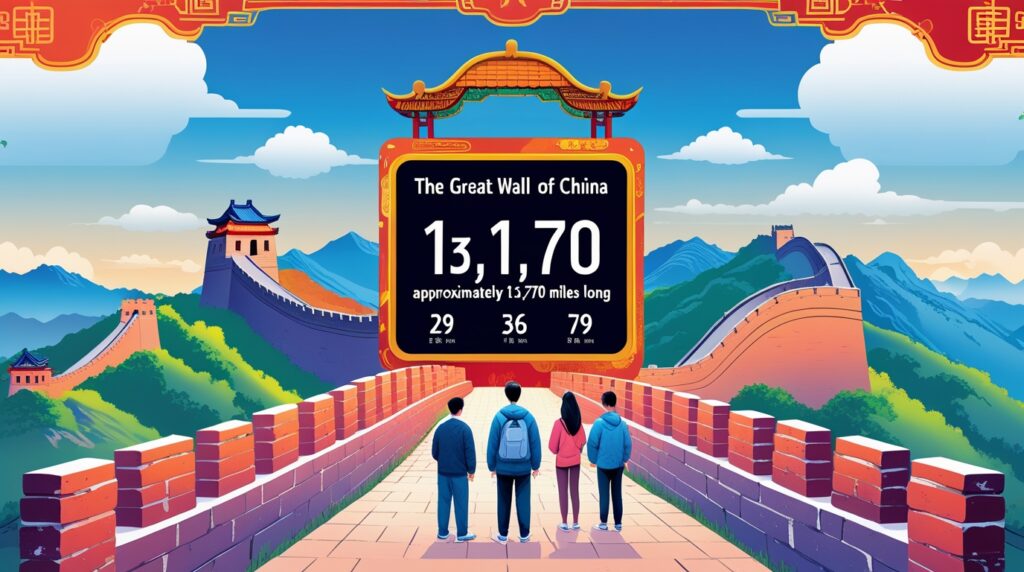
Here is the truth packed into one paragraph. When Chinese researchers spent five years walking, GPS-mapping, photographing, and cataloguing every piece of the structure in 2012, they arrived at a number that stunned historians: 21,196.18 kilometers — or 13,170 miles — across all dynasties combined.
That number is the complete story. But the story behind the number? That is what makes the Great Wall genuinely one of the most astonishing things humans have ever built.
See also “How Cold Was the Water When the Titanic Sank?“
Two Numbers You Need to Understand
Before anything else, there is one confusion worth clearing up right now.
When people talk about the Great Wall, they are almost always talking about two different things without realizing it.
Number one: The Ming Dynasty Great Wall. This is the version that gets photographed. The one in all the travel posters. The one that snakes through mountain ridges near Beijing with its iconic watchtowers and brick construction. It was built between 1368 and 1644 CE. It stretches 8,851.8 kilometers (5,500 miles) from Hushan in the east to Jiayuguan in the west.
Number two: All Great Wall sections ever built across all dynasties. When you add up every wall, trench, fortress, and fortification built by every Chinese dynasty that contributed to the overall northern defense structure — from the earliest fragments in the 7th century BCE all the way through the Ming — the combined total reaches 21,196.18 kilometers (13,170 miles).
Think of it like this. If someone asks how long a river’s full watershed is, that is a different number than asking how long the main channel flows. Both numbers are true. They just measure different things.
For travelers visiting China, the Ming wall is what they see. For historians and archaeologists, the full 21,196 km picture is what captures the true scope.
Why No One Was Aware of the True Number for Such a Long Time
Here is something that genuinely surprises people. For most of modern history, nobody actually knew how long the Great Wall was.
Educated guesses ranged from 5,000 kilometers to 50,000 kilometers. Textbooks in different countries printed different numbers. Tour guides told different stories. Even official Chinese government figures changed dramatically over time.
The problem was measurement. The Wall is not a neat, single line you can follow with a tape measure. Sections from different dynasties overlap. Some parts run parallel to each other — two walls built centuries apart side by side. Sections lie buried underground. Others have crumbled into piles of rubble that barely qualify as “wall” in any visible sense.
Nobody had ever tried to systematically survey all of it at once. The sheer scale made it seem impossible.
In 2006, China’s State Administration of Cultural Heritage launched the most ambitious archaeological survey the country had ever undertaken. Thousands of experts from heritage departments and mapping agencies spread out across 15 provinces. They walked. They used GPS. They took over 200,000 photographs. They collected more than 30,000 videos. They covered over 100,000 kilometers of terrain on foot.
Four years of field work produced a mountain of data. Then came the analysis — another year of computer identification, drafting, and expert verification.
In 2012, the final number was announced: 21,196.18 kilometers.
It was the first time in history that anyone had produced a scientifically verified, officially recognized measurement of the entire Great Wall. And it was roughly two and a half times larger than the 8,850 km figure that most people had been quoting from an earlier 2008 preliminary survey.
Dynasty by Dynasty: Who Built What
The Great Wall was not built in one go by one emperor. It grew in pieces over more than two thousand years. Different rulers in different eras each added their section, modified existing stretches, or built entirely new lines of defense.
The Earliest Walls (7th–3rd century BCE) The first defensive walls appeared during the Spring and Autumn period and the Warring States period — roughly 770 to 221 BCE. These were not built for all of China. They were built by separate Chinese kingdoms to defend against each other as much as against northern invaders. Each kingdom built its own stretch in its own territory. The walls were mostly packed earth — not brick — and most are gone today.
The Qin Dynasty (221–206 BCE) This is the version that most people picture when they think of “the First Emperor building the wall.” Emperor Qin Shi Huang unified China and ordered the northern walls of the former kingdoms to be connected into one continuous defense line. Hundreds of thousands of workers — soldiers, peasants, and prisoners — were conscripted. Conditions were brutal. Many died and were reportedly buried within the wall itself. The Qin wall ran roughly 5,000 kilometers but was mostly rammed earth, and very little of it remains today.
The Han Dynasty (206 BCE – 220 CE) The Han rulers extended the wall significantly westward, pushing it deep into Central Asia along what would become the Silk Road trade routes. The Han wall was the longest single-dynasty construction, reaching an estimated 10,000 kilometers at its peak. It protected not just military borders but the massive trade routes connecting China to Persia, Rome, and beyond.
Northern Wei, Northern Qi, and Sui Dynasties (386–618 CE) During times when steppe invasions posed a continual threat, several northern Chinese dynasties persisted in constructing and strengthening walls. The Northern Qi dynasty alone built over 1,500 kilometers of new fortifications.
The Ming Dynasty (1368–1644 CE) The Ming is the dynasty that created what we all recognize today. After the Mongols were expelled from China, the Ming emperors were determined to keep them out. They were built with fired brick and stone — much more durable than the packed earth of earlier dynasties. They designed standardized watchtowers, beacon towers, garrison stations, and multiple layers of walls in critical areas. The engineering was sophisticated. The construction was meticulous.
The Ming wall spans 8,851.8 kilometers from Hushan in Liaoning Province at the eastern end to Jiayuguan Pass in Gansu Province at the western end. It passes through 10 provinces and 156 counties. About 526 kilometers of it run through Beijing’s surrounding mountains — which is why Beijing has the most famous and best-preserved sections.
What the Wall Is Actually Made Of
Walk up to the wall at Badaling or Mutianyu near Beijing and you will see solid fired brick and stone — the work of Ming craftsmen who built for permanence.
But that material tells only part of the story.
Of the 8,851.8 kilometers of Ming wall, approximately 6,259 kilometers is actual artificial construction — brick and stone walls. Another 359 kilometers consists of trenches dug into the earth. And 2,232 kilometers relies on natural terrain — steep cliffs, deep rivers, and rocky ridges that served as natural barriers requiring no wall at all.
The earlier pre-Ming walls were almost entirely packed earth. Workers would fill wooden frames with soil and pound it hard with weighted poles. Layer by layer, the wall grew. In dry, cold northern China, this rammed earth proved surprisingly durable for centuries. But it does not stand up to the wear of millennia, and most of those sections are now barely recognizable mounds.
Some sections in the Gobi Desert used a mixture of reed bundles, tamarisk branches, and gravel in place of earth — the only materials available in those barren landscapes. Archaeologists have found these sections in remarkably good condition despite their age, preserved by the extreme dryness of the desert.
How Big Is 21,196 Kilometers, Really?
Numbers that large are hard to feel. So let’s put the size of the Great Wall into comparisons that actually mean something.
vs. the Earth’s equator: The total length of all Great Wall sections ever built is roughly half the circumference of the Earth’s equator (40,075 km). If you laid the whole thing out as a straight line, it would stretch from one side of the planet halfway around the other.
vs. the United States: The combined length of all Great Wall sections would cross the continental United States from coast to coast nearly five times. The Ming wall alone would be more than enough to cover the entire US-Mexico border and the southern Canadian land border combined.
vs. a pole-to-pole line: The distance from the South Pole to the North Pole through the Earth’s center is about 12,714 kilometers. The total Great Wall length at 21,196 kilometers is significantly longer than a line that would travel through the entire planet.
vs. the Moon: The distance from Earth to the Moon is roughly 384,400 kilometers. The Great Wall would need to be built about 18 times over to reach it. Though that comparison also quietly disposes of the famous myth that the Wall is visible from space — it absolutely is not. The wall is at most about 9 meters wide in most places. Astronauts and photographs confirm: you cannot see it from the Moon, and even from low Earth orbit it requires perfect conditions and prior knowledge of where to look.
What Remains and What Has Been Lost
Here is a fact that carries real sadness.
Roughly one third of the entire wall has disappeared. Centuries of weather, earthquakes, deliberate demolition, and people taking bricks for their own homes and farms slowly erased what invading armies never could.
During the Cultural Revolution in China from 1966 to 1976, sections of the wall near villages were actively dismantled so the bricks could be used for construction materials. Entire stretches that had stood for 600 years vanished in just a few years.
Even today, erosion continues. UNESCO estimates that about 30 percent of the Ming wall has been severely damaged or destroyed. Some sections in remote areas have degraded to barely knee-high mounds barely distinguishable from natural hillsides.
The well-preserved sections that tourists visit — Badaling, Mutianyu, Jinshanling, Simatai — represent only a tiny fraction of the full wall. They are the showcase pieces. Behind them lies thousands of kilometers of crumbling, forgotten, or entirely vanished fortification.
China has made protection of the remaining sections a national priority. New laws prohibit removing bricks or stones. UNESCO has ongoing programs supporting conservation efforts. But the clock has been running for a long time.
The Famous Sections and What Makes Each One Different
The most popular area in the world is Badaling. Fully restored, accessible by train and bus from Beijing, and genuinely impressive. It is also the most crowded — on peak days, the number of visitors can feel overwhelming. But there is a reason it is the default choice for first-time visitors.
Mutianyu sits about 90 kilometers from central Beijing. It is slightly less crowded, longer in its restored stretch, and has stunning mountain scenery. A cable car takes you up. One of the most memorable ways to descend a 600-year-old fortification is with a toboggan ride.
Jinshanling is beloved by hikers and photographers. It sits on a ridgeline that offers panoramic views in every direction. It transitions into partially unrestored sections, giving visitors a sense of what much of the wall actually looks like beyond the tourist-ready sections.
Jiankou is for the bold. This section is steep, partially crumbled, and not officially restored. There are no guardrails. The walls are overgrown with vegetation. It is genuinely dangerous in wet conditions. And the photographs taken here look like something from a different world — ancient and raw and real in a way the restored sections cannot fully replicate.
Jiayuguan Pass at the western end of the Ming wall sits in the Gobi Desert in Gansu Province. It was known as the “Last Pass Under Heaven” — the final gate before travelers and soldiers entered the wild, ungoverned lands of Central Asia. The fort here is remarkably preserved and carries a solemnity that the more photogenic eastern sections do not.
The Human Cost Behind the Numbers
The lengths and measurements are impressive. The human cost of building them is humbling.
During the Qin Dynasty alone, historians estimate that hundreds of thousands of workers died during construction. The wall was built through some of the most difficult terrain in China — steep mountain ridges, frozen plains, scorching deserts. Workers had no modern equipment. Everything was done by hand: mixing mortar, carrying bricks, hauling stone up cliffs.
The Tang Dynasty poet Du Fu wrote about laborers’ bones being buried in the wall itself. Whether literally true or metaphorical, it captured the reality of what building this structure demanded.
By the Ming Dynasty, the workforce had grown more organized. Military garrisons stationed along the wall also built and maintained it. Skilled craftsmen were brought in for the brick and mortar work. But it was still backbreaking, dangerous, and often deadly work done in remote and hostile environments.
Final Words
The Great Wall of China is 21,196.18 kilometers long when you count every section ever built across every dynasty. The best-preserved and most famous part — the Ming wall — runs 8,851.8 kilometers from Liaoning in the east to Gansu in the west.
But here is what those numbers cannot fully capture.
Every single kilometer of that wall was built by a human being carrying something heavy. Every watchtower was designed by someone who understood the tactics of horse-mounted raiders from the steppes. Every gate pass was defended by soldiers who spent years — sometimes their entire lives — stationed in remote outposts far from family.
The wall is not just an engineering achievement. It is a record of two thousand years of a civilization trying to protect itself, pushing its limits of labor and ambition and endurance to build something that would outlast every individual who worked on it.
It has outlasted all of them. Most of it is still there.
FAQs
Q1. How long is the Great Wall of China in miles?
The total length of all Great Wall sections across all dynasties is 13,170.7 miles (21,196.18 km). The most famous Ming Dynasty wall — the well-preserved section most tourists visit — is approximately 5,500 miles (8,851.8 km) long, stretching from Hushan in the east to Jiayuguan in the west.
Q2. Why do different sources give different length figures?
Because the number depends entirely on what you count. Earlier surveys measured only the Ming wall, giving figures around 3,000–5,500 miles. The 2012 official Chinese government survey counted all wall sections across every dynasty — including buried, crumbled, and underground sections — and arrived at the 13,170-mile total. The misunderstanding continues because different standards yield different statistics.
Q3. When was the Great Wall of China officially measured?
A definitive scientific measurement was completed in 2012 after a five-year survey conducted by China’s National Cultural Heritage Administration. The team walked over 100,000 kilometers of terrain, catalogued 43,721 heritage sites, and produced the officially recognized figure of 21,196.18 kilometers for the first time in history.
Q4. Can you walk the entire Great Wall?
No single continuous walkable path exists. Much of the wall is ruined, inaccessible, or passes through remote and hazardous terrain. Some adventurers have attempted multi-month treks along portions of the wall’s general route, but true end-to-end walking is not possible given the gaps, collapsed sections, and areas where only natural terrain served as the barrier.
Q5. Is the Great Wall of China visible from space?
No. This is one of the most persistent myths in popular culture. The wall is extraordinarily long but only about 4.5 to 9 meters wide — far too narrow to see from the Moon or from low orbit without extreme optical assistance. Multiple astronauts and official space agencies have confirmed this. Photographs from the International Space Station have never clearly captured the wall.
Q6. How thick and tall is the Great Wall?
The Ming Dynasty wall typically stands 6 to 9 meters tall (20 to 30 feet). Its base is usually 6 to 7 meters wide (about 20 feet). The top walkway, wide enough for horse-mounted soldiers to travel along, averages about 4 to 5 meters wide. These dimensions vary significantly along different sections depending on terrain and strategic importance.
Q7. How long did it take to build the Great Wall?
Construction spanned more than 2,000 years — from approximately the 7th century BCE through the end of the Ming Dynasty in 1644 CE. No single emperor or generation built the whole thing. It was the cumulative work of dozens of rulers across multiple dynasties, each adding, modifying, or rebuilding sections for their own military needs.
Q8. Which dynasty built the most of the Great Wall?
The Han Dynasty built the longest single stretch — an estimated 10,000 kilometers of wall extending westward to protect Silk Road trade routes. However, the Ming Dynasty built the most durable, most sophisticated, and most famous sections that exist today. In terms of what survives and is recognized, the Ming is the dominant builder.
Q9. How much of the Great Wall has been lost or destroyed?
Approximately one third of the total wall has been lost or severely damaged. Erosion, earthquakes, deliberate demolition during China’s Cultural Revolution, and centuries of locals removing bricks for building material have all taken a toll. UNESCO and the Chinese government are actively working to preserve what remains, but the deterioration continues in remote unprotected sections.
Q10. Where does the Great Wall start and end?
The Ming Dynasty wall — the most recognized version — starts at Hushan (Tiger Mountain) near Dandong in Liaoning Province in the northeast and ends at Jiayuguan Pass in Gansu Province in the northwest. Shanhaiguan, often called the “First Pass Under Heaven,” is near the eastern end where the wall meets the Bohai Sea. Jiayuguan, called the “Last Pass Under Heaven,” marks the western frontier.
Q11. How many watchtowers does the Great Wall have?
The 2012 survey identified 29,510 watchtowers along the entire Great Wall system. These towers were spaced close enough that soldiers in one could signal the next using smoke by day and fire by night, creating a rapid communication chain that could alert military commanders to an invasion in hours.
Q12. Which section of the Great Wall should a tourist visit?
For a first visit, Mutianyu offers the best balance of scenery, accessibility, and manageable crowds, with a cable car and chairlift available. Badaling is the most famous and most accessible but gets very busy. Jinshanling suits hikers who want longer walks and more dramatic views. Jiankou is for experienced hikers comfortable with unrestored, partially collapsed sections.
Q13. Is the Great Wall a UNESCO World Heritage Site?
Yes. The Great Wall was inscribed on the UNESCO World Heritage List in 1987. It is regarded as an indispensable cultural and historical landmark as well as one of the greatest architectural feats in human history. The inscription covers the wall and its associated structures, including watchtowers, fortresses, passes, and associated cultural landscapes across all regions where it exists.
Keep creating, innovating, and inspiring with Content Ideators every day.
