
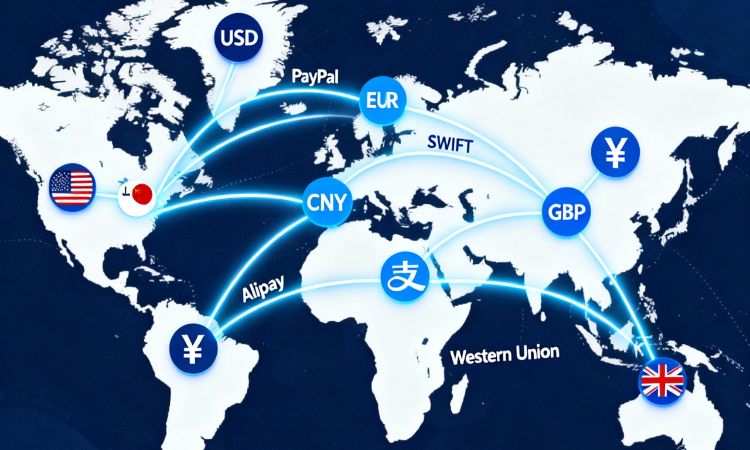
Most people who have sent money internationally have felt that moment of pause when the final amount appears on screen and is noticeably less than what was sent. The fees are rarely explained well, and the exchange rate that gets applied is often not the one you saw on Google. That gap between what you sent and what arrived on the other side is the problem that has long sat at the centre of global payments.
This is not a new issue. Businesses that deal with suppliers in other countries, platforms that pay remote teams, or trade aggregators moving large volumes daily all run into the same wall. The cost of moving money internationally has historically been a combination of correspondent bank charges, currency conversion spreads, and compliance-related overhead, none of which are easy to see upfront. The visible wire transfer fee is often the smallest part of what the transaction actually costs.
Where the Real Costs Come From
When a payment travels from one country to another through the traditional banking route, it rarely takes a straight path. It often passes through one or more intermediary banks before reaching its final destination, and each stop along the way can take a cut. The receiving bank sometimes charges a fee on arrival, too, so by the time the money lands, the total deduction can vary significantly depending on the corridor.
Currency conversion is another layer on top of that. Banks typically apply their own exchange rate, which includes a spread over the mid-market rate, and that spread is where a significant portion of the cost quietly disappears. For a business doing regular international payments, even a small spread on a large volume adds up to a substantial figure over the course of a year.
Settlement time compounds the problem in a different way. When a payment takes several business days to arrive, businesses must hold pre-funded liquidity in foreign accounts to keep operations running. That tied-up capital has a cost too, even if it does not show up as a line item in any transaction record.
Modern cross-border payment infrastructure approaches this differently. By combining traditional fiat rails with stablecoin rails, platforms can route payments through whichever path offers the best combination of speed, cost, and compliance, rather than defaulting to the legacy correspondent banking system every time. This comes up more often than expected in conversations about payment efficiency: the route itself matters as much as the surface-level fee.
How Different Rail Combinations Change the Math
There is a practical way to think about this. Fiat rails, meaning the real-time payment networks that many countries have built over the last decade, are fast and reliable within their own corridors. Stablecoin rails, on the other hand, can move value across borders in minutes without needing pre-funded accounts in both countries. When a payment network can decide in real time which rail to use based on the destination, the currency, and the required settlement speed, the cost floor drops considerably.
This dual-rail approach also changes how liquidity works. Traditional cross-border payments require banks to maintain nostro accounts in multiple currencies, and the cost of maintaining that liquidity gets passed on to the businesses using the network. A system that uses stablecoins as the transit layer between fiat currencies can reduce or eliminate that requirement, translating directly into lower fees for the end user.
Compliance is another consideration that is not always discussed alongside cost. Speed and low cost mean little if a payment cannot pass through regulatory checks in the destination country. A well-built cross-border payment solution handles compliance in parallel rather than as a separate step, which prevents delays and avoids the failed transactions that create hidden costs through refunds and reprocessing.
The Business Case for Switching Early
For a fintech, a payroll platform, or a trade aggregator that processes payments in multiple currencies every week, the math on transaction costs is worth working through. Even a modest reduction in average transaction cost across a meaningful volume can free up significant working capital over a year. That is not a small thing, particularly for businesses operating on tight margins or in growth mode, watching every line of operational spend.
There is also a compounding effect to consider. As payment volumes grow, the absolute cost of inefficient rails grows with them. A platform that solves for this early does not carry that inefficiency forward as it scales. Cross-border payment solutions built on hybrid infrastructure give businesses a way to reduce that drag from the start rather than treating it as a fixed cost of doing business.
Getting familiar with what a payment network actually does at the infrastructure level, whether it relies purely on correspondent banks or uses a combination of rails, is worth the time before a payment volume gets large enough that switching becomes disruptive.
