
My neighbour called me in a panic once. She had just ordered a bed frame online. The mattress she already owned. But when everything arrived, nothing fit. The mattress was too long for the frame. The sheets she bought were too wide. Three returns sleeping on the floor for two weeks.
All of that could have been avoided with one thing — knowing the exact numbers before buying.
This guide gives you every measurement you need about twin beds. The width. The length. The frame. The bedding. How much room you need around it. What it looks like in different countries. All of it. Let’s go.
Quick Reference Table: Twin Bed at a Glance
| Feature | Standard Twin | Twin XL |
| Width (inches) | 38 inches | 38 inches |
| Length (inches) | 75 inches | 80 inches |
| Width (cm) | 96.5 cm | 96.5 cm |
| Length (cm) | 190.5 cm | 203 cm |
| Width (feet) | ~3 ft 2 in | ~3 ft 2 in |
| Length (feet) | ~6 ft 3 in | ~6 ft 8 in |
| Total area (sq ft) | ~19.8 sq ft | ~21 sq ft |
| Mattress thickness | 9–12 inches typical | 9–12 inches typical |
| Minimum room size | 7 × 9 ft | 8 × 10 ft |
| Comfortable room size | 8 × 10 ft | 8 × 10 ft (or larger) |
| Best for | Kids, single adults under 6 ft | Teens, college dorms, taller adults |
| Sleeps | 1 person | 1 person |
| Also called | Single bed | Single XL, Long twin |
What Is a Twin Bed, Really?
Before we talk numbers, let’s talk about what a twin bed actually is.
A twin bed is the smallest standard adult mattress you can buy. It fits one person. It is designed to take up the least amount of floor space while still giving a grown person a real night of sleep.
You probably first encountered one as a kid.The bed was tiny and pressed up against the wall. Maybe you had one with a headboard shaped like a race car. Maybe it was plain and simple. Either way, it was a twin.
The name “twin” comes from hotels. Back in the old days, hotels would place two identical single beds in the same room. Guests called them “twin beds” because they came in matching pairs. The name stuck even when you’re only buying one.
Today, most people use the words “twin” and “single” to mean the exact same thing. They are identical. Same size, different names. In countries like Australia, “single” is still the common term. In the US and Canada, “twin” won.
See also “Taper Fade vs Fade: The Complete Guide You Actually Need“
The Exact Measurements You Need
Let’s get right to the numbers.
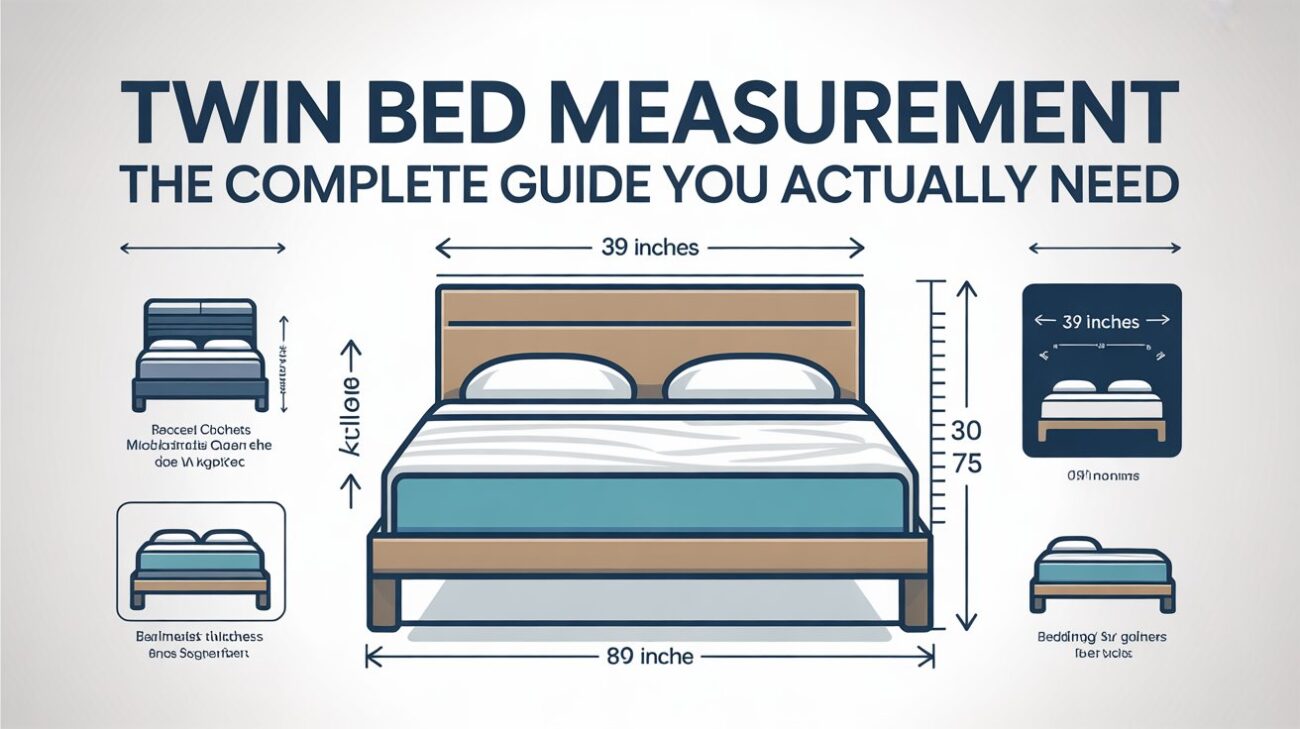
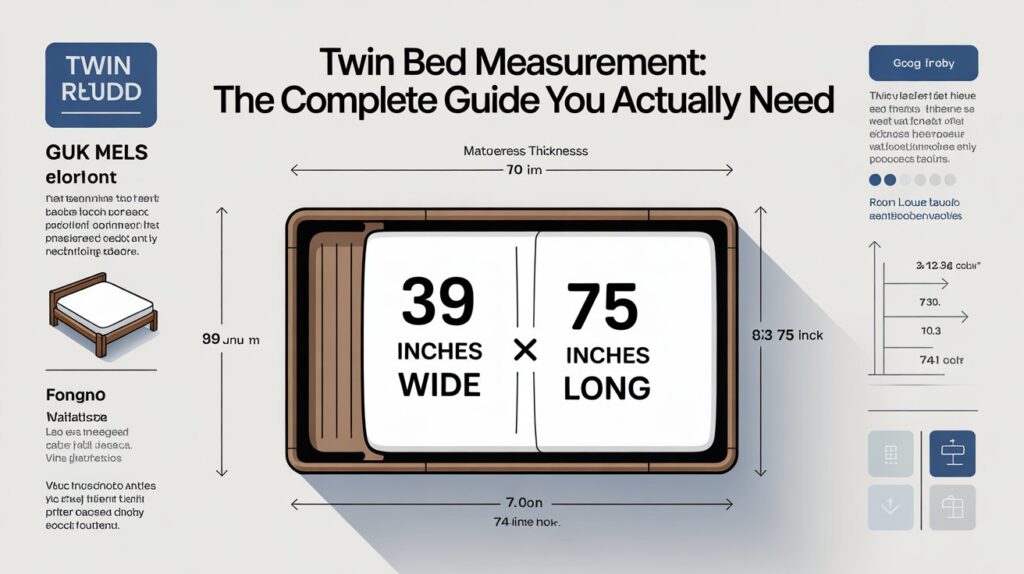
The dimensions of a typical twin mattress are 75 inches long by 38 inches wide.
That’s all. Easy. If necessary, put it in writing.
In other units, that works out to:
- Centimeters: 96.5 cm × 190.5 cm
- Feet: approximately 3 feet 2 inches wide, 6 feet 3 inches long
- Square footage: about 19.8 square feet of sleeping surface
Now, those numbers are for the mattress itself. The bed frame will be slightly bigger — usually 2 to 4 inches wider and 2 to 4 inches longer than the mattress. This is normal. The frame needs room to hold the mattress securely.
So when you’re measuring your room, use the mattress size for calculating sleep space, but use the frame dimensions for figuring out how much floor the whole bed will take up.
Twin XL: When 75 Inches Isn’t Quite Enough
Many folks trip over this.
There are actually two different twin sizes.The Twin XL and the standard twin.
The Twin XL is 38 inches wide — exactly the same as a regular twin. Nothing changes there. But the length goes to 80 inches instead of 75. That’s an extra 5 inches.
Five inches might not sound like much. But if you’re 6 feet tall, those five inches are the difference between waking up comfortable and waking up with your feet hanging off the edge.
The Twin XL is very popular in college dorm rooms across the United States. Most university-owned dorm beds use Twin XL frames. So if you’re heading to college, check what your dorm uses before you buy sheets.
Here is a quick comparison:
| Measurement | Standard Twin | Twin XL |
| Width | 38 inches | 38 inches |
| Length | 75 inches | 80 inches |
| Extra length | — | +5 inches |
| Who it’s for | Kids, shorter adults | Teens, tall adults, dorm students |
The Frame Is Not the Same as the Mattress
This one trips people up constantly.
When you order a twin mattress, you get a mattress. When you order a twin frame, you get a frame built to hold that mattress. But the frame itself is slightly larger.
A typical twin bed frame adds roughly 2 to 3 inches on each side and 2 to 4 inches in length to accommodate the mattress plus the walls of the frame.
So your overall footprint on the floor could be closer to 42–44 inches wide and 78–80 inches long, depending on the frame style.
This matters most when you are placing the bed in a small room and counting on every inch of floor space.
Also important: mattress thickness. Twin mattresses come in different heights. A basic foam mattress might be 6–8 inches thick. A premium memory foam or hybrid mattress can be 10–14 inches thick. Your sheets need to fit the depth of your mattress, not just the length and width.
How Much Room Do You Need Around the Bed?
Now here is the question that most people forget to ask until it is too late.
You need space around the bed, not just space for the bed.
Sleep experts and interior designers recommend at least 24 inches of clearance on each side of the bed where you walk. That means you can stand beside it, make the bed, and not bump into the wall or dresser constantly.
At the foot of the bed, leave at least 36 inches of space. This is the space you walk through every day.
So what does that mean for total room size?
- Bare minimum to fit a twin bed (and nothing else): 7 × 9 feet
- Comfortable room with some walking space: 8 × 10 feet
- Comfortable room with a desk and dresser too: 10 × 10 feet or larger
One helpful trick: take a roll of painter’s tape and mark the exact outline of the bed on your floor before you buy anything. Stand inside the tape. Walk around it. Sit on the floor where it would be. You’ll immediately feel whether it works or not.
Bedding Dimensions for a Twin Bed
Buying sheets and bedding for a twin is easy — as long as you know the right numbers.
Here is what you need:
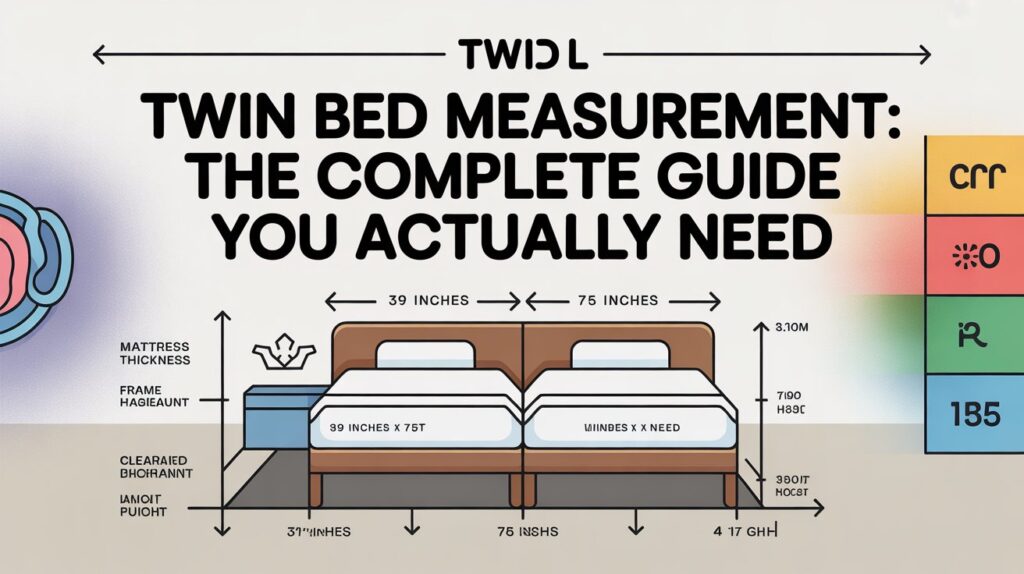
Fitted Sheet: Designed to fit a 38 × 75 inch mattress. Always check the pocket depth. If your mattress is 12 inches thick, your fitted sheet needs at least a 12-inch pocket. Thin pockets pop off in the night.
Flat Sheet: Usually around 66 × 96 inches for a twin. The extra size gives you enough to tuck in on the sides and bottom without pulling loose.
Comforter or Duvet: A standard twin comforter is typically 68 × 86 inches. This gives you a few inches of overhang on each side. Measure your specific comforter though — brands vary.
Pillow: A standard pillow is 20 × 26 inches. It fits a twin bed perfectly. Standard pillowcases are the right match.
Important note if you have a Twin XL: Regular twin sheets will NOT fit. The extra 5 inches of length means your fitted sheet will pull off at the foot. Always buy Twin XL sheets for a Twin XL mattress.
Twin Bed vs. Other Mattress Sizes: How It Compares
It helps to see the twin in context with the other standard sizes.
| Bed Size | Width (inches) | Length (inches) | Difference from Twin |
| Twin | 38 | 75 | — |
| Twin XL | 38 | 80 | +5 in length |
| Full (Double) | 54 | 75 | +16 in width |
| Queen | 60 | 80 | +22 in width, +5 in length |
| King | 76 | 80 | +38 in width, +5 in length |
| California King | 72 | 84 | +34 in width, +9 in length |
The full-size bed (also called a double) is the same length as a twin — but 16 inches wider. That 16 inches makes a real difference for adults who like to spread out.
Two twin beds pushed together can make a king-size bed. This is actually called a “split king” in the mattress world. It works well for couples who like different mattress firmness levels.
Who Is a Twin Bed Actually Good For?
Let’s be honest about this.
A twin bed is perfect for one person who is not over 6 feet tall. That’s the sweet spot.
Kids: Excellent choice. A twin is the classic “first big bed” for a child moving out of a toddler bed or crib. It fits easily in a small bedroom. It works in bunk bed setups. It is affordable to outfit with sheets and blankets. Kids generally love having their own twin bed.
Teenagers: A regular twin works for shorter teens. But a growing teenager — especially one heading toward 5’10” or taller — will quickly feel cramped in a 75-inch bed. Consider the Twin XL at that point.
College students: Most dorms use Twin XL frames. A regular twin sheet won’t fit those beds. Check with your school before you pack.
Single adults: A twin works well for single adults in small apartments who mostly sleep alone. It saves serious floor space. The limitation is width — at 38 inches, you don’t have much room to shift around.
Guest rooms: A twin is a practical guest bed. It takes up minimal space when the room doubles as an office or studio. Your guests will sleep fine on it for a few nights.
Bunk beds: Twin mattresses are the standard size for almost all bunk bed frames. If you’re buying bunk beds, you’re almost certainly buying two twin mattresses.
Twin Beds Around the World
Here’s something most people never think about: bed sizes are NOT the same everywhere.
If you live outside the United States or are buying bedding from overseas, the sizes will be different. This causes real problems if you’re not careful.
| Country/Region | “Single” Size | Width | Length |
| USA / Canada | Twin | 38 in (96.5 cm) | 75 in (190.5 cm) |
| United Kingdom | Single | 36 in (91 cm) | 75 in (190 cm) |
| Australia | Single | 36 in (92 cm) | 74 in (188 cm) |
| Continental Europe | Single | 35.4 in (90 cm) | 78.7 in (200 cm) |
| Japan | Single | 38 in (97 cm) | 77 in (195 cm) |
| China | Single | 42 in (106 cm) | 74 in (188 cm) |
| Brazil | Single | 35 in (88 cm) | 74 in (188 cm) |
See the problem? A UK single and a US twin are close, but not the same. European singles are narrower but longer. Chinese singles are actually wider than a US twin.
If you buy a “twin sheet” from a UK website while living in the US, it may not fit. Always check the exact centimeter or inch measurements — not just the name.
Bunk Beds and Trundle Beds: Special Measurements to Know
Twin beds have a special relationship with bunk beds and trundle beds.
Bunk beds: Almost all standard bunk beds are designed for twin mattresses. The top bunk and bottom bunk are both twin-size. A normal twin mattress (38 × 75 inches) fits inside the frame.
One crucial measurement for bunk beds: vertical clearance. The space from the top of the bottom mattress to the bottom of the top bunk should be at least 33 inches so whoever is sleeping below can sit up without hitting their head. Between the top mattress and the ceiling, leave at least 40 inches for comfortable sitting.
Trundle beds: A trundle is a second bed frame that rolls out from underneath the main bed. Trundle mattresses are usually 75 inches long and 38 inches wide — twin size — but they are much thinner than a regular mattress. Most trundle mattresses are only 4 to 8 inches thick because the frame needs to slide under the main bed.
When buying a trundle mattress, confirm the maximum thickness your specific trundle frame can accommodate.
The History Behind the Twin Bed Size
This is a fun piece of information that almost nobody knows.
The modern standardization of bed sizes in the United States didn’t happen until after World War II.
Before the 1940s, furniture manufacturers made beds in all sorts of sizes with no coordination between brands. That meant buying sheets was a guessing game. A “single” bed in one shop might be a different size than a “single” in another shop.
After the war, manufacturing became more coordinated. Factories started agreeing on standard sizes. The 38 × 75 inch twin became one of those agreed-upon standards. And that measurement has stayed almost perfectly consistent ever since — more than 80 years later.
The queen and king sizes came later. They weren’t introduced until the 1950s and 1960s, when Americans started wanting more sleeping space. But the humble twin just stayed the same.
Budget Considerations
Let’s talk money, because it matters.
A twin mattress is the most affordable standard mattress you can buy. Prices generally range from about $150 on the lower end for a basic foam mattress to $800 or more for a premium organic or hybrid twin mattress.
Compare that to a queen mattress, which typically starts around $400 and can go well past $2,000 for high-end models.
The savings continue beyond the mattress itself. Twin sheets, comforters, and pillowcases cost less than queen or king bedding because there is simply less material involved.
If you are furnishing a child’s room or a small guest space on a tight budget, a twin is genuinely the most cost-effective option.
Measuring Tips Before You Buy
Four things to do before you purchase anything:
1. Measure your room first. Not just the wall space, but the actual floor space. Measure from door to wall. Account for where the door swings open — a bed placed incorrectly can block a door.
2. Measure any existing frame or base. If you already have a frame and want a new mattress, measure the inside of the frame — not the outside. The mattress goes inside.
3. Check your doorways and hallways. A 75-inch mattress needs to navigate hallways, corners, and stairwells to get into the room. Measure those too.
4. Consider the total bed height. Your mattress sits on a foundation or box spring, which sits on a frame. Add those heights up. The ideal total bed height — floor to top of mattress — is around 24 to 26 inches. Too high and it’s hard to climb into. Too low and it’s hard to stand up from.
Final Words
A twin bed is simple. 38 inches wide. 75 inches long. The same measurement it has been for over eight decades.
But those two numbers connect to a whole web of other decisions — frame size, room layout, sheet depth, ceiling clearance, international sizing, age of the sleeper, and your budget. None of it is complicated once you know what to look for.
The best bed for someone is the one that fits their room, fits their body, and fits their life. For millions of kids, students, and solo adults around the world, a twin does exactly that.
Buy with confidence. Measure twice. Sleep well.
FAQ: 13 Real Questions About Twin Bed Measurements
Q1: What are the exact dimensions of a standard twin bed?
The dimensions of a typical twin mattress are 75 inches long by 38 inches wide. In centimeters, that is 96.5 cm × 190.5 cm. In feet, it is roughly 3 feet 2 inches wide and 6 feet 3 inches long.
Q2: What distinguishes a Twin XL from a twin?
Both are 38 inches wide. The Twin XL is 80 inches long instead of 75, giving you 5 extra inches of foot room. If you’re taller than about 5’10”, the XL is worth the upgrade.
Q3: Is a twin bed big enough for an adult?
Yes — for a single adult who is under 6 feet tall. It is narrow (only 38 inches wide), so people who like to spread out sideways might feel cramped. But the length works fine for most adults.
Q4: What size room do I need for a twin bed?
At minimum, a 7 × 9 foot room. For comfortable living with walking space and a bit of furniture, 8 × 10 feet is better. If you want a desk and a dresser too, 10 × 10 feet gives you room to breathe.
Q5: Is a twin bed the same as a single bed?
Yes, completely. The two terms refer to the exact same size — 38 × 75 inches. The US and Canada say “twin.” Many other countries say “single.” Same bed.
Q6: What sheets fit a twin bed?
A fitted sheet for a 38 × 75 inch mattress. Make sure the pocket depth matches your mattress thickness. Flat sheets for twin beds are typically about 66 × 96 inches. Comforters are usually around 68 × 86 inches.
Q7: Can two people sleep in a twin bed?
Two people can fit physically, but it is very uncomfortable for regular use. At 38 inches, each person would have less than 20 inches of space — narrower than a single airline seat. A full/double bed (54 inches wide) is the minimum recommended size for couples.
Q8: Do twin and Twin XL use the same sheets?
No. They need different fitted sheets. A regular twin fitted sheet will not reach the foot of a Twin XL mattress and will pop off constantly. Always check the label before buying bedding.
Q9: How thick is a twin mattress supposed to be?
Standard twin mattresses are typically 9 to 12 inches thick. Thinner budget models can be as low as 6 inches. Premium pillow-top or hybrid models can exceed 14 inches. Your sheets must accommodate whatever thickness your mattress is.
Q10: How big is a twin bed frame compared to the mattress?
A bed frame is slightly larger than the mattress it holds. Expect a twin frame to add roughly 2 to 3 inches in width and 2 to 4 inches in length compared to the 38 × 75 inch mattress.
Q11: Can I use a US twin mattress with sheets bought in the UK?
Probably not well. A UK single mattress is slightly narrower (91 cm vs 96.5 cm) and a different length. The sheets won’t fit properly. Always buy bedding based on the actual centimeter or inch measurements, not just the name.
Q12: What mattress thickness should I use in a trundle bed?
Trundle bed mattresses need to be thin enough to slide under the main bed. Most trundle beds accommodate mattresses 4 to 8 inches thick. Check your specific trundle frame’s maximum height before buying the mattress.
Q13: How often should I replace a twin mattress?
A good quality mattress, used every night, typically lasts 7 to 10 years. Kids’ mattresses may need replacing sooner as the child grows and sleeping needs change. If you notice sagging, lumps, or you wake up with back pain, it is probably time.
Keep creating, innovating, and inspiring with Content Ideators every day.
