You’re mid-recipe. Your hands are floury. The pot is already on the stove. And suddenly you’re stuck on one question: how many cups make a quart again?
It happens to everyone — beginners and people who’ve cooked for twenty years alike. The answer is quick, but the story behind it is actually pretty interesting. Let’s go through all of it.
Quick Reference:
| Measurement | Equals |
| 1 cup | 8 fluid ounces |
| 1 pint | 2 cups / 16 fluid ounces |
| 1 quart | 4 cups / 2 pints / 32 fluid ounces |
| 1 gallon | 4 quarts / 8 pints / 16 cups |
| 1 dry quart | ~4.65 cups |
| 1 imperial quart (UK) | ~4.8 US cups |
| ½ quart | 2 cups |
| 1½ quarts | 6 cups |
| 2 quarts | 8 cups |
| 3 quarts | 12 cups |
| 4 quarts | 16 cups (= 1 gallon) |
The Simple Answer First
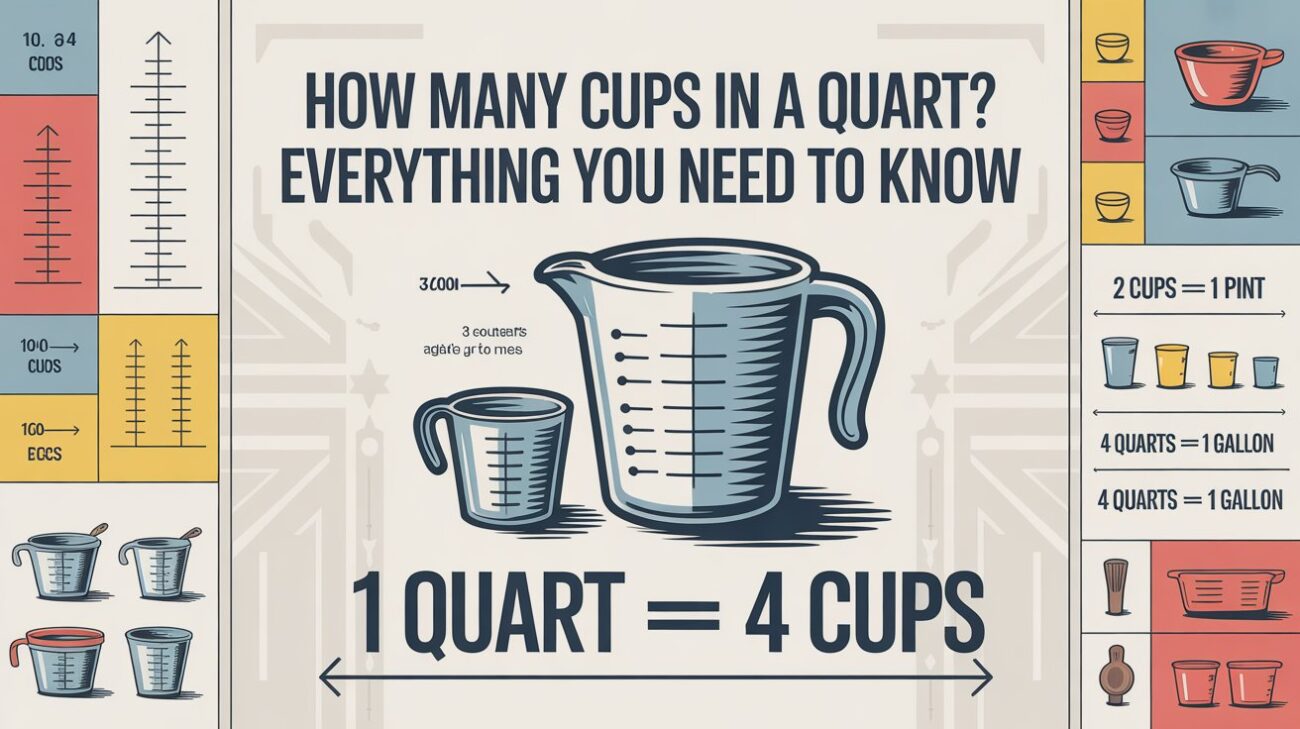
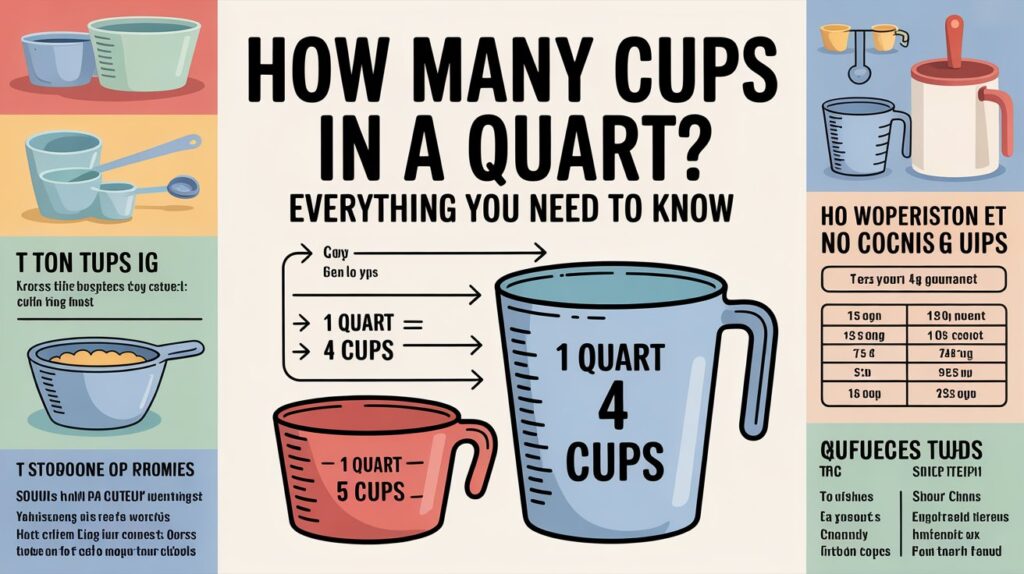
There are 4 cups in 1 quart.
That’s the number you need. Write it on a sticky note. Put it inside a cabinet door. Tattoo it on your brain.
One cup is exactly one-quarter of a quart. So four of them stacked together make one full quart.
See also “I Can’t See Comments On Instagram Desktop — Here’s Everything You Need to Know“
What Even Is a Quart?
The word “quart” comes from Latin. The Latin word quartus means “a fourth.” In French it became quarte, which also means one-fourth.
A quart is literally one-fourth of a gallon. That’s where the name comes from.
It was used as far back as medieval England — around 600 years ago. Geoffrey Chaucer, the famous English poet, even mentioned it in his writing around the year 1370. Back then people used it to measure ale. The amount varied slightly from region to region, but it was always somewhere in the neighborhood of one liter.
Today it’s locked in. One US liquid quart is exactly 946.35 milliliters.
What Is a Cup, Exactly?
A cup sounds simple — it’s a cup, right? But your drinking cup at home is not a measuring cup.
A standard US measuring cup is exactly 8 fluid ounces. That’s about 240 milliliters.
Drinking cups come in all different sizes. A coffee mug might hold 12 ounces. A big tumbler might hold 20. None of those are a measuring cup.
When a recipe says “1 cup,” it means the measuring cup — 8 fluid ounces. Always.
The Full Family of Measurements
Think of US volume measurements like a family. They all fit inside each other neatly.
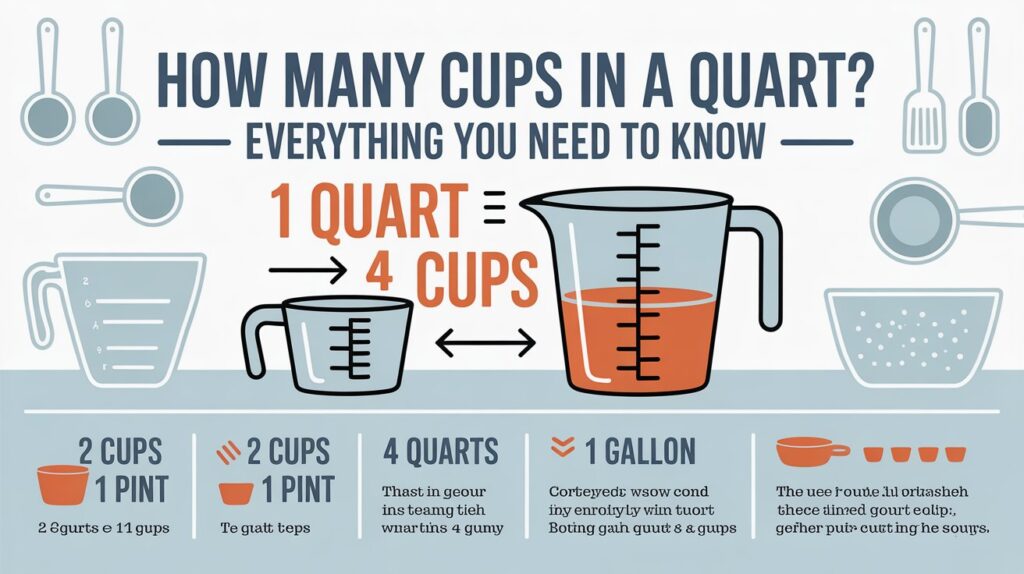
The smallest common one is the cup. Two cups make a pint. Two pints make a quart. Four quarts make a gallon.
Here’s another way to picture it. Imagine a gallon jug sitting on your counter. Now imagine cutting it into four equal pieces. Each of those pieces is one quart. Cut one of those pieces in half and you have a pint. Cut a pint in half and you have a cup.
Everything divides cleanly by two. That pattern is your best friend when you’re cooking.
The Full Conversion Chart: Cups to Quarts
Here’s where things get useful:
- ¼ cup = 0.0625 quarts
- ½ cup = 0.125 quarts
- 1 cup = 0.25 quarts (one-quarter)
- 2 cups = 0.5 quarts (one-half)
- 3 cups = 0.75 quarts (three-quarters)
- 4 cups = 1 quart
- 5 cups = 1.25 quarts
- 6 cups = 1.5 quarts
- 7 cups = 1.75 quarts
- 8 cups = 2 quarts
- 12 cups = 3 quarts
- 16 cups = 4 quarts (1 full gallon)
The trick is this: to turn cups into quarts, divide by 4. To turn quarts into cups, multiply by 4.
That’s all the math you ever need.
Liquid Quart vs. Dry Quart — Yes, There’s a Difference
Here’s something that surprises a lot of people. There are actually two types of quarts in the US system.
One is the liquid quart. That’s the one used for water, milk, juice, broth, and anything that pours.
The other is the dry quart. That’s used for things like grains, berries, dried beans, and produce.
The dry quart is about 16% bigger than the liquid quart. Specifically, a dry quart is 1,101 milliliters compared to 946 for a liquid quart.
In cup terms: a liquid quart holds 4 cups, but a dry quart holds roughly 4.65 cups.
For almost every home cooking and baking recipe, you’re dealing with the liquid quart. When a recipe says “1 quart of chicken broth,” it means the liquid quart — 4 cups. When a farmer’s market sells a quart of strawberries, that container is actually a dry quart.
The US Quart vs. the UK (Imperial) Quart
If you’ve ever cooked from a British recipe, this part matters.
The US and the UK both use the word “quart.” But they’re not the same amount.
A US liquid quart is 946 milliliters. A UK imperial quart is 1,136 milliliters. That’s about 20% more liquid.
This happened because the UK and the US took different paths after American independence. In 1824, Britain passed the Weights and Measures Act and redefined their gallon based on the weight of 10 pounds of water. That produced a bigger gallon — and therefore bigger pints and quarts.
The US had already gone its own way by then, keeping the older “wine gallon” as its standard.
So a pint at a London pub is a bigger pour than one in a New York bar. The same logic applies to quarts.
In cup terms, 1 imperial quart is roughly 4.8 US cups — compared to the US quart’s 4 cups.
When a British recipe calls for a quart of something, you’ll need slightly more than 4 American cups to match it.
Measuring Liquids vs. Measuring Dry Ingredients
You might have two different sets of measuring cups in your kitchen. One set is dry measuring cups — those stackable individual ones. The other is a liquid measuring cup — usually a clear pitcher with lines on the side.
They measure the same volume, but they work differently.
Dry measuring cups are designed to be filled to the very top and then leveled off with a flat edge. That’s how you get an accurate amount of flour, sugar, or oats.
Liquid measuring cups have pour spouts and visible lines on the side. You fill the cup, then bend down to check it at eye level. That way the measurement is accurate, not just what it looks like from above.
Using a dry measuring cup for liquids means you’ll likely spill when you try to carry it. Using a liquid cup for dry ingredients means you won’t be able to level it off properly.
Both tools measure in cups, pints, quarts, and ounces — they just do it in ways that suit their ingredients.
Why Getting This Right Actually Matters
Cooking rewards the person who measures carefully. One wrong amount and a soup tastes flat, a cake won’t rise, or a sauce turns watery.
This is especially true in baking. Baked goods are chemistry experiments. The ratios of ingredients trigger specific reactions. Too much liquid and your bread is dense. Too little and it’s crumbly.
Say a bread recipe asks for 1 quart of warm water. You’re making two loaves, so you need to double it. That means 2 quarts — which is 8 cups. Getting that right matters for how the dough forms.
Or you’re making a big batch of soup for a party. The recipe serves 4 and uses 2 cups of broth. You need to serve 16 people — four times the amount. So now you need 8 cups of broth, which is exactly 2 quarts. Knowing the conversion means you can buy exactly the right container at the store.
Real-World Objects That Are About a Quart
It helps to have a mental picture of what a quart looks like in real life.
A 32-ounce carton of chicken broth at the grocery store is one quart. A standard quart of milk is — no surprise — a quart. A large takeout container of soup is usually about a quart.
A medium saucepan holds about 2 to 3 quarts. A Dutch oven typically holds 5 to 7 quarts. When recipes say “use a large pot,” they often mean something that holds at least 4 quarts.
Ice cream is sometimes sold in quart containers too — which is four cups of ice cream. Not that anyone’s counting those.
The Memory Trick That Actually Works
Some people learn this through a chart. Others through sheer repetition. But there’s a visual trick that sticks for almost everyone.
Picture the letter G for a gallon. Inside it, draw four Qs for quarts. For pints, draw two Ps inside each Q.. Inside each P, draw two Cs for cups.
Everything nests inside the next level up. One gallon holds four quarts. One quart holds two pints. One pint holds two cups.
The pattern is always “times two” as you go down. If you remember that, you can rebuild the whole chart from scratch at any time.
Another simple shortcut: Q × 4 = C. Quarts four equals cups. Cups divided by four equal quarters. Two operations, always the same numbers.
Scaling Recipes Up and Down
This is where the conversion becomes genuinely useful in everyday life.
Scaling UP:
- 1 quart needed → use 4 cups
- 2 quarts needed → use 8 cups
- 3 quarts needed → use 12 cups
- 4 quarts needed → use 16 cups (or just fill a gallon)
Scaling DOWN:
- ½ quart needed → use 2 cups
- ¼ quart needed → use 1 cup
- ¾ quart needed → use 3 cups
If you have a large recipe and want to cut it in half, every quart becomes 2 cups. If you want to make a quarter of the batch, every quart becomes 1 cup.
Metric Equivalents (For International Recipes)
If you’re working from a recipe that uses milliliters or liters, here’s how it lines up with quarts and cups.
- 1 US cup = 240 milliliters
- 1 US liquid quart = 946 milliliters (just under 1 liter)
- 1 liter = approximately 4.2 US cups or just over 1 quart
- 2 liters = about 2.1 quarts or 8.45 cups
So if a European recipe calls for 1 liter of milk, it’s slightly more than a quart. You could use 4 cups (946 ml) and you’d be very close — within about 6% of the correct amount.
For most recipes, that difference won’t matter. For precise baking, it might be worth using a kitchen scale instead.
Final Words
Four cups in a quart. It really is that simple at its core. But the full picture — the dry vs. liquid difference, the US vs. UK split, the way dry measuring cups and liquid cups work differently — that’s what separates a good cook from a great one.
Once you know all of it, you stop second-guessing yourself mid-recipe. You just know. One quart is four cups. Two quarts is eight. A gallon is sixteen.
These measurements have been with us for centuries, literally. Chaucer was writing about quarts in the 1300s. Medieval traders were arguing over pints and gallons before America even existed. The numbers have shifted slightly over time, but the basic idea — organize volume into neat, dividing-by-two units — has never changed.
It works. And now you know exactly how.
FAQs
1. How many cups are in 1 quart?
There are exactly 4 cups in 1 US liquid quart.
2. What is the number of cups in two quarts?
Two quarts equal 8 cups. Simply multiply the quantity of pints by four.
3. How many cups are in a half quart?
Half a quart is 2 cups. It’s also called 1 pint.
4. How many cups are in a dry quart?
A dry quart holds approximately 4.65 cups — slightly more than a liquid quart. Dry quarts are used for things like berries, grains, and dried produce.
5. Is a quart the same as a liter?
Not exactly. A US liquid quart is 946 milliliters. A liter is 1,000 milliliters. They’re close but not the same. One liter is about 4.2 US cups.
6. How many cups in a gallon?
A gallon has 16 cups. That’s 4 quarts, each holding 4 cups.
7. How many cups are in a pint?
A pint holds 2 cups. Two pints make one quart.
8. Is a UK quart the same as a US quart?
No. A US quart is 946 milliliters.An imperial quart in the UK is 1,136 milliliters, or almost 20% more.
9. Can I use a dry measuring cup for liquid measurements?
Technically yes, but it’s not ideal. Dry cups are meant to be leveled off at the top, which is awkward with liquids. A liquid measuring cup with pour spouts and visible lines gives a more accurate reading for fluids.
10. How do I convert quarts to cups quickly?
Multiply the number of quarts by 4. That’s it. 12 cups (3 quarts × 4).. Every time.
11. How many ounces are in a quart?
One US liquid quart is 32 fluid ounces. Since one cup is 8 ounces, 32 ÷ 8 = 4 cups.
12. What everyday container is closest to a quart?
A 32-ounce carton of chicken broth, a store-bought quart of milk, or a large container of orange juice are all exactly one quart.
13. How many cups in 1.5 quarts?
One and a half quarts equals 6 cups. (1.5 × 4 = 6)
14. Why does the US use cups and quarts instead of liters?
The US kept its older customary measurement system based on English colonial units. Most other countries switched to the metric system, but the US still uses cups, quarts, and gallons for everyday cooking.
15. If a recipe from the UK calls for 1 quart, how many US cups do I use?
A UK imperial quart is slightly larger than a US quart. It’s roughly 4.8 US cups. For most recipes, 5 cups is a close enough substitute, or you can measure out 1,136 milliliters if you have a metric-capable measuring jug.
Keep creating, innovating, and inspiring with Content Ideators every day.
