

Choosing between a mainland entity and a free zone structure in the UAE is rarely about picking the “better” option. It is about architectural planning. I see founders every week who sink their capital into a license that fundamentally restricts how they intend to generate revenue. They prioritize the upfront registration fee, only to discover eighteen months later that their chosen jurisdiction prevents them from bidding on the local government contracts they actually need, or that their banking compliance process has turned into an expensive, multi-month nightmare.
Successfully navigating llc company formation in dubai requires an honest assessment of your exit strategy, your target client base, and your appetite for administrative overhead. Too many guides frame this as a simple choice between price points. In reality, it is a choice between operational freedom and startup simplicity. If you align your structure with your long-term growth plan early, you save yourself the massive cost of restructuring later.
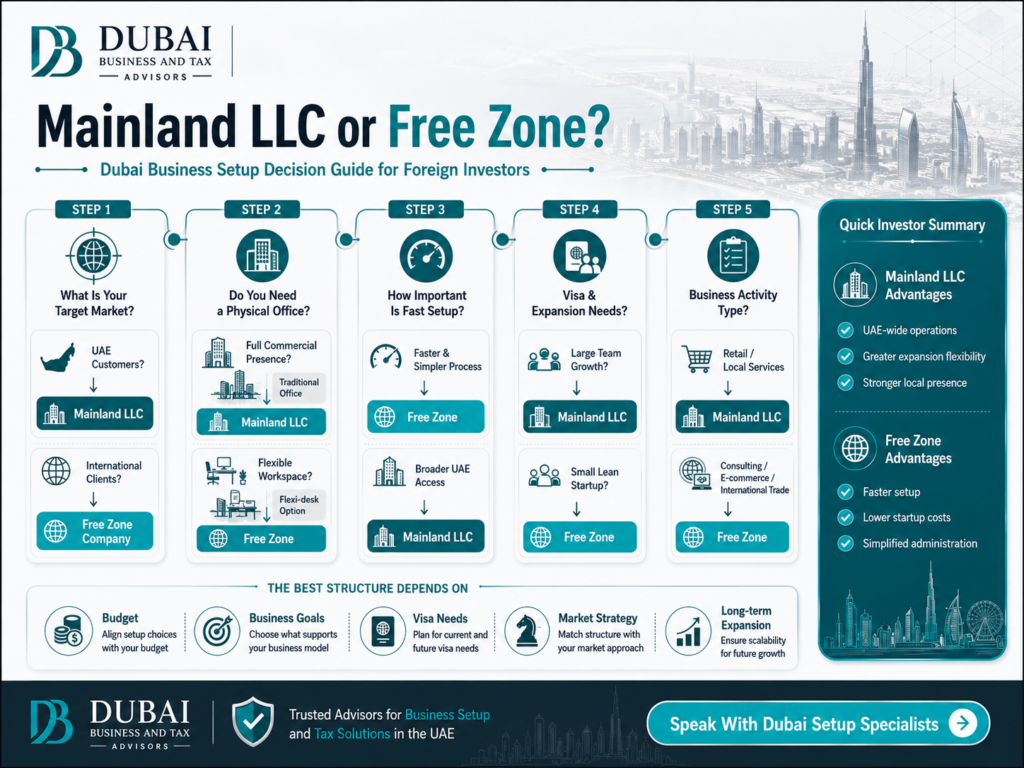
Why Choosing the Wrong Business Structure Can Cost More Than You Think?
A startup founder I worked with recently chose a cheap free zone package for his tech-consulting business because it promised the lowest entry barrier. Six months later, he secured a major contract with a Dubai-based property developer. Because he was locked into a free zone, he couldn’t invoice the developer directly without navigating complex distributor arrangements, losing his margins in the process. He eventually had to pay to liquidate his free zone entity and start from scratch with a mainland LLC.
He didn’t lose money on the license fee; he lost time, revenue, and months of strategic momentum. Founders often overlook these hidden costs:
- Operational Constraints: Many free zones limit where you can lease office space or how many visas you can sponsor.
- Banking Hurdles: Some banks view free zone entities with smaller physical footprints as higher risk, leading to rejected applications.
- Expansion Barriers: Scaling into new markets often triggers the need for a mainland permit that your initial structure may not support.
Understanding the Two Business Structures in Dubai
What Is a Mainland LLC Company?
A mainland entity is a company licensed by the Department of Economy and Tourism (DET). It operates as a distinct legal entity that is free to conduct business anywhere within the UAE without geographic restrictions. Recent legislative changes have removed the old requirement for Emirati equity, allowing full foreign ownership for most commercial activities. It is the gold standard for companies that want to build a recognizable local presence, bid on public tenders, or open physical retail storefronts.
What Is a Free Zone Company?
Free zones are economic districts designed to attract specific industries, from media and technology to commodities. They operate under their own independent regulatory authorities. These zones offer excellent perks, such as simplified customs processes, foreign-investor-friendly office requirements, and specialized infrastructure. However, they function as “islands.” You are generally expected to conduct your business from within the zone or focus your trade outside of the UAE domestic market.
LLC vs Free Zone Company in Dubai
| Feature | Mainland LLC | Free Zone Company |
| UAE Market Access | Unlimited | Limited (Indirect) |
| Setup Cost | Moderate to High | Low to Moderate |
| Office Requirement | Physical Office Needed | Flexi-desk / Virtual |
| Visa Eligibility | Scales with space | Fixed quotas |
| Banking Perception | High Credibility | Varies by Zone |
| Corporate Tax | 9% (Standard) | 0% (if Qualifying) |
| Expansion | Highly Flexible | Zone-Specific |
| Best For | Local/Retail Scaling | Remote/Global Trade |
The Biggest Difference Most Investors Overlook
The most critical factor is the gap between Market Access and Operational Simplicity.
Mainland companies are built for scale. If your business model relies on winning local enterprise contracts, selling products in shopping malls, or managing a physical logistics fleet, you need the reach that only a mainland license provides. The trade-off is higher regulatory compliance and the requirement for a physical office lease.
Free zones prioritize ease of entry. If you are a digital nomad, a consultant managing global clients from a laptop, or a software developer, the low overhead is a clear advantage. You avoid the cost of a full office and benefit from a more streamlined regulatory environment. This structure makes sense if your revenue flows come from outside the UAE or through digital channels that don’t require local physical presence.
Banking Reality in Dubai Nobody Talks About
The most common misconception I encounter is that setup speed equals banking success. You might register your company in three days, but the bank will take three months to vet your profile.
Banks evaluate risk, not speed. They care about:
- Business Substance: Do you have a real office? A professional website? Real contracts with clients?
- Transaction Volume: Do you have a clear plan for your expected revenue flow?
- Industry Scrutiny: Certain activities, such as crypto, fintech, or high-volume import/export, face much tighter compliance checks regardless of your jurisdiction.
Mainland companies often appear more credible to traditional banks because they represent a commitment to the local economy. Some free zone entities, especially those using purely virtual offices find the bank account application process much harder. If your business model involves high-value transactions, the credibility of a mainland setup often pays for itself through a smoother banking experience.
Hidden Costs Most Business Setup Guides Ignore
Mainland LLC Hidden Costs
Many investors look at the license fee and forget the rest. Mainland setup requires an annual commitment to a physical office lease, which is a major recurring expense. You also need to budget for the immigration establishment card, the labor quotas that dictate how many visas you can sponsor, and the ongoing administrative costs of VAT and corporate tax compliance.
Free Zone Hidden Costs
Free zones often lure you in with a “starting from” price. Once you add the necessary visa quotas, upgrade your virtual office to a physical desk, or pay for mandatory annual audits (which some zones require), the cost often creeps up. If you eventually realize you need to sell into the mainland, you will also face the cost of an agent or distributor, which can eat into your net margins significantly.
Corporate Tax Rules Investors Commonly Misunderstand
The UAE’s 9% corporate tax regime applies to mainland entities on all taxable profits. However, the free zone “0% tax” rule is often misinterpreted. To qualify for the 0% rate, you must meet strict requirements to be considered a Qualifying Free Zone Person (QFZP). This means your income must be “qualifying income,” derived primarily from transactions with other free zone companies or international trade. If you start selling goods to customers in the UAE mainland, that specific portion of your revenue may become subject to the standard 9% tax, regardless of your free zone status.
Is Free Zone Still Worth It After UAE Ownership Reforms?
Since the UAE allowed 100% foreign ownership of mainland companies, many ask if free zones are obsolete. The answer is a definitive no. Free zones remain the perfect home for startups and high-growth tech firms that need to stay lean. If your goal is to raise venture capital or manage a remote team without the burden of mainland lease requirements, a free zone provides a superior environment. You get the regulatory sandbox you need to grow without the heavy administrative load of a full-scale local enterprise.
Can Free Zone Companies Work With UAE Mainland Clients?
This is the “forbidden” topic for many competitors, but the answer is nuanced. You cannot simply open a shop in the mainland with a free zone license. However, you have options. You can work with a local distributor, establish a mainland branch, or apply for specific permits that allow limited mainland activity. Newer regulations have introduced “dual licensing” in some cases, but these are exceptions rather than the rule. If your entire business model depends on daily transactions within the UAE mainland, do not try to “hack” it through a free zone license.
Which Structure Fits Your Business Type Best?
- E-Commerce: If you hold inventory in a warehouse in Dubai, you need a mainland license to manage your own logistics.
- Consultants/Agencies: If you are remote-first, a free zone is your best bet for keeping overhead low.
- Trading: If you need to import/export goods through Dubai ports and distribute them locally, the mainland is mandatory.
- Tech/SaaS: Free zones often host the tech clusters, which are better for networking and fundraising.
- Restaurants: A physical location requires a mainland license and local municipal permits.
When a Free Zone Company Becomes the Wrong Choice?
A free zone becomes a liability when you outgrow it. I’ve seen founders try to scale their logistics or retail operations only to find themselves hitting a wall because their zone authority won’t allow them to rent larger warehouse space in a better location. If you find yourself constantly needing “workarounds” to serve your clients, you are paying a hidden tax in the form of lost efficiency and restricted growth.
When Paying More for a Mainland LLC Makes Sense?
You pay a premium for a mainland LLC because you are buying the right to compete on the same level as every other local business. You get access to the entire domestic market, the ability to bid for government contracts, and the credibility that comes with a formal local presence. For any business that requires high-trust relationships with enterprise clients, this structure acts as a signal of stability and long-term commitment.
Can You Switch From Free Zone to Mainland Later?
Yes, it is possible, but it is effectively a restart. You generally have to liquidate the free zone entity and incorporate a new mainland one. While you can sometimes transfer existing assets, the process involves significant restructuring costs and potential disruption to your existing client contracts. It is always cheaper to get it right the first time than to fix it after you have active revenue.
Real Investor Scenarios and Best Choices
- Scenario A: An online clothing brand selling globally. Choice: Free Zone (Low cost, easy to manage).
- Scenario B: A retail chain opening three shops in Dubai. Choice: Mainland LLC (Required for local retail licenses).
- Scenario C: A business consultant working from home. Choice: Free Zone (Minimal overhead).
- Scenario D: An IT firm bidding for state infrastructure projects. Choice: Mainland LLC (Mandatory for government tenders).
Common Myths About LLC and Free Zone Companies
Don’t believe the hype. Free zones aren’t “always” cheaper when you factor in the true cost of scaling. Mainland companies don’t “always” need a local partner; the law has changed. And no, a free zone is not automatically a tax-free haven; if you don’t track your qualifying income correctly, you are simply delaying your tax headaches.
Frequently Asked Questions
What is the fundamental difference between an LLC and a Free Zone company?
An LLC is a mainland business that can trade freely with any customer or company across the UAE. A Free Zone company is set up within a designated zone and is built mainly for international or within-zone operations. Free Zone companies cannot sell directly to mainland UAE customers without going through a distributor or opening a separate branch. The right structure depends entirely on where your target market is located.
How do ownership rights differ between the two structures?
Free Zone companies have always offered 100% foreign ownership, making them attractive to international investors from the start. Following the UAE’s 2021 reforms, mainland LLCs now also allow full foreign ownership for most business activities. However, certain strategic sectors like oil, gas, and security still require a local Emirati partner on the mainland. Always confirm whether your specific activity falls under the liberalized category before proceeding.
How do setup costs and timelines compare between the two?
Free Zone companies are faster and cheaper to set up, with bundled packages covering the license, visas, and office space sometimes ready within a few days. Mainland LLC registration involves multiple approvals, notarized documents, and a physical office lease, which takes longer and costs more upfront. However, the broader market access an LLC provides often justifies the higher initial investment. Each structure suits a different stage and type of business.
How do taxes and financial benefits differ between the two structures?
Both structures fall under the UAE’s 9% corporate tax on profits above AED 375,000, introduced in 2023. Free Zone companies earning qualifying income may still benefit from a 0% tax rate on that portion, subject to specific conditions. Free Zones also offer customs duty exemptions and unrestricted profit repatriation abroad. Mainland LLCs gain access to government tenders, a major revenue opportunity not available to Free Zone companies.
Which industries are best suited to a Free Zone company?
Free Zones work well for import/export, logistics, e-commerce, tech, media, and financial services businesses that operate internationally or digitally. Each zone specializes in specific sectors, so JAFZA suits port logistics, DIFC suits finance, and Dubai CommerCity suits online retail. The built-in industry networks and infrastructure make Free Zones highly efficient for the right business type. Companies that don’t rely on local UAE customers benefit the most from this structure.
Conclusion
There is no universal winner here. A mainland LLC is the right choice for businesses targeting the UAE local market, government contracts, and long-term enterprise growth. A Free Zone company is better suited for international trade, digital businesses, and cost-efficient startups. Your decision should be driven by your revenue source and five-year growth plan not by setup costs alone.
At Dubai Business & Tax Advisors, we help investors choose the right structure from the start. Our team analyses your business model, target market, and goals to recommend what truly fits. From license registration and visa processing to bank account opening and tax compliance, we handle the entire journey so you can focus on growing your business with confidence.
