
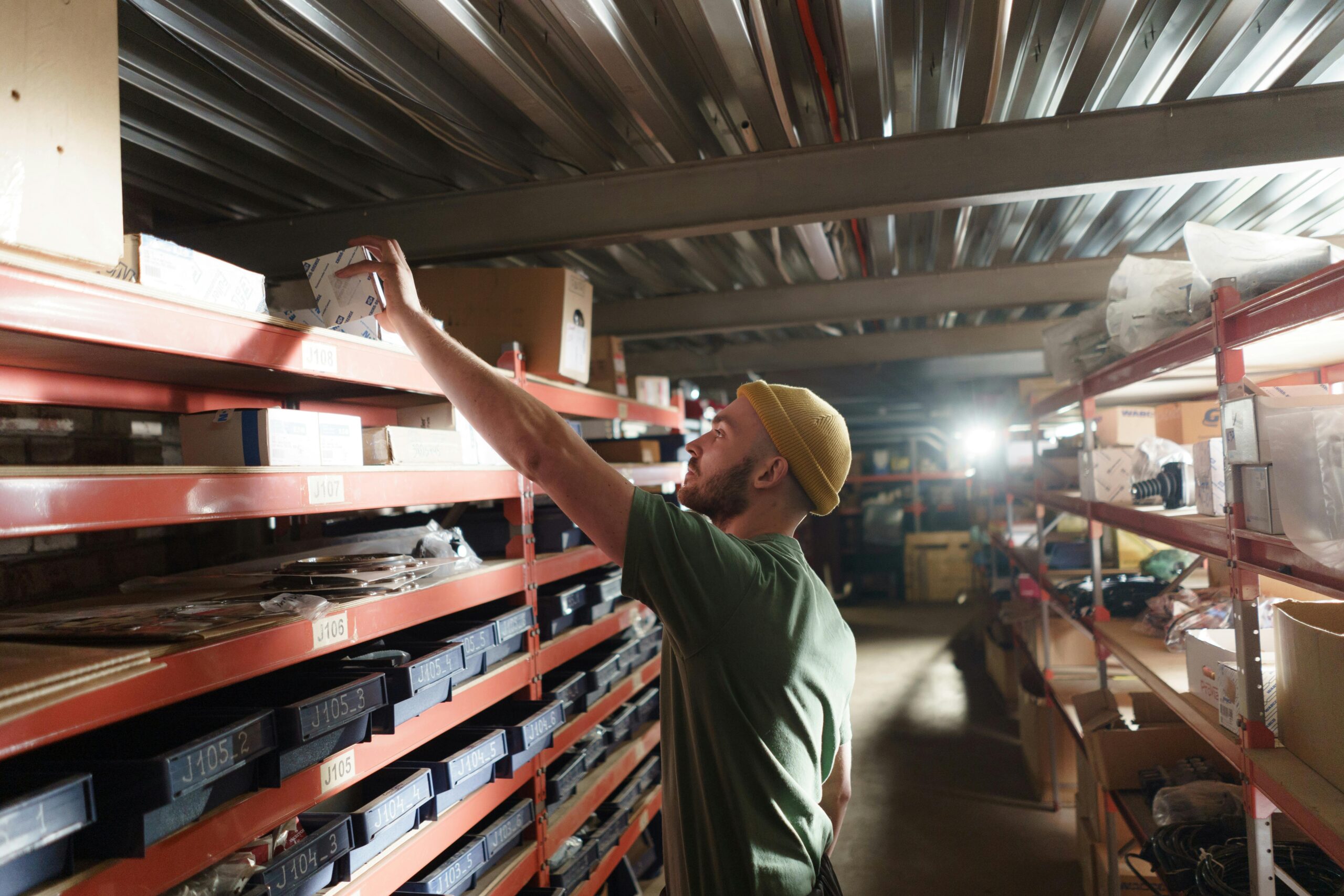
The difference between a warehouse that runs smoothly and one that doesn’t often comes down to whether its shelving system was chosen deliberately or just thrown in to fill space. Proper industrial storage shelves do more than hold stock. They define how quickly items can be located, how accurately inventory is managed, how safely staff work, and how efficiently the space is used. According to a Zebra Technologies study, poor warehouse organisation costs Australian businesses an average of 3,000 to 5,000 hours per year in lost labour productivity. Industrial shelving is the foundation that either multiplies or wastes every hour worked in that space.
What Types of Industrial Shelving Exist and Which Fits Your Operation?
The main categories are boltless rivet shelving for lighter loads and frequent reconfiguration, longspan shelving for bulky but lighter items, selective pallet racking for forklift-accessible pallet storage, and heavy duty solid steel shelving for dense component storage.
Each type has a specific application. Mixing them incorrectly, like using boltless shelving for forklift pallets, creates safety incidents. The selection should start with a load analysis, not a price comparison.
What Load Ratings Apply to Industrial Shelving in Australia?
Industrial shelving in Australian workplaces must be rated in accordance with AS 4084, the Australian Standard for steel storage racking. This standard specifies load capacity per shelf, the maximum load per bay, and the required method of posting load notices.
Posting load notices is a legal requirement under AS 4084 and Work Health and Safety regulations. Every racking bay must display its safe working load in a visible location. Non-compliant racking is an immediate regulatory issue during a WorkSafe inspection.
How Does Shelving Layout Affect Picking Efficiency in a Warehouse?
Pick path length is directly tied to how much time staff spend moving between picks. A poorly laid out warehouse can have staff walking 15 to 20 kilometres per shift. A well-designed layout using zone picking and logical shelving positioning can cut that to 8 to 10 kilometres.
Fast-moving items should be positioned at the beginning of pick paths and at ergonomic height. Slow-moving items go to outer zones and less accessible locations. This layout principle, applied to industrial shelving design, reduces labour cost per unit picked by 15 to 30%.
What Is the Role of Aisle Width in Industrial Shelving Design?
Aisle width is a safety and efficiency variable that’s often compromised to add more shelving rows. The minimum safe aisle width for pedestrian-only access in Australian warehouses is 1.2 metres. For counterbalance forklift access, aisles need to be 3.5 to 4.5 metres wide depending on the truck’s turning radius.
Reducing aisle width to squeeze in more shelving rows is a false economy. Forklift damage to shelving in narrow aisles is a significant ongoing cost, and aisle-related forklift incidents are among the most serious in warehouse environments.
How Do Seismic Requirements Affect Industrial Shelving in Australia?
Australia has significant seismic activity zones, particularly in South Australia, Western Australia, and parts of Victoria. AS 4084 requires racking installations in these zones to be designed for seismic loading, which affects base plate sizing, anchor bolt specifications, and overall frame geometry.
Shelving not designed for seismic conditions in at-risk zones can fail during earthquakes that would otherwise cause no building damage. A structural engineer familiar with AS 4084 should review large-scale racking installations in seismic zones.
What Is the Best Approach to Inventory Management Integration With Shelving?
Effective inventory management requires shelving to have a logical, consistent addressing system. Each bay, level, and position should have a unique alphanumeric location code that maps to a warehouse management system (WMS).
Without consistent addressing, inventory accuracy degrades rapidly as items are placed ad hoc. Australian retailers with warehouse operations lose an estimated $1.6 billion annually to inventory inaccuracy, according to GS1 Australia data. A labelled, addressed shelving system is the physical foundation of any reliable inventory count.
What Maintenance Schedule Keeps Industrial Shelving Safe?
Monthly visual inspections by warehouse supervisors, plus annual engineering audits, are the standard recommended practice under AS 4084. Damage categories are classified as green (minor, monitor), amber (restrict use pending repair), or red (immediate decommission).
Red-tagged shelving must be unloaded and taken out of service immediately, regardless of operational inconvenience. Attempting to operate damaged racking is a prosecutable breach. Maintenance costs for racking are low. The cost of a collapse event is not.
How Does Vertical Space Utilisation Affect Warehouse Cost Efficiency?
Commercial warehouse space in Australian capital cities costs between $120 and $200 per square metre per year in rent. Every square metre of floor space not used for storage has a direct cost.
Industrial shelving systems that reach 6 to 10 metres in height convert floor space into cube space. A 1,000 square metre warehouse with 3-metre racking has 3,000 cubic metres of storage volume. The same footprint with 9-metre racking triples that to 9,000 cubic metres without paying an extra dollar in rent.
